
Risk Reduction for Alzheimers Disease, Setting a Goal for All of Us: The Science and the Time are Right to Incorporate This into Public Awareness, Public Health and Healthcare Practice
Allow me to set the stage with some background for reference. Dementia is changes in the brain that result in loss of cognitive function that interferes with life. While Alzheimer’s disease is the most common, there are several others (Vascular dementia, Frontotemporal dementia, Lewy Body dementia and others). For brevity I will refer to these conditions collectively as “Alzheimers”. We learn more about these conditions though valuable research every year, but it is clear that many cases have multiple causes.
Commentary
Allow me to set the stage with some background for reference. Dementia is changes in the brain that result in loss of cognitive function that interferes with life. While Alzheimer’s disease is the most common, there are several others (Vascular dementia, Frontotemporal dementia, Lewy Body dementia and others). For brevity I will refer to these conditions collectively as “Alzheimers”. We learn more about these conditions though valuable research every year, but it is clear that many cases have multiple causes. We have recently learned as well that there are steps that can be taken to reduce our risk for these conditions, I’ll discuss that more below (Livingston G, et al.) [1].
The view that Alzheimers is a condition of aging and little can be done to impact it’s progress has been turned aside by a number of studies recently – the landmark Lancet Commission Reports from 2017 and updated in 2020 Livingston G, et al. [1] lead the way. It is essential we now recognize Alzheimers as the public health threat that it is, as Dr David Satcher (Former Surgeon General and CDC Director) said in 2014 “Alzheimer’s is the most under- recognized threat to public health in the 21st century”. The three conditions that make it so are the significant burden, significant impact, and opportunity for intervention.
According to the Alzheimers Association Facts and Figures 2022 publication, currently 6.5 million Americans Commentary have Alzheimers. This is likely to increase to 14 million by 2060 without intervention. This translates to 1 in 9 adults age 65+ and 2/3 are women [2]. Prior to the Covid19 Pandemic Alzheimers was the 5th leading cause of death (behind four conditions that all contribute to Alzheimers risk) [3]. These seriousness is exacerbated by evidence of racial and ethnic disparities.
They quantified the differences as follows based on 2014 Medicare Data. Percentage of Adults Aged 65 and Older with Alzheimers Disease: African American -14%; Hispanic – 12%; Non-Hispanic White -10%. This inequity alone calls out for change, but when we consider the modifiable risk factors described below, correcting this inequity and this part of the intervention is even more important.
Other key factors calling out for action include that a large percentage of people with dementias and their caregivers are unaware of the diagnosis; about 25% of hospitalizations in this population were preventable; almost half these people talked to a healthcare provider about memory concerns; having another chronic condition is a complication; and 1 in 3 caregivers report worsening health.
For many years I was professionally lucky to work at the New York State Department of Health with a team of dedicated professionals and talented partner organizations.
New York is home to the oldest and most robust state public health program to address Alzheimers disease in the US [4]. This program took a two-pronged approach of funding Centers of Excellence to improve quality of professional care and access to services and Caregiver Support Initiatives which recognized the reality that this is most often a condition shared with a family member (or others) who provide needed care in the home and benefit from supportive services (like those provided by the Alzheimers Association).
This experience led to my participation in national efforts through the National Alzheimers Project Act (at HHS) and CDC’s Healthy Brain Initiative. These, along with national partners including the Alzheimers Association, National Association of Chronic Disease Directors, US Against Alzheimers; and many more have expanded the knowledge of both the public and professionals over the past few years. Often this has taken the form of implementing the National Alzheimers Project Act Goals. This is reflected in the new Goal #6: Accelerate Action to Promote Healthy Aging and Reduce Risk Factors for Alzheimers Disease and Related Dementias. Details of strategies can be found at ASPE [5]. The presence of this national goal offers us both a focal point and a target for action.
The strategies needed to accomplish this are outlined in the national plan. These include continuing research to hone in on the 60% of risk not currently clear. Facilitating the translation of risk reduction findings into clinical practice, to make the changes necessary to maximize the individual benefit and collective benefit. Acceleration of public health action to address risk factors –recognizing the commonality of risk with other conditions and maximizing impact by assuring the public understand these key aspects of Alzheimers risk. This includes prevention and management of chronic conditions with related risk factors and utilizing related systems (like the aging network). Recognizing and addressing the inequities I mentioned above and addressing these to mitigate the additional risk now present. The last strategy may be the most important, engage the public to reduce risk. By engaging the public we increase the likelihood of hitting more subtle risk factors. Remembering the value of more education throughout life beginning in early life (and quality education while we’re at it); avoiding hearing loss and injury by using readily available safety devices (ear protection, bike helmets, etc); recognizing and correcting the inequities between physical and mental health [6]; focusing on environmental risks where we can make a difference such as air quality; focusing more diligently on behaviorally related risk factors such as not smoking, keeping alcohol use in moderation, and engaging in safe regular physical activity.
The time is right because we now have science demonstrating how we can intervene and reduce risk as much as 40%. So what does this mean? What can we really do? The Lancet Commission highlighted in the following graphic risk factors where intervention could reduce risk, at what time in life this could have most impact and to what percent of the total of 40% each factor relates Figure 1:
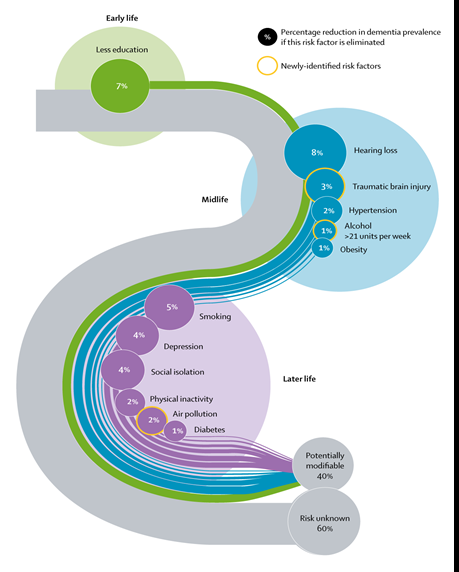
Source: An update to the Lancet Commission on Dementia prevention, intervention and care presents a life-course model showing that 12 potentially modifiable risk factors account for around 40% of worldwide dementias Figure 1: Risk factors for dementia.
This requires a robust population-wide intervention that includes public awareness, public health education, professional education, changes in clinical practice, and changes in public policy. The relationship with risk factors for and other chronic conditions, modifiable risk factors that benefit quality of life (individual and family), health and longevity, also would result in the likelihood of reduced system costs in health and related systems. Everything I’ve learned about ethics and health policy tell me this effort is essential and because the science and evidence is available, the time is now.
The good news is that progress has begun with small steps. A new national plan with focus on risk reduction is in development, and DHHS, CDC and partners like the Alzheimers Association, National Association of Chronic
Disease Directors have some tools available now Hoffman DP (2022) [6, 7]. The key will be to have sufficient resources to accomplish the mammoth task before us NACDD (2020) [8]. To change the conventional wisdom to “There are actions each of us can take today that will make a difference” Note: Special thanks to Dr. Lisa McGuire of CDC and the many other professionals working diligently to bring about change and see this potential for risk reduction realized.
References
-
Livingston G, Huntley J, Sommerlad A, Ames D, Ballard C, et al. (2020) Dementia prevention, intervention, and care: 2020 report of the Lancet Commission. The Lancet Commissions 396(10248): 413-446.
-
Alzheimer’s Association (2022) 2022 Alzheimer’s Disease Facts and Figures. Alzheimers Dement 18: 1-122.
-
CDC - NCHS - National Center for Health Statistics 2022.
-
Alzheimer´s Disease and Other Dementia 2022.
-
ASPE (2021) National Plan to Address Alzheimer’s Disease: 2021 Update.
-
Hoffman DP (2022) The Time has come to Apply Ethical Principles to Mental Health, Doing the Right Thing is Good for our Health. Ann Bioethics Clin App 5(3): 000239.
-
Alzheimer’s Association 10 Ways to Love Your Brain.
-
National Association of Chronic Disease Directors (2020) NACDD Action on Healthy Aging and Brain Health.
- Are We Looking at an Overwhelming Crisis in Healthcare, or A Poorly Hidden Opportunity Calling on us to Improve our Systems? Perhaps Both?
- Sex, Metaphorical Drugs, and the Dissolution of Boundaries in the Perception of Time: Robert Muller’s Tropen: Der Mythos Der Reise (Tropics. The Myth of Travel) From 1915 Serves as an almost Forgotten Example
- Artificial Intelligence in Healthcare: Bioethical and Legal Challenges in the Brazilian Context
- Today Our Health and Our Principles are Challenged on Many Fronts Simultaneously, Where Can We Go from Here?
- The Value of Prevention, Avoid the Games and Focus on Real, Evidenced-Based Opportunities to Improve Health, Wellbeing and Longevity
- A Time of Opportunities to Improve our Health and Address Chronic Diseases