
Ethical Dimensions in Contemporary Medical Practices: A Systematic Review and Analysis of Diverse Perspectives
Objective: This systematic review and analysis aim to comprehensively explore diverse ethical perspectives within contemporary medical practices. Acknowledging the complexity of ethical considerations in medicine influenced by cultural, socio-economic, and legal factors, the objective is to synthesize insights from various studies and delve into key themes such as patient autonomy, informed consent, healthcare equity, and the ethical implications of emerging technologies. Methodology: Adhering to the Preferred Reporting Items for Systematic Reviews and Meta-Analyses (PRISMA) guidelines 2020, this analysis systematically reviewed scholarly articles focusing on ethical considerations within modern medical practices from 2020 to 2023. A thorough screening process, based on specific Medical Subject Headings (MeSH) terms, was conducted in major databases (PubMed, Scopus, Web of Knowledge, and Google Scholar). Eleven relevant studies were included, representing diverse perspectives and ethical frameworks. Result: The systematic study selection process identified 11 relevant studies from an initial pool of 297 records. These studies covered a range of topics, including parental decision-making for adolescents with mental health issues, the legalization of medical cannabis, challenges in patient care during the COVID-19 pandemic and medical education ethics. The included studies were subjected to a meticulous evaluation of their characteristics, outcomes, and limitations. The findings contribute valuable insights into the multifaceted ethical dimensions of contemporary medical practices. Conclusion: This systematic review and analysis provide a comprehensive overview of diverse ethical perspectives inherent in contemporary medical practices. While recognizing the complexity of medical ethics, influenced by various factors, the study identifies patterns, gaps and divergent viewpoints within the selected studies. The analysis aims to inform practitioners, policymakers, and scholars engaged in ethical decision-making in healthcare, fostering a more informed and ethically robust approach to modern medical practices. Despite the limitations in some studies, the findings contribute to the ongoing discourse on medical ethics and highlight the need for further research and dialogue to address evolving ethical challenges in healthcare.
Introduction
Contemporary medical practices operate at the intersection of rapidly evolving scientific advancements, diverse patient needs, and intricate ethical considerations [1]. The dynamic landscape of healthcare, marked by technological breakthroughs and shifting societal values, necessitates a comprehensive exploration of the ethical dimensions inherent in modern medical practices [2]. This article embarks on a systematic review and analysis, aiming to elucidate the multifaceted ethical perspectives that underpin today’s medical landscape. In recent years, medical professionals find themselves confronted with complex moral dilemmas arising from breakthroughs in medical technology, genetic interventions, and personalized medicine [3]. The evolving nature of healthcare delivery, coupled with an increasingly diverse and informed patient population, underscores the urgency of understanding and navigating the ethical nuances embedded in contemporary medical practices [4].
This systematic review takes a nuanced approach, recognizing that ethical considerations in medicine are not monolithic but rather shaped by a myriad of factors, including cultural diversity, socio-economic disparities, and evolving legal frameworks. By synthesizing diverse perspectives, this article seeks to provide a comprehensive overview of the ethical challenges and opportunities that characterize the current state of medical practice. The systematic analysis will delve into key themes such as patient autonomy, informed consent, healthcare equity, and the ethical implications of emerging technologies. Through a meticulous review of existing literature, the article aims to identify patterns, gaps, and divergent viewpoints that contribute to the rich tapestry of ethical considerations in contemporary medical practices.
In essence, this systematic review aspires to contribute valuable insights to practitioners, policymakers, and scholars engaged in the ongoing discourse on medical ethics [5]. By unraveling the layers of ethical complexity in modern healthcare, we aim to foster a deeper understanding of the ethical imperatives that guide medical decision-making, ultimately promoting a more informed and ethically robust approach to contemporary medical practices.
Objective
This systematic analysis aims to comprehensively review diverse perspectives on the ethical dimensions within contemporary medical practices.
Material and Method
The involved scientific protocol to conduct this systematic analysis is summarized as following.
Protocol and Registration
This analysis adheres to the Preferred Reporting Items for Systematic Reviews and Meta-Analyses (PRISMA) guidelines 2020 (15). Review Manager (RevMen 5.4) was utilized for quantitative data analysis to identify the array of ethical dimensions in medical practices.
Eligibility Criteria
This exploration delved into scholarly articles focusing on ethical considerations within modern medical practices, spanning the years [2020, 2021, 2022, 2023]. The selected articles, obtained from reputable sources such as Sci-hub, web of science, Scopus, PubMed, and Google Scholar, represented viewpoints from diverse stakeholders. These contributions elucidated established ethical frameworks or introduced innovative approaches, contributing significantly to the ongoing dialogue on ethical conduct in current medical care. Exclusion criteria ensured a thorough exploration by omitting pieces lacking empirical basis or incongruent with the contemporary scope of this review.
Information Sources, Search Strategy and Selection Process
A database of research articles was created using specific Medical Subject Headings (MeSH) terms in major databases (PubMed, Scopus, Web of Knowledge, and Google Scholar) related to medical ethics, professional practices, family practices, and medical practices. The author performed study selection based on title, abstract, and full-text evaluations.
Data Collection Process and Data Items
Selected research studies were evaluated based on titles and abstracts, followed by a detailed examination of full-text articles. Data extraction was performed frequency, percentage, thematically and verbatim and compiled in a Microsoft Excel Sheet.
Risk of Bias Assessment among Studies
The risk of bias within individual studies was assessed following Cochrane Collaboration ROB-2 guidelines, evaluating biases related to random sequence generation, blinding, incomplete outcome data, and selective reporting.
Additional Analysis and Risk of Bias across Studies
Additional analysis sheets were prepared to assess characteristics such as research design, study settings, interventions, and outcomes of individual studies. The risk of bias was categorized as low, unclear, or high and presented through graphs.
Results
Study Selection
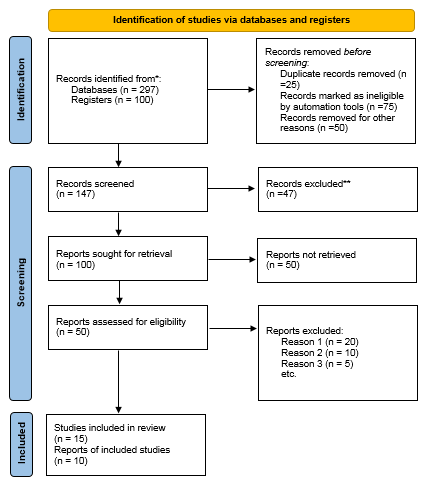
In the quest to explore the ethical dimensions within modern medical practices, a systematic process was adopted to identify, assess, and include pertinent studies. This endeavor commenced by scouring databases, yielding a substantial pool of 297 records, and tapping into registers, adding an additional 100 records to the mix. These records underwent a meticulous screening process: initially, 147 records were evaluated, and among them, 25 duplicates were promptly removed to ensure uniqueness. Automated tools flagged 75 records as unsuitable based on predefined criteria, while an additional 50 records were excluded due to various reasons unrelated to the study’s scope. Furthermore, 50 reports could not be retrieved for further scrutiny. The ones that did undergo assessment-100 reports in total-underwent a stringent evaluation for eligibility. Ultimately, from this thorough screening, 15 studies emerged as fitting the criteria and were included in the review. Among these studies, 11 reports were generated, encapsulating the essence of the included studies, setting the stage for an in-depth analysis of the ethical intricacies within contemporary medical practices. This stringent process aimed to ensure that only the most relevant and fitting studies were incorporated, maintaining the integrity and precision of the exploration into ethical considerations in today’s medical landscape.
Study Characteristics
| Population | Sample Size | Research Design | Variables of Interest | Outcomes | Limitations | |
|---|---|---|---|---|---|---|
| Bieber, et al. | Adolescents with mental health issues | 2 cases | Case report | Parental capacity for medical decision-making | Ethical considerations in overriding parental decisions, challenges in clinical and ethical decision-making | Limited generalizability due to case report nature, lack of specific sample size mentioned |
| Liddell, et al. | Residents in care and group homes during the COVID-19 pandemic | Not specified | Legal analysis | Isolation strategies, ethical considerations | Lawfulness of isolating residents, strategies for isolation, need for potential law reform | Limited information on specific cases or outcomes, focus on legal analysis |
| Chen, et al. | Fourth-year medical students | 135 participants | Mixed methods study | Learning motivation, engagement, performance | Student perceptions, understanding of practical applications, anxiety reduction, interest in medical law courses | Self-reporting bias, reliance on student perceptions |
| El-Khoury, et al. | General population, policymakers, healthcare professionals in Lebanon | Not specified | Narrative review | Legalization of medical cannabis, economic impact, ethical concerns | Symbolic nature of law, mixed reactions, concerns over implementation | Lack of specific data on outcomes, subjective nature of narrative review |
| Erler, et al. | Patients during the first COVID-19 surge in Massachusetts | Not specified | Retrospective cohort mixed methods study | Ethical issues in patient care during the pandemic | Identification of ethical themes during COVID-19 surge, management of ethical issues | Lack of significant difference in consultation cases, reliance on retrospective data |
| KiousBM | Individuals considering medical aid in dying | Not specified | Philosophical evaluation | Injustice, hard choices, medical aid in dying | Evaluation of the impact of injustice on hard choices, considerations for law and policy | Theoretical nature, subjective evaluation of hard choices |
| Vimal, et al. | Postgraduate medical students in India | Not specified | Intervention study | Research ethics training effectiveness | Effectiveness of learner-centered research ethics training | Lack of specific data on training outcomes, self-reported measures |
| Zahedi, et al. | Academic faculties in Iran | 13 faculty members | Qualitative content analysis | Common morality in a pluralistic setting | Themes related to ontology and epistemology of common morality | Limited generalizability, subjective nature of qualitative analysis |
| Towobola, et al. | Pregnant women using cannabis | Not specified | Narrative review | Impact of legalization and decriminalization on risks, ethics, and support | Increased cannabis use trends, unmitigated risks in pregnancy | Limited guidance for clinicians, need for more research |
| Ting, et al. | Medical students and physicians | Not specified | Scoping review | Portfolio-guided teaching and assessing effectiveness | Evidence-guided approach to portfolio-guided teaching | Lack of specific outcomes data, reliance on existing literature |
| Parsa-Parsi, et al. | Global representation of the medical profession | Not specified | Descriptive analysis | International Code of Medical Ethics, revision process | Overview of the ICoME, revision process, broad consensus achieved | Limited specific analysis, lack of detailed outcomes data |
Table 1: Characteristics of Included Studies.
The systematic review analysis encompasses a range of studies within the realm of medical ethics, each delving into distinct aspects of healthcare practices and ethical considerations. In an effort to unravel the intricate ethical dimensions surrounding parental decision-making for adolescents with mental health issues, Bieber, et al. undertook a case report analysis [6]. The study offered a nuanced exploration of parental capacity challenges, shedding light on the ethical complexities of overriding parental decisions. However, the limitation lies in the case report’s inherent narrow focus, hindering the generalizability of its findings. Moreover, the absence of a specific sample size diminishes the precision of the study’s conclusions [6]. Liddell, et al. embarked on a legal analysis journey, aiming to unravel the complexities of isolating residents in care and group homes during the COVID-19 pandemic. While the study successfully explored isolation strategies and ethical considerations, its limitations emerge from the lack of specific case details and a potential bias towards legal aspects (Table 1). The focus on legalities may overshadow a comprehensive understanding of the ethical implications [7].
In an innovative approach to medical ethics education, Chen, et al. engaged fourth-year medical students in a mixed methods study. The study, involving 135 participants, sought to evaluate the effectiveness of a new curriculum. While the mixed methods design adds depth to the findings, self-reporting bias and reliance on student perceptions introduce subjectivity. The lack of specific data on training outcomes further limits the study’s depth [8]. Exploring the intersection of medicine, law, ethics, and economics, El- Khoury, et al. conducted a narrative review on the legalization of medical cannabis in Lebanon. The study illuminated the symbolic nature of the law, presenting a tapestry of mixed reactions and concerns over implementation. However, the lack of specific data on outcomes and the subjective nature of the narrative review introduce potential biases, limiting the study’s robustness [9].
In the midst of the first COVID-19 surge, Erler, et al. undertook a retrospective cohort mixed methods study to dissect the ethical issues in patient care. Identifying themes related to prognostic difficulty, challenges in visitor restrictions, and end-of-life scenarios, and the study provides practical insights. Nevertheless, the lack of a significant difference in consultation cases and reliance on retrospective data may constrain the generalizability of the findings [10]. Venturing into the controversial terrain of medical aid in dying, Kious BM conducted a philosophical evaluation of the impact of injustice on hard choices. The study offers theoretical insights into the ethical considerations surrounding medical aid in dying. Yet, the subjective evaluation of hard choices and the absence of specific data on actual cases may limit the practical application of the study’s findings [11]. Addressing the imperative of research ethics training, a study involving postgraduate medical students in India adopted an intervention approach. Integrating interactive lectures and small group teaching, the study aimed to enhance the effectiveness of research ethics training. However, the lack of specific data on training outcomes and the reliance on self- reported measures introduce potential biases, leaving room for a more comprehensive assessment.
In the diverse landscape of medical ethics, Zahedi, et al. engaged in a qualitative content analysis, seeking to unravel the ideas and experiences of academic faculties in Iran regarding common morality in a pluralistic setting. The study, though rich in insights related to ontology and epistemology of common morality, faces limitations in generalizability due to a small sample size and the subjective nature of qualitative analysis [1]. Navigating the evolving landscape of cannabis legalization, Towobola, et al. conducted a narrative review on the impact of legalization and decriminalization on risks, ethics, and support for pregnant women using cannabis. The study highlighted increased cannabis use trends and unmitigated risks in pregnancy. However, the lack of specific guidance for clinicians and the need for more research may limit the practical application of the study’s findings [5]. In the realm of medical education, Ting, et al. embarked on a scoping review to explore the evidence-guided approach to portfolio-guided teaching and assessing effectiveness. The study contributes to the understanding of effective teaching methods in the domains of communications, ethics, and professionalism [12]. However, the lack of specific outcomes data and reliance on existing literature may limit the depth of the study.
Conclusion
In conclusion, this systematic review and analysis provide a comprehensive exploration of the diverse ethical perspectives inherent in contemporary medical practices. The review acknowledges that ethical considerations in medicine are complex and multifaceted, influenced by cultural diversity, socio-economic factors, and evolving legal frameworks. By synthesizing insights from various studies, the analysis delves into key themes such as patient autonomy, informed consent, healthcare equity, and the ethical implications of emerging technologies. The selected studies encompass a wide array of topics, from parental decision-making for adolescents with mental health issues to the legalization of medical cannabis and the challenges in patient care during the COVID-19 pandemic. Each study brings unique contributions to the understanding of medical ethics, shedding light on specific ethical dilemmas and considerations within different contexts of healthcare.
Despite the valuable insights provided by these studies, limitations are evident. Some studies face challenges related to their narrow focus, lack of specific sample sizes, or subjective nature, which may affect the generalizability and robustness of their findings. Additionally, the reliance on self-reporting measures in certain studies introduces potential biases. This systematic review contributes to the ongoing discourse on medical ethics by identifying patterns, gaps, and divergent viewpoints within contemporary medical practices. The findings aim to inform practitioners, policymakers, and scholars engaged in the ethical decision- making process in healthcare. By unraveling the layers of ethical complexity, this review aspires to promote a more informed and ethically robust approach to modern medical practices. Further research and ongoing dialogue are essential to address the evolving ethical challenges in the dynamic landscape of healthcare.
References
-
Zahedi L, Larijani B, Javadi M, Aawani S, Jafari SA, et al. (2023) A dialog on common morality in medical ethics in a pluralist setting in Iran: a qualitative content analysis. J Med Ethics Hist Med 16: 3.
-
Wessel M, Schweda M (2023) Recognizing the Diverse Faces of Later Life: Old Age as a Category of Intersectional Analysis in Medical Ethics. J Med Philos 48(1): 21-32.
-
Rost TW (2023) Medical-ethical decision-making- contribution of the clinical ethics committee by ethics consultation and development of ethical guidelines. Med Klin Intensivmed Notfmed 118(3): 175-179.
-
Tsagkaris C, Papadakis M, Trompoukis C, Matiashova L, Matis G (2023) What do eels teach about open access, medical education and professional ethics? The inception of Peripheral Nerve Stimulation in ancient Rome. Brain Stimul 16(5): 1300-1301.
-
Towobola A, Towobola B, Nair B, Makwana A (2023) The ethics and management of cannabis use in pregnancy following decriminalisation and licensing for medical use: narrative review. BJPsych Bull 47(1): 28-37.
-
Bieber ED, Edelsohn GA, McGee ME, Shekunov J, Romanowicz M, et al. (2020) The Role of Parental Capacity for Medical Decision-Making in Medical Ethics and the Care of Psychiatrically Ill Youth: Case Report. Front Psychiatry 11: 559263.
-
Liddell K, Keene AR, Holland A, Huppert J, Underwood BR, et al. (2021) Isolating residents including wandering residents in care and group homes: Medical ethics and English law in the context of Covid-19. Int J Law Psychiatry 74: 101649.
-
Chen WT, Fu CP, Chang YD, Shiao YC, Chen PY, et al. (2022) Developing an innovative medical ethics and law curriculum-constructing a situation-based, interdisciplinary, court-based learning course: a mixed methods study. BMC Med Educ 22(1): 284.
-
El-Khoury J, Khalil RB, Nemer A, Richa S (2022) Legalizing Medical Cannabis in Lebanon: the Complex Interface Between Medicine, Law, Ethics, and Economics. Cannabis Cannabinoid Res 7(2): 119-121.
-
Erler KS, Robinson EM, Bandini JI, Regel EV, Zwirner M, et al. (2023) Clinical Ethics Consultation During the First COVID-19 Pandemic Surge at an Academic Medical Center: A Mixed Methods Analysis. HEC Forum 35(4): 371-388.
-
Kious BM (2023) Hard Choices: How Does Injustice Affect the Ethics of Medical Aid in Dying? Camb Q Healthc Ethics 16: 1-12.
-
Ting JJQ, Phua GLG, Hong DZ, Lam BKY, Lim AJS, et al. (2023) Evidence-guided approach to portfolio-guided teaching and assessing communications, ethics and professionalism for medical students and physicians: a systematic scoping review. BMJ Open 13(3): e067048.
- Are We Looking at an Overwhelming Crisis in Healthcare, or A Poorly Hidden Opportunity Calling on us to Improve our Systems? Perhaps Both?
- Sex, Metaphorical Drugs, and the Dissolution of Boundaries in the Perception of Time: Robert Muller’s Tropen: Der Mythos Der Reise (Tropics. The Myth of Travel) From 1915 Serves as an almost Forgotten Example
- Artificial Intelligence in Healthcare: Bioethical and Legal Challenges in the Brazilian Context
- Today Our Health and Our Principles are Challenged on Many Fronts Simultaneously, Where Can We Go from Here?
- The Value of Prevention, Avoid the Games and Focus on Real, Evidenced-Based Opportunities to Improve Health, Wellbeing and Longevity
- A Time of Opportunities to Improve our Health and Address Chronic Diseases