
Wooden Structures as Megaliths: A Reappraisal
The term ‘megalith’ refers to a large stone or monument either alone or in association with other stones. The word megalith comes from the Ancient Greek μÎγας (transl. megas meaning ‘great’) and λίθος (transl. lithos meaning ‘stone’). Megaliths, by definition, therefore, refer to large stones used for funeral or other purposes which can include a variety of functions and uses
Editorial
The term ‘megalith’ refers to a large stone or monument either alone or in association with other stones. The word megalith comes from the Ancient Greek μέγας (transl. megas meaning ‘great’) and λίθος (transl. lithos meaning ‘stone’). Megaliths, by definition, therefore, refer to large stones used for funeral or other purposes- which can include a variety of functions and uses. In reality, however, the meaning of ‘megalith’ is not always connected with large stones, but smaller stones as well. These stone structures take different shapes and sizes – such as the upright standing menhir, the table stones called dolmen, the box-like ossuaries called cist, stone rubble such as cairn, stone slabs covering the mouth of a pit referred to as capstone, and many others. In many cases, a singular stone may be called a megalith, while in many others a number of stones form a megalithic complex.
Megalithic culture, i.e., a culture distinguished by monuments of large stone structures, can still be witnessed today in many living tribal communities across the world. These indigenous people have a series of beliefs and practices connected to these lithic structures, extending to non-lithic structures such as wood. Can these wooden structures be classified as ‘megalith’? I place herein two examples from Northeast India to support my contention that non-lithic structures can also be called megalith if they were used for a certain objective.
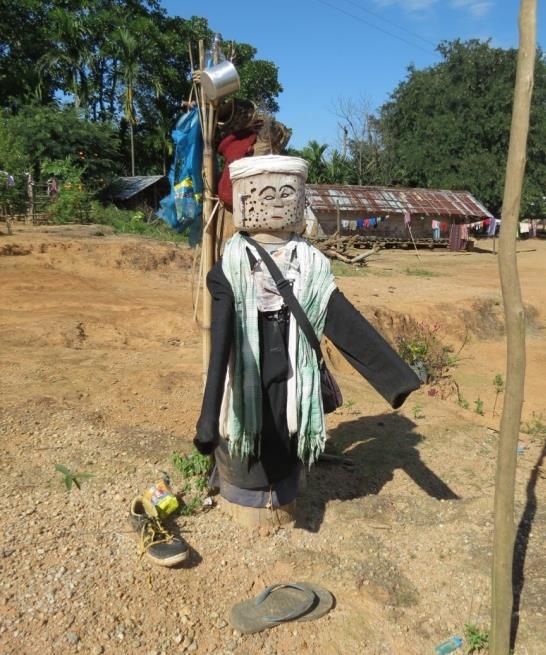
In Garo Hills, the area occupied by the Garo tribe in the state of Meghalaya in India, a number of wooden structures with minimal facial reconstruction can be seen. These are called kima and act as memorials to the dead (Figure 1). The kima is a wooden post carved out in the shape of the deceased, decorated with the material goods of the deceased and erected in front of the house of the deceased person. The relatives of the deceased to commemorate him/her, erect a kima on the second day after the death of the person [1]. The most commonly used wood is the branch of the jackfruit tree, belonging to the deceased person or his family. It is carved out by a skilled man; and often measures 1 to 2 ½ feet in height. The decoration of the kima with the belongings of the deceased indicates their belief in life after death. Kima consists of a pair of posts stuck to the ground, one resembling the deceased person, and the other with notches to support the horns of the bull sacrificed at the cremation [2].
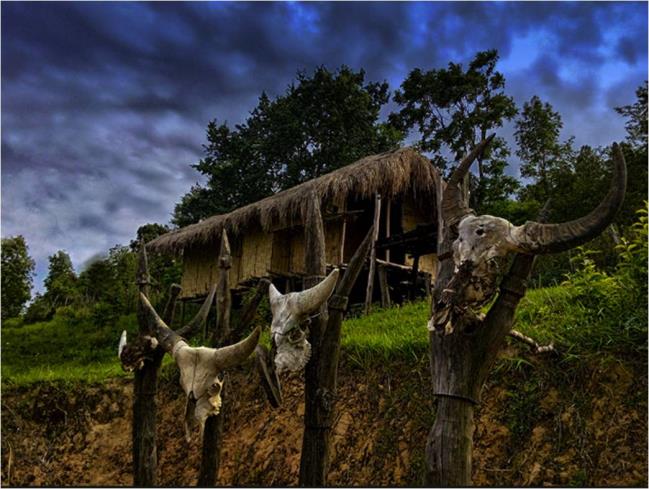
The Mizo tribe sometimes use wooden posts instead of stones as memorials to the dead. The Tlaisun clan living in the Chin Hills of Burma set up wooden memorials to dead chiefs which are accompanied by a long pole of about 4.58 meters high [3]. The Mara also erect wooden posts called thangri along with a stone monument, over the grave of every individual [4]. Aside from these posts, the Mizos also plant the seluphan, a forked or Y-shaped post, for commemorative purposes during the Sedawi ceremony, at the courtyard of the performer (Figure 2) [5]. This is a wooden Y-shaped post on which the skull of a mithun (Bos frontalis) is attached. It is considered a status symbol and it once was the ambition of every Mizo to have a long line of such posts in front of his house.
In available literature on megaliths, it is clearly seen that wood had been used as part of a complex in the past [6, 7]. Darvill [7] discusses the long barrows of England (burial complexes) where wood was mainly used as posts or planks to form orthostats, roofing, walling material, edging for the mound and facade uprights. This supports Colin Renfrew’s statement that early investigators did not find stone tombs in Wessex, and that they (i.e., tombs) instead consisted of unchambered wood structures that had long collapsed. Thus, materials selected and used in the construction of dolmens, long barrows, passage graves, and related monuments were not only composed of stone, but were of many different materials and used in construction in many different ways and “in a range of meaningful ways” [7, pg.11].
In continuation of the above thesis, we might look at the Woodhenge as opposed to the famous Stonehenge of England. The former was identified from an aerial photograph in 1926 [8], and consisted of six concentric oval rings of postholes. Over 40 years after the discovery of Woodhenge, another wood circle of comparable size was discovered in 1966 known as the Southern Circle. It is likely that the sites were integrated into an overall layout with Stonehenge. This preponderance of the use of wood vs. stone may indicate a transformation between life and death, separating the sites into two separate “domains” [9]. This supports Pitts’ theory that pigs were butchered at Woodhenge, showing evidence of feasting, while at Stonehenge only ancestral spirits inhabited, and not living people.
Wood appeared to have been used as a replacement to stone in other regions, especially in Southeast Asia. In the early 1920s, Hutton [10] mentioned that among the Lothas of Nagaland, stones were normally set up as monuments, but Y-shaped posts were sometimes substituted if no suitable stone was available. He further mentioned that in the village of Yekhum there existed a clan who was not allowed to set up stones at all, but instead use Y-shaped wooden posts. In an undated publication, van der Hoop [11] (which was translated in 1932) mentions that if the people or community in a certain area could not find the right stones to make a structure, then they used wood as a substitute.
The contestation between wood and stone appears to be regional. In some societies, stone dominated; in others, wood was considered primal due to its attached cultural importance. No doubt, stone, because of its intrinsic permanence, is the most widely represented and most commonly found in the archaeological context. Wood, on the other hand, is a porous and fibrous structural tissue found in the stems, roots and branches of trees, which by virtue of being organic, decomposes over time. The questions of which material was used first or predominantly, and which was used later or subordinately, are imbedded in the cultural ethos of the makers and users. This could have been pushed by factors of availability of raw material, what was considered fashionable in those times, and on a deeper set of meanings attached to these materials [7]. Visualized cultural values, however, could at times be restricted due to environmental limitations [12].
On the face of availability of raw material in Northeast India (where menhirs and alignments are found plentiful), opportunistic selection might have been limited due to cultural constraints such as those that prevailed in Yekhum village [10]. Additionally, like the Woodhenge, the preoccupation with wood in Garo and Mizo Hills could be connected to their worldview where the use of wood, an impermanent material, reflected the passage of life. Therefore, constructing the kima, among Garos, might not have been as much the creation of a memorial for the dead, but rather the conception of an initiation process wherein and through which life could pass on; while for Mizos, the seluphan might serve as a symbol of the prospering and feasting living people and not the dead.
References
-
Bhuyan G, Sangma TD (2019) Social Markers of the Garos: Looking at a tradition undergoing change. In: Marak Q (Ed.), Megalithic Traditions of North East India, New Delhi, Concept publications, pp: 209-223.
-
Playfair A (1909) The Garos, Guwahati, United publishers.
-
Carey BS, Tuck HN (2008) The Chin Hills, Kolkata, Firma KLM private limited.
-
Parry NE (1976) The Lakhers, Kolkata. Firma KLM private limited.
-
Malsawmliana (2019) Ideological basis of megaliths in Mizo society. In: Marak Q (Ed.), Megalithic Traditions of North East India, New Delhi, Concept publications, pp: 64-76.
-
Renfrew C (1983) The social archaeology of megalithic monuments. Scientific American 249(5): 152-163.
-
Darvill T (2010) Megaliths, monuments, and materiality. Journal of Neolithic Archaeology pp: 1-15.
-
Crawford OGS (1918) Archaeology in the Field, London, Phoenix House limited.
-
Pitts M (2008) The Henge builders. Archaeology 61(1).
-
Hutton JH (1922) The meaning and method of the erection of monoliths by the Naga tribes. The Journal of the Royal Anthropological Institute of Great Britain and Ireland 52: 242-249.
-
Hoop ANJ Th A Th van der, Shirlaw W (1932) Megalithic remains in South Sumatra.
-
Yondri L, Herlina N, Zakaria MM, Mundardjito (2016) Megalithic culture and its post visualization: A short review on findings from archaeological site and loca tradition in Indonesia. History Research 6(3): 157- 163.
- The Indispensable Role of Informal Caregivers in Supporting the Aging Population
- Socio-Religious Significance of Kamakhya Temple in Guwahati, Assam
- Is Anthropology Possible?
- A Contribution to the History and Paleobiology of Harput/Elazığ Türkiye and Its Surroundings
- A Study on the Cowrie Shells of the Dimasas in Assam
- The Significance of International Organizations Cooperation in the Efficient Resolution of Global Conflict