
The Inlay of San La Muerte as Configurations of the Passionate State of Faith
In this presentation we explore the relationships between human bone and the magical-religious ritual use in Northeastern Argentina and southern Paraguay; we approach this problem from the conceptualization of the santera practice as producer of popular sacred art, attending to (a) the use of bone in the carving of the imagery of San La Muerte and (b) its valuation as powerful talisman beyond having been, or not, sculpted in the form of the Saint. We intend to contribute to the description and understanding of part of the religious imagination of Northeastern Argentina and Southern Paraguay, and its derivations and relations with the production of sacred material culture. For the treatment of this problem, fieldwork has been carried out among the population of Catholic faith, prioritizing the ethnographic method were implemented in-depth interviews with devotees and santeros, observations with varying degrees of participation, records in journals and field notes, as well as documentary analysis and varied images.
Presentation
Kurundu: From the Guaraní Kurundu, s. Talisman, anything to which powerful virtues are attributed, designates an amulet that is placed under the skin to have supernatural powers. “is the amulet, the talisman (...) Ex.: Saint Death, made in bone of Christian killed in fight, to become immune to bullets (...) It is attributed supernatural virtue to ward off some damage or danger. Commonly wear neck slope, in a sachet (...) up to under the skin, by incisions made ex professo” [1].
The text that we propose addresses the description and composition of part of the religious imagination of the Northeastern Argentina, mainly addressing the ethnographic present. The information is detailed in the provinces of Misiones, Corrientes and Chaco. We propose to explore the existing relationships between the use of human bone and its use in the making of the Kurundú; especially as it concerns the carving of the imagery of San La Muerte and later incrustation or presence as altar images.
The records correspond to the corpus of the Projects, a) Death, Death, Society and Culture. Funeral Memory and Daily Life. Nordeste Argentino y Sur de la Región Oriental del Paraguay accredited in the Secretariat of Research and Postgraduate Studies of the Faculty of Humanities and Social Sciences of the National University of Misiones, and b) The wake of the angel in Northeastern Argentina and Southern Eastern Region of the Republic of Paraguay.
Centuries XIX, XX and present ethnographic that developed as Researcher of CONICET. Given that this is a highly sensitive subject for the population that is under study and that we have undertaken to deepen it through ethnographic work that includes interviews and audiovisual recordings, the research processes involved in these projects meant a constant reflection on the risks involved in the researcher’s interference in the emotional life of the subjects. Also, the nature of the topic to be investigated required a specific work on the possible resistances by the subjects to express their experiences and beliefs. It should be noted that some of these dimensions were resolved because the field work, being of long duration, has allowed the construction of firm social networks and trust between the researcher and the interlocutors. As noted above, we have prioritized the ethnographic method, observations in different contexts, in-depth interviews with key interlocutors and records in various technological devices.
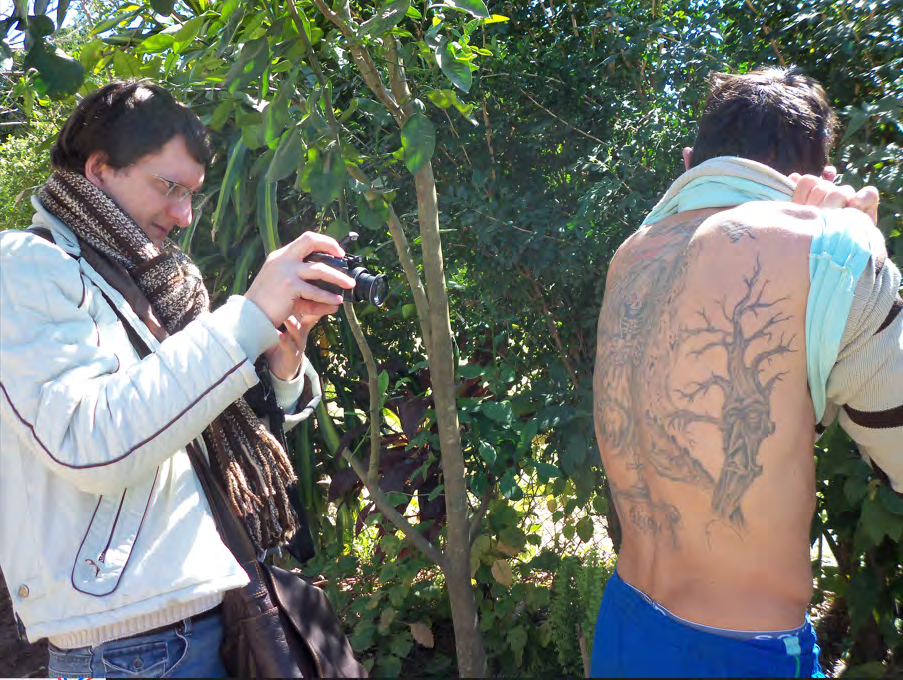
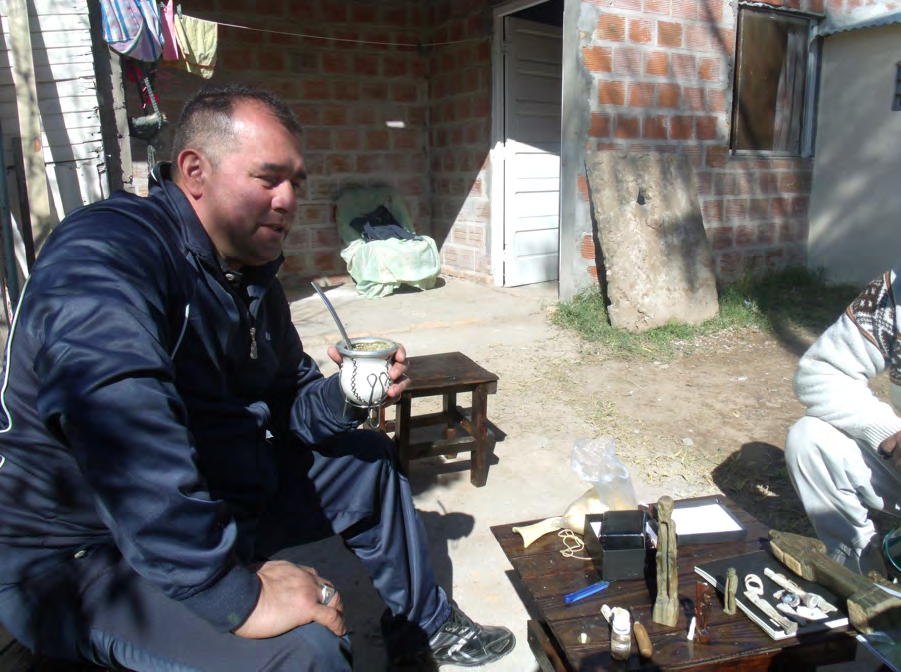
The photographic records were made between 2013 and 2019 and are part of a broader collection that seeks to relate practices and beliefs around San la Muerte, his attributes as a protective lawyer and the perception schemes of the underworld in the Argentine Northeast. The presentation consists of three large sections: a) the tools and the bone: to hang, to carry and to dress the altar; b) the bone to embed: of angel better, and c) the inlay. For each of the sections we have selected some quotes from interviews of direct collection and illustrative bibliographical references (Figures 1 & 2).
On the San La Muerte
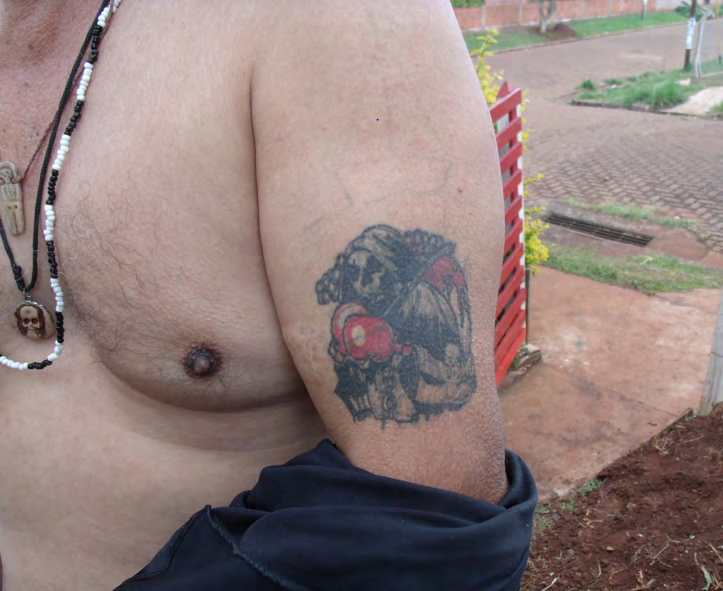
Miranda Borelli [2] and López Breard [3] that the belief in San La Muerte, in Argentina, expands with more power in the provinces of Northeast Argentina, also in the Republic of Paraguay and Brazil. More recent ethnographies such as those of Krautstofl and Krautstofl and Bondar [4] corroborate these claims and account for the recent extension of this belief to the Central, Northwest and South regions of Argentina. In this diversity of contexts the belief in San La Muerte acquires recurring forms of we find altars in domestic spaces, whether public or private, oratorios to the side of the routes and roads or oratorios of greater bearing -like Chapels- for example those in force in the cities of Posadas (Misiones), Barranqueras and Resistencia (Chaco), Caábí Poí y Empedrado (Corrientes) and Ita (Paraguay), between others. In the same way, veneration of the Saint is expressed by bringing him amulet, embedded under the skin or tattooed [4].
Their denominations are varied, among the most common are mentioned Lord Death, Lord of the Good Death, Saint Death, Saint Just, Our Lord of the Death or Lord San La Muerte [3] Krautstofl to the Lord Death, Saint Death, Lord of the Good Death, Lord of Death, Saint Skeleton, or Captain of Death in González Torres [5]. Meanwhile Miranda Borelli [2] highlights that there are own denominations of Paraguay as being San Esqueleto or Oyucaba (or Ayucaba); according to the records of the author the expression would refer to “...whoever kills (...) Carai Oyucaba would be the Lord who mata...” (p. 56). One of the most widespread denominations in the Guaranitic Zone be “...the wedge pirú jha mondá (the skinny and thieving woman)...” (p.56); in the case of Corrientes is cited as Lord of Transit and in Chaco San Severo of the Death. Also called Paje.
The image of the Saint, regardless of his denomination, is represented by a skeleton in some cases it carries a scythe and in others a spear: the first is the Good Death’ and the other of the Bad Death’ (...) Some they wear black robes, as symbolism linked to the cult of death, meeting purple guards in the cloak [also cloak and mantle of red] (...) other attributes have crowns and made thrones in white metal, silver or gold [3].
The size of the image is varied; currently we have recorded images of few millimeters to those that reach 2 meters high. It is observed standing, sitting on a World, on a throne, squatting; the clothing material is various: in palo santo wood, orange, cedar, rough, in metals such as silver, gold, also in plastic, plaster, clay, animal bone or human. Speaker [3], citing an interview with a 78-year-old informant from Cambí Retá of the Department of Ituzaingó, Corrientes, “... that to be more miraculous [the Saint] the grave must be desecrated on Friday night [to remove the bones for size]; [or] in bullet lead extracted, if possible from the body of any murdered...” (p.19).
It is celebrated in the month of August on different dates depending on the Province or the tradition of the family that houses it, we have recorded parties on dates 8, 13, 15 and 20 August. Referred to in López Breard, et al. [2, 3, 4] that the holder of this image will have attributes supernatural that will vary from luck in the game, in love, in business, will be successful in lawsuits, trials and will be protected in the situations where life is at risk. This protective attribute constitutes him in “lawyer” of his bearer.
The Figure of the Santero
The image of the santero is referenced in various genres; literature folk tales and oral narratives. In the field of imagination regional religious the santero is defined as a “carácter” with spatial attributes for the design, manufacture, moulding, carving and (in some cases) consecration of objects. These objects can be relics, images, amulets and talismans; varying its materials according to the attributes of the sacred object, its destiny, relevance or mediating with the supernatural universe.
González Torres [5] exposes that the santeros “make their works, of surprising realistic expression, carving with just knives and sharp penknives, and usually produce small images, from five to twenty-five centimeters of height” (p. 497). In this characterization the works of [1] coincide.
The figure of the santero is usually associated with the idea of “imagery” as a artistic expression. Noya states that after the expulsion of the part of the population of the missions continued the work of the artisan period, cites the work of José Santos (José el Indio) whose work “Christ of the Patience” is exhibited at the Church of La Merced in Buenos Aires.
Thus, to paraphrase the author, the notion of santero seems to be a categorization that already applies to colonial artisans who would have acquired certain skill in the carving of religious imagery. However, there are several experts on the subject the santeros correntinos more Alberto Rolando Gauna, Ramón González, Ramón Cabrera, J. Cáceres, Aquiles Coppini, we cannot fail to mention the outstanding Paraguayans Cándido Rodríguez who since 1940 includes in the work his sons Juana de la Cruz, Carlos, Antonio, Maximiliano and Justo; also the case of Zenón Páez [1]. Attending to second-hand records, and those collected at present ethnographic, the attributes of the santero usually become of: a) oral inheritance received from “teachers” and/ or relatives, and b) supernatural attributes brought from birth. From this way the santero not only reproduces the technique of making the object, but also the ritual steps for their consecration as a sacred element (Figures 3-5).
Tools and Bone: To Hang, To Carry and to Dress the Altar
Cosmogonic myths, rites, sorcery, sacrifices and witchcraft account for how bone, and some parts of the human body, cease to be encapsulated in the shelves of Anatomy and settle in a complex warp that, in the interests of this research, cannot be abstracted from the magical- religious practices of the peoples [6].
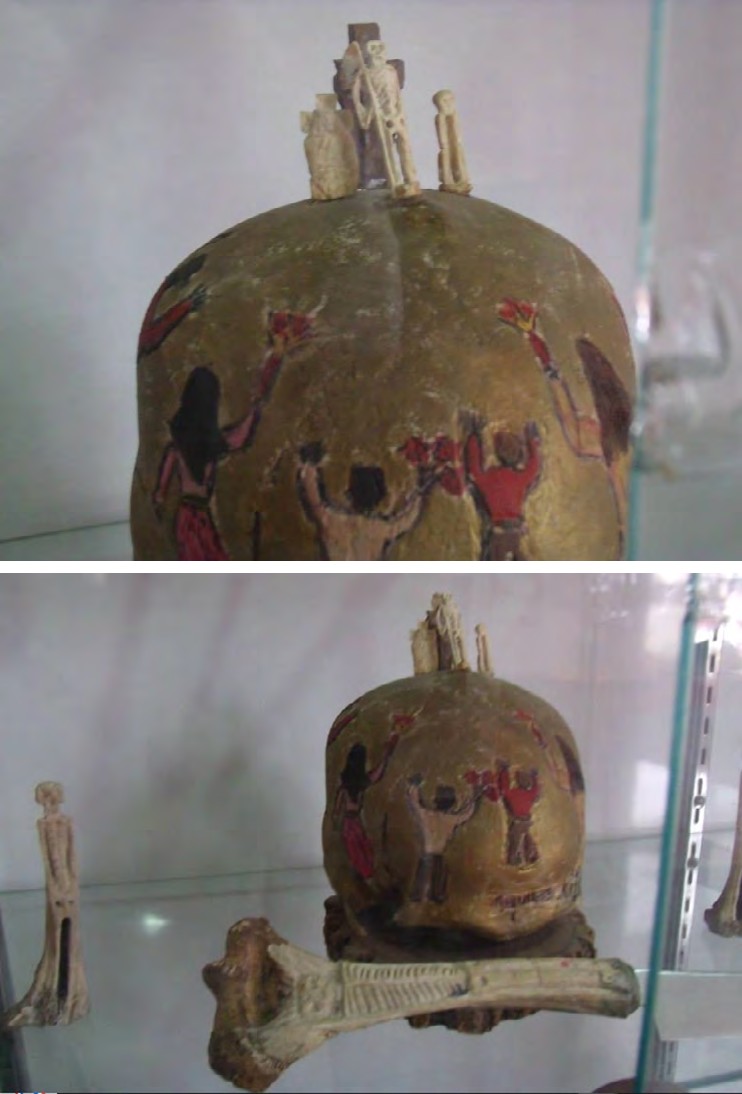
Figure 3
Figure 4
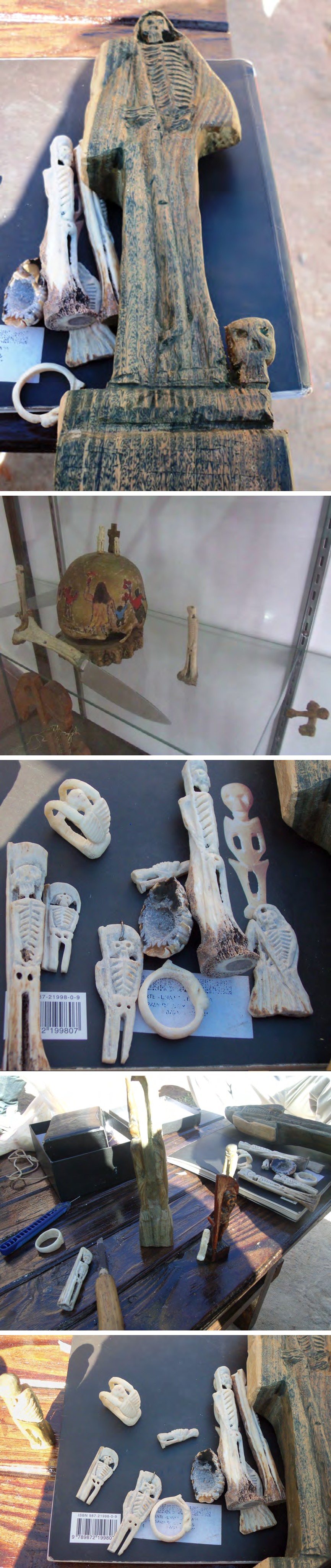
Figure 5
Figures 3, 4 and 5: The painted human skull is presented as the altar of the Santito, the Santito on the human head “regentea todo”; receives devotees and faithful who bring with them various exvotos. At the foot of the skull the dagger with the hilt of human bone; powerful Kurundu before the altercations and fights of knife.
Figures 6: The tool.
Figures 7
Figure 8
Figure 9
Figures 7, 8 and 9: To wear and carry, in the wallet, wallet or finger. “Everything we ask, rings, necklaces, ear rings, ladies put it in the wallet.. here Doña XXX in the bodice carries” (Santero. Corrientes).
We are interested in highlighting the figure of the Santero, the selection of elements and the practice of carving reserved for a few initiates. It is noted in Bondar [7] that the image of the santero appears referenced in various genres; folk literature folk tales and oral narratives. In the field of regional religious imagination the santero is defined as a “character” with spatial attributes for the design, making, molding, carving and (in some cases) consecration of objects. These objects can be relics, images, amulets and talismans; varying their materials according to the attributes of the sacred object, its destiny, relevance or mediating power with gods, spirits, demons, etc. Although there are several experts on the subject, the most cited santeros would be Alberto Rolando Gauna, Ramón González, Ramón Cabrera, J. Cáceres, Aquiles Coppini, We cannot fail to mention the outstanding Paraguayans Cándido Rodríguez who since 1940 included in the work his sons Juana de la Cruz, Carlos, Antonio, Maximiliano and Justo; also the case of Zenón Páez [1]. We present the tools used in the carving of San La Muerte (in human bone or holy stick), the resulting in the form of rings, pendants or altar images. Thus, not any bone can be used, everything will depend on the life that the person has led, on his bad or good deeds: then there will be perfumed bones, other katingudos and others must wait a while and macerate their guilt to be part of the base material for the carving of the Saint (Figures 6-9).
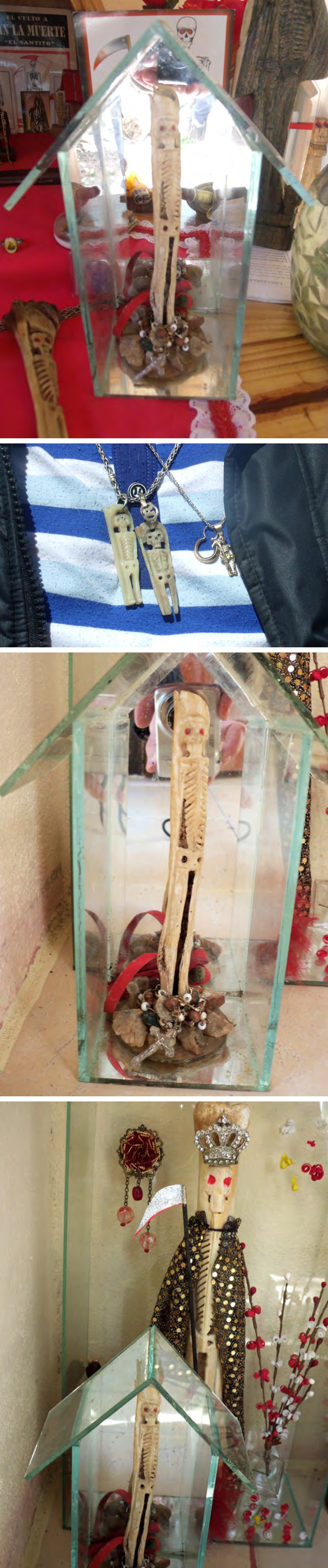
Figure 11
Figure 12
Figure 13 Figures 11, 12 and 13: To Dress the Altar (With A Human Femur, Tibia or Fibula).
The Bone to Embed: from Angel Better
As explained in Bondar and Krautstofl [8], in the case of the use of the angel bone, we can note that the carvings of the imagery of San La Muerte are usually made in the clavicle or the skull of the angel (being one of the few bone pieces that are preserved in time due to the young age of the child) (Figures 10-13). Interlocutors point out that the attribute of purity of deceased children grant extra “powers”, added force, greater effectiveness to kurundu or talisman. On the case Romero points out (s/d cited in Miranda Borelli) [2] that “...must be taken into account especially if it is human bone that is of male child or man of breakdowns...”, or as Jijena and Alposta [9] show can be of human bone (phalanx of dead child after baptism). On this ritual use and efficacy of human bone, at a regional level, it is mentioned that “Equal caution must be taken with the Payé made of dead bone, preferably of unfaithful creatures, that is, without baptizing, pulverized, mixed with wax and placed furtively under the altar cloth to be consecrated during a mass” (Jijena and Alposta [9]: s/d), these strategies of blessing of the page are clearly worked and referenced in Miranda [2] who develops some of the “tricks” that santeros and devotees use to ensure that their Saint possesses the blessing, preferably in seven different churches (Figures 14-16). “... that’s the Santito (...) yes, the one called the San La Muerte, the Good Death (...) that is made of a creature bone, that was my grandchild...” (Woman, 89, Corrientes)”... this one my grandfather gave me, from his grandfather himself... I’ve... told me it was from the bone of mitai (...) half broken already (...) by the pages that make you, he [The Saint] receives and bounces...” (Man, 80, Paraguay).
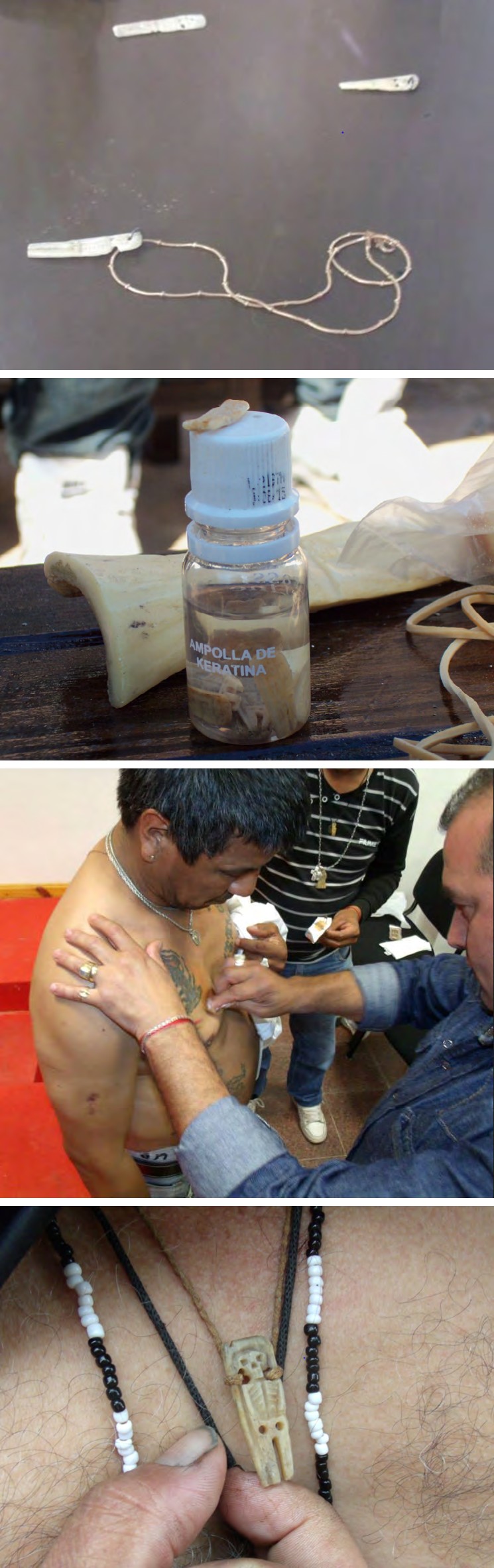
Figure 15
Figure 16 Figures 15 & 16: San La Muerte in mitai bone (skull or clavicle)
The Inlay
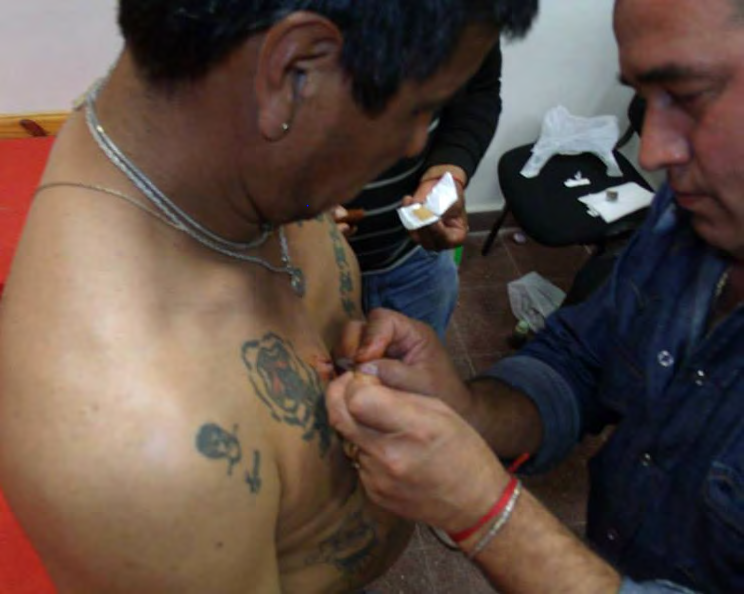
We mean by “incrustation” to the ritualized practice (of Faith) where the santero-incrustador and the devotee intervene; by means of a small excision in the skin of the devotee the santero “incrusta” a size that does not exceed 10 millimeters, flat cut that can be made of bone, lead or gold according to the references of the informants. Thus, we have also recorded situations of self-embedding without intervention of third parties, taking place in the cases of recognized santeros and specialized in practice. Having identified the ideal place for the inlay (as requested by the devotee) the santero performs the blessing of the lump, sterilizes the skin and, “in the name of the Saint” further persecutes it in the name of God and other prayers whispered in you very low, makes a small excision of two centimeters approximately where you enter the size, then stitches two or three (Figures 17-21). The Saint is already embedded, in the coming days will be watched over the evolution of the incrustation, not only for the care of the wound but to be able to perceive if the Saint has accepted this devotee, otherwise “will be expelled” [8]
Figure 17
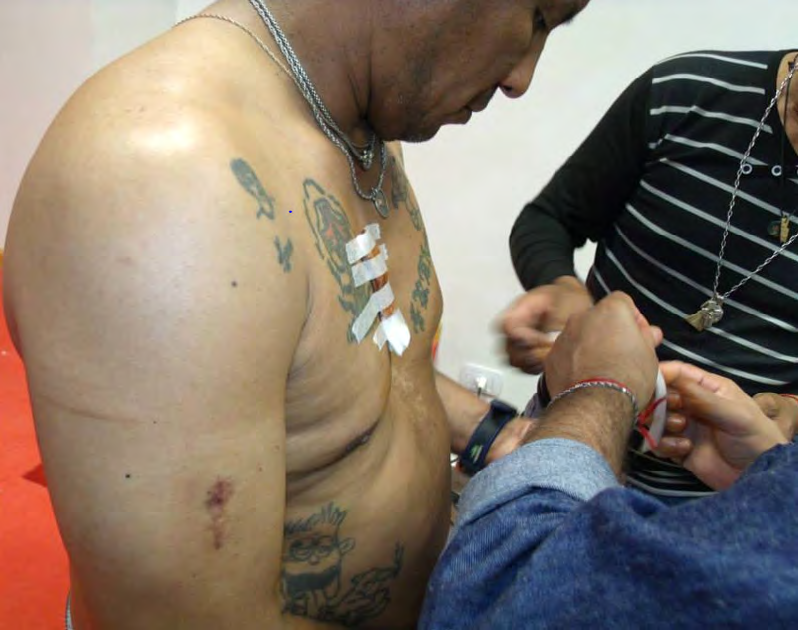
Figure 18
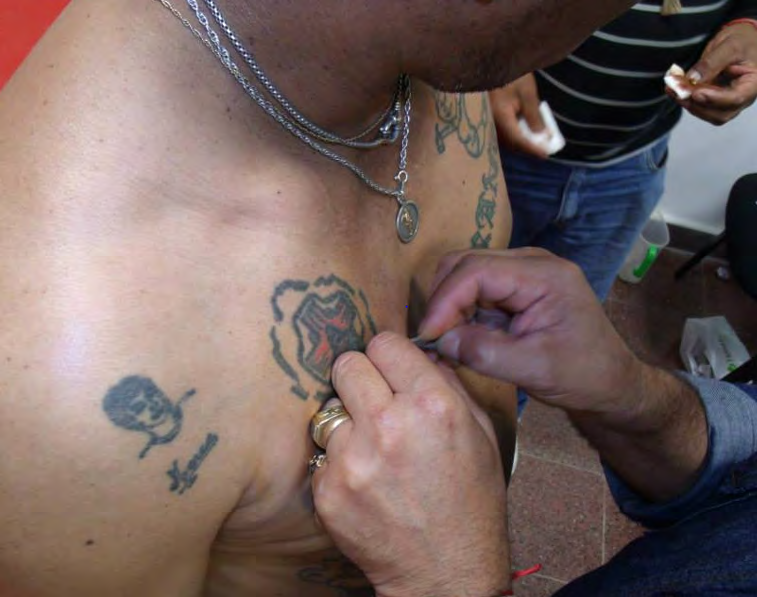
Figure 19
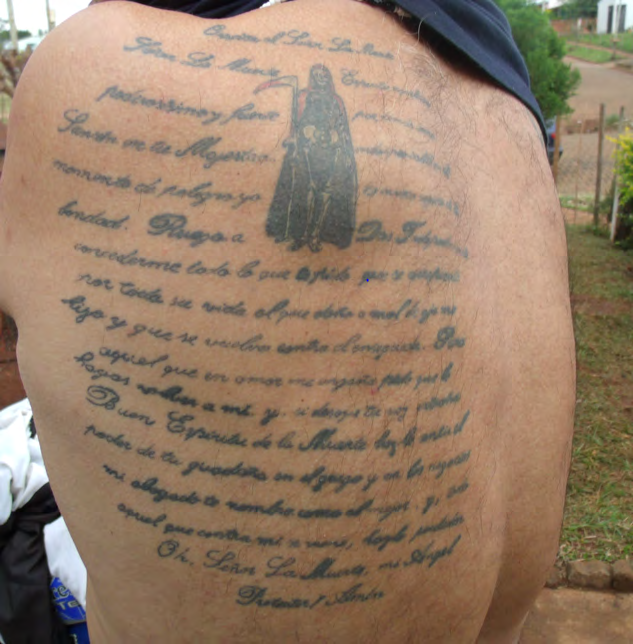
Figure 20
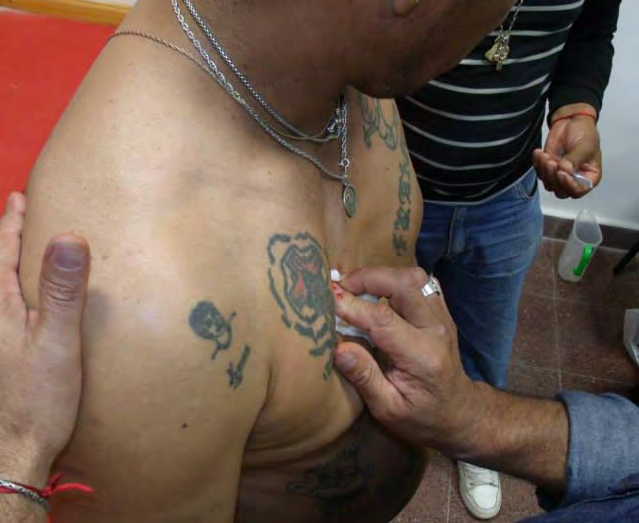
Figure 21 Figures 17, 18, 19, 20, 21: Excision, inlay, “sewing”.
Reflections
It is clear that we observe how the quality of the human bone makes it participate in a complex circuit of popular sacralization, they will be used as amulet of great effectiveness against various altercations that could transit the carrier, fulfillment of desires, works of healer, etc. In this instance we can point out, following [10], that we are before a hierophane [11]: a manifestation of the sacred. “... hierophytias can be extraordinarily diverse and go from the manifestation of the sacred in any object, such as a stone or a tree, to a theophany (manifestation of a god)...” [10]. But we must understand that it is not a question of venerating these objects as such; in this case the bone possesses the faculty of being a hierophane, since it embodies, “shows” something that is no longer just bone, but a sacred object [12, 13].
As Eliade has pointed out (2001:7) “... the object then appears as a receptacle of a strange force that differentiates it from its environment and confers it sense and value...”. [10] adds that the paradox of hierophania is that the object becomes something else, transcending its natural materiality and responding to an archetype, transmutes to something new-but it does not stop being “himself” (Figures 22 & 23).
The image of San La Muerte sculpted in bone and embedded, the bone used as an amulet or ingredient in the “preparations”, would condense a complex archetype: the supremacy of the irrecusable, death, his holiness.
These cases, part of what we have called a regionalized thanatoculture, challenge perceptions about the conceivable as possible; at the same time they re-install dialogues with archaic traditions that are lost in the depths of the socio-processes history that have shaped the region: our thanatoregion, a region founded on sharing specific conceptions linked to the processes of death, death and the link with the dead.
References
-
Breard L, Raul M (2004) Diccionario Folklórico Guaranítico. Corrientes Ed Moglia.
-
Borelli M, Isidro j (1977) Un rasgo indicador de la cultura del nordeste. San la Muerte. Suplemento Antropológico Universidad Católica Paraguay, pp: 45-148.
-
Breard L, Rau M (1983) Devocionario Guaraní. EdColmegna Santa Fe Argentina.
-
Elena Mk, Iván BC (2013) San La Muerte. Estética y estilos de veneración al Santo de La Muerte. Conferencia. III Encuentro sobre Antropo-Semiótica de la Muerte y el Morir. Facultad de Humanidades y Ciencias Sociales Universidad Nacional de Misiones. Posadas, Misiones Argentina.
-
Gonzalez Torres Dionisio M (2012) Folklore del Paraguay. Editora Litocolor SRL Asunción Paraguay.
-
CesarIvan B (2014) (Algunos) Usos del hueso del angelito. Nordeste argentino y Sur del Paraguay. Universidad Nacional de Misiones Conicet, Argentina, pp: 37-59.
-
CesarIvan B (2018) Santero y arte sacro, el hueso humano esculpido: el hueso del angelito en la santería del nordeste argentino y sus del Paraguay. Prácticas artísticas y científicas en torno a visualidades desplazamientos y artefactos, Buenos Aires Editorial Biblos, pp: 77-97.
-
CesarIvan B, Krautstofl Elena M (2015) San La Muerte Estética y estilos de veneración al Santo de La Muerte. En Bondar, César Iván y Krautstofl, Elena M. Lecturas Antroposemióticas sobre la muerte y el morir desde Latinoamérica. Conicet, Posadas, Pp. 13-38.
-
Rafael J, Luis A (1992) Mitos/Supersticiones San La Muerte. Revista de Folklore. Fundación Joaquín Díaz. Tomo 12b.
-
Josep C (2003) Aire. Las creencias religiosas en context En: Antropología de la Religión Una aproximación interdisciplinaria a las religiones antiguas y contemporáneas Elisenda Ardèvol Piera, Glòria Munilla Cabrillana (Coord). Barcelona, pp: 71-179.
-
Salvador AL (2001) Mircea Eliade El Mito Del Eterno Retorno Arquetipos Y Repetición Emecé Editores.
-
Carlos AS, Rey MJB, Becerra SR (1989) La Religiosidad Popular. II. Vida y Muerte: La Imaginación Religiosa. Ed Anthropos Barcelona Editorial del Hombre, pp: 7-16.
-
Ivan BC (2013) La muerte violenta (sacrificial) del inocente como pasaje a la sacralidad: caso Ramoncito Mercedes Corrientes. Encuentro; Tercer Encuentro sobre Antropo-Semiótica de la Muerte y el Morir. Universidad Nacional de Misiones Posadas Argentina Conicet.
- The Indispensable Role of Informal Caregivers in Supporting the Aging Population
- Socio-Religious Significance of Kamakhya Temple in Guwahati, Assam
- Is Anthropology Possible?
- A Contribution to the History and Paleobiology of Harput/Elazığ Türkiye and Its Surroundings
- A Study on the Cowrie Shells of the Dimasas in Assam
- The Significance of International Organizations Cooperation in the Efficient Resolution of Global Conflict