
Experiences of Remembrance of Deceased Children (Angels). Corrientes Province, Argentina, and South of the Republic of Paraguay
We propose in this article to address some of the practices that allow the remembrance of deceased children in the Province of Corrientes, Argentina and the South of the Eastern Region of Paraguay. This approach places us in three exemplary situations that are inscribed in specific temporalities: a) the visit to the cemeteries on November 1, b) the serenades of adults during the morning of November 1 and the walk of children in the afternoon of October 31 or November 1 in the morning (Angeles Somos), and c) the celebration of the angel’s birthday, or the Day of the Child. Thus we could perceive that the visit to the cemeteries during November 1 is a significant recurrent throughout the area under study. In the case of “Ángeles Somos” we have found it in the towns of Norte de Corrientes, not observed in Paraguay. Both the Day of the Child and the birthday and remembrance of the angel are identified more strongly in Paraguay. The records correspond to the period 2006-2022, for this the ethnographic method has been prioritized with interviews, observations and records in various devices.
Introduction
Thinking of the remembrance of deceased children, as staging of complex communicational networks, implies conceiving it as a combination of dominant and instrumental symbols interwoven in complex ritualizations that enable the staging and updating of the memory referred to the popular figure of the angel; its copresencia, movement, experience and validity in the community. It should be noted that the first two cases, visits and Ángeles Somos, are clearly distinguishable during the time of the celebration of souls -31 October to 2 November [1, 2, 3].
Conceptual Paper
We refer next to the matrices of meaning that we perceive as the orchards that nourish the forms of remembrance analyzed: conceiving the dimensions described as mobile images, updated and coming from dissimilar temporalities.
We highlight the contributions of Bajtín [4] in conceiving the dialogic unity between memory and History (the Great Time) and the “impossibility” of the loss of the senses, the recovery, transformation (re-signification) of memory as a constant in dialogical relations. Likewise, the contributions of Lotman [5] in perceiving historical memory beyond simple storage, deposit or memory but as the construction in the present of what matters to recover. Stressing that subjects construct and re-construct the dimension of memory with a view to the future: memory as an intense, creative, projective movement.
The contributions referred to are closely linked to those that Candau [6, 7] has called “the social game of memory and identity: transmit, receive”, an aspect that highlights that social thought results from the transmission of a capital of memories and forgetfulness.
On this point, points out that individual and collective memory follow a complex, plural and diverse path hand in hand with historical-social and cultural diversification. Returning to the contributions of the author we point out that the order of memory that calls our interest corresponds to the “social, historical, cultural memory (...) matrix of collective memory”; linked to funeral practices around angels.
This relationship is based on the long work of Lotman [5], memory as a mechanism of generation and re- production and not as a passive deposit. The memory of culture is not only one, but it is varied, its unity occurs at the level of the “dialects of memory”. Every society establishes what to remember and what to forget.
Also, we highlight the notion of “footprint”. The author notes that an archived memory has ceased to be in the proper sense of the word a memory, that is, something that maintains a relationship of continuity and belonging to a present of which one is aware. It has acquired the status of rest documentary. The characteristic of the footprint is that it can be followed and tracked by a historical conscience. We maintain, together with the author, that memories are distributed and organized in levels of meaning or in “archipelagos” and that memory remains the ability to remember and to go back in time. This movement of memory- vertiginous flow of memory and forgetfulness- configures representative forms of the angel and his attributes. These distinctions, qualities, references or images are present in the different social spheres that we intend to address next.
Visit to the Cemeteries on November 1
The visit to the cemeteries during November 1 and 2, in the area under study, has been long worked in Ambrosetti [8], López Breard [9, 10, 11], Cortazar [12], Salas [13], Galeano Olivera [14] and Gonzáles Torres [15] to mention a few. Background on the processes of transculturation and re- significance of these practices can be found in Nicolaÿ [16].
It is widely believed in the region that at this time the dead enjoy a temporary return to the world of the living, a dish is usually added to the table for them to share the dinner of October 31; review as “many people did not go to bed the night before November 1 so that the souls of the deceased could return and rest in their beds after their long journey to Earth”. On these aspects we find references in Hoyos Sáinz [17].
For his part in the work of it is exposed that the nominally Christian feast of the dead faithful on November 2, seems to have its basis in an ancient Celtic feast dedicated to the dead and adopted by the Church in 988 A.D. He adds that this conjecture is corroborated by the ecclesiastical recognition of the feast; first agreed at the end of the 10th century in France It was Odilo Abbot of the great Benedictine monastery of Cluny, who initiated the change in 998 A.D. by ordering that in all the monasteries of his jurisdiction a solemn Mass be celebrated on November 2 in honor of all the deceased who rested in Christ (...) an ancient Celtic ceremony of the dead lasted in France until the end of the 10th century, when it was finally incorporated into the Catholic ritual as a political strategy.
Regarding the celebration of November 1, points out that it was one of the first attempts of the Catholic Church to replace the soul of the dead by the Saints. It is instituted by Louis the Pious, 160 years before the installation of the Feast of the Dead Faithful on November 2. The definitive inclusion is decreed by Pope Gregory IV1.
1 De Paula Morell (s/d) points out that “(...) Among all the festivals that the Church has instituted in reverence of the saints who are in heaven, the most solemn is the one celebrated on this day in honor of all [The feast of all saints- November 1]... Boniface IV instituted it in Rome in honor of the Blessed Virgin and all the holy martyrs, consecrating them, in 607, the temple called Pantheon, in which all the false gods of gentility had been worshipped. Later Gregory IV ordered that the feast be made in honor of all the saints of heaven (...)” (p. 319). Also Cáceres (2008) highlights that “(...) The enormous number of Christian martyrs that produced the persecution of Diocletian (284-305), led the Church in the fourth century to establish a day to commemorate all, because the almanac was not enough to give each one his own. The original date was February 21. But in 610 the liturgy of the saints changed to May 13, the day on which Pope Boniface IV consecrated the Roman Pantheon where pagan gods were honored (before Christianization) as the temple of the Blessed Virgin and of All Martyrs. Later, Gregory III (731-741) transferred it to November 1 in response to the pagan celebration of the Samhain or Celtic Nevus Year (now called Halloween or Halloween) celebrated on the night of October 31, in the belief that there was an opening between the tangible world and the world of darkness, and that the dead came to visit the living. Then, Gregory IV (827-844) extended the celebration to the whole Church; however, to this day the Greek Orthodox commemorate All Saints’ Day on a moving date: the first Sunday after Pentecost (...)” (s/p.) On the commemoration of the faithful departed, November 2, De Paula Morell (s/d) “(...) After the holy Church yesterday [1° November] celebrated the feast of all the saints, today it extends its charity, and helps with its prayers and suffrages to the souls in purgatory... The works with which we can help them are three [to help the souls in Purgatory]: the first and main is the holy sacrifice of the Mass; the second, prayer; and the third all the penal works with which divine justice is satisfied, such as alms, fasting, penance, pilgrimages, and the like (...)” (p. 320) Adds Cáceres (2008) that “(...) The Day of the Faithful Departed is somewhat later and did not originate in Similarly, points out that in colonial times pre-Hispanic traditions were merged with Christian ones. It states that the celebrations of the dead of the natives continued ahead adapted to the canonical demands of November 1 and 2 in the Christian calendar. Highlights that it is necessary to highlight three pre-Columbian elements that will be present in the colonial and modern cult, with or are modifications: first that all the burials were accompanied by offerings (...) Second that there were two parties of the deceased: that of dead children (in the ninth month) and that of adults (in the tenth month) (...) Finally the indigenous custom of having domestic altars (cues).
Focusing on the visits to the cemeteries during the dates mentioned, we note that they chain together a set of practices that are inscribed in the official liturgical calendar but that do not discredit or exclude the demonstrations, updates and creativity of everyday life.
Remark Cortazar [12] that the so-called “day of the dead” is remembered unanimously among us, especially with visits to cemeteries carrying flowers, attending religious services, etc., but in those regions curious practices are preserved in which, along with pious Hispanic traditions, inherited from colonial times, traces of indigenous survival are noticed (...) In the Litoral, Corrientes for example, donuts, Chipaés, fruits and other food are hung on the crosses that point to the side of the roads, the place where someone has accidentally died (even if they are not buried there). If the need urges the passer-by, it is lawful to take them for sustenance, but whenever they pray, in return, some prayers for the soul of the deceased (p.s).
Throughout the fieldwork the informants have clearly differentiated two temporalities in this schedule of visits, Rome, but in France: it began in the Great Monastery of Cluny, on November 2, 998, when Saint Odilo, his fifth abbot, decided to pray for the rest of “all” the dead. Until there, in Cluny, it was styled to celebrate the “family psalmi”, or prayers by the lay protectors, living or deceased, belonging to the European aristocratic lineages, because this favored the donations of the powerful, many of whom were part of the order. What Saint Odilo did was to “democratize” the psalmi, extending them one day a year to all the dead, including the poor. The initiative was deeply rooted in France, but Rome only adopted it in the fourteenth century and gradually expanded to the whole Church: in the fifteenth century it came to Spain and from there it went to America, where it became involved with indigenous traditions. Rather later, Pope Benedict XV (1914-1922) gave the priests the opportunity to offer three Masses on November 2: one for the poor souls, another for the intentions of the Pope and the other for the intentions of the priest. It should be noted that, if on November 1 Catholics worship all the saints, on November 2 they pray for all the deceased, but do not worship them, because the Church does not worship death. To understand this, it is worth clarifying that three states coexist in it: the Pilgrim Church, constituted by those who are alive; the Church in Purgatory, conformed by the deceased who have not yet gone to heaven and for those who pray on November 2, All Dead Day; and the Triumphant Church, glorified and in heaven, which are the saints who are remembered on November 1 (...)” (s/p) temporalities that we perceive as strongly linked to the sacred and the type of dead, more than simply to the dimensions of death and dying. These aspects are included in the work of Coluccio [3] when referring to the festivities and celebrations of November. Thus, during November 1, the offerings of souls take place, the celebration of the Day of All Saints and Angels (Angels We are) and the tabeada of Souls, reserving November 2 as the Day of the Faithful Departed, Day of Souls or Dinner of Souls.
This calendar distinction translates into a qualitative distinction between the angels and the other departed ones, with different spheres of meaning that can be understood here according to the dates that call us in the first cases: 31 October-1 and 2 November.
We affirm that the angel is not a common dead, like the deceased or other deceased, starting from his condition of purity and closeness to God is assigned a special place separating him from the adult death. This is how the angels will be worshipped and visited on November 1 and not 2 (among some families in Paraguay we have recorded celebrations on Mondays and/or Saturdays understanding these as “days of the angel”).
In this way the visit, as a socio-cultural practice, is clearly linked to the process of thanatoculturization or culturisation of souls. The angel will be visited, cared for, cared for, candy, bottles, clean clothes and toys will be taken. The tomb will be colored, balloons of different shades and new cloths will be attached to it, which we can refer to under the idea of a return visit by Finol.
Thus, we could reactivate some qualities of the idea of double exposed in Morin [18]. Although there are no references to the double in children, since it seems to be a specificity of adults, we cannot fail to mention the idea that “the double feels the same elementary needs as the living, the same passions and feelings”[18]; it must be sheltered, fed, protected. The double, to be vigorous, must die vigorous: hence the reviews about the elderly who are buried still dying so that their double is not too senile; qualities that we can translate in the cases of the angelization of the body of the child and his death in a state of purity.
Thus the ideas around the need for care, food and shelter motivate the visits of November 1; the angel seems to need his toys, songs and maternal warmth. We were surprised to find tombs of angels dating from the 40s, 50 and 60s of the 20th century, still visited; with offerings and “fresh” candles reactivated on the date that summons us. It is clear that, for this little angel, who at present would exceed 80 years, the needs of visit remain related to his time of death: relative to the child; visits reproduced by uncles, cousins or brothers;
due to the death of his parents.
Although the tomb, as a sign, remains immersed in the chains of meanings beyond the time strip worked, it is important to mention the reactivation of some qualities of these depending on the re-memorative dates that summon us. Visits collect graves, “revive” her (in the words of an informant). In the following images we can clearly observe this distinction before and after November 1 (Figures 1-4).
Image N 1: Tumba de angelito, previa al 1 de noviembre.
![Figure 1: César, Iván Bondar [19].](/fulltextimages/10907/fig_1.png)
Image N 2: Same tomb of angel, after November 1.
![Figure 2: César, Iván Bondar [19].](/fulltextimages/10907/fig_2.png)
Images N 3 and N 4: Tomb of an angel, before and after November 1. From left to right.
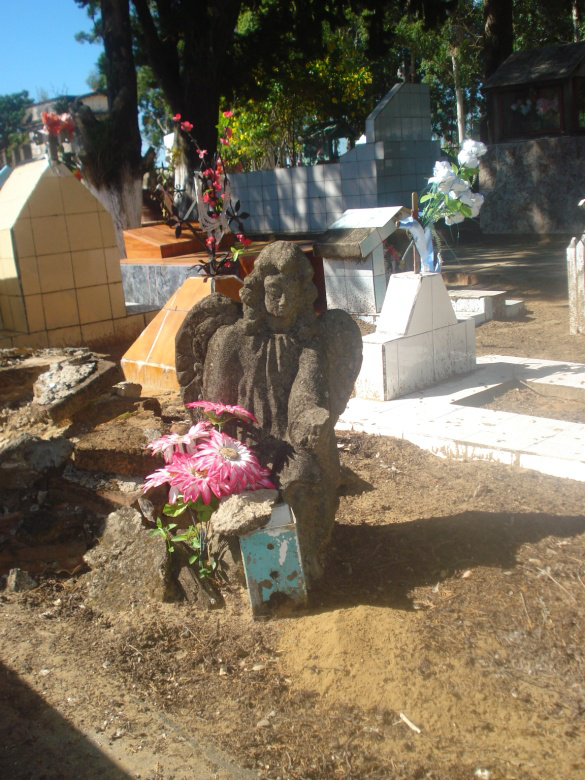
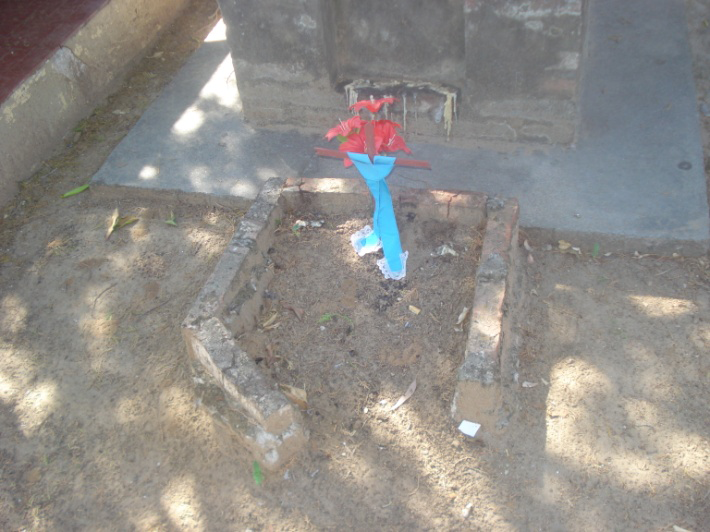
Figures 3 & 4: César, Iván Bondar [19].
There are some very left, and redepente (suddenly) appear painted or floral... it seems that people return to the village and visit... And no, it has not been known for a year of these families, they do not pay for maintenance, some of them are long gone, but the one always sees them (Man, 62, caretaker of a Municipal Cemetery, Corrientes).
We reaffirm our hypothesis of thanatosemiosis when considering these cases of re-activation of funerary memory. Instances where the tomb is consecrated as a sign and immersed in the complexity of the significant chains:
I always pray to him, he’s in my prayers... since his death, 30 years ago, I feel that he is with God, every 1 November I take everything of him (Woman, 58 years, Corrientes).
Reaffirming the need for the reactivation of readings around human emotions, we can affirm that we find tombs abundantly visited and others in abundant expectation of visit, some very named and others of which we know only at certain dates; some gray, moldy, stripped of the angelic color, small points that seem to disappear in the sandy funerary cartography and others overloaded with aromas, cloths, flowers and candles.
Angeles Somos. Northern Province of Corrientes.
If death occurs in a remote place, of those that still exist, where will they bury it? The best is the courtyard with a cross, with its cloth and flowers. Nor is the name mentioned (perhaps it did not get to have it) In the villages, as something folkloric, the traditional visit of the “Angels we are” is still customary, with its well-known quatrains. (Excerpt from the interview with Girala Yampey. Paraguayan folklorist. 2013) Angels We are, Angels We are, from heaven we come Alms we ask in the name of God Collation, collation, the blessing (Verses recited by children during the walk. 31 October or 1 November. Streams. Arg).
The practice of Angeles Somos can be approached taking into account the serenades made by young people and/or adults in the early morning of November 1° and the processions (walks) starring children in the evening hours of October 31, morning or afternoon of November 1°. In its serenade form it is led by young people and adults, accompanied by regional music (mainly chamamé) roam the houses of neighbors and in exchange for the serenades receive various donations: regional meals, other foods or drinks with alcohol.
In the version of the walks of children highlight significant differences of ritualization; although also the houses are visited the groups are composed of children accompanied by some adults, religious songs and Catholic symbols prevail (images of saints and rosaries). In exchange for visits and blessings they receive snacks (offerings) consisting of assorted treats, soft drinks and money. Both versions announce the arrival, thanks or repudiate the non- attendance with popular verses. After the tour is shared the accumulated between the different participants, usually dinner in the case of adults and snacks in the case of children.
Serenade and walk have as objective (re)to remember the angels, to bring prayer and blessings to the families that have deceased children and to expedite the transit of these souls towards the Third Heaven.
Nowadays this form of ritualization of funerary memory is spread throughout the province of Corrientes; a decade ago it was concentrated in the northern area. Its staging responds, basically, to two memorable movements. a. the direct-spontaneous initiative of the community of practitioners or b. Is headed by religious, educational and/or cultural institutions. We include in this reference to the capital of the province where there are public presentations called “White Nights” in opposition to the locally considered “Black Nights” of Halloween. The “White Nights” are characterized by being staged in public squares with the presence of numerous children dressed as angels walking the streets and asking for snacks. These forms of action are led by religious schools, congregations, NGOs, popular libraries, cultural centers, etc. (here we could not point out that these forms of (re)memoration result from the spontaneous expression of the groups, but are taken up as strategies of revalorization of the memories of the province and the region).
The records we present allow us to observe various instances and contexts of expression of practice: private homes, public roads, schools. Also the presence of subjects from different social contexts.
In the case of rural areas, unlike urban areas, participation in these instances of remembrance usually arises from the personalized organization of domestic groups with little intervention by other institutions. The most representative rural cases have been addressed in Loreto, San Miguel, Villa Olivari, Caa Catí and Itá Ibaté (for this presentation the records of Villa Olivari have been selected).
With regard to urban areas we take up the cases of the cities of Corrientes Capital, Ituzaingó, Mburucuya and Virasoro where the mediations of primary schools and the Catholic Church are those that allow the concretion of Ángeles Somos (in the case of urban areas, the Ituzaingó records shall be submitted).
It should be noted that the interventions of other institutions beyond families have been recorded in the case of children’s walks, but not in the serenades of young people and adults. The serenade continues to include instances of organization and staging independent of the influence of educational or religious institutions [3].
Points out that this practice comes from the belief that on the first of November the angels or infantile souls visit the houses of the villages. Because the majority of families, relatives or acquaintances have deceased children contribute to the validity of this demonstration.
We also wish to refer to the contributions of López Breard [11] and his local ordering of the practices described. He maintains that the Day of the Angels, inscribed in the Catholic sanctuary of the Gregorian calendar, has in the region -during November 1°- three special moments: the night serenade, the visit to the cemeteries (which extends during November 2) and the walks of Angels We are…during the day, the Angels are usually personified in children, who carrying a small cross of occasion, adorned with flowers of crepe paper, carey or natural, travel the neighborhood, presenting themselves in the houses to ask “a alms for the love of God (s/p).
With regard to the matrices that order the practice we maintain that this form of remembrance of small death results from complex processes of substitution and miscegenation between derivations of the European Mayal Festivals, the offerings of the luminaries made in Neuquén, the walks and sets of altar boys recorded by, the processions and representations of Corpus Christi described by Garay Díaz [20], the medieval processions of All Saints and the English celebration of the death of Guy Fawkes [21], all dimensions of complex transculturation processes. These aspects, framed in the Gregorian calendar, fulfilled an effective evangelizing function [22].
We do not intend to affirm an order between the temporalities of the practices defining which of them are older or more current, nor to point out Edenic states of germination. We are simply talking about temporary projections and refractions that have evidently taken back from secular practices a set of manifestations in order to generate liturgical strategies for evangelization and conversion. However, the dynamics of the collective memory are currently provoking a neo-secularizing process of manifestations that have been markedly liturgical.
While the geographical extension of the practice of Angels We Are coincides significantly with the expansion of Christianity in America, we believe that we cannot limit the germination of Angels We Are to the mere Christianization of “paganism”.
As we have explained, we consider Ángeles Somos (in the forms of serenade and walk) a resulting crossing, scaffolding, syncretism and resignification co-creative of culture, combining images of Christianity, local religious and secular senses, aspects of popular religiosity (as a general framework in which it is currently inscribed), perceptions about the living and the dead, evangelizing strategies, games and hilarity, ideological matrices (customary and idiosyncratic).
Thus, these culturally memorable ritualized forms, in their process of re-signification, have been updating -in a vertiginous (harmonious) movement to the future- aspects that are strongly intertwined with the ways of being-feeling and acting of the people. The discursive forms -entangled in their order- expose a complexity that overflows the margins of original evangelizing attempts: they have become weavers of memory, songs, meals, codes, secularized practices, dances, sayings.
The resignifying processes of life and death were delineating boundaries of senses, demarcating spaces of belongings and actions (pensable/projective). Serenade and walk participate of the significant dimensions exposed previously, reform the images of the mestizo network and polish new senses and relations with death, remembrance and coexistence. They delimit significant territories.
Possibly the distinction between serenade and walking is (complexely) the distinction between temporalities and meanings NIGHT - DAY / DARKNESS - LIGHT / ADULT - CHILD. Grounds where you can (or cannot) be-remain- perceive-feel. Spheres of concern, not only of age, but also of duties, functions and senses in the fabric of relations and communications of culture.
Day of the Child and/or Birthday of the Angel
Offering a special celebration to the little angel on the Day of the Child, whether it be a family celebration or to the little angels in general, is an experience that we have registered with validity in Paraguay. We believe that it is due not only to the re-memory of the regional image of the angel, but also to a historical event that has significantly marked Paraguayan society: the War of the Triple Alliance.
On August 16, 1869, in the framework of the Great War, a battle was fought: the Battle of Acosta Ñú or Campo Grande. In this war episode 3,500 children dressed as adults and with false beards, together with elderly and women, face the troops of Pedro II of Brazil. Children and their mothers are massacred and incinerated in the brush.
In commemoration of that bloody episode, August 16 was established as the Day of the Paraguayan Child, enabling many civic and religious celebrations. In the same way in the domestic/intimate spaces the angels are remembered, in case the family has a deceased child. The figure of the angel is not the only one present in this celebration, besides the other children who live near the apartment are summoned. Many families that do not hold this celebration on August 16 begin to star after the death of a son, grandson, godson or nephew.
This meeting is presided by an altar dedicated to the little angel, in the altar there are various toys, flowers, colored ribbons and a photograph of the child. On various occasions the altar is moved from the interior of the house and is “embellished” with new ribbons and flowers. We have already mentioned in previous sections references linked to this particular practice.
The hosts, mainly women, take care of the preparation not only of the altar, but also of the edibles that will be offered to the children who attend accompanied by their parents, cousins and older brothers. The center of the celebration is occupied by a long table where biscuits, chipa -many zoomorphic- are arranged, candies and a special cookie to which the informants have referred as “wake cookie”; in the form of animals accompanied by egg-shaped candies of various colors (whose trademark is “Fauna”). It is called “wake cookie” because it is usually present when you sail a body, it is easily accessible, comes in large bags and at low cost. It is accompanied with juices or milk chocolate.
We observed these memories on several occasions in Encarnación, Ayolas, Pilar, Villarica and Asunción. In some situations, mothers or grandmothers often travel to the cemetery and offer their little angel some cookies, chocolate and candies on the grave. An important case was that of Villarrica where a family celebrated the day of the child around the small tomb in the backyard of the house.
Similar scenarios are often observed in cases of celebration of the anniversary of the birth of the deceased child. These situations have been recorded in both Corrientes and Paraguay, in the same way in the town of Posadas, Misiones, Argentina mainly among descendants of Paraguayans or Paraguayan residents in some neighborhoods of the missionary capital. As we have mentioned before it is relevant how the angel is usually re-remembered on the day of his birth rather than the day of his death, the paradox is that -the case of some baby angels- these dates are usually coincident or keep a few days apart. We can observe how these situations place the subjects -mainly the mourners- in differential tempo-spatial states of consciousness. Thus, paraphrasing Durkheim (1968: 10), these states of consciousness are located on certain dates and affective values struggle from a common consciousness that grants the time of biophysical death the valence of continuity, the remembrance and celebration of the angel’s validity in Heaven.
Closing Remarks
We can see how the horizons of possibilities and fields of action on which we have inquired are highlighted as children’s grounds and adult grounds. These relational networks constitute agencies of social and cultural reproduction. Points out that “their products, and the resources used in them, take part, and party, of the institution of the world of common sense as a matrix of meaning”. In this way the valid and invalid, possible and impossible, conceivable or inconceivable, the false, the wrong or right, pure or impure are conjugated as mediating agencies between men and the worlds of actions.
The socializing, mobile, articulating and updating instances of memory generate and re-generate the definition of identity and its scaffolding with the world, relationships, needs, different discursive spheres.
The acceptance of the authority of the referring symbols embodies and proceeds from the very performance of the ritual that involves them, as we have pointed out, by provoking a series of moods and motivations and by defining an image of cosmic order through a series of symbols The moods and motivations generated by participation in the scenes (re). Memorabilia have an impact outside the limits of the rite itself, because they lend value to the individual’s conception of the established world [23].
These conceptions, narrated, imbrican following, community and memory: an exchange of experiences. The author emphasizes that the listener of a story actively participates in the community (narrated) of the narrators. This community of narrated experiences builds the inherited cultural footprints, is narrated by doing, is narrated by singing, is narrated by observing and learning from others, from the community where the codes of one’s own mean. Likewise, to retain what is narrated is possible by the conjunction of the forms to which we have referred. Chains of memories and stories regenerate in these chronotopic partialities the “recipes” of how to do and when to do (for the angels).
These chains of experiences are basically configured by a set of links that navigate between dissimilar dimensions constituted by the exchange of information, the conformation of the community, the orientation of collective interests on the life of culture and memory around angels.
The experiences collected condense the particularities of the Homo Narrans explained. Counting is shaped as a generator of community, counting socializes, regenerates and carries historicity, recalls useful memory instances according to each situation, describes an integrated and holistic perception of the memoryous; the narrative activity put into play -play- at this time “teaches” the relative ways of doing-saying-silent and believing.
Somehow the games of the funeral memory incorporate dissimilar ways of seeing, perceiving and acting before (and with) the manifestations of culture; in planes of the public and the private. Domestic spaces become “exemplars” for the transmission and updating of memory. Concentric spirals traversed transversely by diverse chronotopies [24, 25, 26, 27, 28, 29, 30].
References
-
Coluccio F (1954) Diccionario del Folklore Americano (Contribución), Tomo I A-D. Buenos Aires: El Ateneo Editorial.
-
Coluccio F (1990) Diccionario de Creencias y Supersticiones, Argentinas y americanas. Corregidor, Ediciones Culturales.
-
Coluccio F (1995) Fiestas y Celebraciones de La República Argentina. Argentina: Ed Plus Ultra.
-
Bajtín M (1989) Las formas del tiempo y del cronotopo en la novela, Ensayos de poética histórica (Ed.): Teoría y Estética de la Novela. Madrid, Taurus.
-
Lotman Y (1996) La semiósfera I Semiótica de la cultura y del texto. Ed. Madrid, Cátedra.
-
Candau J (2002) Antropología de la memoria, Buenos Aires. Nueva Visión.
-
Candau J (2001) Memoria e Identidad, Buenos Aires. Ediciones del Sol.
-
Ambrosetti JB (1947) Supersticiones y leyendas, región misionera, valles Calchaquíes, las pampas. Ed. Lautaro. Buenos Aires.
-
Breard L, Raúl M (1983) Devocionario Guaraní. Santa Fe: Colmegna.
-
Breard L, Raúl M (2004) Diccionario Folklórico Guaranítico. Corrientes: Ed. Moglia.
-
Breard L, Raúl M (2011) Celebraciones del día de los Ángeles en la Región Guaranítica. Trabajo presentado en el Primer Congreso de Cultura Popular, Lenguajes y Folklore. Octubre, Ituzaingó. Corrientes. Argentina.
-
Cortazar AR (1959) “Usos y Costumbres”, En: José Imbelloni. Folklore Argentino. Nova, Bs As. pp: 158-196.
-
Alberto AS (2004) Creencias y Espacios Religiosos del NEA. Buenos Aires, (Ed.) Cooperativa Chilavert Artes Gráficas.
-
David OG (2012) “La Muerte en la cultura popular Paraguaya”, Conferencia II Encuentro de Antroposemiótica de la muerte y el morir. Facultad de Humanidades y Ciencias Sociales. Universidad Nacional de Misiones. Posadas, Misiones, Argentina, 18 y 19 de octubre.
-
Dionisio TG (2012) Folklore del Paraguay. Asunción, Paraguay: Servi Libro.
-
Fernando N (1904) Historia de las Creencias. Supersticiones, usos y costumbres. Tomo segundo. Montaner y Simón Editores. Barcelona (España).
-
Sáinz H, Luis de-Sancho, Hoyos ND (1947) Manual de Folklore. La vida popular tradicional. Manuales de la Revista de Occidente.
-
Morin E (1970) L´Homme et la Mort devant l´histoire. (Ed.) Du Seuilb, Paris.
-
Bondar CI (2012) (Ed.) La muerte (re)memorada: Lecturas Antropo-Semióticas sobre la (re)memoración de los niños difuntos. Villa Olivari, Corrientes, Argentina. Alemania: Editorial Académica Española.
-
Díaz G, Narciso E (1999) Tradiciones y Cantares de Panamá. Panamá.
-
Tuleja T (1993) Costumbres Curiosas. Bogotá: Voluntad.
-
Iván CB (2010) Ñane Mandu´a: sobre ritos y fiestas. N 1. Posadas: Ed. Universitaria (UNaM).
-
Geertz C (1995) La interpretación de las culturas. Barcelona: Gedisa.
-
Julio BC (1972) Superstición y Ciencia. Colección Ensayos. Fundación Juan March (Madrid).
-
James FG (2012) La Rama Dorada. Madrid. FCE.
-
Marcelino G (2004) Narración-Semiosis y Memoria. Posadas: Ed. Universitaria (UNaM).
-
Nieves SH (1962) “Costumbres funerarias y culto a los muertos en tierras de Don Quijote”. En: Cuadernos del Instituto Nacional de Investigaciones folklóricas. Ediciones Culturales Argentina. Buenos Aires.
-
Paul R (2004) La memoria, la historia, el olvido. Buenos Aires FCE.
-
Paul R (2008) Vivo hasta la muerte, seguido de fragmentos. Buenos Aires FCE.
-
Turner V (1999) La selva de los símbolos. Madrid, Siglo Veintiuno.
- The Indispensable Role of Informal Caregivers in Supporting the Aging Population
- Socio-Religious Significance of Kamakhya Temple in Guwahati, Assam
- Is Anthropology Possible?
- A Contribution to the History and Paleobiology of Harput/Elazığ Türkiye and Its Surroundings
- A Study on the Cowrie Shells of the Dimasas in Assam
- The Significance of International Organizations Cooperation in the Efficient Resolution of Global Conflict