
Effects of Sonchus asper Extract on Diabetes-induced Learning and Memory Impairment in Rats
Cognitive impairment occurs in diabetes mellitus. Sonchus asper has been used in folk medicine to improve mental performance. Here it is hypothesized that chronic treatment with an extract of Sonchus asper (6, 12 and 25 mg/kg, p.o.) would have effects on passive avoidance learning (PAL) and memory in control and streptozotocin-induced diabetic rats. Treatments were begun at the onset of hyperglycaemia. PAL was assessed 30 days later. A retention test was done 24 h after training. At the end, the animals were weighed and blood samples were drawn for plasma glucose measurement. Diabetes caused impairment in acquisition and retrieval processes of PAL and memory. Sonchus asper treatment (12 and 25 mg/kg) improved learning and memory in control rats and reversed learning and memory deficits in diabetic rats. A dose of 6 mg/kg did not affect cognitive function. Sonchus asper administration did not alter the body weight and plasma glucose levels. These results show that Sonchus asper prevented the deleterious effects of diabetes on PAL and memory. As Sonchus asper would be free of major side effects compared with other nootropic medications, it may provide a new potential alternative for demented diabetic patients.
Introduction
Diabetes mellitus, one of the most serious health problems in the world, is associated with neurological complications in both the peripheral and central nervous system [1]. Evidence indicates that diabetes causes learning and memory deficits [2]. In fact, moderate impairment of learning and memory has been observed in adults with diabetes [3]. Cognitive impairment has been also reported to occur in streptozotocin-induced diabetes as a well-characterized experimental model for type I diabetes mellitus [4]. Treatment of diabetes mellitus and its complications in the recent context has focused on the usage of plant extracts. The WHO has estimated that approximately 80% of the Earth’s inhabitants rely on traditional medicine for their primary health care needs, and most of this therapy involves the use of plant extracts [5]. Sonchus asper (Sa) is one of the most important medicinal plants that belong to Asteraceae family. It can be used as a supplementary drug for colds, and tonsil pain, as well as treating burns, and anemia [6, 7]. Also, it can be used in treating various other diseases as well like stomach disorders, skin sores and intestine disease [8]. Kidney, liver problems, and impotency are one of the plants known for its use in treating asthma, digestive system infections, and heart diseases [9]. There are phytochemical compounds in the plant, such as flavonoids, carotenoids, sesquiterpenes, and phenolic compounds [10]. One of major constituents that exist in this plant is apigenin-7-glucoside (Ap7G) that belongs to flavonoids [11, 12]. Recently, we are demonstrated the analgesic activity of Sa in mice [13]. In light of these reports, this study examined whether doses of Sonchus asper extract could protect against learning and memory deficits in diabetic rats. Therefore, the aim of this study was to evaluate the effects of long- term administration of Sonchus asper (6, 12 and 25 mg/kg, p.o.) on passive avoidance learning (PAL) and memory performance in healthy and diabetic rats.
Materials and Methods
Animals
Fifty six locally produced male Wistar rats (250–280 g, 3–4 months old) were used in the present experiments. All animals were maintained at a constant temperature (22 0.5 C) with 12 h light: 12 h dark cycle. They had free access to laboratory chow and tap water. Each experimental group consisted of seven animals that were chosen randomly from different cages and each was used only once [14].
Chemicals
Streptozotocin (STZ) was obtained from Pharmacia & Upjohn (USA) and dissolved in 1 mL normal saline immediately before use and ketamine HCl was obtained from Rotexmedica (Trittau, Germany). The extract was prepared according to the method explained in previously published studies (Feily and Abbasi, 2009; Khalifa, 2001). Briefly, the plant (Sonchus asper) was grown in Hamadan province and was harvested in August. After collection, overground parts (leaves, flowers and stem) of the plant were dried at room temperature and their voucher specimens are kept at the Herbarium of the Faculty of Pharmacy, Hamadan University. Five grams of semicrushed plant materials was boiled in distilled water for 15 min. Following filtration and removal of water by lyophilization, dry extracts were obtained. Sonchus asper extract was dissolved in saline with the help of an ultrasound vortex and was fed to rats orally in doses of 6, 12 and 25 mg/kg, once a day for 30 consecutive days.
Experimental Design
The animals were divided into eight equal groups (n = 7); four diabetic and four control groups. Diabetes was induced by a single i.p. injection of STZ (60 mg/kg). Three days later, fasting blood glucose levels were determined. Animals were considered diabetic if plasma glucose levels exceeded 250 mg/dL. As soon as diabetes was confirmed, the diabetic groups received saline or 6, 12 and 25 mg/kg of the extract orally using a gavage needle for 30 days. The control groups received saline or the extract at the same doses as the diabetic groups orally using a gavage needle for 30 days. After the treatment period, learning and memory of the different animal groups were tested by a standard experimental paradigm of learning and memory. At the end of the experiment, all rats were weighed and underwent sampling for plasma glucose measurement. The operator was unaware of the specific treatment group to which an animal belonged. All research and animal care procedures were approved by the Ethics Committee of Islamic Azad University, Tehran and were performed in accordance with the National Institutes of Health Guide for Care and Use of Laboratory Animals (NIH Publication no. 85-23, revised 1985).
Passive Avoidance Learning (PAL) Test (Step- Through Test)
The apparatus and procedure was basically the same as in previous studies [15]. Briefly, the step-through passive avoidance apparatus consisted of a lighted chamber (20 cm x 20 cm x 30 cm) made of transparent plastic and a dark chamber whose walls were made of dark opaque plastic. The floor of both chambers was made of stainless steel rods (3 mm diameter) spaced 1 cm apart. The floor of the dark chamber could be electrified using a shock generator. A rectangular opening (6 cm x 8 cm) was located between the two chambers and could be closed by an opaque guillotine door.
Training
First, all experimental groups were given two trials to habituate them to the apparatus. For these trials, the rats were placed in a lighted compartment of the apparatus facing away from the door and 5 s later the guillotine door was raised. The rat has native preference to the dark environment. Upon the rat entering the dark compartment, the door was closed and after 30 s the rats were taken from the dark compartment into their home cage. The habituation trial was repeated after 30 min and followed after the same interval by the first acquisition trial. The entrance latency to the dark compartment (step- through latency, STLa) was recorded when the animal had placed all four paws in the dark compartment. After the animal had spontaneously entered the dark compartment, the guillotine door was lowered and a mild electrical shock (0.5 mA) was applied for 3 s. After 30 s, the rat was taken from the dark compartment to the home cage. Then after 2 min, the procedure was repeated. The rat received a footshock each time it reentered the dark and had placed all four paws in the dark compartment. Training was terminated when the rat remained in the light compartment for 120 consecutive seconds. The number of trials (entries into the dark chamber) was recorded.
Retention Test
The retention test was performed 24 h after the PAL acquisition trial. The rat was placed in the lighted chamber as in PAL training and 5 s later, the guillotine door was raised, and the step-through latency (STLr) and the time spent in the dark compartment (TDC) were recorded up to 300 s. If the rat did not enter the dark compartment within 300 s, the retention test was terminated and a ceiling score of 300 s was assigned.
Measurement of Plasma Glucose Levels
At the end of the experiment, all rats were decapitated under ketamine HCl anaesthesia (50 mg/kg, i.p.) and blood samples were drawn. Plasma glucose levels were measured using the kit (through enzymatic ‘glucose oxidase’) (Zistshimi, Tehran, Iran) and a spectrophotometer (UV3100, Shimadzu, Tokyo, Japan).
Statistical Analysis
All data are expressed as mean SEM. Differences among groups were statistically tested by one-way analysis of variance (ANOVA) with Tukey as a post hoc test. Spearman correlation coeffi- cients were calculated to explore the relationship between plasma glucose levels and memory performance in the diabetic and control groups. Correlation analyses were carried out by SPSS (Version.11). Probability values less than 0.05 were considered significant.
Results
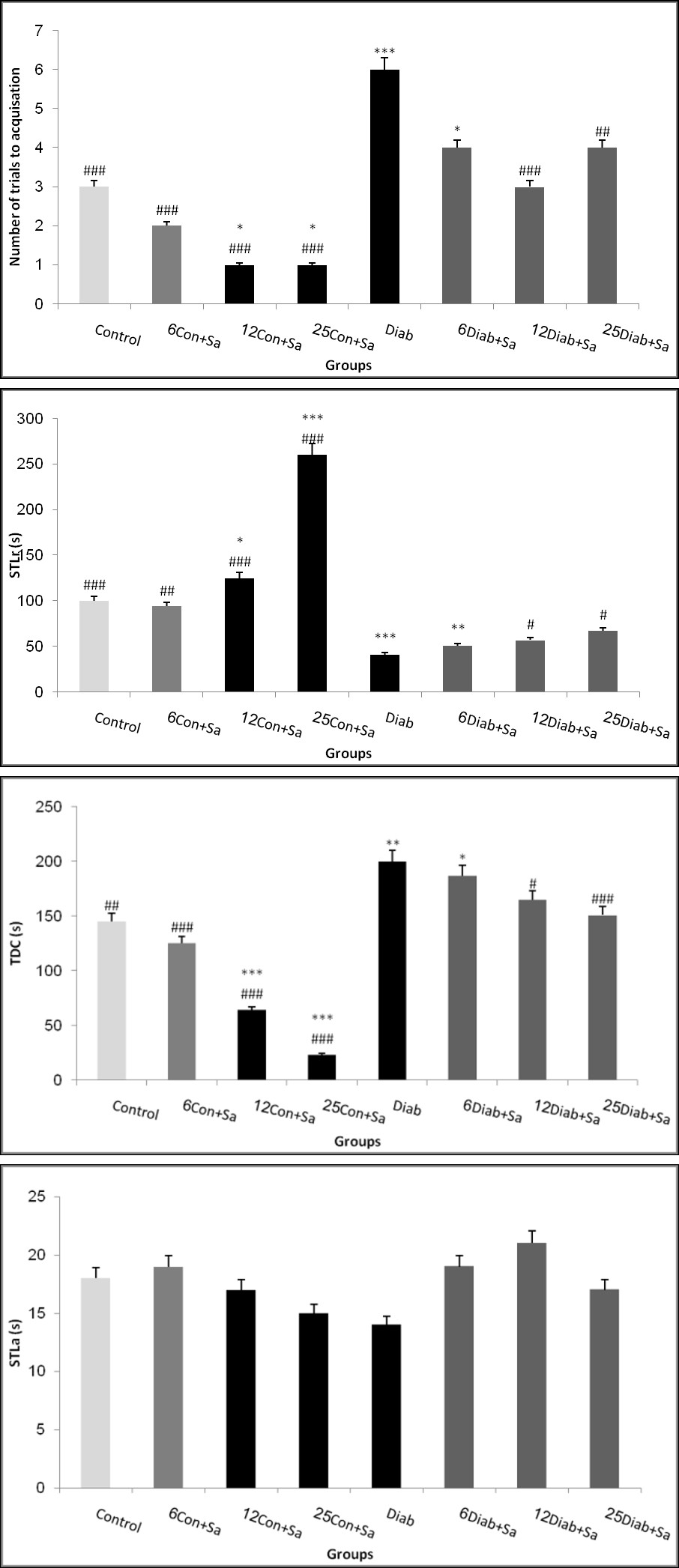
There was no significant difference in the STLa among the diabetic and control groups in the first acquisition trial (before receiving the electrical shock) (p > 0.05, Figure 1A).There was a significant difference (p < 0.001) in the number of trials to acquisition between the diabetic group (5.28±0.28) and the control group (2.71±0.2) (Figure 1B). In the retention test, the diabetic group had a decreased STLr (45.42±6.53) and an increased TDC (194±17.27) compared with the control group (99.1 ±7.7, 135.5±6.36, respectively) (p < 0.001, p < 0.01) (Figures 1C & 1D). One-way ANOVA indicated that there was no significant difference in the STLa of the first acquisition trial between the groups (p > 0.05, Figure 1A). Sonchus asper (6 mg/kg) administration to control rats did not have a significant effect on the number of trials to acquisition, STLr and TDC (Figures 1B-D).The number of trials to acquisition of 12 and 25 mg/kg Sonchus asper treated control groups was less than the untreated control group (p < 0.05, p < 0.05, respectively) (Figure 1B). However, there was no difference between the acquisition trials of the former two groups. In the retention test, Sonchus asper (12 and 25 mg/kg) administration to control rats caused an increased STLr (138.14±11.25, 264.42±14.95, respectively) compared with the untreated control rats (99.1±7.7, respectively) (p < 0.05, p < 0.001, respectively) (Figure 1C). The TDC of 12 and 25 mg/kg extract treated control groups (66.28 ±4.38, 24.5 7.4) was significantly less than the untreated controls (135.5±6.36) (p < 0.001, p < 0.001, respectively) (Figure 1D). In addition, there was a significant difference in the STLr and TDC between the 12 and 25 mg/kg Sonchus asper treated control rats (p < 0.001, p < 0.05, respectively) (Figure 1C, 1D). In the diabetic groups, administration of Sonchus asper (6 mg/kg) did not significantly alter the number of trials to acquisition, STLr and TDC compared with the untreated diabetic group (Figures 1B-D). However, administration of 12 and 25 mg/kg Sonchus asper to diabetic animals produced a significant difference in the number of trials (p < 0.001, p < 0.01, respectively), STLr (p < 0.05, p < 0.05, respectively) and TDC (p < 0.05, p < 0.001, respectively) than in the untreated diabetic animals (Figures 1B-D). There was no significant difference between the extract treated diabetics and untreated controls in these parameters (Figures 1B-D). The Spearman’s correlation analysis was applied to assess the relationship between the Full-size table blood glucose levels and STLr. Spearman correlation coefficients in the control and diabetic groups are r = 0.064 (p > 0.05) and r = -0.36 (p < 0.05), respectively. However, there was no significance difference in correlation coefficients between the control and diabetic groups (p = 0.113) (Data not shown). The body weight and blood glucose levels of different animal groups at the beginning and at the end of the experiment are shown in Table 1. There was no significant difference in body weight or plasma glucose between any groups before the onset of diabetes. Body weight and plasma glucose level were measured at the end of behavioral assays (30 days after the onset of hyperglycemia). At the end of assays, the body weight of the untreated (213 ±9) and Sonchus asper (6, 12 and 25 mg/kg) treated diabetic rats (207±3, 210±7, 205±4, respectively) were significantly (p < 0.001, p < 0.001, p < 0.001, p < 0.001, respectively) lower than the control rats (311±5). Furthermore, there was no significant difference in the body weight of extract (6, 12 and 25 mg/kg) treated and untreated control animals. Regarding the plasma glucose level, untreated diabetic animals had significantly (p < 0.001) elevated plasma glucose levels (386.32 14.37 mg/dL) compared with the control animals (82.85±5.54 mg/dL). Although administration of Sonchus asper (6 mg/kg) did not affect the plasma glucose of diabetic rats, 12 and 25 mg/kg doses of Sonchus asper caused a minor, but not significant, decrease in plasma glucose levels of diabetic groups (353.9±17 mg/dL, 335.2±18.2 mg/dL, respectively) compared with the untreated diabetic group (386.32±14.3 mg/dL). However, there was still a significant difference in plasma glucose levels between the 12 and 25 mg/kg extract treated diabetic animals and untreated control animals (p < 0.001, p < 0.001, respectively) (Table 1).
(a)
(b)
(c)
(d)
Figure 1: Effects of long-term administration of Sonchus asper (Sa) extract on the PAL test. The effect of long-term oral administration of extract with doses of 6, 12, and 25 mg/kg on the step-through latency (STLa) in the first acquisition trial (a), the number of trials to acquisition (b), step-through latency (STLr) in the retention test (c) and the time spent in the dark compartment in the retention test (TDC) (d) between different control (Cont) and diabetic (Diab) groups (n = 7). *p < 0.05, p < 0.01 and *p < 0.001 compared with the control group. #p < 0.05, ##p < 0.01 and ###p <
0.001 compared with the diabetic group. Each column and bar represents mean SEM.
| Body weight | Plasma glucose (mg/dL) | |||||||||||||
|---|---|---|---|---|---|---|---|---|---|---|---|---|---|---|
| Group | ||||||||||||||
| Beginning | End | Beginning | End | |||||||||||
| Control | 272±4 | 311±6 | 68.4±3.6 | 82.8±5.5 | ||||||||||
| Cont + Sa 6 (mg/kg) | 265±2 | 309±1 | 78.4±4.5 | 81.4±6.9 | ||||||||||
| Cont + Sa 12 (mg/kg) | 273±8 | 320±2 | 79.8±6.6 | 86.7±5.3 | ||||||||||
| Cont + Sa 25 (mg/kg) | 267±3 | 312±5 | 83.2±5.8 | 83.5±5.8 | ||||||||||
| Diab (mg/kg) | 271±1 | 213±3a | 90±6.2 | 386.3±14.3a | ||||||||||
| Diab + Sa 6 (mg/kg) | 269±5 | 207±8a | 87.8.4±7.1 | 403.4±11.8a | ||||||||||
| Diab + Sa 12 (mg/kg) | 268±4 | 210±5a | 86.8.4±9.1 | 353.9±17a | ||||||||||
| Diab + Sa 25 (mg/kg) | 266±2 | 205±7a | 70.5±6.1 | 335.2±18.2a |
Table 1: Body weight and plasma glucose level of control, control treated _Sonchus asper_ (Sa) (6 mg/kg) (Cont + Sa 6), control t
Table 1: Body weight and plasma glucose level of control, control treated Sonchus asper (Sa) (6 mg/kg) (Cont + Sa 6), control treated Sonchus asper (Sa) (12 mg/kg) (Cont + Sa 12), control treated Sonchus asper (Sa) (25 mg/kg) (Cont + Sa 25), Diabetic (Diab), diabetic treated Sonchus asper (Sa) (6 mg/kg) (Diab + Sa 6), diabetic treated Sonchus asper (Sa) (12 mg/kg) (Diab + Sa12) and diabetic treated Sonchus asper (Sa) (25 mg/kg) (Diab + Sa25) at the beginning and end of the intervention. A Significant difference compared with control group (p < 0.001, ANOVA, Tukey’s test for post-hoc comparisons).
Discussion
The principal findings of this study are two-fold. First, treatment with Sonchus asper (12 and 25 mg/kg) for 30 days improved PAL and memory of control rats. Second, such treatment for 30 days from the onset of diabetes alleviated the negative influence of diabetes on learning and memory. The decrease in the number of trials to acquisition in the PAL task is evidence of an improvement in acquisition. The increase in STLr and decrease in TDC during the retention test demonstrates facilitatory effects on memory retention (4). Our present result showing a significant improvement of rat cognition function by Sonchus asper using the PAL task is consistent with some previous published studies. For example, Sonchus asper was previously shown to induce an enhancement of retrieval memory of a conditioned avoidance response paradigm in mice and in rats In the retention test, STLr was decreased and TDC was increased, which represents memory retention deficits induced by diabetes. Learning and memory deficits induced by diabetes mellitus have been reported previously in animals and humans [4, 16]. Our current experiments expand on these reports and demonstrate the potential of Sonchus asper to protect against memory impairment effects of diabetes. The results are quite promising. Administration of Sonchus asper clearly prevented the deficits of cognitive functions caused by diabetes. Indeed, Sonchus asper administration (12 and 25 mg/kg) to diabetic animals reversed the increased number of trials to acquisition, showing the preventive effect of the treatment on acquisition deficits.
In the retention trial, the decreased STLr and increased TDC of diabetic rats were also reversed by Sonchus asper treatment. Interestingly, it has been reported that low doses of the Sonchus asper extract (4, 8, 12 and 25 mg/kg, p.o.) demonstrate antioxidant properties by protecting rat brain from elevated oxidative status in the model of scopolamine-induced amnesia [17]. As oxidative stress is thought to play a crucial role in the development of memory impairment in diabetes mellitus [18], antioxidant properties of the low doses of the extract may be responsible for the observed memory enhancing effects. Furthermore, diminished cholinergic transmission due to a decrease in central acetylcholine level may be associated with cognition deficits induced by streptozotocin in rats [19]. As central cholinergic pathways play a prominent role in learning and memory processes, the Sonchus asper-induced increase in cortical muscarinic acetylcholine receptor capacity [19, 20] may be involved in the nootropic effects of Sonchus asper in control and diabetic animals. Although Sonchus asper is one of the most widely used herbal medicines in Western countries and it has been used for centuries as a neuroprotective drug [21], there is also evidence of undesirable effects of this herbal medicine. The clearly most relevant safety issue with Sonchus asper extracts is interaction [22]. Furthermore, it has been shown recently that Sonchus asper extract inhibited adipogenesis and insulin sensitive glucose uptake in fat cells [17]. These inhibitory effects can be a causative factor in the development of insulin resistance [23]. Our recent in vivo study showed that the extract treatment for 30 days did not alter plasma glucose levels of the diabetic rats. Induction of insulin resistance in fat tissues of treated diabetic animals may be involved in the observed effects. Furthermore, there was no significance difference in correlation coefficients between the control and diabetic groups. Accordingly, the memory enhancing effect of Sonchus asper in diabetes may not be related to changing plasma glucose levels. There have been no reported effects of Sonchus asper on motor function in doses equal to or greater than those used in this study [24]. In addition, as STLa in the first acquisition trial was not different between the animal groups and no abnormal motor behavioral responses were observed during the experiments, the nootropic properties of Sonchus asper may not be attributed to possible effects on locomotion [25].
Conclusion
This study demonstrates the potential of Sonchus asper to protect against memory impairment effects of diabetes in rats. Therefore, Sonchus asper may be considered as a new potential alternative for demented diabetic patients after confirmation with clinical trials.
Conflict of interest statement
The authors have no conflict of interest to declare.
Acknowledgments
The authors would like to express their gratitude to the staff of the Islamic Azad University of Tehran for helping us to carry out this project.
References
-
Luchsinger JA, Ma Y, Christophi CA, Florez H, Golden SH, et al. (2017) Metformin, Lifestyle Intervention, and Cognition in the Diabetes Prevention Program Outcomes Study. Diabetes care 40(7): 958-965.
-
Riederer P, Korczyn AD, Ali SS, Bajenaru O, Choi MS, et al. (2017) The diabetic brain and cognition. J Neural Transm (Vienna) 124(11): 1431-1454.
-
Umemura T, Kawamura T, Hotta N (2017) Pathogenesis and neuroimaging of cerebral large and small vessel disease in type 2 diabetes: a possible link between cerebral and retinal microvascular abnormalities. J diabetes investig 8(2): 134-148.
-
Baydas G, Nedzvetskii VS, Nerush PA, Kirichenko SV, Yoldas T (2003) Altered expression of NCAM in hippocampus and cortex may underlie memory and learning deficits in rats with streptozotocin-induced diabetes mellitus. Life sci 73(15): 1907-1916.
-
Li W, Zheng H, Bukuru J, De Kimpe N (2004) Natural medicines used in the traditional Chinese medical system for therapy of diabetes mellitus. J ethnopharmacol 92(1): 1-21.
-
Zargari A (1995) Medicinal plants: Tehrari University Publications, ISBN.
-
Neamatian MA, Yaghmaei P, Mohammadi S (2017) Assessment of the antinociceptive, antiinflammatory and acute toxicity effects of Ducrosia anethifolia essential oil in mice. Scientific Journal of Kurdistan University of Medical Sciences 22(3): 74-84.
-
Koche D, Shirsat R, Imran M, Zingare A, Donode K (2008) Ethnobotanical and Etnnomedicinal Survey of Nagzira Wild Life Sanctuary, District Gondia (MS) India-Part I. Ethnobotanical Leaflets 12: 56-69.
-
Sabeen M, Ahmad SS (2009) Exploring the folk medicinal flora of Abbotabad city, Pakistan. Ethnobotanical Leaflets 13: 810-833.
-
Hussain J, Muhammad Z, Ullah R, Khan FU, Ullah I, et al. (2010) Evaluation of the chemical composition of Sonchus eruca and _Sonchus asper_. J Am Sci 6(9): 231- 235.
-
Balasundram N, Sundram K, Samman S (2006) Phenolic compounds in plants and agri-industrial by- products: Antioxidant activity, occurrence, and potential uses. Food chemistry. 99(1): 191-203.
-
Golshani Y, Mohammadi S (2017) Antinociceptive and Acute Toxicity Effects of Erigeron acer L. In Adult Male Rats. Journal of Medicinal Plants 2(62): 85-93.
-
Zarei M, Shahidi S, Fallahzadeh AR (2017) Effects of _Sonchus_ _asper_ and apigenin-7-glucoside on nociceptive behaviors in mice. Journal of Pharmacy & Pharmacognosy Research 5(4): 217-227.
-
Mohammadi S, Zarei M, Zarei MM, Salehi I (2016) Effect of Hydroalcoholic Leaves Extract of Rhus Coriaria on Pain in Male Rats. Anesthesiology and pain medicine 6(1).
-
Ardeshiri MR, Hosseinmardi N, Akbari E (2017) The effect of orexin 1 and orexin 2 receptors antagonisms in the basolateral amygdala on memory processing in a passive avoidance task. Physiol Behav 174: 42-48.
-
Golshani Y, Mohammadi S (2015) Evaluation of antinociceptive effect of methanolic extract of Lallemantia iberica in adult male rats. Armaghane danesh 19(12): 1058-1068.
-
Khan R (2017) Antidiabetic, Antioxidant, and Hypolipidemic Potential of _Sonchus asper_ Hill. Altern Ther Health Med 23(5): 34-40.
-
Kucukatay V, Ağar A, Gumuslu S, Yargiçoğlu P (2007) Effect of sulfur dioxide on active and passive avoidance in experimental diabetes mellitus: relation to oxidant stress and antioxidant enzymes. Int J Neurosci 117(8): 1091-1107.
-
Tiwari V, Kuhad A, Bishnoi M, Chopra K (2009) Chronic treatment with tocotrienol, an isoform of vitamin E, prevents intracerebroventricular streptozotocin-induced cognitive impairment and oxidative–nitrosative stress in rats. Pharmacol Biochem Behav 93(2):183-189.
-
Mohammadi S, Zarei M, Mahmoodi M, Zarei MM, Nematian MA (2015) In Vivo Antinociceptive Effects of Persian Shallot (Allium hirtifolium) in Male Rat. Avicenna Journal of Neuro Psych Physiology 2(1): 1.
-
Ryan E, Pick M, Marceau C (2001) Use of alternative medicines in diabetes mellitus. Diabet Med 18(3): 242-245.
-
Zarei M, Mohammadi S, Abolhassani N, Nematian MA (2015) The Antinociceptive Effects of Hydroalcoholic Extract of Bryonia dioica in Male Rats. Avicenna Journal of Neuro Psych Physiology 2(1).
-
Wang MY, Grayburn P, Chen S, Ravazzola M, Orci L, et al. (2008) Adipogenic capacity and the susceptibility to type 2 diabetes and metabolic syndrome. Proc Natl Acad Sci USA 105(16): 6139-6144.
-
Khan RA, Khan MR, Sahreen S (2012) Brain antioxidant markers, cognitive performance and acetylcholinesterase activity of rats: efficiency of _Sonchus asper_. Behav Brain funct 8(1): 21.
-
Fallahzadeh AR, Zarei M, Mohammadi S (2016) Preliminary Phytochemical Screening, Analgesic and Anti-inflammatory effect of Eryngium pyramidale Boiss & Husson Essential Oil in Male Rat. Entomology and Applied Science Letters 3(5):140-147.
- Gallic and Citric Acid Present in the Peels of Tropical Fruits as an Alternative in the Fight against Cancer
- Treating the Forehead Lines with Combination of Forehead and Glabellar Botulinum Toxin Among Japanese Patients
- Clinical Evaluation of Patients Suffering from Breast Cancer & Determination of Treatment Therapies and Better Strategies Related to Breast Cancer
- Medieval Recipes by Al-Zahrāwī for Heart Palpitations Treatment
- Etiology and Prescription Errors of Myocardial Infarction in Different Health Care Systems of Azad Kashmir
- Early Diagnosis and Multidisciplinary Management of Turner Syndrome: A Paediatric Case Study