
The Knowledge Triangle for Food Innovation by Harnessing the Tradition and Assuring Sustainability KNOWinFOOD Project as a Tool to Educate Students to Obtain Innovative Products Incorporating Bioactive Compounds
Cecilia Georgescu*, Monica Mironescu and Ion Dan Mironescu
Opinion
As a result of the paradigm shifts in the jobs market of the future, the European education system should reinvent itself in order to foster innovation and to change focus to skill-based learning. One possible way is to combine the use of the digital and online media with the practical work to form the skills required by the digital factory of the future. Another challenge for Europe is to enhance the industrial innovation by tightly coupling the three components of the Knowledge Triangle: the HIGH EDUCATION as knowledge producer, the academic RESEARCH as creativity source, and BUSINESS, with its entrepreneurial spirit. Europe is also facing the loss of its cultural and material identity, inclusive the culture of traditional foods and the endangerment of sustainable food resources.
The Erasmus+ project "Knowledge triangle for food innovation by harnessing the tradition and assuring sustainability" KNOWinFOOD is offering a solution for these three challenges. The project aims to bring together students' education and industrial innovation in a collaborative environment. The environment stimulates and guides a process of innovative food developments which capitalizes tradition and envisages sustainability, in order to trigger more innovation and general development.
The” Knowledge Triangle for Food Innovation by Harnessing the Tradition and Assuring Sustainability” KNOWinFOOD Project as a Tool to Educate Students to Obtain Innovative Products Incorporating Bioactive Compounds Opinion In order to achieve this aim, the objectives of the KNOWinFOOD project were:
- For HE: to design an innovative and attractive educational approach for students in order to increase their participation and develop their innovation skills in food design.
- For RESEARCH: to systematize the knowledge in the fields of traditional foods, sustainable resources and innovative food ingredients and technologies so that it can be used to support the innovative process of functional food development and to ensure the personalized nutrition.
- For BUSINESS: to recruit and train students in an efficient way as future employees.
Four universities from four countries participated in the project: The Lucian Blaga University of Sibiu, Romania; the Claude Bernard University of Lyon, France; the University of Food Technology in Plovdiv, Bulgaria; the University of Debrecen, Hungary, together with an industrial partner, namely Solina Romania. Industrial collaborators were also involved in the project.
The main need solved by the project is those for new educational approaches by creating a flexible and computer-based collaborative environment, allowing the active implication of all KT components, together with Adv Pharmacol Clin Trials
students. To solve this need, in the first part of the project, instruments were developed: the web platform allowing access to Knowledge Bases (KB): KB-T with tasks/interest point; KB-TP with Traditional Products; KB-SRP with Sustainable Resources and Processes; KB-IPI with Innovative Processes and Ingredients; On-line training material TM.
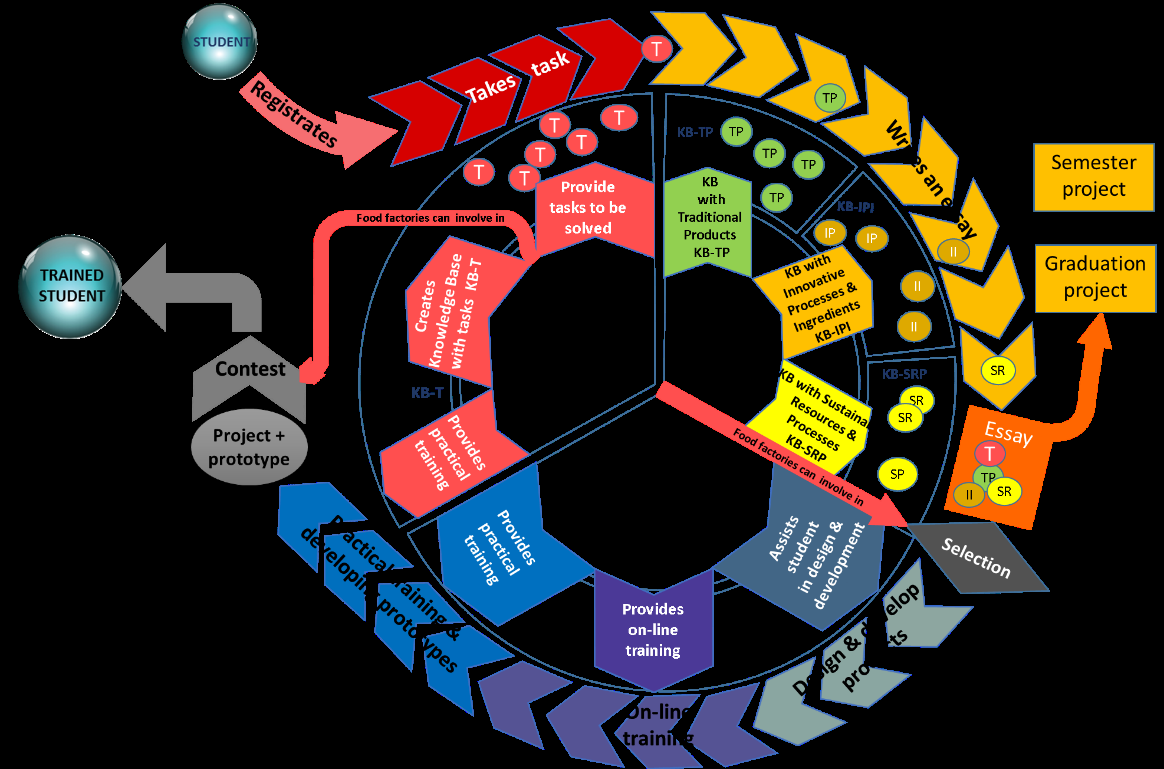
Working methodology with students was based half on the theoretical activity on the web platform half on practical work in a factory. The students were supported to design and develop an innovative product which should be sustainable and safe, starting from a traditional one, from idea to the real final product, as follows:- Student prepared a proposal by selecting a task from KB- T, then choosing a set of eligible TPs. The student had the possibility to choose from a set of IPIs based on the suitability (from KB-SRP) to the proposed TPs. The student wrote a short essay related to the idea of solving the task. His/her professional resume was automatically added. The research team reviewed the essay and approved or rejects it. The approved proposal was marked in KB-T. Industry supervised the offers and expressed the level of participation, from only rating of the product when the prototype was finalised to an internship and/or full development support; - Students with approved essays were accepted to participate in the training. They were divided into international teams, each team with one student from each participating country, with the aim to stimulate the students to speak English. One or two trainers were assigned to each team, to facilitate their work. A task from industry was assigned to each team, meaning an innovative product which starts from a traditional one and which has to incorporate sustainable resources and/or be based on sustainable processes.
The training had two parts: part one was theoretical and part two was practical. In the first part, students participated to online courses on the web platform and were assessed (formative and summative); students and trainers started the process of designing the product assigned as tasks. During the second part of the training, students and trainers met and worked together in a food factory to develop a prototype for solving the task. They documented the research so that at the end an essay was written. The resulted product as a prototype was judged by a commission formed by members of all three components of the knowledge triangle:
- Industry appreciated sustainability and practical application
- Research appreciated the innovation degree
- HE appreciated the traditional elements and also health and safety of the final product The working approach is described in Figure 1. The prototypes developed during the project KNOWinFOOD are described in Table 1.
Cecilia Georgescu, et al. The” Knowledge Triangle for Food Innovation by Harnessing the Tradition and Assuring Sustainability” KNOWinFOOD Project as a Tool to Educate Students to Obtain Innovative Products Incorporating Bioactive Compounds. Adv Pharmacol Clin Trials 2019, 4(1): 000150.
Copyright© Cecilia Georgescu, et al.
| No | Task, practical realisation and team involved in solving it |
|---|---|
| 1. | Bakery products enriched with fibres GIVEN BY: Solina Romania / PRACTICAL TRAINING REALISED AT: Solina Romania Starting from traditional - cozonac Sustainable resource - apple fibres Innovative ingredients - sucralose (to replace a part from sugar in cozonac) Fibres: - Fibrosol (natural soluble and enzyme-resistant fiber) - Soy fibres (improving laxation and cholesterol- lowering ability) - Aronia fibres (antioxidant activity). TEAM BLUE: Ionela MORARU (ULBS), Roshni ASHOK KADAM (DU), Antoni PETROV (UFT), Amadou NDIAYE (UCBL) TRAINERS: Mihai OGNEAN Alexandru HUPERT (Supremia), Endre MATHE (DU) |
| 2. | Bread enriched with fibres GIVEN BY: Solina Romania / PRACTICAL TRAINING REALISED AT: Solina Romania • Starting from traditional - bread • Sustainable resource - potato flakes • Innovative ingredients - sourdough (can be considered sustainable resource, too) Fibre: - Fibersol (a digestion-resistant maltodextrin from corn starch) TEAM GREEN: Ayaz SHAIKH (DU), Zoé RAZANDRY (UCBL), Teodora TOMOVA (UFT), Florin TITESCU (ULBS) TRAINERS: Mihai OGNEAN (ULBS); Alexandru HUPERT, Solina Romania |
| 3. | Cottage cheese with bioactive compounds GIVEN BY: BioMilk SRL Romania / PRACTICAL TRAINING REALISED AT: Solina Romania • Starting from traditional - cottage cheese • Sustainable resource - medicinal and aromatic plants • Innovative ingredients - black seeds, caraway • Innovative packaging- suitable two-compartments container TEAM CHEESE: Valentina DAVID (ULBS), Eva DELORE (UCBL), Lama ISMAIEL (DU), Kiril KOLEV (UFT) MAIN TRAINERS: Mihaela TIȚA (ULBS), Cecilia GEORGESCU (ULBS) Other trainers: Gerda DIOSI (DU); Alexandru HUPERT (Solina); Alexandra FOFIU (Solina); Alexandra SICOE (Solina) |
| 4. | Synbiotic yogurt GIVEN BY: BioMilk SRL Romania / PRACTICAL TRAINING REALISED AT: Solina Romania • Starting from traditional - yogurt • Sustainable resource - pectin Solina Romania, from waste products in the production of fruit juices - inulin, waste at the production of ethanol, fruit juices, etc. - fructans, waste from juice production after modification • Innovative concept: To bring together pre- and probiotics - prebiotics: pectin, inulin, fructans - probiotics: Lactobacillus acidophilus, Bifidobacterium breve • Innovative packaging design TEAM YOGURT: Andreea MIHAILA (ULBS), Brice LEVASSEUR (UCBL), Magdalina GARBOVA (UFT), Olamide S. FADAIRO (DU) MAIN TRAINERS: Georgi KOSTOV (UFT); Maria KANEVA (UFT) Other trainers: Alexandru HUPERT (Solina); Alexandra FOFIU (Solina); Alexandra SICOE (Solina) |
| 5. | Candy enriched with bioactive compounds GIVEN BY: ApiLife SRL, Sibiu / PRACTICAL TRAINING REALISED AT: Amylon SA Sibiu • Starting from traditional - hard candy • Sustainable resource - propolis, bee bread (with bioactive action) • Innovative ingredients - powder Chlorella, turmeric and beetroot (as natural colorants) - volatile oils: lime, tee tree, lemongrass TEAM CANDY: Marie PLAISANT (UCBL), Klaudia TÓTH (DU), Kalin ANGELOV (UFT), Ilie BÎRSAN (ULBS) MAIN TRAINERS: Monica MIRONESCU (ULBS); Endre MATHE (DU); Other trainers: Petar NEDYALKOV (UFT) |
| 6. | Nutraceutical jelly GIVEN BY: ApiLife SRL, Sibiu / PRACTICAL TRAINING REALISED AT: Amylon SA Sibiu • Starting from traditional - starch-based jelly (rahat) • Sustainable resource - honey (dew honey) - pollen (nutraceutical) - immunity cocktail from bee (nutraceutical) • Innovative ingredients - dried wild cherries - powder turmeric, spirulina (as natural colorants) - ginger and volatile oil from lemongrass as flavourer TEAM JELLY: Krisztina Ildikó GÁL (DU), Beáta Hajnal KÁLMÁN (ULBS), Kricho DIMITRIEV (UFT), Clément DIJOUD (UCBL) TRAINERS: Monica MIRONESCU (ULBS); Gerda DIOSI (DU); Ilie BÎRSAN (Amylon SA) |
| 7. | Development of functional low-fat mayonnaise GIVEN BY: Protey M, Bulgaria / PRACTICAL TRAINING REALISED AT: Solina Romania • Starting from traditional - mayonnaise • Sustainable resource - herbs • Innovative ingredients - essential oils from herbs- probiotics - natural colorants: turmeric, spirulina - starch as fat replacer TEAM MAYONNAISE: Imad MHANNA (UCBL), Alexandra LOLEA (ULBS), Vivien NAGY (DU), Vesela ZAPRYANOVA (UFT) MAIN TRAINER: Georgi KOSTOV (UFT) Other trainers: Alexandru HUPERT (Solina); Alexandra FOFIU (Solina); Alexandra SICOE (Solina) |
| 8. | Development of functional chocolate mousse GIVEN BY: Protey M, Bulgaria / PRACTICAL TRAINING REALISED AT: Solina Romania Starting from traditional - chocolate mousse Sustainable resource - elderberry powder Innovative ingredients - aquafaba, pomegrate seeds - probiotics TEAM MOUSSE: Areha ABID (DU), Boryana ANGACHEVA (UFT), Clementine AUPOIL (UCBL), Oana GREERE (ULBS) MAIN TRAINER: Vesela NEVELINOVA (UFT) Other trainers: Alexandru HUPERT (Solina); Alexandra FOFIU (Solina); Alexandra SICOE (Solina) |
| 9. | Pasta enriched with fibers GIVEN BY: Balmaz Sutode KFT, Hungary / PRACTICAL TRAINING AT: Trans Agape SRL Sibiu Starting from traditional - pasta Sustainable resource - chickpea Innovative ingredients - natural colorants: spirulina, turmeric, beetroot - fibres from psyllium husks; chickpea TEAM PASTA: Diana REXHEPI (DU), Indra ZADICK (UCBL), Emanuil PETKOV (UFT), Iulia PARASCHIV (ULBS) MAIN TRAINERS: Endre MATHE (DU), Gerda Diosi (DU) Other trainer: Iulian NIȚĂ (Trans Agape Romania) |
| 10. | Cookies with improved nutritional value and innovative sensorial characteristics GIVEN BY: Trans Agape SRL Sibiu / PRACTICAL TRAINING REALISED AT: Trans Agape SRL Sibiu • Starting from traditional - cookies • Sustainable resource - powder carrots, dried blueberry • Innovative ingredients - hemp seeds- ginger powder TEAM COOKIES: Alexandra DRAGOMAN (ULBS), Aurelien DELTENRE (UCBL), Eunice LEON (DU), Ayten SEID (UFT) MAIN TRAINER: Mihai OGNEAN (ULBS) Other trainer: Iulian NIȚĂ (Trans Agape Romania) |
Table 1: Tasks given by industry and solutions offered at the practical trainings in the project KNOWinFOOD. Abbreviations: ULBS:
Cecilia Georgescu, et al. The” Knowledge Triangle for Food Innovation by Harnessing the Tradition and Assuring Sustainability” KNOWinFOOD Project as a Tool to Educate Students to Obtain Innovative Products Incorporating Bioactive Compounds. Adv Pharmacol Clin Trials 2019, 4(1): 000150.
Copyright© Cecilia Georgescu, et al.
Cecilia Georgescu, et al. The” Knowledge Triangle for Food Innovation by Harnessing the Tradition and Assuring Sustainability” KNOWinFOOD Project as a Tool to Educate Students to Obtain Innovative Products Incorporating Bioactive Compounds. Adv Pharmacol Clin Trials 2019, 4(1): 000150.
Copyright© Cecilia Georgescu, et al.
A number of 40 students from four universities in Europe were trained. This educational approach stimulated the culture of creativity among students, as an advantage for finding jobs in the engineering area. Two examples are given: a student from the first training was employed at Solina, where the practical training was made and another student from the second training received a workplace in a food factory, both in the R&D departments. A student was accepted to Ph.D. to develop the prototype realised during the training. Another student participated in the European contest Ecotrophelia and used the idea developed during the project to create the product for Ecotrophelia. The project fits the actual tendency of students for mobility and increases their abilities for work in international teams.
The project KNOWinFOOD offers a solution to the need to strengthen the collaboration between KT components, in order to integrate research results and innovative practice into the educational offer and to exploit the potential for marketable products and services.
Cecilia Georgescu, et al. The” Knowledge Triangle for Food Innovation by Harnessing the Tradition and Assuring Sustainability” KNOWinFOOD Project as a Tool to Educate Students to Obtain Innovative Products Incorporating Bioactive Compounds. Adv Pharmacol Clin Trials 2019, 4(1): 000150.
An example is that the prototype for two products will be developed in the factory who gave the task. In this way, local food organisations will be able to achieve future market development by keeping their specificity and, at the same time, by evidencing the ethical, environmental and societal benefits of their production.
More than 15 trainers from the universities and food factories implied in the project participated in training events and, thus, they improved their competencies as trainers, acquired knowledge in working with international students and improved their language skills. KNOWinFOOD allowed the academic staff and students to learn from each other educational systems. It helped them to develop a unitary and high-quality e-learning system that fit all HEIs partners and can be used in the future by other EU countries. With its transnational organisation, the project contributed to the improvement of the collaboration across Europe, to the increase in international experience and trust in the Erasmus tools.
Copyright© Cecilia Georgescu, et al.
- Gallic and Citric Acid Present in the Peels of Tropical Fruits as an Alternative in the Fight against Cancer
- Treating the Forehead Lines with Combination of Forehead and Glabellar Botulinum Toxin Among Japanese Patients
- Clinical Evaluation of Patients Suffering from Breast Cancer & Determination of Treatment Therapies and Better Strategies Related to Breast Cancer
- Medieval Recipes by Al-Zahrāwī for Heart Palpitations Treatment
- Etiology and Prescription Errors of Myocardial Infarction in Different Health Care Systems of Azad Kashmir
- Early Diagnosis and Multidisciplinary Management of Turner Syndrome: A Paediatric Case Study