
Effect of Curcumin on Alloxan Induced Diabetes Mellitus in Mice
Alloxan, also referred to by its chemical name 5,5-dihydroxyl pyrimidine-2,4,6-trione, is a carcinogen, cytotoxic glucose analog, and organic compound. Alloxan is one of the common diabetogenic agents frequently used to evaluate the antidiabetic potential of both pure compounds and plant extracts. Alloxan has been administered in single or multiple doses via a variety of routes. Through the GLUT2 glucose transporter, toxic glucose analogs such as alloxan and streptozotocin preferentially accumulate in pancreatic beta cells. Dialuric acid, the reduction product of alloxan is produced in a cyclic redox reaction with reactive oxygen species (ROS) in the presence of intracellular thiols particularly glutathione. Dialuric acid undergoes autoxidation, producing superoxide radicals, hydrogen peroxide, and hydroxyl radicals in the last stage of the reaction that is catalyzed by iron. The death of the beta cells, which have a notably low capacity for antioxidant defense, turmeric is a rhizomatous perennial medicinal plant (Curcumalonga) that has been used since ancient times in Asian countries such as China and Southeast Asia. Curcumin supports novel signaling mechanisms involved in the pathophysiology of diabetes, including glucagon-like peptide-1, dipeptidyl peptidase-4, glucose transporters, α-glycosidase, α-amylase, and peroxisome proliferator-activated receptor γ (PPARγ), in addition anti-inflammatory and antioxidant activities.
Samia Elzwi1* and Akram Alabdali2#
#equally contributes towards this manuscript Keywords: Curcumin; Alloxan; Anti-inflammatory; Hyperglycemia; Albino Mice
Introduction
Alloxan, also referred to by its chemical name 5,5-dihydroxyl pyrimidine-2,4,6-trione, is a carcinogen, cytotoxic glucose analog, and organic compound [1]. The compound’s relative molecular mass is 142.06, and its molecular formula is C4H2N2O4. In studies involving diabetes, alloxan is one of the common diabetogenic agents frequently used to evaluate the antidiabetic potential of both pure compounds and plant extracts. The two most often used diabetogenic agents in studies are streptozotocin (STZ) and alloxan. Other known diabetogenic agents include dithizone, monosodium glutamate, gold thioglucose, high fructose load, high glucose load, and anti-insulin serum. Animals Perspective administered or injected with alloxan can develop alloxan- induced diabetes, a type of insulin-dependent diabetes mellitus [2, 3]. Numerous animal species, including cats, dogs, mice, rats, rabbits, and monkeys, have all had it successfully induced [4, 5]. Alloxan has been administered in single or multiple doses via a variety of routes (intraperitoneal, intravenous, and subcutaneous); the most commonly used mode appears to be the single intraperitoneal administration. The medication’s dosage varies as well between studies; it ranges from 90 to 200 mg/kg of body weight (BW), with the most common dosage being 150 mg/kg BW. The species of animal, the method of administration, and the state of nutrition have all been thought to affect the amount of alloxan that is suitable for inducing diabetes [6].
Through the GLUT2 glucose transporter, toxic glucose analogs such as alloxan and streptozotocin preferentially accumulate in pancreatic beta cells. Dialuric acid, the reduction product of alloxan, is produced in a cyclic redox reaction with reactive oxygen species (ROS) in the presence of intracellular thiols, particularly glutathione. Dialuric acid undergoes autoxidation, producing superoxide radicals, hydrogen peroxide, and hydroxyl radicals in the last stage of the reaction that is catalyzed by iron. The death of the beta cells, which have a notably low capacity for antioxidant defense, and the subsequent condition of insulin-dependent “alloxan diabetes” are ultimately caused by these hydroxyl radicals. Alloxan functions as a thiol reagent and selectively suppresses the release of insulin in response to glucose by blocking the beta cell glucose sensor glucokinase [7]. Inhibition of glucokinase reduces glucose oxidation and ATP generation [8], thereby suppressing the ATP signal that triggers insulin secretion [9]. Inhibition of glucokinase is achieved within 1 min of exposure to alloxan). After injection, a triphasic glycemic response is observed, including initial hyperglycemia (1 to 4 hours later). And a profound hypoglycemia (6–12 h) and persistent, marked hyperglycemia after 24 hour and there is a very marked reduction in plasma-insulin concentrations.
Inhibition of insulin secretion from the pancreatic beta cells due to reactive oxygen species (ROS) attack accounts for this phase of alloxan diabetogenicity. Turmeric is a rhizomatous medicinal perennial plant (Curcuma longa) and has a rich history of being used in Asian countries, such as China and South East Asia [10, 11]. The main natural polyphenol in C. longa and in other Curcuma species is known as either curcumin (1,7-bis(4-hydroxy-3-methoxyphenyl)- 1,6-heptadiene-3,5-dione) or diferuloylmethane [12].
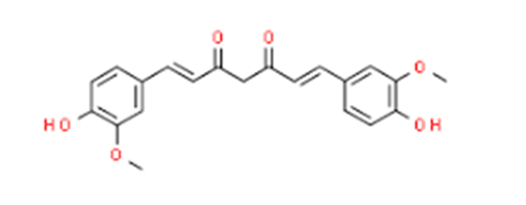
Other curcuminoids such as demethoxycurcumin and bisdemethoxycurcumin are structurally similar to curcumin, differing only in the number of methoxy groups on the aromatic ring. There is many treatment types of diabetes mellitus each associated with special adverse effects especially in older patients and in patients with renal insufficiency so trends towards herbal treatment in increasing nowadays therefore our work in concentrated with herbal treatment of diabetes especially curcumin due to its antioxidant properties. The objective of this paper is to show the effect of curcumin on alloxan induced diabetes in mice and its role as complementary treatment in diabetes patients.
Method
Experimental Animals
Albino mice of either sex weighing 25-35g maintained in the animal house of Faculty of Medicine University of Benghazi, Libya. The mice were bred in the faculty animal house. All animals were housed in standard polypropylene cages (48×35×22cm) and kept under controlled room temperature (20±5 °C; relative humidity 60-70%) in a 12h light-dark cycle. The animals were given a standard laboratory diet and free water. Food was withdrawn 12h before and during the experimental hours. The mice is divided into four groups each contain six mice
- Control group given normal saline in dose of 0.2ml each.
- Alloxan induced group given alloxan monohydrate in dose of 150 mg/kg dissolved in 0.9 % normal saline freshly prepared and given in dose of 0.2 ml. After six hours 20% Dextrose in dose of 1 ml each mouse was injected i.p to avoid hypoglycemia, because alloxan induced destruction of pancreatic B cells. Then 5% Dextrose was given orally in the drinking water bottles for twenty-four hours to avoid hypoglycemia, the animals kept on normal diet for seven days, their plasma glucose level were assessed by tail vein.
- Curcumin group: Given curcumin powder in a dose of 200 mg/kg dissolved in 300 ml of drinking water for 60 days, and after 24 hour of fasting blood glucose in measured by Accu-Chek Guide Glucose Test Strips.
- Glibencalamide was given in a dose of 0.5mg/kg by dissolving 5mg tablets of glibenclamide in 50 ml of distilled water and mice given (0.3 ml orally ) and then after 3 hours blood glucose was assessed, blood glucose levels more than 250 mg/dL were classified as diabetics and assigned to various experimental groups.
Results
Testing of Normality
There are two broad classifications of statistical tests used in data analysis, namely parametric and non-parametric. The use of parametric tests is considered appropriate when the observations need to be normally distributed or normally approximated. They are considered one of the critical assumptions that must be made before using parametric tests. However, if a sample does not degrade normally, a nonparametric test is more appropriate than a parametric test.
The above Table 1 shows the Shapiro-Wilk test. In our case, since we have only 5 elements, the Shapiro-Wilk test is used hence we fail to reject the null hypothesis if p-value > 0.05 this mean we can reject the alternative hypothesis and conclude that the data comes from a normal distribution. It is obvious that parametric techniques are more suitable used in this work.
| Shapiro-Wilk | Alloxan150 mg/kg | 36 | 44.15 | |||
|---|---|---|---|---|---|---|
| Statistic | df | Sig. | Alloxan and curcumin 200mg/kg | 23 | 55.67 | |
| 0.663 | 24 | 0.001 | Glibenclamide 5m/kg | 15 | 42 |
Table 2: Test of Normality.
The above Table 1 shows the Shapiro-Wilk test. In our case, since we have only 5 elements, the Shapiro-Wilk test is used. From the above table, the p-value < 0.05 we can reject the null hypothesis and conclude that the data does not come from a normal distribution. It is obvious that non-parametric techniques are more suitable used in this work.
- Kruskal-Wallis Test: Is Non-parametric equivalent to one-way ANOVA when dependent variable was Continuous (scale) but not normally distributed used to test the following hypothesis:
- The Main Hypothesis: There are no statistically significant differences between means, and to answer this question the test of Kruskal-Wallis Test was conducted.
Table 2 represent the results of Kruskal-Wallis Test were p < 0.01, there is a significant difference between at least two means and to find out which pairs are different see diagram (Dotted line = significant difference between pairs).
| N | Mean Rank | |
|---|---|---|
| Control | 18 | 43.22 |
| Alloxan150 mg/kg | 36 | 44.15 |
| Alloxan and curcumin 200mg/kg | 23 | 55.67 |
| Glibenclamide 5m/kg | 15 | 42 |
Table 1: Results of the Kruskal-Wallis Test. Kruskal-Wallis H= 15.89, df=3 , p-value=0.001
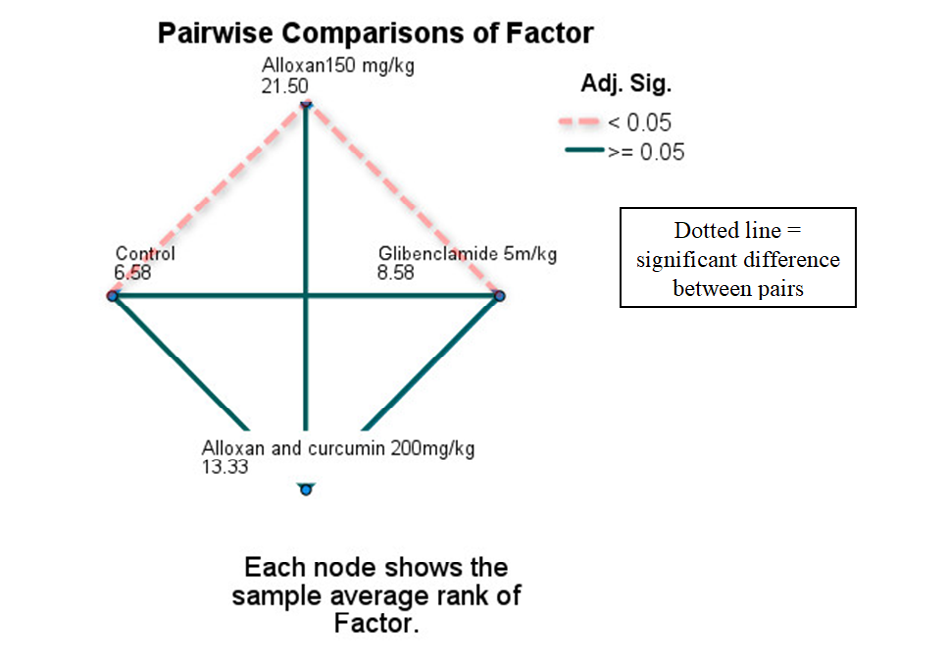
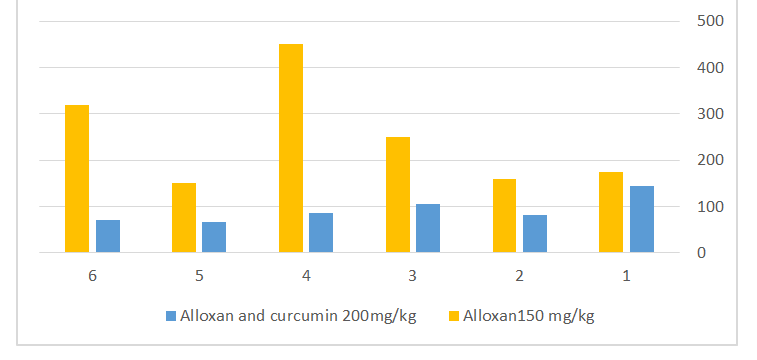
The diagram1 Post hoc tests shows the mean rank for each method and an dotted line joins significantly different pairs were the difference in the mean ranks Control with Alloxan150 mg/kg and Glibenclamide 5m/kg with Alloxan150 mg/kg was significant P< 0.05 indicate to that the difference return to Alloxan150 mg/kg.
Discussion
Diabetes mellitus (DM) and its associated complications have had a significant impact on the quality of life of human beings, and have become a major public health issue. Diabetes mellitus is a measure of the antidiabetes function and relevance of therapeutic compounds, including medicinal plants, in restoring glycemic balance (or homeostasis) in patients with hyperglycemia. The most commonly used test compounds for assessing their antidiabetes or hypoglycemia capacity are Alloxan and streptozotocin (alloxan is much less expensive and easier to obtain) than Streptozotocin. Alloxan is used to induction of diabetes in mice in our paper in accordance with another study done on rats. The animals were fasted overnight with free access to water prior to induction of diabetes [13]. Diabetes was induced by single intraperitoneal injection of Alloxan monohydrate (Sigma St. Louis, U.S.A.) at a dose of 150mg/kg body weight dissolved in 0.9% cold normal saline solution. Since Alloxan is capable of producing fatal hypoglycemia because of massive pancreatic insulin release, the rats were treated with 20% glucose solution orally after 6h [14].
In our paper curcumin reduced blood glucose as shown in the study done on rats for eight weeks rats with type 2 diabetes were given both low and high dose of curcumin. The findings demonstrated that in type 2 diabetes mellitus rats, high-dose curcumin significantly decreased liver coefficient, malondialdehyde levels, triglycerides, total cholesterol, low- density lipoprotein cholesterol, high- density lipoprotein cholesterol, alanine aminotransferase, and aspartate transaminase, as well as BCL2-Associated X expression. In rats with type 2 diabetes mellitus, high- dose curcumin enhanced the expression of liver B-cell lymphoma-2, phosphatidylinositol 3-kinase, phosphorylated phosphatidylinositol 3-kinase, protein kinase B, and phosphorylated protein kinase B. It also increased the levels of liver superoxide dismutase, catalase, and glutathione [15]. Compound 4 [1,7-bis(3,4-dimethoxyphenyl)hepta- 1,6-diene-3,5-dione] was discovered to be a possible hypoglycemic agent based on curcumin (at a dosage of 100 µg/kg), which decreased the concentration of glucose in vitro. However, with a different curcumin derivative [compound 10; 1,5-bis(4-hydroxy-3-methoxyphenyl) penta-1,4-dien-3-one], the outcomes of in vitro and in vivo experiments did not agree. Nonetheless, we think that in vitro testing could be crucial as preliminary screening methods for assessing antidiabetic herbs or chemicals that could then be investigated further in humans or animals. To precisely determine the compound’s hypoglycemic mechanism, more research will be needed [16].
Overall, all available in vivo animal studies examining the effects of curcumin indicate significant improved glucose and lipid homeostasis [17]. Serum glucose and lipid levels were significantly reduced. Oxidative stress and lipid peroxidation were reduced with curcumin treatment, while antioxidant enzyme activities were increased. In addition, pro- inflammatory cytokine levels and macrophage infiltration to adipose and liver tissues were reduced. Furthermore, mitochondrial biogenesis was improved with curcumin administration. Administration of curcumin to animal models of diabetic nephropathy resulted in improved kidney function [18]. Additionally, curcumin may regulate novel signaling molecules and enzymes involved in the pathophysiology of diabetes, including glucagon-like peptide-1, dipeptidyl peptidase-4, glucose transporters, alpha-glycosidase, alpha-amylase, and peroxisome proliferator-activated receptor gamma (PPARγ) [19]. However one of the reasons for decreasing blood glucose after ingestion of curcumin may be a reduction of the absorption rate of glucose in the gastrointestinal tract due to inhibition of the Na+ glucose cotransporter [20]. One of the most important findings is that Curcuma longa rhizome intake can stimulate secretion of pancreatic glucose regulating hormones– insulin and C peptide [21].
References
-
Lenzen S (2008) The mechanisms of alloxan- and streptozotocin-induced diabetes. Diabetologia 51(2): 216-226.
-
Federiuk IF, Casey HM, Quinn MJ, Wood MD, Ward WK (2004) Induction of type-1 diabetes mellitus in laboratory rats by use of alloxan: Route of administration, pitfalls, and insulin treatmen. Comp Med 54(3): 252-257.
-
Tripathy D, Chavez AO (2010) Defects in insulin secretion and action in the pathogenesis of type 2 diabetes mellitus. Curr Diab Rep 10(3): 184-191.
-
Saltiel AR (2001) New perspectives into the molecular pathogenesis and treatment of type 2 diabetes. Cell 104(4): 517-529.
-
Alam MA, Subhan N, Rahman MM, Uddin SJ, Reza HM, et al. (2014) Effect of citrus flavonoids, naringin and naringenin, on metabolic syndrome and their mechanisms of action. Adv Nutr 5(4): 404-417.
-
DeFronzo RA (2004) Dysfunctional fat cells, lipotoxicity and type 2 diabetes. Int J Clin Pract Suppl 143: 9-21.
-
Peschke E, Ebelt H, Brömme HJ, Peschke D (2000) ‘Classical’ and ‘new’ diabetogens--comparison of their effects on isolated rat pancreatic islets in vitro. Cell Mol Life Sci 57(1): 158-164.
-
Campbell JE, Newgard CB (2021) Mechanisms controlling pancreatic islet cell function in insulin secretion. Nat Rev Mol Cell Boil 22(2): 142-158.
-
Bacevic M, Rompen E, Radermecker R, Drion P, Lambert F (2020) Practical considerations for reducing mortality rates in alloxan-induced diabetic rabbits. Heliyon 6(6): e04103.
-
Kocaadam B, Şanlier N (2017) Curcumin, an active component of turmeric (Curcuma longa), and its effects on health. Crit Rev Food Sci Nutr 57(13): 2889-2895.
-
Chattopadhyay I, Biswas K, Bandyopadhyay U, Banerjee RK (2004) Turmeric and curcumin: Biological actions and medicinal applications. Cur Sci 87(1): 44-53.
-
Shoba G, Joy D, Joseph T, Majeed M, Rajendran R (1998) Influence of piperine on the pharmacokinetics of curcumin in animals and human volunteers. Planta Med 64(4): 353-356.
-
Das KK, Razzaghi-Asl N, Tikare SN, Santo RD, Costi R, et al. (2016) Hypoglycemic activity of curcumin synthetic analogues in alloxan-induced diabetic rats. J Enzyme Inhib Med Chem 31(1): 99-105.
-
Imtiaz F, Islam M, Saeed H, Ahmed A, Rathore HA (2023) Assessment of the antidiabetic potential of extract and novel phytoniosomes formulation of Tradescantia pallida leaves in the alloxan-induced diabetic mouse model. FASEB J 37(4): e22818.
-
Xia ZH, Zhang S, Chen Y, Li K, Chen WB, et al. (2020) Curcumin anti-diabetic effect mainly correlates with its anti-apoptotic actions and PI3K/Akt signal pathway regulation in the liver. Food Chem Toxicol 146: 111803.
-
Onyenibe NS, Nathaniel NA, Udogadi NS, Iyanu OO (2019) Hypoglycemic and Antioxidant Capacity of Curcuma Longa and Viscum Album in Alloxan Induced Diabetic Male Wistar Rats. International Journal of Diabetes and Endocrinology 4(1): 26-34.
-
Yahfoufi N, Alsadi N, Jambi M, Matar C (2018) The Immunomodulatory and Anti-Inflammatory Role of Polyphenols. Nutrients 10(11): 1618.
-
Meng B, Li J, Cao H (2013) Antioxidant and antiinflammatory activities of curcumin on diabetes mellitus and its complications. Curr Pharm Des 19(11): 2101-2113.
-
Babu PS, Srinivasan K (1998) Amelioration of renal lesions associated with diabetes by dietary curcumin in streptozotocin diabetic rats. Mol Cell Biochem 181(1-2): 87-96.
-
Vallon V, Rose M, Gerasimova M, Satriano J, Platt KA, et al. (2013) Knockout of Na-glucose transporter SGLT2 attenuates hyperglycemia and glomerular hyperfiltration but not kidney growth or injury in diabetes mellitus. Am J Physiol Renal Physiol 304(2): F156-167.
-
Gorboulev V, Schürmann A, Vallon V, Kipp H, Jaschke A, et al. (2012) Na (+)-Dglucose cotransporter SGLT1 is pivotal for intestinal glucose absorption and glucose- dependent incretin secretion. Diabetes 61(1): 187-196.
- Gallic and Citric Acid Present in the Peels of Tropical Fruits as an Alternative in the Fight against Cancer
- Treating the Forehead Lines with Combination of Forehead and Glabellar Botulinum Toxin Among Japanese Patients
- Clinical Evaluation of Patients Suffering from Breast Cancer & Determination of Treatment Therapies and Better Strategies Related to Breast Cancer
- Medieval Recipes by Al-Zahrāwī for Heart Palpitations Treatment
- Etiology and Prescription Errors of Myocardial Infarction in Different Health Care Systems of Azad Kashmir
- Early Diagnosis and Multidisciplinary Management of Turner Syndrome: A Paediatric Case Study