
Histochemical and Organolyptic Analysis of Major Aroma Compound (2-acetyl-1-pyrroline) in Kalanamak Rice Landraces and Some Basmati Rice Varieties
<p>In the present paper, the histochemical analysis was carried out to localize the presence of aroma compound i.e 2-acetyl-<br />1-pyrroline in the rice caryopsis of the kalanamak rice landraces. For the localization of 2-AP, reagent 2, 4-Dinitrophenyl<br />hydrazine was used. Presence of the aroma was confirmed by organolyptic analysis of the Kalanamak rice accessions,<br />Type-3, Pusa Basmati-1 and PantDhan-18.The sensory test appeared to be a simple and reliable method for rapid<br />identification of aromatic rice. This study may help in better understanding the biology of rice grain and improvement of<br />rice quality.</p>
Anita Kumari*, Anil Kumar and Anil Kumar Gaur
Molecular Biology and Genetic Engineering, Collage of Basic Sciences and Humanities, G.B. Pant University of Agriculture and Technology, Pantnagar, India Collage of Basic Sciences and Humanities, G.B. Pant University of Agriculture and Technology, Pantnagar (Uttrakhand), India, Tel: 8449327911; Email: anitaani91@gmail.com .Abstract rice quality.
Introduction
Rice (Oryza sativa L.) is the staple food for more than two billion people in Asia. The cultivation of high-quality rice has significantly increased in recent years, and consequently, the aromatic rice cultivars grown in Asian countries are attracting attention [1]. Small variations in sensory properties can change the perception of the consumers, whether highly desired by or unacceptable to consumers [2]. Consequently, aroma and flavor have been rated as the major criteria for preference among consumers [3]. To increase the production of aromatic rice and satisfy the diversification of the demand from current rice consumers worldwide, it is necessary to develop the suitable breeding methods of aromatic rice.
Materials and Methods
The evaluation of rice aroma is not easy, and classical smelling or chewing methods are not supposed to be totally reliable because of their subjective nature [4]. For the sensory evaluation, seeds of all the genotypes of Kalanamak, Type-3 and Pusa basmati-1 and non-scented Pantdhan-18 were collected from Norman E. Boralog Crop Research Centre of GBPUA & T, Pantnagar (U.K.), India. All the genotypes of Kalanamak, Pantdhan-18, Type-3 and Pusa Basmati-1 were manually dehusked. For the test using seeds, 10 seeds of each genotype were taken in Stoppard test tubes. About 10ml 1.7% KOH solution was added to each Stoppard test tube and left at room temperature for 30 min. After 30 minutes, each Stoppard test tube was opened and the degree of aroma was evaluated by sniffing and was scored on the 1-4 scale with 1, 2, 3 and 4 corresponding to the absence of aroma, slight aroma, moderate aroma and strong aroma. The score for each sample was recorded by a panel of 5 experts according. All measurements were recorded in triplicates and these were expressed as mean ± SE. For histochemical studies, Seeds of all the varieties were soaked overnight to soften the seed-coat and were manually dehusked and hand-cut transverse sections were obtained using a razor blade. Theses thin sections were transferred through 60% alcohol grade. Afterward, Sections were transferred to 2, 4-dinitrophenyl hydrazine reagent in a beaker and incubated in hot air oven at 60°C for 30 min. Later sections were mounted by Canada balsam and observed under bright field microscope [5].
Results and Discussion
The presence or absence of aroma in the rice seeds was assessed for 70 Kalanamak rice accessions, Type-3, Pusa Basmati-1 and PantDhan-18 from Uttrakhand region. Table 1 lists the aroma responses of the rice cultivars. The result showed that most of the Kalanamak Genotypes were found give moderate to the slight aroma. Out of 70 Genotypes, 4 genotypes had the strong aroma, 38 genotypes had the slight aroma and 26 genotypes had the moderate aroma.
| Genotype | Accession No | Weight/ Seeds (gm) | Aroma | ||||||||
|---|---|---|---|---|---|---|---|---|---|---|---|
| Pant Dhan 18 | - | 0.21 | 1 | ||||||||
| Pusa Bas.-1 | - | 0.17 | 3 | ||||||||
| Type-3 | - | 0.16 | 2 | ||||||||
| Kalanamak 1 | 3089-P | 0.10 | 2 | ||||||||
| Kalanamak 2 | 3089-SN | 0.10 | 2 | ||||||||
| Kalanamak 3 | 3144-SN | 0.11 | 2 | ||||||||
| Kalanamak 4 | 3114-1-P | 0.09 | 2 | ||||||||
| Kalanamak 5 | 3114-1-SN | 0.11 | 3 | ||||||||
| Kalanamak 6 | 3114-2-P | 0.12 | 2 | ||||||||
| Kalanamak 7 | 3117-P | 0.12 | 4 | ||||||||
| Kalanamak 8 | 3117-SN | 0.11 | 2 | ||||||||
| Kalanamak 9 | 3119-P | 0.12 | 3 | ||||||||
| Kalanamak 10 | 3119-SN | 0.10 | 3 | ||||||||
| Kalanamak 11 | 3119-1-SN | 0.12 | 2 | ||||||||
| Kalanamak 12 | 3119-2-P | 0.12 | 2 | ||||||||
| Kalanamak 13 | 3119-2-SN | 0.11 | 4 | ||||||||
| Kalanamak 14 | 3120-P | 0.12 | 3 | ||||||||
| Kalanamak 15 | 3120-SN | 0.13 | 2 | ||||||||
| Kalanamak 16 | 3120-1-P | 0.12 | 2 | ||||||||
| Kalanamak 17 | 3120-1-SN | 0.13 | 3 | ||||||||
| Kalanamak 18 | 3120-2-P | 0.12 | 3 | ||||||||
| Kalanamak 19 | 3120-2-SN | 0.12 | 3 | ||||||||
| Kalanamak 20 | 3121-P | 0.10 | 3 | ||||||||
| Kalanamak 21 | 3121-SN | 0.11 | 2 | ||||||||
| Kalanamak 22 | 3121-1-SN | 0.16 | 2 | ||||||||
| Kalanamak 23 | 3122-P | 0.17 | 4 | ||||||||
| Kalanamak 24 | 3122-SN | 0.18 | 2 | ||||||||
| Kalanamak 25 | 3124-P | 0.17 | 2 | ||||||||
| Kalanamak 26 | 3124-SN | 0.18 | 2 | ||||||||
| Kalanamak 27 | 3125-SN | 0.17 | 3 | ||||||||
| Kalanamak 28 | 3126-P | 0.17 | 2 | ||||||||
| Kalanamak 29 | 3126-SN | 0.16 | 2 | ||||||||
| Kalanamak 30 | 3128-P | 0.20 | 3 |
Table 1: Organolyptic analysis of Kalanamak rice accessions, Type-3, Pusa Basmati-1 and PantDhan-18. From the earlier studies, it
| Kalanamak 31 | 3128-SN | 0.14 | 3 |
|---|---|---|---|
| Kalanamak 32 | 3129-P | 0.12 | 2 |
| Kalanamak 33 | 3129-SN | 0.14 | 2 |
| Kalanamak 34 | 3130-P | 0.13 | 3 |
| Kalanamak 35 | 3130-SN-CH | 0.19 | 3 |
| Kalanamak 36 | 3131-SN-CH | 0.17 | 2 |
| Kalanamak 37 | 3131-SN | 0.11 | 2 |
| Kalanamak 38 | 3131-P | 0.10 | 3 |
| Kalanamak 39 | 3131-2-P | 0.12 | 3 |
| Kalanamak 40 | 3131-2-SN | 0.11 | 1 |
| Kalanamak 41 | 3212-P | 0.13 | 3 |
| Kalanamak 42 | 3212-CH-SN | 0.10 | 2 |
| Kalanamak 43 | 3213-SN | 0.11 | 3 |
| Kalanamak 44 | 3214-N | 0.10 | 3 |
| Kalanamak 45 | 3214-SN | 0.13 | 2 |
| Kalanamak 46 | 3215-P | 0.16 | 2 |
| Kalanamak 47 | 3215-SN | 0.16 | 3 |
| Kalanamak 48 | 3215-1-P | 0.14 | 3 |
| Kalanamak 49 | 3216-P | 0.15 | 3 |
| Kalanamak 51 | 3216-SN | 0.14 | 2 |
| Kalanamak 52 | 3216-1-P | 0.17 | 3 |
| Kalanamak 53 | 3219-P | 0.15 | 2 |
| Kalanamak 54 | 3219-SN | 0.17 | 2 |
| Kalanamak 55 | 3221-SN | 0.15 | 2 |
| Kalanamak 56 | 3222-P | 0.17 | 2 |
| Kalanamak 58 | 3224-P | 0.13 | 2 |
| Kalanamak 59 | 3229-SN | 0.15 | 2 |
| Kalanamak 60 | 3256-P | 0.16 | 2 |
| Kalanamak 61 | 3256-CH-SN | 0.14 | 2 |
| Kalanamak 63 | 3257-P | 0.12 | 2 |
| Kalanamak 64 | 3257-CH-P | 0.12 | 3 |
| Kalanamak 65 | 3253-SN | 0.13 | 3 |
| Kalanamak 66 | 3266-P | 0.12 | 2 |
| Kalanamak 67 | 3266-1-P | 0.11 | 2 |
| Kalanamak 68 | 3266-SN | 0.11 | 4 |
| Kalanamak 69 | 3266-4-P | 0.13 | 2 |
| Kalanamak 70 | 3278-P | 0.13 | 3 |
| Mean – 2.485 | |||
| Range – 1-4 | |||
| STD - 0.651 |
Table 2: Organolyptic analysis of Kalanamak rice accessions, Type-3, Pusa Basmati-1 and PantDhan-18. From the earlier studies, it
Table 1: Organolyptic analysis of Kalanamak rice accessions, Type-3, Pusa Basmati-1 and PantDhan-18. From the earlier studies, it was concluded the 2-AP was present in the aleurone layer than the endosperm [6, 7]. Histochemical studies revealed that aromatic compound i.e. 2-acetyl-1-pyrroline was present in the aleurone layer. 2, 4- dinitrophenyl hydrazine reacts with methyl ketones to give an orange-red color.
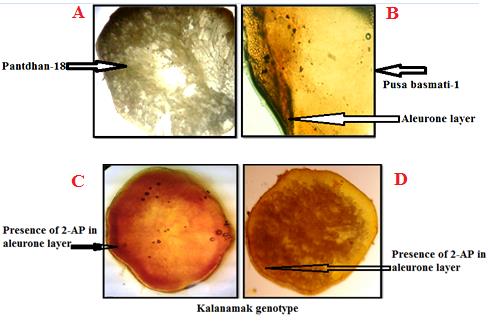
Organoleptic test with consumer preferences of different rice accessions provides information for improvement of valuable grain quality traits. So it is important to identify the aromatic substances determining the aroma in rice. In addition, further studies should be carried out to confirm the precursors and pathways of 2-AP formation in aromatic rice cultivars to elucidate the nature and expression of the aroma trait in rice.
Acknowledgements
We are thankful to the Department of Biotechnology, Government of India, for funding this work under the Program Mode Support in Agricultural Biotechnology Initiative.
References
-
Hien NL, Yoshihashi T, Sarhadi WA, Thanh VC, Oikawa Y, et al. (2006) Evaluation of Aroma in Rice (Oryza sativa L.) using KOH Method, Molecular Markers and Measurement of 2-Acetyl-1-Pyrroline Concentration. Jpn J Trop Agr 50(4): 190-198.
-
Yau NJN, Liu TT (1999) Instrumental and sensory analysis of volatile aroma of cooked rice. J Sens Stud 14: 209-233.
-
Del Mundo AM, Juliano BO (1981) Consumer preference and properties of raw and cooked milled rice. J Texture Stud 12: 107-120.
-
Garris AJ, Tai TH, Coburn J, Kresovich S, McCouch S (2005) Genetic Structure and Diversity in Oryza sativa L. Genetics 169(3): 1631-1638.
-
Nadaf AB, Krishnan S, Wakte KV (2006) Histochemical and biochemical analysis of major aroma compound (2-acetyl-1-pyrroline) in basmati and other scented rice (Oryza sativa L). Current Science 91(11): 1533-1536.
-
Buttery RG, Ling LC, Juliano BO, Turnbaugh JC (1983) Cooked rice aroma and 2-acetyl-1-pyrroline. J Agric Food Chem 31(4): 823-826.
-
Buttery RG, Juliano BO, Ling LC (1983) Identification of rice aroma compound 2-acetyl-1-pyrroline in pandan leaves. Chem Ind 478.
- The Muculent Bleb-Mucinous Cystic Neoplasm-Hepatobiliary Region
- Insulin Sensitizers as Anti-Aging Agents: Unveiling Synergies with Albumin, GLP-1RA, Klotho Protein, and Metformin in the Quest to Combat Aging
- Reprogramming of GLP-1 Response at Prediabetes for the Prevention of Type 2 Diabetes: The Role of Albumin and GLP-1 Receptor Agonists
- The Mingled Allies-Combined Hepatocellular Carcinoma and Cholangiocarcinoma
- Compilation and Embodiment-Leydig Cell Tumour Testis
- Glucolipotoxicity: A Novel Different Perspective on the Causes of Cancer