
Identification of Secondary Metabolites, Antimicrobial and Antioxidant Activity of Grape Fruit (Vitis vinifera) Skin Extract
Background: The aim of the present study was to evaluate the antimicrobial and antioxidant activity of Vitis venifera in fruit skin extract against clinically important pathogens. Materials and methods: The preliminary phytochemical screening of grape skin extracts was carried out by secondary metabolites assay. The secondary metabolites and functional groups of the Vitis venifera were identified by gas chromatography mass spectroscopy (GCMS). The FT-IR analysis were performed for the presence of different chemical groups like reducing sugars, tannins, saponins, steroids, flavonoids, alkaloids, and glycosides. Antibacterial assay of V. venifera fruit skin aqueous extract were carried out by agar-well diffusion method with different pathogenic bacteria. The in vitro antioxidant activity was assessed using Diphenyl picryl hydrazine (DPPH) scavenging assay. Results: The grape fruit skin extract showed good bactericidal activity against both the gram-negative and gram-positive bacteria. The phytochemical profile found the presence of alkaloids, carbohydrates, flavonoids, phenols, proteins, terpenoids, tannins, and sterols. Finally, the GCMS spectrum showed the presence of the compounds such as α-Tocopherol, β-D-mannoside, Lupenone, Glycerin, Cymene, Ethyl Oleate, L-glucose, Norolean-12-ene, Palmitic acid, Cis oleic acid, norolean-12-ene , ϒ-sitosterol, D-Allose , (+-)-p-menth-1-en-4-ol, Cis-Dimethyl morphine, Procyanidin B1, B2, C1 and flavon-3-ol. Conclusion: The present study showed that grape skin extracts contained substantial bioactive compounds, which possessed antimicrobial, antioxidant and anti-obesity properties.
Introduction
Multi-drug resistant pathogens were now-a-days become a serious threat for the human society. The factors causing health issues were bacteria, fungal and free radicals released lead to the oxidative stress which causes cancer, cardiovascular and food borne diseases [1]. The recent trends for antimicrobial and wound healing were engaged towards the naturally existed compounds extracted from the various plants and marine resources [2]. Patients with various maladies were as of now swung to get conventional medications such as ayurvedha (complete plant concentrates) and naturopathy. The ayurvedhic treatment frameworks never utilize engineered added substances and more focuses on the medication for human wellbeing and ailment cure. The recent researches were focused towards the natural antimicrobial compounds isolated from the plants and other marine resources [2]. Patients with different diseases were currently turned to get traditional medicines such as ayurvedha (complete plant extracts) and naturopathy. The ayurvedhic treatment systems never use synthetic additives and more concentrates on the drug safety and disease cure. Grape (Vitis vinifera) is one of the most widely consumed fruits, which is rich in bioactive compounds, nutraceuticals and antioxidants. The demand for grapes and grape products is increasing because of the associated health benefits. Grapes are rich in phenolic compounds with approximately 75% of grape polyphenols existing in the skin and seeds [3]. The biological activity of grapes has been widely investigated using in vitro and in vivo models, as well as clinical studies. The grapes are used for treating diverse health problems including cancer, cholera, smallpox, nausea, eye infections and skin, kidney and liver diseases. Grape seed is available as a dietary supplement in capsules, tablets and liquid extracts. Among other beneficial effects, the active compounds in grape are believed to have pharmacological activities such anti-inflammatory [4], anticancer [5], antifungal [6], anti-bacteria [7, 8] and antioxidant activity. The present work was to identify the bioactive compounds in grape skin extract using gas chromatography and mass spectroscopy (GCMS), Fourier transform infra-red spectroscopy (FTIRS) and phytochemical assays. Further the in vitro antibacterial and antioxidant efficacy on skin extracts of black grapes V. venifera variety from Tamil Nadu region, with a view to exploiting its potential as a source of natural antioxidants [3, 4, 5].
Materials and Methods
Plant collection
Edible V. vinifera or black grapes variety is largely cultivated in household gardening. The black grapes are widely grown in the State of Tamil Nadu, India. The grapes were collected from a Kamaraj market in Thanjavur, Tamil Nadu, India.
Extraction
Fresh and healthy plant fruits of V. venifera were washed thoroughly with running tap water and grape skin were peeled and allowed to natural drying under shade for several days. Finally the dried material was pulverized to powdering form. The 20g of pulverized sample was dissolved in 200ml of distilled water, heated at 80°C for 30min and filtered using Whattman No.1 filter paper to obtain the extract. The filtrates were then lyophilized by freeze drying technique using Christ Alpha 1-2 LD Freeze Dryer.
Phytochemical screening
The preliminary phytochemical assays were carried out for the detection of secondary metabolites such as polyphenols, flavonoids; alkaloids, terpenoids, steroids, tannins, saponins, and cardiac glycosides were profiled using standard phytochemical methods [9, 10].
Antibacterial activity
The Aqueous extracts of grape skin were screened for the antibacterial activity against gram-negative bacteria such as Aeromonas hydrophilic, Escherichia coli, Salmonella typhi O, Salmonella typhi H, Klebsiella pneumonia and gram-positive bacteria viz., Bacillus subtillis, Staphylococcus aureus using agar-well diffusion method [11]. The antibacterial activity was presented by minimum inhibitory concentration through zone of inhibition (mm).
GC MS analysis of grape skin
The Gas chromatography mass spectroscopy analysis of the grape skin aqueous extract was performed by Shimadzu GCMS - QP2010. The inert gas helium (99.9995%) is used as carrier gas. The ionization and flow through the column was fixed as 1.0ml/min. The sample split ration was set as 10:1; the injector volume is set as 1.0 µL. The column used is fused capillary silica (30m × 0.25mm × 0.25 µm) column. The temperature was programmed as injector: 260°C, detector: v 300°C, column: 70°C, 10°C min-1, 260°C (10min). The total GC run time is up to 2 hours. The Mass range was m/z 40-1000 at scan interval of 0.5s, speed of 2000 amu s-1 and detector voltage of 1.0kV. The post run was analyzed in the Nits library database provided in the GCMS system [12].
Fourier transform infrared (FTIR) analysis
FTIR spectrophotometer was used to identify the characteristic functional groups in the grape skin extracts. The aqueous extract (5.0mg), were added with potassium bromide (KBr) in a mortar and pressed at pressure of 6 bars within 2min in order to prepare a thin translucent sample discs. The FTIR spectrum was obtained using Perkin Elmer 2000 spectrophotometer system with a scan range from 400 to 4000 cm−1 [13, 14].
In vitro antioxidant activity
The Stable 1, 1-diphenyl-2-picryl hydrazine (DPPH) free radical scavenging activity of the AE was measured according to the methods of Blois, (2001) but with minor modifications. One mL of 0.2 mM DPPH solution in methanol was mixed with the 1mL extracts of 50, 100, 250, 500, and 1000 _µ_g/ml The mixture was incubated in dark for 20min at 27°C and the absorbance was measured at 517nm. The free radical scavenging activity was determined by comparing its absorbance with that of a blank solution. Ascorbic acid was used as a standard. The ability to scavenge the DPPH radical was calculated using the following equation [15, 16, 17, 18, 19], A=13, A=20.
Results and Discussion
Antimicrobial activity and photochemistry of grape fruit skin aqueous extract
The antibacterial efficacy of Grape Skin aqueous Extract was presented in (Table 1). The aqueous extract of grape skin was found to inhibit all the screened broad spectrum bacteria with notable inhibitory activity. Among bacteria, significant inhibition was observed in S. aureus, K. Pneumonia and Salmonella typhi O & H whereas E. coli was inhibited to least extent. The positive control Ciproflacin showed higher antibacterial activity than the grapes skin extract. The extracts showed good bactericidal activity against both the gram-negative and gram-positive bacteria. The preliminary photochemical studies of AE of grape skin extract was profiled and presented in the (Table 2). The phytochemical profile showed the presence of alkaloids, carbohydrates, flavonoids, phenols, proteins, terpenoids, tannins, and sterols. Saponins and cardiac glycosides were found to be present in the aqueous extract of grape skin.
| Extracts of Vitis vinifera | |||||||||||||||
| S. No | Micro organism | Ethanol Extract (mm) | Positive Control Ciproflacin | ||||||||||||
| Concentration in µg | |||||||||||||||
| 100 | 150 | 200 | 250 | 100 | 150 | 200 | 250 | ||||||||
| 1 | E.coli | 11 | 13 | 16 | 20 | 15 | 17 | 20 | 25 | ||||||
| 2 | Bacillus subtilis | 12 | 11 | 15 | 16 | 15 | 18 | 20 | 23 | ||||||
| 3 | Salmonella typhi O | 11 | 12 | 15 | 15 | 20 | 20 | 22 | 24 | ||||||
| 4 | Aeromonas hydrophila | 10 | 10 | 11 | 9 | 11 | 15 | 14 | 17 | ||||||
| 5 | Staphylococcus aureus | 12 | 10 | 10 | 11 | 12 | 15 | 13 | 18 | ||||||
| 6 | Klebsiella pneumonia | 12 | 15 | 10 | 11 | 15 | 17 | 17 | 20 | ||||||
| 7 | Salmonella typhi H | 14 | 13 | 10 | 11 | 16 | 16 | 15 | 20 |
Table 1: Antibacterial activity of Grape skin aqueous extract against broad spectrum bacteria.
(+) denotes presence of the secondary metabolites, (-) absence of the secondary Metabolites.
| Presence/ | ||||||||
| S.No | Phytochemicals | |||||||
| absence | ||||||||
| 1 | Alkaloids | + | ||||||
| 2 | Steroids | + | ||||||
| 3 | Terpenoids | + | ||||||
| 4 | Phenolic Compounds | + | ||||||
| 5 | Flovanoids | + | ||||||
| 6 | Tannins | - | ||||||
| 7 | Anthrocyanin | + | ||||||
| 8 | Anthraquinones | - |
Table 2: phytochemical profiles of Grape skin aqueous Extract.
GC MS analysis
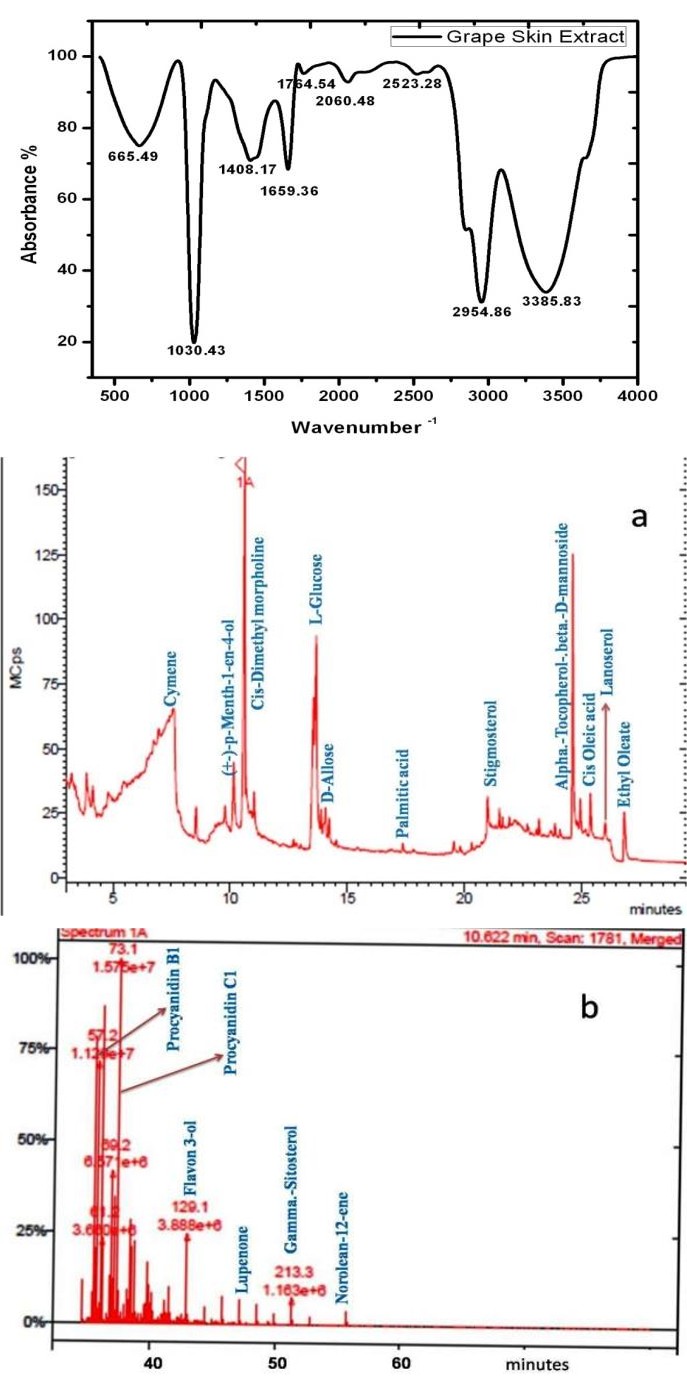
Figure 1 a&b: Identification of compounds from Grape skin aqueous extract using Gas Chromatography Mass Spectroscopy The GCMS analysis of the grape skin aqueous extract was displayed in the (Figure 1a&b). The peaks obtained in the GCMS spectrum showed the presence of 17 vital bioactivity rich compounds. The compounds were found as α-Tocopherol, β-D-mannoside, Lupenone, glycerin, cymene, ethyl Oleate, L-glucose, norolean-12-ene, Palmitic acid, Cis oleic acid, norolean-12-ene , ϒ-sitosterol, D- Allose ,(+-)-p-menth-1-en-4-ol, Cis-Dimethyl morph line, flavon-3-ol, Procyanidin B1, Lano sterol, stigma sterol, Procyanidin B2 and Procyanidin C1. Previous reports revealed that, the skin and seeds of grapes are known to be rich sources of phenolic compounds, both flavonoids and non-flavonoids [20, 21].
Fourier transform infrared fingerprint analysis
The FTIR spectroscopic studies revealed the presence of various functional groups by peak observed at 665.4, 1030, 1408, 1659, 2060, 2523, 2954 and 3385 presented in the (Figure 2) (Table 3). The respective peaks expressed the chemical group such as alkyl, ketone, aldehyde, carboxylic acids, esters, and amide in aqueous extracts of V. vinifera fruit skin [22].
| Name of the | |||||||||||
| Functionalic | |||||||||||
| S.No | Frequency | Functionalic | |||||||||
| group | |||||||||||
| Group | |||||||||||
| 1 | 3385.83 | N-H( stretching) | Amines and amides | ||||||||
| 2 | 2954.86 | C-H (stretch) | Alkane groups | ||||||||
| 3 | 2523.28 | O-H (stretch) | Acid groups | ||||||||
| 4 | 2060.4 | C=O | Amides | ||||||||
| 5 | 1764.54 | C=C (stretch) | Carbonyl group | ||||||||
| 6 | 1659.36 | C=O | Amides | ||||||||
| 7 | 1408.17 | O-H (stretch) | Alcohol or Phenol | ||||||||
| 8 | 1030.43 | C-O | Alcohols, ether, esters | ||||||||
| 9 | 665.49 | -C-H( stretching) | Cis RCH=CHR |
Table 3: FTIR functional groups representation of Grape Skin Extract _Vitis vinifera._
In vitro antioxidant activity
The free radical scavenging activity of grape fruit skin extracts were determined by the DPPH method. Antioxidant molecules can quench DPPH free radicals and convert them to a colorless product, resulting in a decrease in absorbance at 517nm. In our study, the grape skin extracts exhibited significant scavenging activity when compared with standard ascorbic acid (Table 4). The IC50 values of grape skin extract was observed to be
- % of inhibition of aqueous grape
- % of inhibition of
- Ascorbic Acid
- S.No
- Concentration
- (μg/ml) skin extract
- 1
- 50
- 26±0.42
- 22±0.25
- 2
- 100
- 38±0.35
- 25±0.34
- 3
- 250
- 53±0.26
- 33±0.24
- 4
- 500
- 65±0.41
- 55±0.55
- 5
- 1000
- 75±0.32
- 87±0.22
Table 4: In vitro Diphenyl picryl hydrazine Free Radical
Grapes are one of the palatable, sweet in taste and exceedingly nutritious rich in flavonoids, polyphenols and vitamin, consumers from all parts of the world devour this organic product to a great extent. Yet, the assessment of the medical advantages was less. Therefore the present study showed that grape skin extracts contained substantial bioactive compounds, which possessed antimicrobial, antioxidant and anti-obesity properties.
References
-
Carpenter R, O Grady MN, OCallaghan YC, OBrien NM, Kerry JP (2007) Evaluation of the Antioxidant Potential of Grape Seed and Bearberry Extracts in Raw and Cooked Pork. Meat Science 76(4): 604-610.
-
Serra AT, Matias A, Nunes VM, Leitão MC, Brito D, et al. (2008) In Vitro Evaluation of Olive and Grape- Based Natural Extracts as Potential Preservatives for Food. Innovative Food Science and Emerging Technologies 9(3): 311-319.
-
Bagchi D, Bagchi M, Stohs SJ, Das DK, Ray CA, et al. (2000) Free radicals and grape seed proanthocyanidin extract: importance in human health and disease prevention. J Toxicol 148(2-3): 187-197.
-
Baydar NG, Ozkan G, Çetin ES (2007) Characterization of grape seed and pomace oil extracts. Aca J 29-33.
-
Chacona MR, Ceperuelo-Mallafrea V, Maymo-Masipa E, Mateo-Sanzb JM, Arolac L, et al. (2009) Grape-seed Procyanidin modulate inflammation on human differentiated adipocytes. J in vitro Cytokine 137-142.
-
Cantos E, Espin JC, Tomas-Barberan FA (2002) Varietal differences among the polyphone profiles of seven table grape cultivars studied by LC-DAD-MS- MS. J Agric Food Cheam 5691-5696.
-
Canby HS, Bardakçı B (2011) Determination of fatty acid, C, H, N and trace element Composition in grape seed by GC/MS, FTIR, elemental analyzer and ICP/OES. SDU J Science 6(2): 140-148.
-
Canuti V, Conversano M, Calzi ML, Heymann H, Matthews MA, et al. (2009) Headspace solid-phase micro extraction-gas chromatography mass spectrometry for profiling free volatile compounds in Cabernet Sauvignon grapes and wines. J Chromatography A 3012-3022.
-
Dopico-Garcia MS, Fique A, Guerra L, Afonso JM, Pereira O, et al. (2008) Principal Components of phenolic to characterize red Vinho Verde grapes. J Talanta 1190-1202.
-
Edoga HO, Okwu DE, Mbabane BO (2005) Photochemical Constituents of some Nigerian medicinal plants. African J Biotechnol 4(7): 685-688.
-
Arnous A, Makris D, Kefalas P (2001) Effect of principal polyphenolic components in relation to antioxidant characteristics of aged red wines. Journal of Agricultural and Food Chemistry 4: 5736-5742.
-
Vennila S, Bupesh G, Mathiyazhagan K, Basker M, Amutha S, et al. (2012) Qualitative photochemical Screening and In vitro antioxidant activity of Hisora, Advanced Biotech Journal 14: 3-20.
-
Fuji Y, Shibuya T, Nakatani K, Itan IT, Hiradate S, et al. (2004) Assessment methods for allelopathic effect from leaf litter leachates. J Weed Boil Management 19-23.
-
FAO Production Year Book (1997) FAO Statistics no
-
Food and Agriculture Organization of the United Nations, Rome 151.
-
Frankel E, Kanne J, German J, Parks E, Kinsella J (1993) Inhibition of oxidation of human low-density lipoprotein with phenolic substances in red wine. Lancet 454-457.
-
Bupesh G, Amutha C, Nandagopal S, Ganeshkumar A, Sureshkumar P, et al. (2007) Antibacterial activity of Mentha piperita L (peppermint) from leaf extracts a medicinal plant, Acta agriculture Slovenia 89 (1): 73 - 79.
-
Kammerer D, Claus A, Carle R, Schieber A (2004) Phenolic screening of pomace from red and white grape varieties (Vitis vinifera L.) by HPLC-DAD-MS/ MS. J Agric Food Chem 4360-4367.
-
Li H, Wang X, Li P, Li Y, Wang H (2008) Comparative study of antioxidant activity of grape (Vitis vinifera) seed powder assessed by different methods. J Food Drug Analysis 1-7.
-
Lengyel E (2012) Primary aromatic character of wines. Acta Universitatis Cibiniensis Series E. Food Technol 3-18.
-
Robichaud JL, Noble AC. Astringency and Bitterness of Selected Phenolic in Wine. J Science Food Agric 53(3): 343-353.
-
Kim SY, Kim JH, Kim SK, Oh MJ, Jung MY (1990) Antioxidant activities of selected oriental herb extracts. J Am Oil Chem Soc 71: 633-640.
-
Giridharan Bupesh, Chinnaiah Amutha, Krishnan Saravana Murali, Natarajan Saran, Pitchaipillai Shanthi, et al. (2015) Lipid Characterization and Fatty Acid Profiles of Clarius batrachus and Its Defense Activity, British journal of Pharmaceutical Research 7(5): 2015-2017.
- Investigation of Polymorphisms in PPAR-Ɣ and TRHR Genes and their Impact on Turkish Diabetic and Obese Individuals
- The Impact of Aircraft Noise Exposure on the Efficacy of Empagliflozin Therapy in an Animal Model of Obesity
- Rooibos Mitigates Metabolic and Inflammatory Dysfunctions in Mice Fed a High-Carbohydrate Diet
- Synergistic Effect of Combined Leaf Extract of Vernonia amygdalina, Ocimum gratissimum, and Zingiber officinale Tuber on Phytochemical Profile, Antioxidant Activity, Serum Insulin, and Biochemical Parameters in Streptozotocin-Induced Diabetic Rats
- Investigation of Cardiovascular Responses to Aerobic Exercise in Obese University Students
- A Look at the Phase Angle Obtained by Electrical Bioimpedance