
Diabetic Neuropathy – Future Genetic Prospects
Diabetes Mellitus is a metabolic disease with high level of pancreatic insulin secretion, a condition where muscle, liver and fat cells poorly respond to insulin. According to the published reports by International Diabetes Federation (IDF), 387 million individuals were estimated to be with diabetes globally in 2014, and it has been predicted to raise to 592 million in the year 2035.
Editorial
Diabetes Mellitus is a metabolic disease with high level of pancreatic insulin secretion, a condition where muscle, liver and fat cells poorly respond to insulin. According to the published reports by International Diabetes Federation (IDF), 387 million individuals were estimated to be with diabetes globally in 2014, and it has been predicted to raise to 592 million in the year 2035 [1]. In 70% of DM patients, diabetes is accompanied by neuropathies that can affect organs of the body and these complications are the main cause of mortality and morbidity among DM patients [2]. The microvascular complications damage small vessels and capillaries leading to clinical outcomes. Diabetic Neuropathy (DN) affects nerves leading to foot ulcers, loss of sensation and amputation as result of prolonged elevated blood glucose levels. The different types of DN include focal neuropathy, peripheral neuropathy, autonomic and proximal neuropathy [3]. Peripheral neuropathy is one of the most common microvascular complication affecting T2DM patients [4]. Obesity is also considered as the significant risk factor for DN development [5]. In spite of huge advances in DN, the exact mechanism of pain causation in neuropathy remains unidentified. The origin of pain could be from the peripheral nerves in the nervous system. Genomic research tools have already provided us with a wealth of data on several genetic variants related with human metabolic disorders.
Likewise, candidate gene approach, Genome-wide association studies (GWAS), linkage analysis have identified genetic risk factors for diabetic microvascular complications including diabetic neuropathy [6]. Based on biological process the candidate genes (40) were studied for genetic association with diabetic microvascular complications such as Erythropoietin (EPO), Angiotensin 1 Converting Enzyme (ACE), Vascular Endothelial Growth Factor-A (VEGFA) and Aldo-keto reductase family 1, member B1 (AKR1B1) but most of the studies have documented inconsistent results, even though they were systematically investigated [7]. Most T2DM genes appear to be related with B-cell dysfunction, inflammatory response, involve in metabolic and vascular (Polyol pathway, Hexosamine) pathways, related to insulin resistance with obesity as risk factor. The obesity gene variants linked with pathways affecting the energy homeostasis. Although, several diabetes and obesity- associated genes have been identified till date, only 15% of the known genes predict T2DM and 5% obesity risk [8]. Earlier studies documented the genetic risk factors of DN, but they still remain scarce and nearly 60 loci have been identified to influence of developing T2DM risk [9]. (Figure 1) explains the risk factors leading to the development of diabetic neuropathy and its complications in human body.
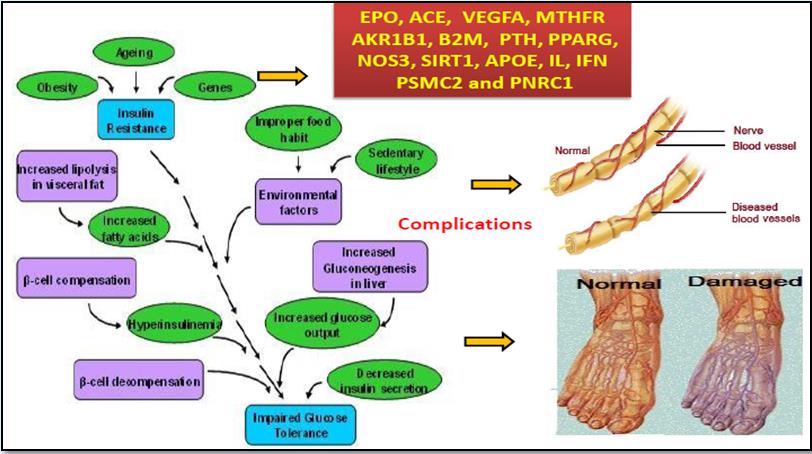
DN is a multi-factorial disease affecting the function of all organs in the body due to alteration of glucose metabolism. In current state, the additional genes which play vital role in obesity associated DN should be discovered using high-throughput sequencing technologies leading to gene-gene, gene-environment and epigenetic interactions involving with diabetes. The identified DN targets (genes and proteins) can be more effectively used to determine the development and progression of neuropathies, an in-depth understanding of this disease etiology will be gained, enabling us to be more comprehensive in assessing an individual’s genetic risk profile.
References
-
Joshi, Shashank R (2016) Diabetes Care in India, Annals of Global Health 81(6): 830-838.
-
Khandoker AH, Jelinek HF, Moritani T, Palaniswami M (2010) Association of cardiac autonomic neuropathy with alteration of sympatho-vagal balance through heart rate variability analysis. Med Eng Phys 32(2): 161-167.
-
Witzel II, Jelinek HF, Khalaf K, Lee S, Khandoker AH, et al. (2015) Identifying common genetic risk factors of diabetic neuropathies. Frontiers in endocrinology 28(6): 88-95.
-
Ko SH, Cha BY (2012) Diabetic peripheral neuropathy in type 2 diabetes mellitus in Korea. Diabetes & metabolism journal 36(1): 6-12.
-
Aslam A, Singh J, Rajbhandari S (2014) Pathogenesis of painful diabetic neuropathy. Pain research and treatment 25(6): 20-30.
-
Kwak SH, Park KS (2015) Genetic studies on diabetic microvascular complications: focusing on genome- wide association studies. Endocrinology and Metabolism 30(2): 147-158.
-
Witzel II, Jelinek HF, Khalaf K, Lee S, Khandoker AH, et al. (2015) Identifying common genetic risk factors of diabetic neuropathies. Frontiers in endocrinology 28(4): 6-20.
-
Eckel RH, Kahn SE, Ferrannini E, Goldfine AB, Nathan DM, et al. (2015) Obesity and type2 diabetes: what can be unified and what needs to be individualized? The Journal of Clinical Endocrinology & Metabolism 96(6): 1654-1663.
-
Wu Y, Ding Y, Tanaka Y, Zhang W (2014) Risk factors contributing to type 2 diabetes and recent advances in the treatment and prevention. International journal of medical sciences 11(11): 1185-1200.
- Investigation of Polymorphisms in PPAR-Ɣ and TRHR Genes and their Impact on Turkish Diabetic and Obese Individuals
- The Impact of Aircraft Noise Exposure on the Efficacy of Empagliflozin Therapy in an Animal Model of Obesity
- Rooibos Mitigates Metabolic and Inflammatory Dysfunctions in Mice Fed a High-Carbohydrate Diet
- Synergistic Effect of Combined Leaf Extract of Vernonia amygdalina, Ocimum gratissimum, and Zingiber officinale Tuber on Phytochemical Profile, Antioxidant Activity, Serum Insulin, and Biochemical Parameters in Streptozotocin-Induced Diabetic Rats
- Investigation of Cardiovascular Responses to Aerobic Exercise in Obese University Students
- A Look at the Phase Angle Obtained by Electrical Bioimpedance