
Modulation of Hepatic Gluconeogenesis: A Therapeutic Target for Diabetes
Liver is the major organ responsible for the maintenance of glucose homeostasis under fasting conditions. Hepatic gluconeogenesis is tightly regulated by the complementary actions of insulin and glucagon, the principal hormones that respond to feeding status.
Regulation of Hepatic Gluconeogenesis
Liver is the major organ responsible for the maintenance of glucose homeostasis under fasting conditions. Hepatic gluconeogenesis is tightly regulated by the complementary actions of insulin and glucagon, the principal hormones that respond to feeding status. In the fasted state, glucagon secreted from pancreatic alpha cells promotes the synthesis of cyclic adenosine monophosphate (cAMP) from adenosine triphosphate (ATP) through activation of adenylcyclase. The serine/threonine (Ser/Thr) kinase protein kinase A (PKA) is a heterotetramer that consists of two regulatory subunits and two catalytic subunits [1]. PKA is activated when cAMP binds to its regulatory subunits, thus exposing the catalytic subunits [2, 3]. During the prandial phase, however, glucagon secretion is diminished, while insulin secretion from pancreatic beta-cells is enhanced, resulting in the inhibition of hepatic gluconeogenes is, in part through activation of the Ser/Thr kinase Akt/protein kinase B [4]. The opposing actions of insulin and glucagon on hepatic gluconeogenesis are tightly orchestrated and integrated by the transcription factor cAMP response element binding protein (CREB) [5] and its associated co- activators cAMP-regulated transcriptional co-activators (CRTCs) and CREB-binding protein (CBP)[5, 6, 7, 8, 9]. Upon glucagon stimulation, PKA catalytic subunits activate CREB by phosphorylation at Ser133 [10]. PKA also activates Ser/Thr phosphatases, such as protein phosphatase 2B (PP2B/calcineurin) and suppressor of MEK null (SMEK)/PP4C and, which dephosphorylate
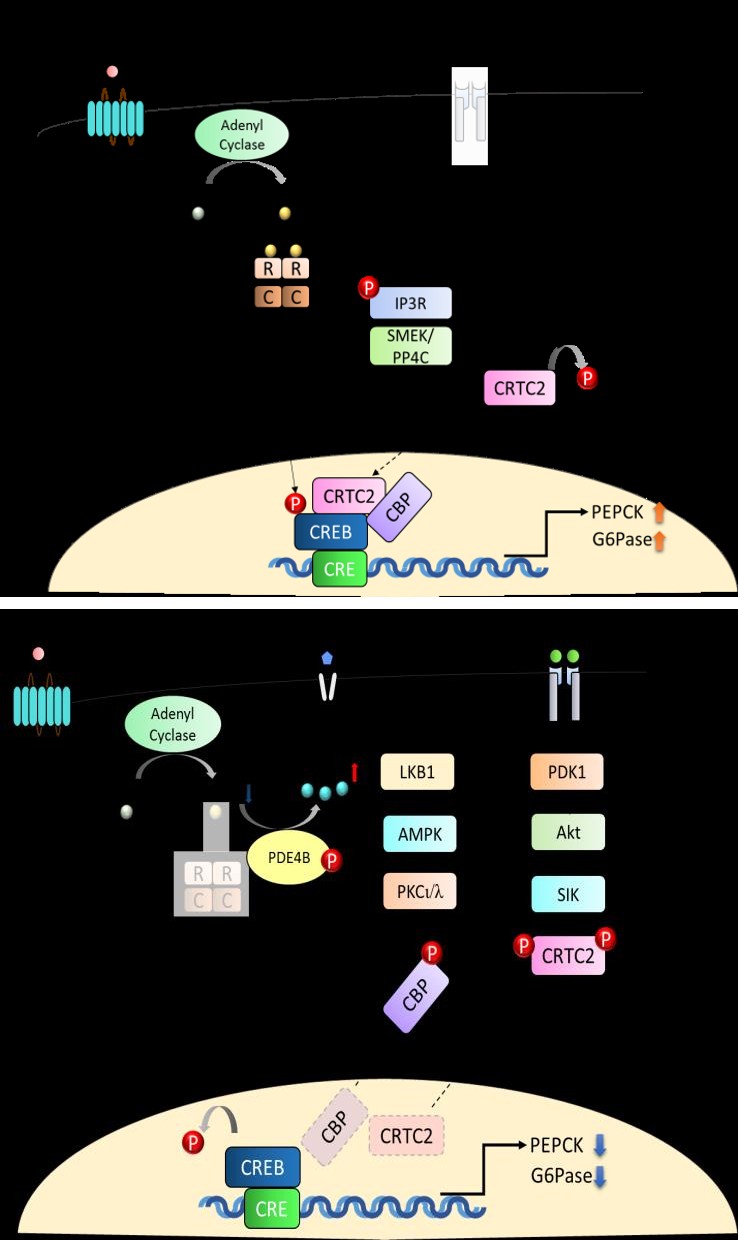
Figure 1(A): Suggested mechanism by which hepatic gluconeogenesis is enhanced upon glucagon stimulation in diabetes or during fasting. Dephosphorylation of CBP and CRTC2 is required for their nuclear localization and subsequent complex formation with CREB. These co-activators potentiate the transcriptional activity of CREB thereby increase hepatic gluconeogenesis upon glucagon stimulation.
Modulation of Gluconeogenic Signaling: A Therapeutic Target for Diabetes
The signaling mechanisms regulating gluconeogenesis that have been discussed above may represent therapeutic targets for diabetes, given that hyperglucagonemia induced by increased pancreatic alpha cell activity has emerged as one of the main pathophysiological features of type 2 diabetes [18]. Metformin, one of the most frequently prescribed oral anti-diabetic agents, attenuates hepatic gluconeogenesis in a number of ways. The therapeutically effective concentration (≤ 80 µM) of metformin was sufficient to activate AMPK, leading to CBP phosphorylation and inhibition of the cAMP-PKA-CREB pathway [19]. However, when higher concentrations are used, metformin inhibits mitochondrial complex I, thereby increasing intracellular AMP in mouse hepatocytes [20]. This results in inhibition of adenyl cyclase activity, thus reducing intracellular cAMP concentrations. Furthermore, a very recent paper showed that a small-molecule AMPK activator inhibits gluconeogenesis by activation of phosphodiesterase 4B [21]. Taken together, these findings indicate that AMPK activators attenuate gluconeogenesis by modulation of cAMP-PKA-CREB pathway. In summary, regulation of the hepatic cAMP-PKA-CREB pathway using small molecule inhibitors might be an attractive option for future therapy of diabetes in cases where glucagon action is inappropriately enhanced.
References
-
Altarejos JY, Montminy M (2011) CREB and the CRTC co-activators: sensors for hormonal and metabolic signals. Nat Rev Mol Cell Biol 12(3): 141-151.
-
Taylor SS, Buechler JA, Yonemoto W (1990) cAMP- dependent protein kinase: framework for a diverse family of regulatory enzymes. Annu Rev Biochem 59: 971-1005.
-
Taylor SS, Bubis J, Toner-Webb J, Saraswat LD, First EA, et al. (1988) CAMP-dependent protein kinase: prototype for a family of enzymes. FASEB J 2(11): 2677-2685.
-
Saltiel AR, Kahn CR (2001) Insulin signalling and the regulation of glucose and lipid metabolism. Nature 414(6865): 799-806.
-
Dentin R, Hedrick S, Xie J, Yates J 3rd, Montminy M (2008) Hepatic glucose sensing via the CREB coactivator CRTC2. Science 319(5868): 1402-1405.
-
Herzig S, Long F, Jhala US, Hedrick S, Quinn R, (2001) CREB regulates hepatic gluconeogenesis through the coactivator PGC-1. Nature 413(6852): 179-183.
-
Dentin R, Liu Y, Koo SH, Hedrick S, Vargas T (2007) Insulin modulates gluconeogenesis by inhibition of the coactivator TORC2. Nature 449(7160): 366-369.
-
Chrivia JC, Kwok RP, Lamb N, Hagiwara M, Montminy MR, et al. (1993) Phosphorylated CREB binds specifically to the nuclear protein CBP. Nature 365(6449): 855-859.
-
Kwok RP, Lundblad JR, Chrivia JC, Richards JP, Bachinger HP, et al. (1994) Nuclear protein CBP is a coactivator for the transcription factor CREB. Nature 370(6486): 223-226.
-
Sands WA, Palmer TM (2008) Regulating gene transcription in response to cyclic AMP elevation. Cell Signal 20(3): 460-466.
-
Yoon YS, Lee MW, Ryu D, Kim JH, Ma H, et al. (2010) Suppressor of MEK null (SMEK)/protein phosphatase 4 catalytic subunit (PP4C) is a key regulator of hepatic gluconeogenesis. Proc Natl Acad Sci USA 107(41): 17704-17709.
-
Wang Y, Li G, Goode J, Paz JC, Ouyang K, et al. (2012) Inositol-1,4,5-trisphosphate receptor regulates hepatic gluconeogenesis in fasting and diabetes. Nature 485(7396): 128-132.
-
Koo SH, Flechner L, Qi L, Zhang X, Screaton RA, et al. (2005) The CREB coactivator TORC2 is a key regulator of fasting glucose metabolism. Nature 437(7062): 1109-1111.
-
Oh KJ, Park J, Kim SS, Oh H, Choi CS, et al. (2012) TCF7L2 modulates glucose homeostasis by regulating CREB- and FoxO1-dependent transcriptional pathway in the liver. PLoS Genet 8(9): e1002986.
-
Wang Y, Inoue H, Ravnskjaer K, Viste K, Miller N, et al. (2010) Targeted disruption of the CREB coactivator Crtc2 increases insulin sensitivity. Proc Natl Acad Sci USA 107(7): 3087-3092.
-
He L, Sabet A, Djedjos S, Miller R, Sun X, et al. (2009) Metformin and insulin suppress hepatic gluconeogenesis through phosphorylation of CREB binding protein. Cell 137(4): 635-646.
-
Ravnskjaer K, Kester H, Liu Y, Zhang X, Lee D, et al. (2007) Cooperative interactions between CBP and TORC2 confer selectivity to CREB target gene expression. EMBO J 26(12): 2880-2889.
-
Defronzo RA (2009) Banting Lecture. From the triumvirate to the ominous octet: a new paradigm for the treatment of type 2 diabetes mellitus. Diabetes 58(4): 773-795.
-
Cao J, Meng S, Chang E, Beckwith-Fickas K, Xiong L, et al. (2014) Low concentrations of metformin suppress glucose production in hepatocytes through AMP- activated protein kinase (AMPK). J Biol Chem 289(30): 20435-20446.
-
Miller RA, Chu Q, Xie J, Foretz M, Viollet B, et al. (2013) Biguanides suppress hepatic glucagon signalling by decreasing production of cyclic AMP. Nature 494(7436): 256-260.
-
Johanns M, Lai YC, Hsu MF, Jacobs R, Vertommen D, et al. (2016) AMPK antagonizes hepatic glucagon- stimulated cyclic AMP signalling via phosphorylation- induced activation of cyclic nucleotide phosphodiesterase 4B. Nat Commun 7: 10856.
- Investigation of Polymorphisms in PPAR-Ɣ and TRHR Genes and their Impact on Turkish Diabetic and Obese Individuals
- The Impact of Aircraft Noise Exposure on the Efficacy of Empagliflozin Therapy in an Animal Model of Obesity
- Rooibos Mitigates Metabolic and Inflammatory Dysfunctions in Mice Fed a High-Carbohydrate Diet
- Synergistic Effect of Combined Leaf Extract of Vernonia amygdalina, Ocimum gratissimum, and Zingiber officinale Tuber on Phytochemical Profile, Antioxidant Activity, Serum Insulin, and Biochemical Parameters in Streptozotocin-Induced Diabetic Rats
- Investigation of Cardiovascular Responses to Aerobic Exercise in Obese University Students
- A Look at the Phase Angle Obtained by Electrical Bioimpedance