
Effect of Storage Time on Spiced Non-Alcoholic Beverage Made from Tiger-Nut Blends (Kunun Aya)
Kunun-aya is a traditional non-alcoholic beverage widely consumed in Northern Nigeria especially during the dry season. The beverage was prepared from tiger nut with the addition of spices such as cloves, date and ginger at different ratio of blends. The samples were stored at 4°C for 5 days and the effects of spices on their proximate, microbial and sensory properties were evaluated. Fresh tiger nuts and spices were purchased from Kure Ultra-modern market in Minna, Niger State. The tiger nut seeds were sorted and foreign materials, bad/cracked nuts, which may affect the taste and keeping quality of the drink were removed, washed and rinsed with portable water then soaked overnight to soften the fibre and to remove off-flavour. One kilogram of the fresh tiger nuts was blended several times into slurry with water. The slurry was pressed using muslin cloth to recover the extract. A 9-point hedonic scale was used to assess the sensory attributes of the spiced drink based on mouth feel, texture, taste, aroma, appearance and general acceptability. Five samples of the spiced drink were analyzed for total energy, crude protein, fat, carbohydrate, ash, crude-fibre and moisture contents. Results of the proximate analyses revealed a range of 87.4-90.0% for moisture which was high. The crude protein ranged from 3.3-3.6 with the samples containing tiger nut and date being significantly different from the others. The fat content ranged from 2.5-4.8, while the energy and carbohydrate contents ranged between 56.6-71.7 and 1.74-6.1 respectively. The bacterial count of the Kunun-aya samples ranged from 1.2 - 9.2×10⁴ CFU/ml and fungal count ranged from 1.2-9.0×10⁴ CFU/ml on days 1, 3 and 5, respectively. Bacterial and fungal counts of the samples generally increased with the storage period and the samples with 20% inclusion of clove and 10% inclusion of ginger, clove and date respectively were the most acceptable among the treated samples. No significant differences existed among the treated samples in terms of mouth feel, aroma, taste, consistency and appearance. The study revealed a nutritious and acceptable spiced drink from tiger-nut which can serve as a substitute to alcoholic and carbonated beverages.
Materials and Methods
Fresh tiger nuts (Cyperus esculentus) and spices, ginger, clove and date were purchased from Kure Ultra- modern market, Minna, Niger State.
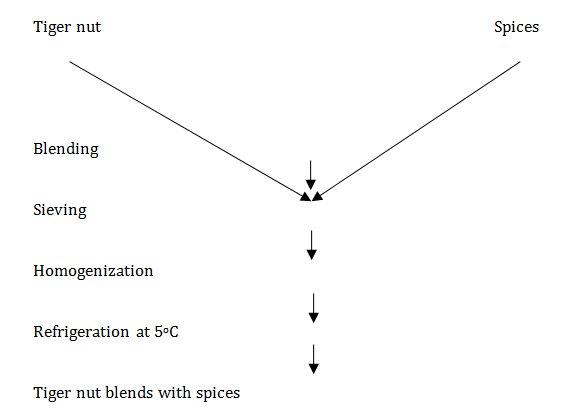
One kilogramme of the tiger nuts was steeped in distilled water for 8 hours. The tiger-nuts were drained and blanched at 70 ᵒC for 5 minutes mainly to inactivate enzymes that might cause clumping of the extract. The fresh tiger nuts were then blended several times into slurry with water made up to 6L in a Q-link auto-clean blender. The slurry was pressed using muslin cloth to extract the milk. The extract was pasteurized at 72°C for 5 seconds and homogenised and rapidly cooled. The flow chart for tiger nut milk drink (TMD) also called Kunun -aya production is shown in (Figure 1).
Preparation of Tiger Nut Milk (Kunun-Aya) with Added Spices
The tiger nut milk was mixed with ginger, clove, date and sugar at a varied ratio of 8:2 and 7:1:1:1, i.e. tiger nut to ginger, to clove, to date. The milk was stirred thoroughly to have the spices and sugar properly dissolved. The resulting tiger-nut milk samples obtained were pasteurized at 70 °C for 30 minutes in a water bath with continuous stirring. The samples were allowed to cool and a representative sample was taken from each sample for analysis while the remaining portions of each sample were stored in a
3 Food Science and Nutrition Technology
Proximate Composition
Moisture, crude protein, total ash, crude fibre and carbohydrate contents were determined using standard methods as outlined by AOAC [10]. Briefly, oven drying method at 105°C for 5 h for moisture determination, micro -Kjeldahl method for crude protein, total ash was obtained by igniting 2g sample at 550oC for 4 h using muffle furnace. Crude fibre was determined using digestion method and carbohydrate was estimated by the difference [100 - (% water + % protein + % fat + % ash + % crude fibre)]. Crude fat was determined using standard soxhlet extraction method with diethyl ether as the solvent as specified by AOAC [10].
Microbial Plate Counts
Total bacterial and fungal plate counts of the kunun- aya samples were carried out according to the method of Musa & Hamza [11]. The nutrient agar (NA) and the potato dextrose agar (PDA) used for the isolation of bacteria and fungi, respectively were prepared according to the manufacturer’s instructions and the counts were expressed in cfu/ml.
Sensory Evaluation
The sensory quality attributes including taste, appearance, texture, aroma and overall acceptability of the five kunun-aya samples were evaluated by 40 member
Statistical Analysis
All evaluation tests were conducted in triplicates. Data obtained for the proximate composition, microbial plate counts and sensory evaluation were subjected to one way Analysis of Variance (ANOVA) and differences among the means were determined using Duncan multiple range test (DMRT). Statistical Package for Service Solution (SPSS) Version 23.0 was used to analyze the data and p <0.05 was considered to be statistically significant. Results were expressed as mean ±standard deviation.
Results And Discussion
Proximate Composition of Spiced Tiger Nut- Milk Drink (Kunun-Aya)
The effect of adding different spices on Kunun-aya is presented in (Tables 1&2). The effect varied among the parameters. The results indicated that the moisture content which ranged from 87.38% in kunun-aya treated with spices to 87.7% in the control formed the major component of the Kunun-aya samples and consequently, made it a good alternative to soft drinks in the supply of water to human body. The values obtained were comparable to 81.7 - 86.4% and 92.4% reported by Awonorin & Udeozor [13] and Bristone, et al. [14], Kayode, et al. [3] respectively but were higher than the 62.8-82.5% reported by Musa & Hamza [11] for tiger-nut milk. There was significant difference (p˂0.05) between moisture content of the control and the treated samples with the treated samples having significantly higher values.
The high moisture content of the kunun-aya got from the present study could be responsible for its poor storage quality as high moisture content is reported to encourage microbial growth during storage [3].
The Kunun-aya treated with date had the highest protein content of 3.6% while the lowest value of 3.3% was recorded for ginger spiced Kunun-aya. The crude protein obtained was comparable to the value range of 2.7 - 3.3% reported by Musa & Hamza [11] but was higher than 0.8% and 1.0% reported by Bristone, et al. [14] & Nwobosi, et al. [8], respectively. This may be due to the
4 Food Science and Nutrition Technology
| Sample | MC% | ASH% | FAT% | CP% | CHO% | EV (Kcal) | ||||||||
|---|---|---|---|---|---|---|---|---|---|---|---|---|---|---|
Table 1: Proximate composition of spiced tiger nut-milk drink
Values are mean ± standard error. Means on the same column with different superscript letter are significantly different (p<0.05) while those with the same superscript letter are not significantly different (p>0.05). KEY: Sample A=80% Tiger nut and 20%Ginger Sample B=80% Tiger nut and 20%Clove Sample C=80% Tiger nut and 20%Date Sample D=70% Tiger nut, 10%Ginger, 10%Clove and 10%Date Control=100% Tiger nut milk Table 1: Proximate composition of spiced tiger nut-milk drink
| Sample | MC% | ASH% | FAT% | CP% | CHO% | EV (Kcal) | ||||||||
|---|---|---|---|---|---|---|---|---|---|---|---|---|---|---|
Table 2: Proximate composition of spiced tiger nut-milk drink Spices such as cloves, ginger and garlic had been reported to co
A 89.50±0.01b 0.64±0.01a 4.81±0.01a 3.32±0.01e 1.74±0.01e 63.58±0.00b
B 90.01±0.01a 0.21±0.01d 3.52±0.02c 3.43±0.01c 2.83±0.01d 56.57±0.01e
C 87.38±0.01e 0.55±0.01b 2.48±0.01e 3.56±0.01a 6.05±0.01a 60.64±0.01c
D 87.92±0.01c 0.25±0.01e 2.54±0.01d 3.53±0.01b 5.75±0.01b 58.88±0.01d
Control 87.65±0.01d 0.29±0.01c 4.71±0.01b 3.37±0.01d 3.98±0.01c 71.71±0.01a
Values are mean ± standard error. Means in the same column with different superscript letters are significantly different (p<0.05) while those with the same superscript letters are not significantly different (p>0.05). KEY: Sample A=80% Tiger nut and 20%Ginger Sample B=80% Tiger nut and 20%Clove Sample C=80% Tiger nut and 20%Date Sample D=70% Tiger nut, 10%Ginger, 10%Clove and 10%Date Control=100% Tiger nut milk Table 2: Proximate composition of spiced tiger nut-milk drink Spices such as cloves, ginger and garlic had been reported to contain considerable amounts of fat Otunola, et al. [7], Kayode, et al. [3]. Fat contributes substantially to the energy value of food. Interestingly, the carbohydrate content of the Kunun-aya in the present study generally increased with the addition of individual spices which made most of the values higher than the 1.7 - 2.5% and 5.8% reported by Awonorin & Udeozor [13] and Bristone, et al. [14] respectively. Carbohydrate is known to serve as a primary source of energy in diets [17].
Microbial Loads of Kunun-Aya Treated with Different Spices
Time in days on the bacterial and fungal counts of kunun-aya treated with different spices are represented in Tables 3and 4. It was observed that microbial growth increased throughout the storage period. The presence of some of these microorganisms may be due to storage time of the product at ambient temperature which is a factor that may result in spoilage. The presence of microbial growth in the sample can be caused by contamination that
5 Food Science and Nutrition Technology
| Samples | Fresh | 1 | 2 | 3 | 4 | |||||||
|---|---|---|---|---|---|---|---|---|---|---|---|---|
Table 3: Total bacterial count (cfu/ml) of _Kunun-aya_ fresh and stored samples with spices.
NM = numerous KEY Sample A =80% Tiger nut and 20%ginger Sample B = 80%Tiger nut and 20%cloves Sample C = 80%Tiger nut and 20%date Sample D = 70%Tiger nut and 10%ginger, 10%cloves and 10%date Control = 100% Tiger nut Table 3: Total bacterial count (cfu/ml) of Kunun-aya fresh and stored samples with spices.
The presence and increased bacterial count observed health risk on susceptible populations such as infants, in all the samples may be due to bacteria that survived at young children and people with compromised immune low temperature. In the spices All the bacteria counts systems as observed by Obire, et al. [19]. observed were indicators of contamination while bacteria in the drink are considered as an indication of bacteria The fungi found on these drinks may be linked to pollution by human origin that may be introduced during contamination through air or dust, packaging material or processing or packaging. The presence of the bacteria in processing environment (Table 4). the present produced Kunun-aya may pose a special
| Samples | Fresh | 1 | 2 | 3 | 4 | |||||||
|---|---|---|---|---|---|---|---|---|---|---|---|---|
Table 4: Total fungal count (cfu/ml) of _Kunun-aya_ fresh and stored samples with spices.
KEY Sample A =80% Tiger nut and 20%ginger Sample B = 80%Tiger nut and 20%cloves Sample C = 80%Tiger nut and 20%date Sample D = 70%Tiger nut and 10%ginger, 10%cloves and 10%date Control = 100% Tiger nut Table 4: Total fungal count (cfu/ml) of Kunun-aya fresh and stored samples with spices.
6 Food Science and Nutrition Technology
Sensory Analysis of Spiced Tiger Nut-Milk Drink
The effect of storage time of spiced beverage on the sensory attributes of Kunun-aya is shown in (Table 5). There were significant differences (p˂0.05) between the organoleptic properties of the treated Kunun-aya samples compared with the control having the highest mean
| Sample | Mouth feel | Aroma | Taste | Consistency | Appearance | General | ||||||||||||||
|---|---|---|---|---|---|---|---|---|---|---|---|---|---|---|---|---|---|---|---|---|
| Acceptability |
Table 5: Sensory analysis of spiced tiger nut-milk drink.
A 2.93±0.16c 2.53±0.15bc 3.10±0.17c 2.73±0.13b 2.13±0.13a 2.95±0.17c B 3.98±0.15d 3.20±0.18d 4.20±0.13d 3.45±0.12c 3.38±0.20c 3.70±0.15d C 1.55±0.12a 2.00±0.16a 1.63±0.14a 2.03±0.12a 1.78±0.14a 1.60±0.13a D 3.05±0.13c 3.90±0.12cd 3.38±0.11c 2.95±0.12b 2.85±0.15b 3.05±0.11c Control 4.45±0.15b 4.40±0.14ab 4.45±0.13b 4.63±0.14b 4.18±0.15a 4.43±0.15b Values are mean ± standard error of duplicate determination. Means on the same column with different letter superscript are significantly different (P<0.05) while does with the same letters are not significantly different (P>0.05). KEY: Sample A=80% Tiger nut and 20%Ginger Sample B=80% Tiger nut and 20%Clove Sample C=80% Tiger nut and 20%Date Sample D=70% Tiger nut, 10% Ginger, 10%Clove, and 10%Date Control=100% Tiger nut milk Table 5: Sensory analysis of spiced tiger nut-milk drink.
References
-
Bamishaiye EI, Bamishaiye OM (2011) Tiger Nut: As a Plant, Its Derivatives and Benefits. African Journal of Food, Agriculture, Nutrition and Development 11(5): 5157-5159.
-
Muhammad NO, Bamishaiye EI, Bamishaiye OM, Usman LA, Salawu MO, et al. (2011) Physicochemical Properties and Fatty Acid Composition of Cyperus esculentus (Tiger Nut) Tuber Oil. Bioresearch Bulletin 5: 51-54.
-
Kayode RM, Joseph JK, Adegunwa MO, Dauda AO, Akeem SA, et al. (2017) Effects of Addition of Different Spices on the Quality Attributes of Tiger-Nut Milk (Kunun-Aya) During Storage. Journal of Microbiology, Biotechnology and Food Sciences 7(1): 1-6.
-
Adejuyitan JA (2011) Tigernut Processing: Its Food Uses and Health Benefits. American Journal of Food Technology 6(3):197-201.
-
Bosch L, Alegría A, Farré R (2005) RP-HPLC determination of tigernut and Orgeat amino acid contents. Food Science Technology International 11(1): 33-40.
-
Ene-Obong HN, Onuoha NO, Aburime LC, Mbah O (2015) Nutrient composition, phytochemicals and antioxidant activities of some indigenous spices in Southern Nigeria. 11th IFDC Hyderabad, India, pp: 1- 31.
-
Otunola GA, Oloyede OB, Oladiji AT, Afolayan AJ (2010) Comparative analysis of the chemical composition of three spices - Allium sativum L. Zingiber officinale Rosc. and Capsicum frutescens L. 7 Food Science and Nutrition Technology
-
Nwobosi PNU, Isu NR, Agarr OO (2013) Influence of pasteurization and use of natural tropical preservatives on the quality attributes of tiger nut drink during storage. International Journal of Food and Nutrition Science 2: 27-32.
-
Gambo A, Da’u A (2014) Tiger nut (_Cyperus_ _esculentus_): composition, products, uses and health benefits - a review. Bayero Journal of Pure and Applied Sciences 7(1): 56-61.
-
AOAC (2005) Official Methods of Analysis 19th (Edn.), Washington, DC, USA: Association of Official Analytical Chemists.
-
Musa AA, Hamza A (2013) Comparative analysis of locally prepared “kunun-aya” (Tiger nut milk) consumed by students of Kaduna state university, Kaduna, Nigeria. Science World Journal 8(2): 13-18.
-
Ihekoronye AI, Ngoddy PO (1985) Integrated Food Science and Technology for the Tropics. London and Oxford: Macmillan Education Ltd.
-
Awonorin SO, Udeozor LO (2014) Chemical 20. Oluwadara PO, Abiodun OO, Mulunda M, Olubukola Properties of Tiger nut-Soy Milk Extract. IOSR Journal OB (2019) Prevalence of Mycotoxins and Their of Environmental Science, Toxicology and Food Consequences on Human Health. Toxicological Technology 8(3): 87-98. Research 35(1): 1-7.
-
Bristone C, Badau MH, Igwebuike JU, Igwegb AO (2015) Production and Evaluation of Yoghurt from
-
Belewu MA, Belewu KY (2007) Comparative physico- chemical evaluation of tiger-nut, soybean and coconut milk sources. Int. J Agric Biol 9: 785-787.
-
Belewu MA, Abodunrin OA (2008) Preparation of Kunun from unexploited rich food source: Tiger nut (Cyperus esculentus). Pak J Nutr 7(1): 109-111.
-
Grieshaber M (2013) Metabolic regulation of energy metabolism. Exogenous and endogenous influences on metabolic and neural control 1: 225-242.
-
Tembo L, Chiteka ZA, Kadzere I, Festus KA, Tagwira F (2008) Storage temperature affects fruit quality attributes of Ber (Ziziphus mauritiana Lamk.) in Zimbabwe. African Journal of Biotechnology 7(8): 3092-3099.
-
Obire O, Tamuno DC, Wemedo SA (2005) Bacteriological Water Quality of Elechi Creek in Port Harcourt, Nigeria. Journal of Applied Science Environmental and. Management 9(1): 79-84.
- The Role of Podocyte Apoptosis and the Involvement of SIRT1 in Diabetic Nephropathy
- Dealcoholization of Beer by Osmotic Distillation for the Beverage Industry
- Biopolymer-Based Edible Packaging- Biomaterials, Methods, and Applications in Food Industry: An Updated Review
- Influence of Bioprocessing Methods on 'China Rice' (Gawal R1), and Soyabean Supplementation on the Quality of Complementary Food
- Cassava (Manihot esculenta) Varietal Growth, Yield and Cyanide Content Performance in Three Sites in the South- Eastern Semi Arid Regions of Kenya
- Food Waste Treatment, Recycling, Management and Production of Value-Products-An Update on Methodologies and Current Trends