
Sales Environment and Hygienic Practices of Street Food in N'Djamena, Chad
The preparation and sale of street food is a sociocultural and economic fact in all countries of the world. For more than a decade, this activity has a remarkable growth given the rampant urbanization of African cities in general and N'Djamena, the capital of Chad in particular, the development of the middle class and the development of work both formally and informally. However, the hygienic failures observed around this activity constitute a source of contamination of these foods. The objective of this work is to evaluate sales environment and hygienic practices of Street Food in N'Djamena, Chad. The study was conducted from October 2013 to January 2018 in N'Djamena, Chad. Thus 809 sellers and 455 consumers were surveyed in the public squares of N'Djamena. The results showed a strong presence of women with a proportion of 63.04%. Our study showed that 66.63% of vendors sold in an unclean environment, 61.81% kept their food in pots placed on the floor and 100% of the same vendors did not wear gloves or bucco-nasal masks. The surveyed vendors (92.58%) received no training in hygiene and food technology. The majority (90.99%) of consumers ate their foods with bare hands and 93.33% said they found undesirable elements in foods. Only 23.08% of consumers said there is no risk of food transmitting disease Improving the environmental conditions of the preparation areas and the sales site will prevent foodborne diseases. The competent authorities are called upon to train these sellers but also to implement clear texts with regular monitoring and follow-up plans to improve the hygienic conditions of the latter.
Introduction
Street food refers to all food and beverages prepared and / or sold by vendors in streets and other public places for immediate consumption or consumption without further processing or preparation [1, 2]. These street foods, because of their ease of access, their relatively low price, etc. provide food security for low-income urban population groups [3, 4]. For example, many households save on their daily income through the use of street food [5, 6]. Today, this sector has become a societal phenomenon due to its socio-economic and nutritional importance [7, 8, 9]. It provides a steady source of income for millions of people, men and women (many of them without training in food hygiene) in developing countries.
Studies in Africa, Asia, and South America suggest that some street food handlers lack protective equipment such as aprons, berets, or facial tissues [10, 11, 12, 13]. The lack of training of these producers could be a compromising element for the safety of food offered on public roads [10, 13]. The study conducted by Nieto-Montenegro and collaborator in 2008 revealed that the educational lessons alone produced a significant positive improvement in hygienic knowledge related to washing hands after using the toilet [14].
The preparation and sale of street foods takes place in an environment that can in some cases guarantee the quality of these foods and in other cases help to alter them. Several studies have clearly shown that these foods are sold close to open gutters, with the presence of stray animals and even insects that are true vectors of contamination [8, 11, 13, 15]. The main causes of the unhealthy nature of these foods come from non- compliance with good hygiene practices in their processing, cooking, preservation or sale [16, 17, 18].
In Chad, a survey was conducted among street food vendors through the Research and Support Project for Food Safety in Street Food (PRASAR). The study shows that all food categories exist on the street. The majority of salespeople moved in the heap without specific training and these sellers were rather fixed than ambulant. Foods are often exposed to the outdoors. Many deficiencies in hygiene practices have been identified [18]. According to the World Health Organization (WHO), food-borne illnesses significantly degrade health and reduce economic growth in developed and developing countries [19].
The growth rate in N'Djamena is 2.9% [20]. As in other African cities, the expansion of the population of N’Djamena and the many daily constraints that this population faces has led to an increase in the number of street vendors in recent years. The objective of this work is to study the sales environment and hygiene practices in the street food sector in N'Djamena, Chad, to prevent foodborne illness.
Material and Methods
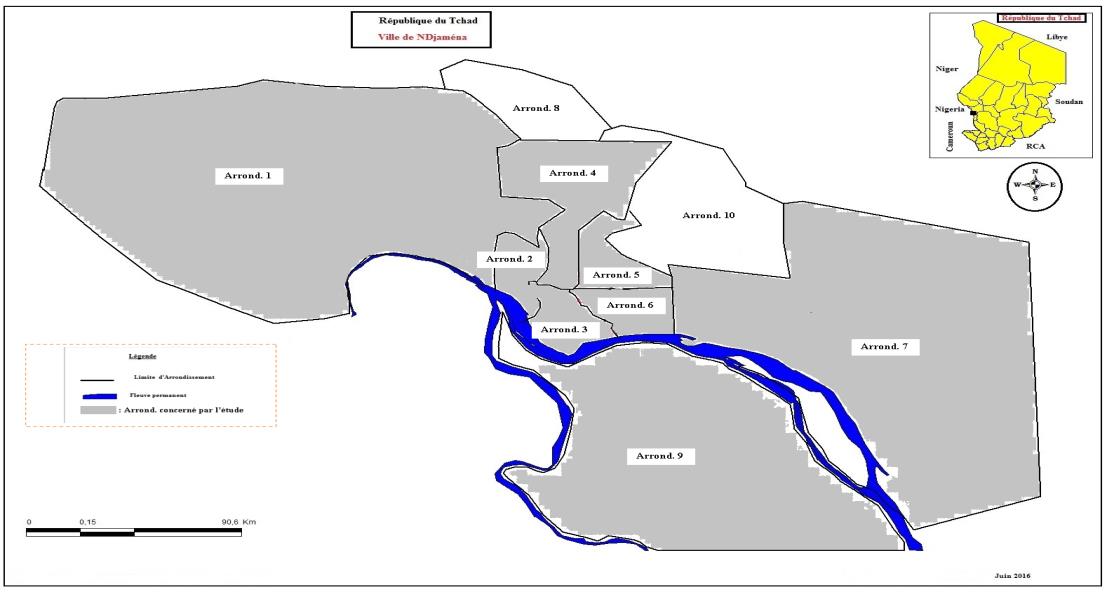
This study was carried out in N’Djamena, capital of the Republic of Chad. N’Djamena subdivided in ten districts which comprise sixty-four quarters distributed unevenly. Among ten districts, eight were drawn at random for this study (Figure 1).
The sample size for the surveys was estimated by the simple random sampling method taking ɛ = 1.96 for an accuracy α = 5%, the formula is as follows:
Q = 1 - p and being the precision. The prevalence of intoxication is estimated to be 5% for sellers and 10% for consumers (the phenomenon is more important for consumers who consume compared to sellers). So, for the ( ) ( ) size of sellers invistigate, and for the ( ) ( ) size of consumers to investigate, This resulted in a number of sellers equal to 75 and a number of consumers equal to 140. However, given the availability, the interviews took place with 809 sellers and 455 consumers.
As far as the seller is concerned, the questionnaire dealt with Sex, Training in hygiene and food technology, Sales environment (dust, wind, garbage nearby, sewage around the sale), Food protection, Cutting tools for raw and cooked foods, Source of water used by sellers, State of dish water, Apron Wear, Gloves use, Buco-nasal mask use, Clean clothes, Hair cover, Food preservation materials, Ustensils, Handling of food by customers, Manipulation of money by sellers, Medical follow-up of street food sellers, Taking money by the sellers, Handwashing device, Soap use. The questionnaire included Tools used by guests to eat, Unwanted elements found in foods by consumers, Spoiled/undercooked foods found by consumers, Consumer perception on Vendor Hygiene, Food transmitting disease.
Once in a neighborhood, the investigators placed themselves in the center of the neighborhood in relation to the directions of the warden and one of the four cardinal points is drawn to determine the direction in which the investigators will begin the interviews. The rest of the journey was clockwise until the neighbourhood was swept away. Once at the point of investigation, the different sellers are codified and randomly drawn according to the predefined number. The same operation was carried out for consumers. Those selected to complete the questionnaires received a brief overview of the purpose of the work and the interview was not completed until after the respondent's approval.
The data was processed using R 3.6.0 software (In the processing of statistical data, for a degree of significance p < 0.05, the results obtained were considered significant.
Results and Discussion
Result
Gender and Training in Hygiene and Food Technology for Vendors: The results of our surveys showed a strong presence of women in the sale of street food in the city of N'Djamena (Chad) with a proportion of 63.04%. Ninty two point fifty-eight percent (92.58%) of vendors surveyed received no training in hygiene and food technology (Table 1).
| Sex | (n=809) | ||||
|---|---|---|---|---|---|
| Female Male | 510 (63.04 %) 299 (36.96 %) | ||||
| Training in hygiene and food technology | |||||
| Yes No | 60 (07.42 %) 749 (92.58 %) |
Table 1: Gender and Training in Hygiene and Food Technology for Vendors.
Sales Environment: In the majority of cases (66.63%), food was sold in an environment consisting of dust, winds, nearby garbage and sewage around (dirty). The presence of insects (flies, mosquitoes, etc.) was observed in 67.61% of sellers in all categories (fixed, semi-fixed and mobile). Nine point fifteen percent (9.15%) vendors operated in conditions where animals wandered all around. The 50.19% of respondents did not provide any mechanism to protect the various dishes offered to consumers from possible bad weather (dust, rain, etc.) (Table 2). Hygienic Practices : It also appears that in the 72.06% of cases, the utensils were not sufficiently washed, i.e. summarily cleaned in water that was not sufficiently soapy and loaded with organic matter and then rinse once in water still laden with organic matter. Work tools and water service, shown in Table 2, show that 84.05% of vendors handled food with their bare hands. It was also noted that 41.53% of the vendors surveyed used the same sharp tool to cut both raw and cooked foods. Most (63.29%) producers used water from the Chadian Water Company for preparation and other uses as part of their activities. In 86.03% of cases, dishwashing water was very dirty (not soapy enough and loaded with organic). A high percentage (69.22%) of the outlets surveyed had half a barrel as a hand-washing device for consumers. Only 29.91% of sellers accompanied this hand-washing device with soap.
In terms of personal hygiene, clothing and behavioral standards for sellers (Table 2), 87.27% were not wearing an apron. All (100%) vendors had no masks or gloves. However, 31.64% of these vendors had clean clothing (no oil or dust stains making the garment dirty). We found that 60.57% of growers had a hair gear (scarf or beret).
The same table 2 shows that in the majority of cases (91.97%), customers did not handle the food exposed for sale. However, 95.43% of sellers handled money while serving food. Only 06.06% had regular medical follow- ups.
- Sales environment (dust, wind, garbage nearby, sewage around the sale)
- Clean
- 270 (33.37 %)
- 539 (66.63 %)
- Presence of insects in sales outlets
- Dirty
- Yes
- 547 (67.61 %)
- 262 (32.39 %)
- Presence of animals in sales outlets
- No
- Yes
- 74 (09.15 %)
- 735 (90.85 %)
- No
Table 2: Sales environment.
Majority (90.99%) consumers ate their food with their bare hands. Unwanted items were found in food by 93.33% of consumers. Those who found undercooked or spoiled food accounted for only 20.44 per cent of those surveyed. The large proportion (59.78%) found the sellers to be dirty (dirty clothes) (Table 3).
| Food protection | |
|---|---|
| Yes | 403 (49.81 %) |
| No | 406 (50.19 %) |
| Cutting tools for raw and cooked foods | |
| Same tool for raw and cooked foods | 336 (41.53 %) |
| Different tools for cooked and raw foods | 473 (58.47 %) |
| Tools used by vendors to serve food | |
| Ladle | 129 (15.95 %) |
| Hands | 680 (84.05 %) |
| Source of water used by sellers | |
| Drilling water | 186 (22.99 %) |
| Water from the Chadian Water Company | 512 (63.29 %) |
| Purchase of Water from the Chadian Water Company from water peddlers | 97 (11.99 %) |
| Others (wells, pond, river) | 14 (01.73 %) |
| State of dishwater | |
| Dirty water | 696 (86.03 %) |
| Less clean water | 98 (12.11 %) |
| Clean water | 15 (01.86 %) |
| Apron Wear | |
| Apron use | 103 (12.73 %) |
| Apron non use | 706 (87.27 %) |
| Gloves use | |
| Yes | 0 (00.00 %) |
| No | 809 (100.00 %) |
| Buco-nasal mask use | |
| Yes | 0 (00.00 %) |
| No | 809 (100.00 %) |
| Clean clothes | |
| Yes | 256 (31.64 %) |
| No | 553 (68.36 %) |
| Hair cover | |
Table 3: Consumer Perception of Food Quality and Hygiene of Sellers.
| Yes | 490 (60.57 %) |
| No | 319 (39.43 %) |
| Food preservation materials | |
|---|---|
| Pots on fire | 56 (06.92 %) |
| Pot on the floor | 500 (61.81 %) |
| Plastic bucket | 225 (27.81 %) |
| Cooler | 28 (03.46 %) |
| Ustensils | |
| Clean | 183 (22.62 %) |
| Not enough washed | 583 (72.06 %) |
| Dirty | 43 (05.32 %) |
| Handling of food by customers | |
| Yes | 65 (08.03 %) |
| No | 744 (91.97 %) |
| Manipulation of money by sellers | |
| Same hand used to serve foods | 772 (95.43 %) |
| Other hand | 37 (04.57 %) |
| Medical follow-up of street food sellers | |
| Yes | 49 (06.06 %) |
| No | 760 (93.94 %) |
| Taking money by the sellers | |
| Same hand used to serve | 772 (95.43 %) |
| Other hand | 37 (04.57 %) |
| Handwashing device | |
| Half drum | 560 (69.22 %) |
| kettle | 233 (28.80 %) |
| Other | 16 (01.98 %) |
| Soap use | |
| Yes | 242 (29.91 %) |
| No | 567 (70.09 %) |
Table 4: Consumer Perception of Food Quality and Hygiene of Sellers.
- Table 4 shows that only 23.08% of consumers said there is no risk of food transmitting disease. However, the
- 50.55% and 26.37% said it was possible to have stomach aches or get typhoid fever respectively when eating poor quality food (Table 5).
- Tools used by guests to eat
- Spoon
- 41 (09.01 %)
- 414 (90.99 %)
- Unwanted elements found in foods by consumers
- Hand
- Yes
- 411 (90.33 %)
- No
- 44 (09.67 %)
- Spoiled/undercooked foods found by consumers
- Yes
- 93 (20.44 %)
- 362 (79.56 %)
- Consumer perception on Vendor Hygiene
- No
- Clean
- Middle
- 79 (17.36 %)
- 42 (09.23 %)
- 272 (59.78 %)
- Dirty
- Indifferent
- 62 (13.63 %)
- Food transmitting disease
- Stomach aches
- 230 (50,55 %)
- 120 (26,37 %)
- 105 (23,08 %)
- Typhoid fever
- Diseases transmitted by food
Table 5: Consumer Perception of Food Quality and Hygiene of Sellers.
It is important for street food sellers to be knowledgeable and aware of good hygiene practices in order to maintain the health of consumers. Even when food is safe from insidious levels of microorganisms, the risk of foodborne illness still exists. Maintaining hygiene standards in all aspects of food preparation sold in public places is fundamental. It has been observed that in 66.63% of cases, food is sold in an unclean environment. Nurudeen, et al. [15] also came to the same conclusion. Contrary to these data, other studies have shown that street foods are sold largely in a clean environment [21, 15, 11]. The presence of insects at the point of sale was noted in 67.61% of cases, confirming the work of Nurudeen, et al. [15], Hilario [13], Ntow, et al. [11], which revealed that there is always the presence of insects around the outlets. We observed the presence of evidence of relationship (p < 0,05) between unclean environment and the presence of insects at the point of sale. We found that in the majority of cases (50.19%) the food was not protected. Our results are contrasted by those of Criselda, et al. [21] who revealed in their work that food sold in public places is still protected. During the time of sale, most of the food is kept in pots placed on the floor (61.81%) and only 6.92% of the time that food is kept in the fire. In their study, Ntow, et al. [11] found that in 21.39% of cases food was kept on fire during the sale. Poor food preservation associated with the increased presence of insects and unsanitary environment could contribute to food contamination. The use of bare hands to serve food was observed in 84.05% of salespeople surveyed, in Nigeria, Chukuezi [12] found a rate much lower than ours (47.69%). Hand-washing can lead to cross-contamination, resulting in the introduction of microbes into healthy foods. Tap water produced by the Chadian Water Company (STE) is widely used in the food production chain sold in public squares (63.29%). Studies in Benin and Uganda have found that tap water is the main water used in the street food production chain [22, 23]. We observed in our study that the main handwashing device was half-barrel (69.22%). However, the presence of soap beside these devices is only found in 29.91% of the cases studied. Unlike our work, Criselda, et al. [21] found that there is only occasionally a hand washing device (sink) but each time we noted the presence of soap. Our study reported for wearing apron, covered hair and handling money with the same bare hand used to serve, rates of 12.73%, 60.57% and 95.43% respectively. In his study, Chukuezi found that 42.86% of the respondents wore aprons. Adjrah [23] also reported that 57.78% of the street food vendors surveyed covered their hair. In keeping with our findings, Chukuezi [12] found that 61.90% of the street food vendors surveyed handled money at the same time as food. We also observed the presence of evidence of relationship (p < 0,05) between vendors handled money at the same time as food and vendors who are no training in hygiene and food technology. Approximately 40 to 60% of cases of reported foodborne outbreaks were caused by inadequate handling practices that also include contamination between the cutting board and utensils [24].
Conclusion
The results presented in this study show a failure in good manufacturing practices and good hygiene practices among street food vendors in N'Djamena. The health risks associated with street foods could be minimized if good hygiene practices were followed during the preparation, storage and sale of these foods.
In view of the socio-economic and nutritional benefits of street foods, various measures and arrangements need to be taken to improve their qualities. It would be necessary to sensitize and train street food vendors on good hygiene practices and good food manufacturing practices. Food quality is related to the health of the environment. The production and sale of food must take place in a safe environment away from dust and other vectors such as flies and insects. It is important to sweep up and clean the food preparation media frequently. A clean environment too is one of the conditions necessary for the healthy production of food.
Conflict of Interests
The authors do not declare any conflict of interest.
Acknowledgements
The authors would like to thank the coordination of the Research and Support Project for Street Food Safety (PRASAR) and all its investigators for their financial and technical support during the data collection. Our sincere thanks also go to the highest authorities in Chad country for funding PRASAR.
References
-
Barro N, Tahita MC, Traoré O, Sangaré L, De Souza C, et al. (2008) Risks Associated with Practices, Prosesses and Environment of Ready-to-Eat and Street-ended Foods That Lead to Contamination by Common Foodborne Viruses. In: Hygiene and Its Role in Health. P L Aderson, JP Lachan. Nova Biomedical. New York. USA, pp: 324.
-
Food and Agriculture Organization of the United Nations (FAO) (1988) Street foods. Report of an FAO expert consultation, Yogyakarta, Indonesia. Food Nutr Pap 46: 1-96.
-
Kharel N, Uma P, Prakash TJ (2016) Microbiological assessment of ethnic street foods of the Himalayas. Journal of Ethnic Foods 3(3): 235-241.
-
Barro N (2007) Caractéristiques, facteurs de contamination biochimique et microbienne des aliments vendus sur la voie publique au Burkina Faso et les mesures d’hygiènes pour prévention des infections associées. Th Doct d’Etat Université de Ouagadougou, pp: 252.
-
Ohiokpehai O (2003) Nutritional aspects of street foods in Botswana. Pakistan Journal of Nutrition 2(2): 76-81.
-
Mwangi AM, den Hartog AP, Mwadime RK, van Staveren WA, Foeken DW (2002) Do street food vendors sell a sufficient variety of foods for a healthful diet ? The case of Nairobi. Food Nutr Bull. 23(1): 48-56.
-
Nonato IL, Minussi LOA, Pascoal GB, De-Souza DA (2016) Nutritional Issues Concerning Street Foods. J Clin Nutr Diet 2(1) : 1.
-
Barro N, Nikiema PA, Ouattara CAT (2002) Evaluation de l’hygiène de la qualité microbiologique de quelques aliments de rue et les caractéristiques des consommateurs dans les villes de Ouagadougou et de Bobo-Dioulasso (Burkina Faso). Rev Tech Sci Santé 25: 7-21.
-
Canet C, N’Diaye C (1996) L’alimentation de rue en Afrique. FNA/ANA. 17/18: 4-13.
-
Cortese RDM, Veiros MB, Feldman C, Cavalli SB (2016) Food safety and hygiene practices of vendors during the chain of street food production in Florianopolis, Brazil: Acrosssectionalstudy. Food Control 62: 178-86.
-
Ntow GE, Kwabla MP, Der J (2016) Hygiene Practices Among Food Vendors in Hohoe Township. Cent Afr J Public Health 2(2): 43-50.
-
Chukuezi CO (2010) Food Safety and Hygienic Practices of Street Food Vendors in Owerri, Nigeria. Stud Sociol Sci 110: 50-57.
-
Hilario JS (2015) An Evaluation of the Hygiene and Sanitation Practices Among Street Food Vendors Along Far Eastern University (FEU). Int J Adv Res 3: 604-615.
-
Nieto-Montenegro S, Brown L, La Borde LF (2008) Development and Assessment of Pilot Food Safety Educational Materials and Training Strategies for Hispanic Workers in the Mushroom Industry Using the Health Action Model. Food Control 19: 616-633.
-
Nurudeen AA, Lawal AO, Ajayi SA (2014) A survey of hygiene and sanitary practices of street food vendors in the Central State of Northern Nigeria. J Public Health Epidemiol 6: 174-181.
-
Mufizur RM, Hasibur RM, Nazma PA (2014) Safety Issues of Street Foods in Bangladesh. Time J Biol Sci Tech 2: 21-32.
-
Tidjani A, Bechir M, Moussa A, Dionadji M, Mbairi DG (2016) Les aliments vendus sur la voie publique : Expérience du Projet de Recherche et d’Accompagnement pour la Salubrité des aliments de la Rue (PRASAR) au Tchad ». Revue Scientifique du Tchad - Série spéciale - mai 2016 - Forum National sur la Nutrition et l’Alimentation, pp: 75-86.
-
Ire I (2016) Bacteriological Quality Evaluation and Safety of Randomly Selected Ready-to Eat Foods Sold in Port Harcourt City, Nigeria. JALSI 7: 1-10.
-
Organisation Mondiale de la Santé (OMS) (2013) Salmonella (non-typhoidal).
-
Institut National de la Statistique, des Études Économiques et Démographiques (INSEED)-TCHAD (2011) Deuxième Recensement Général de la Population et de l’Habitat en 2009 au Tchad (RGPH2). Rapport proviso ire, pp: 219.
-
Criselda AT, Che MBA, Silaran FY, Maria Cristina A Bildan (2018) Sanitary conditions of food vending sites and food handling practices of street food vendors: implication for food hygiene and safety. Int J Educ Res 6(3): 31-34.
-
Muyanja C, Nayiga L, Namugumya B, Nasinyama G (2011) Practices, knowledge and risk factors of street food vendors in Uganda. Food Control 22(10): 1551- 1558.
-
Adjrah Y, Soncy K, Anani K, Blewussi K, Karou DS, et al. (2013) Socio-Economic Profile of Street Food Vendors and Microbiological Quality of Ready-to-Eat Salads in Lomé. Int Food Res J 20(1): 65-70.
-
Soares LS, Almeida RC, Cerqueira ES, Carvalho JS, Nunes IL (2012) Knowledge, attitudes and practices in food safety and the presence of coagulase-positive staphylococci on hands of food handlers in the schools of Camaçari, Brazil. Food Control 27(1): 206- 213.
- The Role of Podocyte Apoptosis and the Involvement of SIRT1 in Diabetic Nephropathy
- Dealcoholization of Beer by Osmotic Distillation for the Beverage Industry
- Biopolymer-Based Edible Packaging- Biomaterials, Methods, and Applications in Food Industry: An Updated Review
- Influence of Bioprocessing Methods on 'China Rice' (Gawal R1), and Soyabean Supplementation on the Quality of Complementary Food
- Cassava (Manihot esculenta) Varietal Growth, Yield and Cyanide Content Performance in Three Sites in the South- Eastern Semi Arid Regions of Kenya
- Food Waste Treatment, Recycling, Management and Production of Value-Products-An Update on Methodologies and Current Trends