
Effect of Analogue Milk Enrichment with Whole Soy Bean Flour
The potential of milk enrichment with soybean flour was studied .Yoghourt control Sample A: 100% Milk powder (Dano)and o% wholes soyabean flour, Sample B: 90% fermented milk powder (Dano) and 10% whole soybean flour, Sample C: 80% fermented milk powder (Dano) and 20% whole soybean flour, Sample D: 70% fermented milk powder (Dano) and 30% whole soybean flour, Sample E: 60% fermented milk powder (Dano) and 40% whole soy bean flour were produced respectively. The proximate composition, physio-chemical properties and sensory evaluation were determined using standard methods .The results on proximate obtained showed increase in values for moisture (77.7989.34) %, protein (3.06-9.23) % , fat content (1.57-3.97)% and fibre content (0.18-2.45)%. However, reversed trend was observed for ash and carbohydrate values respectively. The physiochemical analysis results obtained showed decrease in total solids (22.21-10.66)%, total solid non-fat (201.64-6.70)%, TTA (1.34-0.78)%, viscosity (10.54-0.86)Pa.s and PH with had increased values from (4.5-5.13). The sensory evaluation result revealed that there were no significant difference p>0.05 between the control and sample B in appearance but there were significance difference p
Introduction
Consumer interest in healthy eating is shifting towards the potential health benefits of specific food known as functional foods. There has been a considerable interest in functional foods over the past years due to the increasing cost of health care [1], relatively less residue effect and naturally dietary supplement associated with functional foods [2], the growing global concern on nutrition and personal health. Consumers’ interest in relationship with diet and health is on the rise and interest is geared towards wellness through diet.
Probiotics and prebiotics are evolving nutritional concepts in the development of dairy foods particularly functional yoghurt [3]. Probiotics are described as cultures of live microorganisms that are beneficial to health while prebiotics are non-digestible food components that enhance viability of desirable gut bacteria and reduce risk of gastrointestinal diseases or disorders. Recent studies or research attention is focused on the combined use of probiotics and prebiotics generally known as symbiotic, to get their synergistic health properties. Combination of probiotics active culture and prebiotics non digestible food ingredient, beneficially had affected the host by improving the survival of live microbial dietary supplement by stimulating the activity of colon bacteria.
Yoghurt is a coagulated milk product, which results from lactic acid fermentation of milk by probiotics Lactobaczllus bulgarzcus and Streptococcus thermophilus. The beneficial effect of yoghurt containing live and active culture on the digestion of lactose in patient who suffers from lactose intolerance are well documented. The risk of colon cancer and other gastrointestinal diseases which are prevalence in many developed and developing countries is inversely correlated to intake of dietary fiber (a prebiotic). Products such as yoghurt that does not naturally contain fiber is being researched for the possibility of fiber being added to it to reduce the risk of colon cancer and other chronic diseases and improve the health status of the consumers [4]. Although the addition of novel fibers to milk products such as yoghurt is seldomly reported Sendra, et al. [5].
Soybean has a good potential for-application in the functional food industry, as it contains a good protein profiles, isoflavones, and protein oligosaccharides [6]. Whole soybean flour is a good source of dietary fiber [7] because it contains relatively high fiber content. Alterations in dietary protein intake have an important role in prevention and management of several forms of kidney disease. Studies have shown that the consumption or partial substitution of soy protein for animal protein usually decreases hyper filtration in diabetic patients and may reduce urine albumin excretion (proteinuria) and reduces the risk of heart disease by lowering low density lipoprotein [8, 9]. Soybeans have been used in the production of analogue yoghurt; however no study had investigated the quality of whole soybean incorporation for symbiotic yoghurts production.
This study aimed to investigate the potential of producing acceptable symbiotic (functional) yoghurt enriched with whole soybean flour. Dairy products like yoghurts are not a good source of fiber [4]. yoghurts are highly consumed in our modern society and relatively less expensive, whole soy enriched symbiotic yoghurt can therefore serves as an important vehicle to supply fiber (probiotics), lactic acid bacteria (probiotics) and high dense soy protein products to consumers and thus reduced the risk of gastrointestinal and cardiovascular diseases. Also, Partial substitution of milk with whole soy flour could maintain or improved the nutritional and sensory value of home and commercial yoghurt.
Materials and Method
Raw Materials
The soybean seeds and commercial powdered milk were obtained from Wadata Market in Makurdi. The freeze-dried starter culture was purchased from modern market in Makurdi, and portable water was strictly used throughout the experiment.
Production of Whole Soybean Flour
Whole soybean flour was prepared according to the method described by Olaniyan and Ademola with modifications. The procured soybean seeds were thoroughly sorted and washed to remove dirt and other extraneous materials such as sands, sticks, leaves and debris. It was then oven dried. The soybean were toasted and milled into fine flour using milling machine (Figure 1). The flour was packed and sealed in polyethylene bags ready for blending analysis.
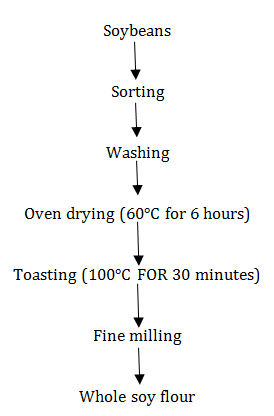
Blend Formulation
| Sample | Milk powder (g) | Whole soybean flour (g) | ||||||
|---|---|---|---|---|---|---|---|---|
| A | 100 | 0 | ||||||
| B | 90 | 10 | ||||||
| C | 80 | 20 | ||||||
| D | 70 | 30 | ||||||
| E | 60 | 40 |
Table 1: blends formulation of enriched yoghurt. Source: adapted from Olaniyan and Ademola Key: Sample A: 100% F-Milk powder (Dan
Table 1: blends formulation of enriched yoghurt. Source: adapted from Olaniyan and Ademola Key: Sample A: 100% F-Milk powder (Dano) and o% whole soybean flour Sample B: 90%F- milk powder (Dano) and 10% whole soybean flour Sample C: 80%F- milk powder (Dano) and 20% whole soybean flour Sample D: 70%F- milk powder (Dano) and 30% whole soybean flour Sample E: 60%F- milk powder (Dano) and 40% whole soy bean flour
Production of Enriched Whole Milk
The whole soybean flour was blended with the powdered milk at different levels of powdered milk substation of 0%, 10%, 20%, 30% and 40%, using portable water to produce milk-slurries and was labeled as sample A (control), B, C and D respectively.
The whole soybean-milk mixture was heated at 85°C for 15 minutes to kill undesirable microorganism that can influence product quality and safety and partially break down the milk proteins. The samples were then cooled to 44°C. Commercial freeze dried mixed culture of L. bulgaricus, S. thermophiles and L. acidophilus was used to inoculcate each of the whole soybean-milk slurries at the same temperature of 44°C. This was inoculated for approximately 7 hours to allow for fermentation and rapid production of lactic-acid by the inoculant (bacteria) which coagulated the milk. The milk enriched samples produced was cooled rapidly to 10°C and refrigerated throughout the period of the other analysis (Figure 2).
Results and Discussion
![Figure 2: Flow chart for the production of yoghurt enriched with whole soybean flour. Source: adapted from Ndife [3].](/fulltextimages/4617/fig_2.png)
Methodology
Proximate analysis: Moisture content determination, Ash content determination, Fat content determination and Crude Fiber Determination were carried out according to AOAC. While Protein Content Determination as described by Shagufta [10]. Determination of Carbohydrate Content was by difference as described by Olagunju, et al. [11] as follows; CHO = 100 %-( ash + protein + fat + moisture) %. Physicochemical Analysis: Total Solids, Total Solids- Non-fat, Titratable Acidity, Viscosity were according to AOAC. PH determination was as described by Igbabul and Sensory evaluation as opined by Ihekoronye & Ngoddy. Statistical Analysis: Analysis of variance (ANOVA) was performed on the data obtained to determine differences at 5% probability level of significance, while LSD test was used to separate the means. All statistical analysis of data was performed using SPSS (version 20.0) software.
| Parameters | Samples | LCD | ||||||||||
|---|---|---|---|---|---|---|---|---|---|---|---|---|
| A | B | C | D | E | ||||||||
| Moisture % | 77.79±1.84d | 80.67±1.270 | 82.48±0.73c | 86.29±1.04b | 89.34±0.76a | 2.19 | ||||||
| Ash % | 1.40±0.82a | 0.56±0.03b | 0.53±0.01b | 0.47±0.02b | 0.39±0.05b | 0.67 | ||||||
| Crude protein % | 3.06±0.23c | 4.88±1.69bc | 6.11±0.45abc | 6.76±0.90ab | 9.23±3.83a | 3.51 | ||||||
| Fat (%) | 1.57±0.25c | 3.31±0.46b | 3.53±0.19ab | 3.67±0.24ab | 3.97±0.15a | 0.51 |
Table 2: Proximate composition of whole soybean enriched yoghurt. Values are mean ± SD triplicate determinations. Values with dif
| Crude fiber (%) | 0.18±0.02e | 0.73±0.33d | 1.21±0.20c | 1.73±0.16b | 2.45±0.24a | 0.39 |
|---|---|---|---|---|---|---|
| Carbohydrate () | 16.19±1.76a | 10.59±1.20 | 7.36±0.72c | 2.80±0.92d | 0.11±0.18e | 1.98 |
Table 3: Proximate composition of whole soybean enriched yoghurt. Values are mean ± SD triplicate determinations. Values with dif
Table 2: Proximate composition of whole soybean enriched yoghurt. Values are mean ± SD triplicate determinations. Values with different superscript within the same row are significantly different (P< 0.05) Sample A: 100% Milk powder (Dano) and o% whole soybean flour Sample B: 90% milk powder (Dano) and 10% whole soybean flour Sample C: 80% milk powder (Dano) and 20% whole soybean flour Sample D: 70% milk powder (Dano) and 30% whole soybean flour Sample E: 60% milk powder (Dano) and 40% whole soy bean flour
Proximate Composition
The result of the proximate composition on parameters analyzed for the yoghurt samples are presented in table 2. From the result, the moisture content range from (77.79) % in sample A to 89.34% in sample E. This was dependent on the production of powdered milk to whole soybean flour used. Plain or controlled milk yoghurt (sample A) had the lowest moisture value (77.79) %compared to the enriched milk with soy flour (sample B, C, D and E) respectively. There were significant differences (P< 0.05) in the moisture content of the control yoghurt with enriched milk. However, the moisture contents of sample A, B, C, and D fell within the moisture content range (78.2-87.1) % of nine commercial yoghurts evaluated by olugbuyiro and Oseh [12].
The ash content of the samples range from 0.39% in sample E to 1.40% in sample A. There was significant difference (P< 0.5) in the ash content of the plain yoghurt (sample A) and the enriched sample (B, C, D and E) respectively. The ash content decreased as the concentration of whole soybean flour increased. This may be attributed to the relatively low mineral content of soybean. The total mineral content of whole soybean is reported to be 4.90% while that of powdered milk (Dano) is 5.43%.
The protein content of the samples ranged from 3.06% in sample A to 9.23% in sample E. the value of protein content increased as the proportion of whole soybean flour increased. This could be due to the high protein content of soybean. According to Ndife [3] protein content of soybean is about 12 times of milk. There was no significant difference (P< 0.05) in the protein content of sample A (control yoghurt), B and C while sample A, D and E vary significantly (p< 0.05) in their proportional protein content. The protein contents of samples D and E were relatively high as compared to the 5.0% mean protein content of five commercial yoghurts evaluated by Igbabul.
A clinical study conducted by Aderson [8] showed that substitution of soy protein for animal protein decreases hyper filtration in diabetic persons and may reduce urine albumin excretion (proteinuria). Hence soy flour symbiotic milk is a potential diet for diabetes.
The fat content of the sample ranged from 1.57% in sample A to 3.97% in sample E. there was significant difference (P< 0.05) in the fat content of the plain yoghurt (sample A) and the enriched milk s (sample B, C, D and E). The value of fat content increased as the proportion of the whole soybean flour increased. Soybean has a high oil content which is rich in polyunsaturated fats [13]. According to Lokuruka [7] unsaturation of soybean and its products is critical for human health.
As shown in table 2, the crude fiber of samples ranged from 0.18% in sample A to 2.45% in sample E. There were significant differences (P< 0.05) in the crude fiber content of all the samples. Incorporating whole soybean flour into yoghurt had significantly increased (P>0.05) the fiber contents of the enriched yoghurts (sample B,C,D,E) Compared to that of the plain yoghurt (sample A), hence good for ulcer patients. This agrees with result on other whole soy substituted products by Farzana & Mohajan [14]. Whole soybean contains a fiber that has indigestible polysaccharides that could serve as prebiotics and play important physiological role in disease prevention.
The carbohydrate content of the samples ranged from 0.011% in sample E to 16.19% in sample A. There was significant difference (P>0.05) in the carbohydrate content of all samples. The carbohydrate content decreased as the concentration of whole soybean flour increased. Carbohydrate (Lactose) is the major constituents of milk that is converted to lactic acid during fermentation. Also, soybeans have relatively low carbohydrate content compared to milk. Thus, the conversion of lactose to lactic acid and the increase in proportion of whole soybean flour account for the decrease in carbohydrate content as observed in the result (Table 3). This result corresponds with observation of Ndife, et al. [3] on incorporating coconut milky water in yoghurt milk decreases the carbohydrate content.
| 4 | Samples | LSD | ||||||||||||||
|---|---|---|---|---|---|---|---|---|---|---|---|---|---|---|---|---|
| A | B | C | D | E | ||||||||||||
| Total slides (%) | 22.21±1.84a | 19.33±1.29b | 17.52±0.73b | 13.71±1.04c | 10.66±0.76d | 2.19 | ||||||||||
| Total solids not-fat (% | 20.64±1.59a | 16.03±1.57b | 14.00±0.91b | 10.03±0.99c | 6.70±0.88d | 2.24 | ||||||||||
| pH | 4.50±0.00d | 4.90±0.00c | 5.00±0.00b | 5.10±0.00a | 5.13±0.06a | 0.00 | ||||||||||
| Titratable acidity (%) | 1.34±0.05a | 1.23±0.02b | 0.96±0.02c | 0.84±0.03d | 0.78±0.02c | 0.00 | ||||||||||
| Viscosity (Pa.s) | 10.54±0.02a | 8.13±0.03b | 5.70±0.02c | 3.28±0.01d | 0.86±0.02c | 0.00 |
Table 4: Physicochemical properties of whole soybean enriched yoghurts. Values are means ± SD triplicate determinations. Values w
Table 3: Physicochemical properties of whole soybean enriched yoghurts. Values are means ± SD triplicate determinations. Values with different superscript within the same row are significantly different (P<0.05). KEY: LSD = least significant difference Sample A: 100% Milk powder (Dano) Sample B: 90% milk powder (Dano) and 10% whole soybean flour Sample C: 80% milk powder (Dano) and 20% whole soybean flour Sample D: 70% milk powder (Dano) and 30% whole soybean flour Sample E: 60% milk powder (Dano) and 40% whole soy bean flour
Physicochemical Properties
The physicochemical properties of the whole soybean enriched milk are shown in table 3. The total solids and total solids non-fat of the samples ranged from 10.66% in sample E to 22.21% in sample A and from 6.70% in sample E to 20.64% in sample A respectively. The total solids are an indication of the dry matter content of yoghurt samples while total solids not-fat indicates the fraction of the total solids that is not fat and constitute of protein, carbohydrate and minerals. There were significant differences (P<0.05) in the total solids and total solids not-fat of the plain yoghurt (sample A) and those of the enriched yoghurts (sample B, C, D and E). The total solids not-fat of the plain yoghurts were relatively high compared to those of the enriched yoghurts as they decrease in yoghurt samples enrichment with whole soybean flour. These result agreed with findings of Ndife, et al. [3] who also observed a similar trend in yoghurt samples enriched with coconut-cakes.
The result of the PH of the different enriched milk samples as presented in table 3, which showed that, the PH value ranged from 4.50 in sample A to 5.13 in sample E. there were significant difference (P< 0.05) in the PH of plain or control yoghurt (sample A) and the enriched milk (sample B, C, D and E) respectively. The pH value increased as the quantity of whole soybean flour increased and the plain yoghurt had the lowest value (4.50) when compared with the enriched milk. This could be due to more availability of lactose for fermenting bacterial. Tomovska reported that most producers of milk yoghurt have a set PH point between PH 4.0 and 4.6 in order to prevent the growth of any pathogenic organisms. The PH values of the enriched samples are above this set point. However, these values are within the pH range (4.53-5.11) of five commercial milk yoghurt samples evaluated by Igbabul.
The titratable acidity of the samples ranged from 0.78% in sample E to 1.34% in sample A. There were significant differences (P<0.05) in the titratable acidity. The enriched milk samples had lower titratable acidity values than the plain or control yoghurt. This could also be attributed to relatively low availability of lactose in the enriched samples. However, these values are above the minimum titratable acidity of 0.6% requiring by food standard code for plain yoghurt [15].
The viscosity of samples ranged from 0.86 pa.s in samples E to 10.54% in sample A. There were a significant differences (P<0.05) between the viscosity of all the samples. These viscosities are reasonably low compared to the viscosity of four commercial milk yoghurts samples (34.05, 37.51, 31.26, and 99.51 Pa..s) Respectively as reported by Igbabule who further stated that, the viscosity of commercial yoghurt is usually enhanced by addition of stabilizers and thickeners as modifiers and sometimes natural starches, pectin, edible gums (Table 4).
| Parameters | Samples | LSD | ||||||||||||||
|---|---|---|---|---|---|---|---|---|---|---|---|---|---|---|---|---|
| A | B | C | D | E | ||||||||||||
| Appearance | 8.30a | 7.35ab | 6.95bc | 6.40bc | 6.25c | 0.96 | ||||||||||
| Aroma | 7.65a | 5.30bc | 5.60b | 4.25ed | 3.70d | 1.07 | ||||||||||
| Taste | 7.35a | 5.10bc | 5.35b | 4.20ed | 3.90d | 1.06 | ||||||||||
| Mouth feel | 6.65a | 5.60b | 5.55b | 4.70bc | 4.45c | 0.94 | ||||||||||
| Overall acceptability | 7.35a | 5.75b | 5.70b | 4.55c | 4.10c | 0.87 |
Table 5: mean scores for sensory properties of whole soybean enriched yoghurts. Means with different superscript within the same
Table 4: mean scores for sensory properties of whole soybean enriched yoghurts. Means with different superscript within the same row are significantly different (P<0.05). Key: LSD = Least significant difference Sample A: 100% Milk powder (Dano) and o% whole soybean flour Sample B: 90% milk powder (Dano) and 10% whole soybean flour Sample C: 80% milk powder (Dano) and 20% whole soybean flour Sample D: 70% milk powder (Dano) and 30% whole soybean flour Sample E: 60% milk powder (Dano) and 40% whole soy bean flour
Sensory Properties
The mean sensory scores of the organoleptic evaluation for acceptability for the different yoghurt samples are presented in table 4. From the result, sample A (Plain or control yoghurt) had the highest score (8.30) for appearance and was significantly different (P<0.05) from sample C, D, and E. Sample A and B did not vary significantly (P<0.05) in their appearance. The appearance may have been influenced by color appeal. The panelist showed preference for the lighter and white color of sample A which had no soybean enrichment.
The aroma and taste of sample A (plain yoghurt) where significantly different (P<0.05) from those of the enriched samples (B,C,D, and E). The enrichment of the milk with whole soybean flour resulted in low aroma and taste scores. This must have resulted from masking effect from soybean flour. Sample A had the highest scores of 7.65 and 7.35 for aroma and taste, while sample E had the lowest scores of 3.70 and 3.90 for aroma and taste respectively. This may be attributed to the beany flavor of the soybean. Osaili [16] Reported that products have had limited consumer acceptance because of its undesirable or beany flavour after taste.
The sensory scores for mouth-feel relate to texture and were influenced by the addition of whole soybean. The mean score for mouth-feel of sample A (6.65) was significantly different (P<0.05) from those of the enriched samples (B, C, D, and E). The enriched yoghurts had lower score when compared to plain yoghurt (sample A) mainly due to their poor consistency (flowing nature).
The plain yoghurt had the best overall acceptability rating of 7.35 and was significantly different from the enriched yoghurts. Sample B with 10% whole soybean substitution rank next to the plain yoghurt (sample A) with over all acceptability rating of 5.75 and was not statistically different (P<0.05) from sample C.
Conclusion
Based on the findings of this study, fiber, fat, and moisture contents of the enriched milk flour mixture were significantly higher than those of the control. The protein content significantly increased at 30% and 40% level of substitution of whole soybean flour into the fermented milk. On the other hand, Ash and carbohydrate contents of the enriched samples were significantly low compared to the control. Hence an excellent diet source for obese, diabetes and colon cancer patients. The physiochemical properties competed favorably with the control and enriching milk with soybean flour produced a general acceptable mimic of composite yoghurt.
Acknowledgement
The authors acknowledged the department of Food science and Technology for support in the course of this research.
Conflict of Interest
The authors agreed and there are no conflict of interest concerning this article.
References
-
Siro I, Kapolna B, Lugasi A (2008) Functional Food. Product Development, marketing and consumer acceptance.A review. Appetite 51(3): 456-467.
-
Ansari S, Chauhan B, Kalam N, Kumar G (2013) Current concepts and prospects of Herbal Nutraceutical: A review. Journal of Advanced Pharmaceutical Technology & Research 4(1): 4.
-
Ndife J (2014) Production and Quality Assessment of Functional Yoghurt Enriched with Coconut. International Journal of Nutrition and Food Sciences 3(6): 545-550.
-
Ares G, baixauli R, Sanz T (2013) Influence of Dietary fiber Addition on the Properties of Probiotics Yoghurt. Food Hydrocolloids 16(3): 311-328.
-
Sendra E, Kuri V, Fernandez-Lopez J, Sayas-barbera E, Navarro C, et al. (2010) Viscoelastic properties of orange fiber enriched yoghurt as a function of fibre dose, size and thermal treatment. LWT- food science and technology 43(4): 708-714.
-
Bau TR, Garcia S, Ida EI (2014) Evaluation of a Functional Soy Product with Addition of Soy Fiber and Fermented with Probiotic Kefir Culture. Brazilian Archives of Biology and Technology 57(3): 402-409.
-
Lokuruka M (2010) Soybean nutritional properties: The good and the bad about soy foods consumption - A review. African Journal of Food Agricultural Nutrition and Development 10(4): 2439-2459.
-
Anderson JW (2008) Beneficial effects of Soy Protein Consumption for Renal Function. Asia Pacific Journal of Clinical Nutrition 17(1): 324-328.
-
Jenkins DJA, Mirrahimi A, Srichaikul K, Berryman CE, Wang Li, et al. (2010) Soy Protein Reduces Serum Cholesterol by both Intrinsic and Food Displacement Mechanisms. Journal of Nutrition 140(12): 2302S- 2311S.
-
Shagufta F, Ashif S, Muzaffar K, Neelofar J, Jaffar A, et al. (2016) Determination of Chemical Composition of Milk Marketed in Quetta Pakistan. International Journal of Advanced Research in Biological Sciences 3(5): 98-103.
-
Olagbunju A, Muhammed A, Aliyu S, Aliyu S, Mada SB, et al. (2013) Nutritional values of powdered Milk Commercially consumed in West Africa. International Journal of Food Nutrition and Safety 4(2): 55-61.
-
Olugbuyiro JAO, Oseh JE (2011) Physico-Chemical and Sensory Evaluation of Market yoghurt in Nigeria, Parkistan. Journal of Nutrition 10(10): 914-918.
-
Milhail L, Zoran PS (2011) Polymerization of Soy Bean Oil with Superacids. Soybean-Application and Technology, PP: 365-387.
-
Farzana T, Mohajan S (2014) Effects of incorporation of soy flour to wheat flour on nutritional and sensory quality of biscuits fortified with mushroom. Food Sci Nutr 3(5): 363-369.
-
WHO (2011) World health Organization and Food and Agricultural Organization of the United State Codex Standard for Fermented Milks-CODEX STAN -243- 2003, Codex Alimentarius, pp: 56-58.
-
Osaili T (2014) Sensory Evaluation of Flavoured Soy Milk-based Yoghurt: A Comparison between Jordanian and Malaysian Consumers. Journal of Food Science and Engineering 4: 27-35.
-
Bolarinwa IF, Olaniyan SA, Adebayo LO, Ademola AA (2015) Malted Sorghum-Soy Composite Flour: Preparation, Chemical and Physic-Chemical Properties. Journal of Food Processing & Technology 6(8): 1-7.
-
Siro I, Kapolna B, Lugasi A (2008) Functional Food. Product Development, marketing and consumer acceptance. A review. Appetite 51(3): 456-467.
-
Yangilar F (2013) The Application of Dietary Fibre in Food Industry: Structural Features, Effects on Health and Definition, Obtaining and Analysis of Dietary Fiber: A review. Journal of Food and Nutrition Research 1(3): 13-23.
- The Role of Podocyte Apoptosis and the Involvement of SIRT1 in Diabetic Nephropathy
- Dealcoholization of Beer by Osmotic Distillation for the Beverage Industry
- Biopolymer-Based Edible Packaging- Biomaterials, Methods, and Applications in Food Industry: An Updated Review
- Influence of Bioprocessing Methods on 'China Rice' (Gawal R1), and Soyabean Supplementation on the Quality of Complementary Food
- Cassava (Manihot esculenta) Varietal Growth, Yield and Cyanide Content Performance in Three Sites in the South- Eastern Semi Arid Regions of Kenya
- Food Waste Treatment, Recycling, Management and Production of Value-Products-An Update on Methodologies and Current Trends