
Biological Assessment of Ready-To-Eat Flaked Breakfast Cereal Produced From Malted Quality Protein Maize (Zea Mays), Cowpea (Vigna Unguiculata L. Walp) and Garden Egg (Solanum Melongena)
Ready-to-eat breakfast cereal was produced from blends of malted quality protein maize, cowpea and garden egg with a view to assessing the nutritional quality using the animal feeding trials. The biomaterials were processed separately to flour and blended at varying ratios, the blends were processed to flaked breakfast cereal using standard procedure. The ready to eat meal was subjected to feeding trial using wistar rats weighing between 60 and 85 g. During the 28 day feeding trial, weight changes, growth rate, protein and feed efficiency ratios, mortality rate, nitrogen retained, biological value, true digestibility and net protein utilization were monitored. The results obtained were feed intake (126.99-164.39 g), the protein efficiency ratio (-4.40 and 2.50), mean weight gain/loss (-14.6 g and 8.15g). The weight of animal fed with meal containing garden egg reduced marginally over the period. The biological value (63.13-88.2%), true digestibility (39.29-58.80%) and net protein utilisation (24.79–49.43%) reduced as the garden egg increased. There was no mortality in the groups fed with garden egg containing meal. The study concluded that addition of garden egg helped in weight management of the animals and compared favourably with commercial meal in terms of parameters determined.
Practical Application
Ready-to-eat breakfast meal produced from blends of malted quality protein maize, Cowpea and garden egg fed to experimental animals supported their health and maintained their weights over the period of the feeding trials. The meal has implication for weight maintenance of consumers.
Introduction
Nutrition in most adults is concerned with the supply and metabolism of those components of the diet needed to Commentary maintain normal functioning of the body (water and oxygen are also necessary, but these are not generally regarded as nutrients) [1]. This is so because adults are fully grown and excess supply of some of the nutrients can become agents of imbalance in the body. Breakfast meal is regarded as important meal to start the day, however, such meal must be consistent with the needs of this group of people. Breakfast cereals are manufactured from wheat and other cereals which lacks certain nutrients and such are produced from refined flour which is very low in fibre which is needed by adults than younger folks. There is general drive to eat more food containing high level of fibres. Dietary fibre has been shown to reduce postprandial glucose elevations in the blood [2]. Cereal-based foods constitute the most important daily source of energy and other nutrients in Africa. Quality protein maize a bio-fortified hybrid of common maize has been reported to have 28% more of lysine and 22% more of tryptophan compared to common maize and other cereals where these essential amino acids are limiting. Although the crude protein of common maize and quality protein maize is almost the same [3, 4]. It has been utilized in the production of various products [5, 6]. It is low in fibre. Cowpea is a legume high in protein and other essential nutrients. Garden egg is a vegetable which is consume fresh or cooked depending on the varieties and location of consumption. It is high in protein, fibre and certain antinutrient which is responsible for the astringent taste [7, 8]. Novel products are subjected to selected tests to ascertain safety and nutritional value. In vivo (bioassay) testing is recommended for novel products to confirm or otherwise the acceptability and safety of such products. Due to the physiological composition of albino (white) rat it has been in use in in vivo testing and the results have been very useful although it is not without its shortcomings [9, 10]. This study is aimed at assessing nutritional quality of ready-to-eat flaked breakfast meal produced from blends of malted quality protein maize, cowpea and garden egg using animal feeding experiment.
Materials and Methods
Material Collection
Quality protein maize (Zea mays) was purchased from Teaching and Research Farm, Obafemi Awolowo University, Ile Ife. Cowpea (Vigna unguiculata L.Walp) seeds and garden (Solanum melongena) egg fruits were purchased from the Sabo Market, Ile Ife. The Cowpea and Garden egg species were authenticated at the Department of Crop Protection and Production, Obafemi Awolowo University, Ile Ife, Nigeria.
Methods
Production of Ready to Eat Flaked Breakfast Cereal: Ready- to- eat flaked breakfast meal was produced from constituent flour samples of malted quality protein maize, cowpea and garden egg produced as earlier described in the report of Onireti & Ikujenlola [11]. To 100 grams of each blended flour samples, 0.1 g of sweetener, 1 g of salt, 6 ml of vegetable oil, 4 g of hydro-colloid and 75 ml of water were added and mixed to obtain homogeneous viscous paste. It was cooked under pressure for 30 minutes to gelatinize starch. The dough was allowed to cool/age at room temperature and then divided into fragments. After cooling/ageing, the dough was flaked using a manual pasta cutting machine, after which it was toasted at 75 °C for 90 minutes. The resulting products were cooled and then packaged in high density polyethylene until needed [12].
Production of Protein Free Diet (Basal Diet): The protein- free diet (Basal diet) was prepared according to description of Fashakin, et al. [13] using corn-starch (800 g), sucrose (60 g), vegetable oil (100 g), vitamin mixture (30) and mineral mixture (10 g). These were thoroughly blended for 30 minutes using Hobart mixer.
Animal Feeding Experiment: The method of Ijarotimi [14] was adopted. Adult forty wistar albino rats of both sexes weighing 60 – 85 g were obtained from Animal House, Faculty of Pharmacy, Obafemi Awolowo University, Ile Ife, Osun State. The animals were housed individually in metabolic cages and acclimatised for five days during this period the animals were fed the normal pellet diets as they had been previously fed during the breeding period. After acclimatisation, the animals were weighed and grouped into 8 groups with five rats per group into labelled individual wire-bottomed cages to allow faecal matter to drop on a base tray. The weight difference was maintained within ±2 g of each other. Groups 1-6 were fed with the breakfast meal containing (malted QPM, Cowpea and Garden egg flour blends) while group 7 and group 8 were fed with commercial sample Infinity Cornflakes(R) (positive control diet) and protein free meal -(basal diet) (negative control) respectively. During the feeding experiment, water was supplied ad libitum. For growth and weight changes the dietary intake, disposition and growth changes were monitored regularly. Excess and spilled food were collected, dried and weighed to determine food consumed. For the protein quality assessment the faecal discharge was collected, dried and kept until needed for nitrogen determination and urine was collected and preserved in a container containing 0.1N H2SO4 for nitrogen analysis. At the completion of the experiment, the animals were anaesthetically sacrificed. Data collected during the feeding experiment were used in determination of growth rate/weight changes, weight of selected organs, protein efficiency ratio, feed efficiency ratios, biological value, true digestibility and net protein utilisation of the various diets. The rats had about 12 hours of light and 12 hours of darkness in a day. Temperature was maintained at 28- 32°C.
Animal Rights
Animal trials were carried out in line with regulations on use of animals for research [15]. The protocol followed the ethics guiding the use of animals and rights of animal in experimental trial according to the regulation of the Research Committee of both of the Department and University.
Nitrogen Retention
The nitrogen retained in the experimental animals was
calculated as the algebraic differences between the food and sum of both the faecal and urinary nitrogen for the collection period. NR = Ni – (FN + UN) Where; NR = Nitrogen Retained, Ni = Nitrogen Intake in food, FN = Faecal nitrogen, UN = Urinary nitrogen Protein Efficiency Ratio (PER) and Food Efficiency (FER) were calculated as follows: PER = (Weight gained)/(Protein consumed) FER = (Weight gained)/(Food consumed) True Digestibility (TD) was calculated as follows:
TD = (Ni-(NF1-NF2))/Ni×100 Biological Value was calculated as follows: BV=(Ni-(NF1-NF2)-(Nu1-Nu2))/(Ni-(NF1-NF2))×100 (d) Net Protein Utilization (NPU) was calculated as follows NPU=(BV×TD)⁄100
Results and Discussion
Feed Intake of the Experimental Animals During Feeding Experiment
The feed intake of experimental animals during the feeding trial is shown in Table 1. The total feed intake ranged between 126.99 and 164.39 g. The average feed intake per group ranged between 4.53 and 5.87 g. There were significant differences (p < 0.05) between the feed intakes of the animals fed with the diets compared to the control. It was observed that animals placed on protein free meal- basal diet (sample J) recorded lowest feed intake and there was variations in the feed intake between the groups. Feed intake suggests the acceptance or otherwise of the meal. This observation may be influenced by a number of factors such as the flavour, taste of the meal, the texture, the particle size and ease of consumption. Other factors may include the health status of the animals. The feeding outcomes depend on both the quality and quantity of diets consumed. It was observed that the feed intake reduced as the level of garden egg increased. This might be connected with the taste and aftertaste associated with garden egg due to the astringent properties of the biomaterial. It is known that diet of high nutritional quality eaten at reasonable quantity will give better outcome in terms of growth and development than similar quantity eaten below the recommended allowance [16]. It was observed that there was no significant difference (p>0.05) between the feed intake of breakfast containing up to 25% garden egg and other meals assessed. The observation expressed in this study is a reflection of the level of acceptance of the diet to the experimental animals. In general the diets were all acceptable to the animals however at varying degrees.
| Sample | Feed intake (g) | Average feed intake (g) | FER | PER | Mean Weight gain/loss (g) |
|---|---|---|---|---|---|
| A | 148.71±13.21abc | 5.31±0.47abc | 0.135±0.01b | 1.35±0.03b | 4.00±0.06b |
| D | 157.58±13.61ab | 5.63±0.49ab | 0.254±0.03a | 2.50±0.07a | 8.15±0.07a |
| E | 164.39±10.14a | 5.87±0.36a | -0.085±0.01d | -0.840±0.02d | -2.78±0.04ab |
| F | 151.57±10.10abc | 5.41±0.36abc | -0.271±0.01e | -2.63±0.01e | -8.20±0.06bc |
| G | 143.67±13.13bc | 5.13±0.18bc | -0.362±0.02f | -3.45±0.02f | -10.41±0.03c |
| H | 127.00±12.63d | 4.54±0.45d | -0.469±0.01g | -4.40±0.04g | -11.93±0.01bc |
| I | 145.79±4.30bc | 5.21±0.15bc | 0.050±0.01c | 0.53±0.01c | 1.44±0.04ab |
| J | 126.99±12.22d | 4.53±0.44d | -0.574±0.02e | ND | -14.6±0.01d |
Table 1: Feed intake, feed efficiency ratio (FER), protein efficiency ratio (PER) and mean weight gain/loss of experimental anima
Table 1: Feed intake, feed efficiency ratio (FER), protein efficiency ratio (PER) and mean weight gain/loss of experimental animals during feeding trial. The mean values along the same column with different superscripts are significantly different (p < 0.05) using Duncan multiple range test. Where: A= 100% Quality protein maize; D=90% Quality protein maize, 10% Cowpea; E= 85% Quality protein maize, 10% Cowpea, 5% Garden egg; F= 75% Quality protein maize, 10% Cowpea, 15% Garden egg; G = 65% Quality protein maize, 10% Cowpea, 25% Garden egg; H= 55% Quality protein maize, 10% Cowpea, 35% Garden egg; I= Commercial diet (Infinity cornflakes); J = Basal diet; ND= Not determined.
According to FAO [9] and Kamau, et al. [17] food intake is determined by the body requirements of growth and development as well as the ability of the foods to satisfy these needs.
The Food Efficiency Ratio (FER) and Protein Efficiency Ratio (PER)
Food Efficiency Ratio (FER) and Protein Efficiency Ratio (PER) are presented in Table 1. The FER values ranged between -0.469 and 0.254. The group fed with the protein free meal -basal diet (sample J) had the lowest food intake, while the animals on QPM based diets were much higher. This is in agreement with previous findings by Elijah, et al. [18] who reported that experimental rats fed with protein free diet had the lowest feed intake. FER shows the ability of a food to support growth [18]. Samples A, D, and I, had higher values showed the possibility of supporting growth.
PER is one of the commonly used methods in assessing protein quality [9]. The PER ranged between -4.40 and 2.50. A food with higher PER is deemed superior to a lower PER. There were significant differences (p<0.05) between the formulated samples. Sample D containing 90% QPM and 10% cowpea had a superior PER than sample A containing 100% QPM. This confirms that cereals and legumes combination have complementary and synergy effect on the protein this is responsible for superior protein quality [19]. Moreover, there was significant difference (p<0.05) between samples A, D and I. The PER gives indication of how well the protein has been effectively utilized by the animals. The lower PER signifies the fact that the samples E, F and G did not support growth. The low PER observed in these diet might be due to low protein value and low bioavailability of protein intake of garden egg containing meals as observed in the report of Onireti & Ikujenlola [11] on protein value and amino acids profile. Other reason include higher concentration of anti- nutrient factors such as tannins, alkaloids and protease inhibitors, which decrease digestibility [18, 20]. The PER and FER values reduced as garden egg level increased, this may be adduced to high level of fibre in the biomaterial. This meal is designed for adult, a group that requires low protein for maintenance unlike children that require high protein for growth. This meal may be inadequate to meet the protein requirement of children but satisfactory to adults. The low values of PER and FER in the garden egg containing meal may be of little concern because the meal is not designed as major source of protein but weight managing meal [21].
Weight Changes and Growth Performance of the Experimental Animals
The weight changes and growth performance of the experimental animals fed with the flaked breakfast diets and control diet is presented in Figure 1.
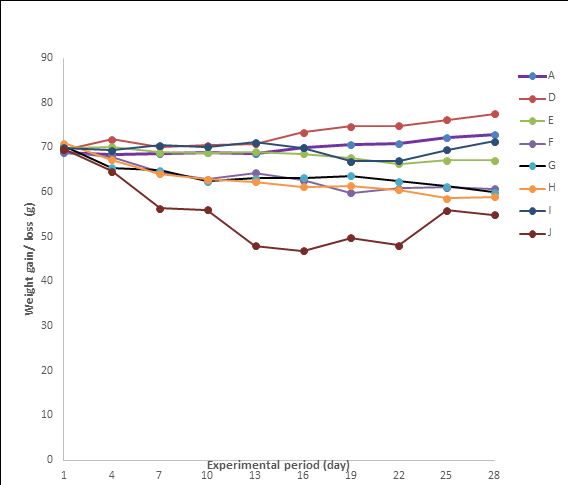
Figure 1: Growth rate of the Experimental Rat feed with the Formulated Diet and Control. Where A= 100% Quality protein maize; D=90% Quality protein maize, 10% Cowpea; E= 85% Quality protein maize, 10% Cowpea, 5% Garden egg; F= 75% Quality protein maize, 10% Cowpea, 15% Garden egg; G = 65% Quality protein maize, 10% Cowpea, 25% Garden egg; H= 55% Quality protein maize, 10% Cowpea, 35% Garden egg; I= Commercial diet (Infinity Cornflakes); J=Protein free- Basal diet.
The mean weight gain/loss as shown in Table 1 ranged between -14.6 g (animals fed with basal diet) and 8.15g (animals fed with sample D containing 90% QPM, and 10% cowpea). It was observed that the weight of the experimental animals decreased in the animals fed with samples E, F, G and H containing varying degrees of garden egg. Sample D supported the best weight gain among all the breakfast meals while the basal diet supported least weight gain. Inclusion of garden egg in the meal enhanced favourable weight management with satisfactory weight maintenance. The animals fed with garden egg containing meals were healthy, agile and feeding well unlike the basal diets. The increase in weight gained in samples A and D were largely influenced by the quality of the protein constituents of the diets. Protein is required among other nutrients for good growth, healthy living, maintenance and production of cell and tissues of the body [22, 23].
The growth rates of the animals fed with garden egg containing meal were significantly different (p <0.05) in samples A, D and I. The basal diet did not support growth. The samples E, F, G and H did not increase the weight of the animals but maintained the weight over the period of the experiment. The observation may be due to the high fibre and alkaloids in the garden egg. It was observed that the physical characteristics of the rats fed with the basal diet were inferior when compared with the rats fed with the other samples. All the animals that depended on the basal diet for survival were found to become leaner and weaker as the experiment progressed. The level of protein in the diets contributed to the ability of the diets to sustain the animals.
However, the fibre content of the diets might be responsible for the decline in weight of animals. The decline in weight in the protein free meal and garden egg containing meals is based on different reasons. The protein free meal lost weight because of lack of protein which is necessary for growth and increase in weight. However, the garden egg containing meal contain protein (>9.00%) which may be reasonable enough to support growth and weight increase but for the high level of fibre and anti-nutrients present in the garden egg. Dietary fibre has been reported to help in weight management and reduction in glycaemic level [24]. The meal containing garden egg will be of advantage to those who wish to maintain their weight. The commercial breakfast cereal has protein less than 10.00%. Breakfast cereals are not designed to be good source of protein but contain average level of protein enough to maintain good health. The issue of overweight and obesity is becoming a serious issue in the developing nations Nigeria inclusive where it is on the increase unlike in the developed nations where it is an established concern with it attendant problems [24]. Food high in fibre has been advocated as one of the ways out of the problem. Dietary fibres are important for their hypoglycemic effect, hypolipidemic effect; lowering serum cholesterol hence helps in prevention of atherosclerosis, antitoxic effect and anti-cancerous effect [25]. Vegetables have also been used as fibre source, garden egg is good example [26, 27].
Mortality Rate of the Experimental Animals During the Feeding Trial
The mortality rate of the experimental animals during the feeding trial is shown in Table 2.
| Samples | Week 1 | Week 2 | Week 3 | Week 4 | Total |
|---|---|---|---|---|---|
| A | 0 | 0 | 0 | 0 | 0 |
| D | 0 | 0 | 0 | 0 | 0 |
| E | 0 | 0 | 0 | 0 | 0 |
| F | 0 | 0 | 0 | 0 | 0 |
| G | 0 | 0 | 0 | 0 | 0 |
| H | 0 | 0 | 0 | 0 | 0 |
| I | 0 | 0 | 0 | 0 | 0 |
| J | 0 | 20 | 20 | 20 | 60 |
Table 2: Mortality rate (%) during the experimental period. Where: A= 100% Quality protein maize; D=90% Quality protein maize, 10
Table 2: Mortality rate (%) during the experimental period. Where: A= 100% Quality protein maize; D=90% Quality protein maize, 10% Cowpea; E= 85% Quality protein maize, 10% Cowpea, 5% Garden egg; F= 75% Quality protein maize, 10% Cowpea, 15% Garden egg; G = 65% Quality protein maize, 10% Cowpea, 25% Garden egg; H= 55% Quality protein maize, 10% Cowpea, 35% Garden egg I= Commercial Diet; J= Protein free- Basal Diet.
Mortality may results from any form of malnutrition under- or over-nutrition. The most prevalent form in the Sub-Sahara region of Africa where there is shortage of food supply in most cases is undernutrition. In the study, the quality of the meal may account for mortality in the animals. It was observed that there was no death recorded for any of the groups except protein free group. The mortality was 60% at the end of the study. Although there was weight loss in the animals fed with meals containing garden egg and cowpea (samples E, F, G and H) but the diets were good enough to sustain the animals without records of mortality. Meals grossly depleted of macronutrients and micronutrients (hidden hunger) are implicated in undernutrition and by extension death in most case [28]. Africa has record of high mortality among infants and children as a result of childhood malnutrition due to protein and energy malnutrition. Adults may suffer death due to starvation.
Nitrogen Retained, Biological Value, True Digestibility and Net Protein Utilisation of Experimental Animals
The Nitrogen Retained (NR) Table 3 of the diets ranged between 0.54 and 1.27. There were significant differences (p<0.05) between the samples. It was observed that there was a decrease in the nitrogen retained as inclusion of garden egg increased. This may be as a result of the fibre content.
| Sample | N i | NR | N f | Nu | BV | TD | NPU |
|---|---|---|---|---|---|---|---|
| A 2.36±0.02e 1.05±0.06b 1.17±0.03b | 0.14±0.06cd | 88.26±4.18a | 50.56±1.61bc | 44.59±0.70b | |||
| D 2.56±0.03b 1.27±0.03a 1.07±0.01b | 0.23±0.04bc | 84.61±2.59ab | 58.42±0.49a | 49.43±1.09a | |||
| E 2.69±0.07a 1.23±0.01a 1.11±0.02b | 0.35±0.01a | 77.99±0.16bc | 58.80±0.79a | 45.86±0.52b | |||
| F 2.49±0.03c 0.99±0.02c 1.16±0.02b | 0.33±0.03ab | 74.97±1.94c | 53.40±0.62b | 40.03±0.57c | |||
| G 2.41±0.05d 0.88±0.02d 1.29±0.01b | 0.25±0.02ab | 77.85±1.27bc | 46.70±0.25c | 36.35±0.78d | |||
| H 2.16±0.08g 0.54±0.01e 1.32±0.01a | 0.31±0.04ab | 63.13±3.25d | 39.29±0.89d | 24.79±0.71e | |||
| I 2.19±0.09f 0.92±0.04d 1.16±0.10b | 0.12±0.07d | 88.82±5.51a | 47.04±1.48c | 41.65±1.63c |
Table 3: Nitrogen Intake (Ni), Nitrogen Retained (NR), Faecal Nitrogen (Nf); Urinary Nitrogen (Nu); Biological Value (BV) of expe
Table 3: Nitrogen Intake (Ni), Nitrogen Retained (NR), Faecal Nitrogen (Nf); Urinary Nitrogen (Nu); Biological Value (BV) of experimental animals during feeding trial (%). The mean values along the same column with different superscripts are significantly different (p < 0.05) using Duncan multiple range test. Where: Ni= Nitrogen Intake; NR= Nitrogen Retained; Nf = Faecal Nitrogen; Nu = Urinary Nitrogen; BV = Biological Value; NPU= Net protein utilization; TD= True protein digestibility; PER = Protein efficiency ratio; A= 100% Quality protein maize; D=90% Quality protein maize, 10% Cowpea; E= 85% Quality protein maize, 10% Cowpea, 5% Garden egg; F= 75% Quality protein maize, 10% Cowpea, 15% Garden egg; G = 65% Quality protein maize, 10% Cowpea, 25% Garden egg; H= 55% Quality protein maize, 10% Cowpea, 35% Garden egg; I=Commercial diet Biological value (BV) is a scale of measurement used to determine the percentage of dietary nitrogen utilised by the body from protein intake [29]. This parameter also determines how readily digested protein can be used for protein synthesis and thus justifies variation of BV in different foods owing to food preparation and diet consumed [30, 31]. The results of the BV ranged from 63.13% - 88.82%. Sample A containing 100% QPM had the highest BV compared to the other meals. There were no significant differences (p>0.05) between samples D, E, F and G. The results implied that the inclusion of garden egg had a similar protein utilisation on the animals. This might be due to the presence of anti- nutrients in garden egg flour or the proteins present in the samples are not made available for use. It was also observed that samples A, D and I were not significantly different (p>0.5) which might be due to bioavailability of the protein. BV is directly related to the efficiency of protein utilisation; however, it ignores the importance of factors that influence digestion of the protein and interaction of protein with other dietary factors before absorption [32, 23].
The results of the true digestibility (TD) ranged from 39.29% - 58.42%. Decrease in true digestibility was observed in samples E, F, G and H. Fasuyi [33] reported that legumes and oilseeds has reduced digestibility due to the presence of anti-nutritional factors like tannins, alkaloids and trypsin inhibitor. It was also reported in the study that phenolic compounds like tannins exert influence by binding with various compounds including protein and making them less available to the animal. As dietary tannin content increases, the digestibility, energy and protein in the diet decreases. Apart from the fact that the presence of anti- nutritional factor reduces the protein digestibility, large intakes of dietary fibres especially hemicelluloses increased the excretion of nitrogen in the faeces, thereby reducing the apparent protein digestibility of about 10% [34]. This may account for the decrease in TD in samples containing garden egg flour.
Net Protein Utilization (NPU) is the ratio of amino acid converted to proteins from amino acids supplied. This is somewhat affected by the salvage of essential amino acids within the body, but is profoundly affected by the level of limiting amino acids within a foodstuff [35]. The NPU of the diets varied between 24.79 % and 49.43 %. It was observed that there was lower protein utilisation for diet with garden egg flour. This implies that these samples have proteins but the utilisation of protein was low when compared to samples without garden egg flour.
Weight of Various Organs of the Experimental Animals
The weights of the various organs of the experimental animals are shown Table 4. The mean weight of the kidney of the experimental animals ranged between 0.44 g and 0.62 g. There were no significant differences (p>0.05) between the samples. The sizes of the organs under consideration are related to the body weight/size of the experimental animals.
| Sample | Kidney | Liver | Heart | Muscle (Plantaris) |
|---|---|---|---|---|
| A | 0.56±0.09ab | 2.99±0.05a | 0.25±0.04a | 0.24±0.14a |
| D | 0.60±0.09ab | 2.85±0.02a | 0.27±0.05a | 0.29±0.21a |
| E | 0.62±0.07a | 3.06±0.06a | 0.26±0.02a | 0.22±0.08a |
| F | 0.59±0.13ab | 3.16±0.08a | 0.29±0.06a | 0.25±0.05a |
| G | 0.49±0.15ab | 2.91±0.08a | 0.25±0.09a | 0.15±0.12a |
| H | 0.51±0.12ab | 2.64±0.04a | 0.22±0.03a | 0.14±0.04a |
| I | 0.52±0.11ab | 2.23±0.03a | 0.26±0.03a | 0.22±0.09a |
| J | 0.44±0.03b | 2.21±0.08a | 0.23±0.01a | 0.20±0.06a |
Table 4: Weight of selected Organs of Experimental Rats (g). The mean values along the same column with different superscripts ar
Table 4: Weight of selected Organs of Experimental Rats (g). The mean values along the same column with different superscripts are significantly different (p < 0.05) using Duncan multiple range test. Where: A= 100% Quality protein maize; D= 90% Quality protein maize, 10% Cowpea E= 85% Quality protein maize, 10% Cowpea, 5% Garden egg; F= 75% Quality protein maize, 10% Cowpea, 15% Garden egg; G = 65% Quality protein maize, 10% Cowpea, 25% Garden egg H= 55% Quality protein maize, 10% Cowpea, 35% Garden egg; I= Commercial diet; J= Protein free- Basal diet The average weight of liver ranged between 2.21 g and 3.16 g. There was no significant differences (p >0.05) between the samples. The mean weight of the heart of the rats ranged between 0.23 g and 0.29 g. There were no significant differences (p>0.05) between the samples. The mean weight of Muscle (Plantaris) ranged between 0.14 g and 0.29 g. There were no significant differences (p > 0.05) between the samples. Generally, the tissues collected from the animals fed on basal diet was found to be very small and indeed much smaller than those of animals from other experimental groups which was due to protein deficiency in the diet. The weights of kidney and muscle tissues in the groups followed the same trend as that of the liver. The size of the organ is expected to be of average good size for good functionality. Starvation can be responsible for reduced size and less functionality of organs.
Conclusion
This study concluded that breakfast meal produced from combinations of malted protein maize, cowpea and garden egg was acceptable to the experimental animals, it maintained the weight, and the animals were agile and healthy during the experiment. There was no mortality. The garden egg containing meals have nutritional properties comparable to commercial meal.
Acknowledgment
Authors expressed their appreciation to the Department of Food Science and Technology for support during the study.
Conflict of Interest
Authors declare no conflict of interests
Funding
Authors declare that the study received no funding from any funding agent Authors’ contributions: Ikujenlola conceived and designed the study, supervised the experiment, analysed data, wrote the final draft and present for publication. Onireti: carried out the experiment, collected the data, analysed the data. Wrote the first draft.
References
-
Rosentrater KA, Evers AD (2018) Kent’s Technology of Cereals: An Introduction for Students of Food Science and Agriculture. Woodhead Publishing Series in Food Science, Technology and Nutrition, UK.
-
Tabatabai A, Li A (2000) Dietary fiber and type 2 diabetes. Clinical Excellence for Nurse Practitioners 4(5): 272-276.
-
Vassal SK, Srinivasan G, Pandey S, Gonzalez FC, Crossa J, et al. (1993) Heterosis and combining ability of CIMMYT’s quality protein maize germplasm. Crop Science 33(8): 46-51.
-
Abiose SH, Ikujenlola AV (2014) Comparison of chemical composition, functional properties and amino acids composition of quality protein maize and common maize (_Zea may L)._ African Journal of Food Science and Technology 5(3): 81-89.
-
Meseret B (2011) Effect of fermentation on Quality Protein Maize-soybean blends for the production of weaning food. MSc Thesis Addis Ababa University, Addis Ababa 6(7): 128.
-
Desalegn BB, Abegaz K, Kinfe E (2015) Effect of Blending Ratio and Processing Technique on Physicochemical Composition, Functional Properties and Sensory Acceptability of Quality Protein Maize (QPM) Based Complementary Food. International Journal of Food Science and Nutrition Engineering 5(3): 121-129.
-
Eze SO, Kanu CQ (2014) Phytochemical and nutritive composition analysis of Solanum aethiopicium L. Journal of Pharmaceutical and Scientific Innovation 3(4): 358.
-
Oyeyemi SD, Ayeni MJ, Adebiyi AO, Ademiluyi BO, Tedela PO, et al. (2015) Nutritional quality and photochemical studies of _Solanum anguivi_ (Lam.) fruits. Journal of Natural Sciences Research 5(4).
-
FAO (2011) Dietary protein quality evaluation in human nutrition. FAO Food and Nutrition Paper 92: FAO Expert Consultation, Auckland, New Zealand.
-
Boye J, Wijesinha-Bettoni R, Burlingame B (2012) Protein quality evaluation twenty years after the introduction of the protein digestibility corrected amino acid score method. The British Journal of Nutrition 108: 183-211.
-
Onireti FM, Ikujenlola AV (2020) Nutrients, Antinutrient and Amino Acids of Malted Quality Protein Maize (_Zea_ _Mays_ L.) Based Ready-to-Eat Breakfast Cereal Fortified with Cowpea (_Vigna unguiculata_ L.Walp) and Garden Egg (_Solanum Melongena_). Croatian Journal of Food Science and Technology.
-
Usman GO (2012) Production and evaluation of breakfast cereal from blends of African yam bean (Sphenostylis stenocarp), maize (Zea mays) and defatted coconut (Cocos nucifera). Journal of food processing and Preservation 38(3): 1037-1043.
-
Fashakin JB, Awoyefa MB, Furst P (1986) The application of protein concentrates from locally available legumes in the development of weaning foods. Z Ernährungswiss Germany 25: 220-227.
-
Ijarotimi OS (2008) Protein and haematological evaluations of infant formulated from cooking banana fruits (Musa spp, ABB genome) and fermented Bambara groundnut (Vigna subterranean L. Verdc) seeds. Nutrition Research and Practice 2(3): 165-170.
-
National Research Council Manual (2011) Guide for the Care and Use of Laboratory Animals 8th (Edn.), The National Academies Press, Washington DC.
-
Weaver CM (2015) Diet, gut microbiome, and bone health. Current Osteoporosis Reports 13(2): 125-130.
-
Kamau EH, Charlotte AS, Wamunga FW (2017) Rat Bioassay for Evaluation of Protein Quality of Soy-Fortified Complementary Foods. Journal of Food Research 6(6): 35-44.
-
Joseph E, Swanson BG (1993) Growth and nitrogen retention of rats fed bean (Phaseolus vulgaris) and bean and rice diets. Food Research International 26(4): 261- 269.
-
Zem ML, Helm CV, Herriques SG, Cabrini AD, Zuffelato- ribas CK (2017) Pereskia aculeate: Biological analysis on wistar rats. Food Science Journal, Campinas 37(1): 42- 47.
-
Mendes FQ, Oliveira MGA, Costa NMB, Pires CV, Hoffmam ZB (2009) Qualidade proteica de diversos alimentos, incluindo diferentes variedades de soja. Alimentos e\ Nutrição 20 (1): 77-86.
-
Laminu HH, Sheriff M, Bintu BP, Muhammad AA (2014) Evaluation of the Protein Quality of Composite Meals produced from Selected Cereals and Legumes for infants. Scholarly Journal of Agricultural Science 4(11): 536-542.
-
Abiose SH, Ikujenlola AV, Abioderin FI (2015) Nutritional quality assessment of complementary foods produced from fermented and malted quality protein maize fortified with soybean flour. Polish Journal of Food and Nutritional Science 65 (1): 49-56.
-
WHO (2017) Obesity and overweight Fact sheet. Geneva, Switzerland: World Health Organization.
-
Thilagavathi TP, Kanchana PB, Ilamara M (2015) Effect of heat moisture treatment on functional and phytochemical properties of native and modified millet flours. Plant Archives 15(1): 15-21.
-
Hemery Y, Chaurand M, Holopainen U, Lampi AM, Lehtinen P, et al. (2011) Potential of dry fractionation of wheat bran for the development of food ingredients, Part I: Influence of ultra-fine grinding. Journal of Cereal Science 53(1): 1-8.
-
Hosseinian F (2017) Dietary fibre functionality in food & nutraceuticals: from plant to gut. John Wiley & Sons Ltd, UK.
-
WHO (2018) Double burden of malnutrition.
-
Hoffman JR, Michael JF (2004) Protein- Which is best. Journal of Sports Science and Medicine 3(3): 118-130.
-
FAO/WHO (1991) Food and Agriculture Organization; World Health Organization. Protein quality evaluation 51 Food And Agricul Ture Organization of the United Nations.
-
Hernandez M (1996) The Protein Efficiency Ratio of 30:70 mixtures of Animal: Vegetables protein are similar or higher than those of the animal foods alone. Journal of Nutrition 126(5): 574-581.
-
Srikantia GA (1981) The use of biological value of a protein in evaluating its quality for human requirement. Joint FAO/WHO/UNU Expert and Protein Requirements EPR/81/29: 6-11.
-
Fasuyi O.A (2007) Bio nutritional evaluation of three tropical leaf vegetables (Telfaria accidentalis, Amarantus cruentus and Taklinum triangulare) as sole dietary protein source in rat assay. Food chemistry 103(3): 757- 765.
-
FAO/WHO/UNU (1991) Energy and protein requirements. Report of a joint FAO/WHO/UNU Expert Consultation. World Health Organization Technical Report Series 724: 86-98.
-
Young VR, Pellet VL (1991) Protein evaluation, amino acid scoring and food and drug’s administration’s proposed food labelling regulations. Journal of Nutrition 12(1): 145-150.
-
Elijah HK, Charlotte AS, Florence WW (2017) Rat bioassay for evaluation of protein quality of soya fortified complementary foods. Journal of Food Research 6: 6.
- The Role of Podocyte Apoptosis and the Involvement of SIRT1 in Diabetic Nephropathy
- Dealcoholization of Beer by Osmotic Distillation for the Beverage Industry
- Biopolymer-Based Edible Packaging- Biomaterials, Methods, and Applications in Food Industry: An Updated Review
- Influence of Bioprocessing Methods on 'China Rice' (Gawal R1), and Soyabean Supplementation on the Quality of Complementary Food
- Cassava (Manihot esculenta) Varietal Growth, Yield and Cyanide Content Performance in Three Sites in the South- Eastern Semi Arid Regions of Kenya
- Food Waste Treatment, Recycling, Management and Production of Value-Products-An Update on Methodologies and Current Trends