
Review on Changes in Bioactive Composition of Fruits during Juice Processing
Fruits and vegetables are consumed at all times, and due to their convenient size; they are an excellent between-meal snack. Fruit juices are naturally rich in bioactive compositions like phenolic compounds. However, in some other cases heat processing may partially destroy them or significantly reduce their bioavailability, thus reducing beneficial health effects. Modern processing, packaging, ingredient technology and distribution systems are taken as a system that assure safe, stable and appealing fruit juice products in a convenient, economical form far from the raw material source or season. Fruits may contain different bioactive compounds, many of which may have antioxidant capacity. Many complex biochemical reactions are involved during the ripening process, such as the hydrolysis of starch and the synthesis of carotenoids, anthocyanins, and phenolic compounds in addition to the formation of various volatile compounds. The processing such as thermal pasteurization and sterilization, pulsed electric fields, high pressure, ultrasound, microwave treatment, and microfiltration aimed to preserve fruit juices due to their ability to inactivate a wide range of microorganism’s and spoilage enzymes may have another effect on bioactive compounds. So that avoiding over processing to save bioactive nutrients and following the best juice processing methods, adopting high energy transfer processing method such as high temperature short time pasteurization to reduce the treatment time, improving temperature and time combination in processing is recommended.
Introduction
Horticulture has become one of the most important agricultural development sectors both in the world and in our country today. Among horticultural products, fruits and vegetables contribute a lot in food industry, alleviate nutritional deficiencies, and regarded as one of the most important sources of phenolic compounds (one of bioactive compounds) in our diet. Many of these compounds exhibit a wide range of biological activities, especially antioxidant activity. Fruit and vegetable consumption is considerably increasing in the daily diet because they supply high levels of biologically active compounds that impart health benefits beyond basic nutrition [1]. They provide an optimal mixture of antioxidants, such as vitamins C and E, polyphenols and carotenoids, along with complex carbohydrates and fiber.
Fruits and vegetables are consumed at all times, and due to their convenient size; they are an excellent between-meal snack. They are relatively low in calories and fat (avocado and olives being the exceptions), rich in carbohydrates and fiber. They also contain vitamin C and carotene, good source of vitamin B6and have no cholesterol. Fruits and vegetables are relatively low in sodium and high in potassium. Ascorbic acid in fruits and vegetables enhances the bioavailability of iron in the diet. Because of all these characteristics, fruits and vegetables have a unique role in a healthy diet. A growing body of research has shown that fruit and vegetable consumption is associated with reduced risk of major diseases, and possibly delayed onset of age-related disorders, promoting good health. Nutritional recommendations emphasize fruit and vegetable consumption due to the above stated health- benefits associated with bioactive nutritive molecules (nutrients, vitamins, minerals, fibers, etc.) as well as non- nutritive phytochemicals (phenolic compounds, flavonoids, bioactive peptides, etc.) content of these types of foods. However, in many cases fruit and vegetable consumption is still below the dietary guideline goal of consuming 5-10 servings each day.
The nutritional value or of fruits and vegetables depends on their composition, which shows a wide range of variations as influenced by factors of genetic (species and variety) and environmental condition (maturity stage and processing methods during juice preparation) that may modify negatively due to oxidative reactions [2]. Fruit juices are naturally rich in bioactive compositions like phenolic compounds. In some studies, it has been reported an enhancement of the phenolic compounds and antioxidant activity during thermal processing, as a reaction to the stress induced by temperature. However, in some other cases heat processing may partially destroy them or significantly reduce their bioavailability, thus reducing beneficial health effects. Modern processing, packaging, ingredient technology and distribution systems are taken as a system that assure safe, stable and appealing fruit juice products in a convenient, economical form far from the raw material source or season. Therefore, the aim of this review is to report the effects of processing on bioactive composition of fruit juices or review on changes in bioactive composition of fruits juice during processing.
Fruit Juice Processing
The process starts with sound fruit freshly harvested from the field or taken from refrigerated or frozen storage. Though washing is usually necessary to remove dirty and foreign objects and may be followed by a sanitation step to decrease the load of contaminants. Sanitizing is especially important for minimally processed juice. That relies on hygienic conditions to ensure the safety of perishable products. Sorting to remove decayed and moldy fruits is also necessary to make sure that the final juice will not have a high microbial load. For most fruit preparation steps such as pitting and grinding will be required prior to juice extraction, heating and addition of enzymes might also be included before the mash is transferred to extraction stage. Juice extraction can be performed by processing or by enzymatic treatment followed by decanting. The extracted juice will then be treated according to the characteristics of the final product. Therefore, the juice processing follows harvesting of matured fruit, cleaning, sorting, crushing and juicing as indicated in the following diagram [3] (Figure 1).
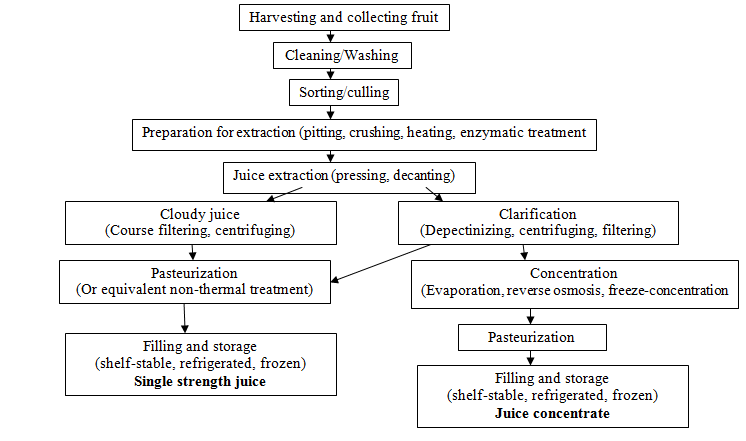
Unit Operation Applied to Juice
There are a number of unit operations involved in converting whole fruit to the desired juice, puree, or pulp product (Table 1). Fruit handling depends upon the process design. If the raw material is destined for multiple uses such as fresh market, whole piece processing, additional products and juice, the flow scheme will differ greatly from one for a juice-only plant. In some circumstances, cleaning, sorting and inspection precede in-plant storage or the operations can be reversed or repeated immediately prior to juicing. As indicated, an ounce of prevention (preventing/removing contaminants from raw material) is worth a pound of cure (trying to clean up contaminated juice).
| Unit Operation | Result |
| Mass transfer | Fruit delivered, dry cleaned |
| Extraction | Washed |
| Separation | Sized, graded |
| Separation | Peeled, cored and deseed |
| Size reduction | Crushed, comminuted |
| Pressure application | Juice extracted |
| Separation | Solids screened |
| Deaeration | Oxygen removed |
| Centrifugation | Solids separated |
| Filtration | Clarification |
| Fluid flow | Juice transferred, pumped |
| Heat transfer | Enzymes inactivated, juice pasteurized and cooled |
| Concentration/ evaporation | Volume reduction, stability |
| Mass transfer | Packaging, shipping |
Table 1: unit operation involved in juice manufacture.
Common Bioactive and Nutritional Composition in Fruit
Fruit consumption has increased nationally and internationally due to an increasing recognition of fruit nutraceutical values [4]. Fruits may contain different bioactive compounds, many of which may have antioxidant capacity. Many complex biochemical reactions are involved during the ripening process, such as the hydrolysis of starch and the synthesis of carotenoids, anthocyanins, and phenolic compounds in addition to the formation of various volatile compounds. The bioactive compounds constitute a group of heterogeneous compounds resulting from secondary metabolism in the plants, and these compounds can be classified as glucosinolates, carotenoids, or polyphenols, including flavonoids and anthocyanins [5]. The antioxidant capacity of fruits varies according to the contents of ascorbic acid, flavonoids, anthocyanins, and other phenolic compounds and can be evaluated by different methods [6, 7]. The fruits, in addition to having phenolic compounds and carotenoids, they also contain vitamin C or L-ascorbic acid, which is a widely distributed water-soluble and thermolabile vitamin [8]. Dovyalis fruits are considered a good source of vitamin C that contains on average 120.3 mg/100 g-1 of fresh fruit [9].
The structure and functional aspects of fruits dictate their composition. Table 2 shows some typical nutritional constituents of fruit (and subsequently juices) and the range of values dependent upon fruit, cultivar, cultivation, maturity and other factors to be presented later.
| Range (%) | Comments | |
|---|---|---|
| Water | 97 - 70 | Influenced by cultivation and post-harvest conditions |
| Carbohydrates | 25 - 3 | Sugars and polymers - pectin, hemicellulose, cellulose |
| Protein | 5 - trace | More in oily fruit and seeds |
| Lipids | 25 - trace | Traces in cell membrane, in seeds, high in avocado |
| Acids | 3 - trace | Citric, tartaric, malic, lactic, acetic, ascorbic + minor |
| Phenolics | 0.5 - trace | Tannins and complex phenols |
| Vitamins | 0.2 - trace | Water soluble > fat soluble |
| Minerals | 0.2 - trace | Soil and species dependent |
| Dietary fibre | <1 to >15 | Peel and core dependent |
| Pigments | 0.1 - trace | Carotenoids, anthocyanins, chlorophyll |
Table 2: Fruit edible portion composition ranges* (Fresh weight basis) [10].
A. Water The most abundant single component of fruits and vegetables is water, which may account for up to 90% of the total mass. The maximum water content varies between individual fruits and vegetables because of structural differences.
B. Organic Acids There are two types of acids, namely aliphatic (straight chain) and aromatic acids. The most abundant acids in fruits and vegetables are citric and malic (both aliphatic) acids. However, large amounts of tartaric acid occur in grapes. Malic acid is the major component in oranges and apples. The acid content of fruits and vegetables generally decreases during maturation. For example, the citric acid content of clingstone peaches decreases faster than the malic acid content, while the malic acid content of apples and pears decreases faster than the citric acid content. Aromatic organic acids occur in several fruits and vegetables, but in very low concentrations. Benzoic acid occurs in cranberries, quinic acid in bananas and chlorogenic acid in potatoes. Organic acids play an important role in the sugar to acid ratio, which affects the flavor of fruits and vegetables. The distribution of acids within a fruit is not uniform.
C. Proteins Proteins represent less than 1% of the fresh mass of fruit and vegetable tissue. Leguminous seeds are rich in protein, containing 15% to 30%. The proteins of fruits and vegetables are built from amino acids, but other related simple nitrogenous compounds also occur. Fruits, vegetables and legumes account for 1.2%, 5.5% and 6.1%, respectively, of the protein in the US food supply [11]. Fruits are low in proteins, but tree nuts are a good source of high-quality proteins.
D. Lipids and Fatty Acids Plant lipids represent a very broad group of compounds with functions that vary among products. Lipids are an energy source for plants during germination, forming components of cellular membranes and cuticular waxes, and they are mainly present as triglycerides (esters of glycerol and three fatty acids) or phospholipids (in which one fatty acid has been replaced by a phosphate group). Generally, most postharvest products are relatively low in total lipids, except for avocados, olives and many seeds. The fat content of fruits and vegetables is usually below 1% and varies with the product. Examples of fat content on a dry mass basis are;Avocado: 35-70%;Olive: 30-70%;Grape: 0.2%; Banana: 0.1%; and Apple: 0.06%.
E. Metabolizable Carbohydrates After water, carbohydrates are the most abundant constituents in fruits and vegetables, representing 50% to 80% of the total dry weight. Carbohydrate functions include, among others, the storage of energy reserves and the make- up of much of the structural framework of cells. Simple carbohydrates, which are also the immediate products of photosynthesis, are important components of sensorial quality attributes. Glucose and fructose are the predominant forms of simple sugars found, especially, in fruits. Sucrose, the primary transport form of carbohydrate in most plants, is a disaccharide yielding glucose and fructose upon hydrolysis. Glucose, fructose and sucrose are water-soluble and together they comprise most of the sugars associated with the sweet taste of fruits and vegetables. The relative proportions of glucose and fructose vary from fruit to fruit and, to a lower extent, in the same fruit according to maturity.
F. Dietary Fiber An expert panel adopted the term “dietary fiber consisting of non-digestible carbohydrates and lignin that are intrinsic and intact in plants” [12]. Dietary fiber includes very diverse macromolecules exhibiting a large variety of physico-chemical properties. The main components included as fiber are cellulose, hemicelluloses, pectins, lignin, resistant starch and non-digestible oligosaccharides.
G. Vitamins Vitamins are organic molecules required in trace amounts for normal development, which cannot be synthesized in sufficient quantity by the organism and must be obtained from the diet. The term “vitamin” derives from the words “vitalamine” because the first vitamin discovered (thiamine) contained an amino group. The 14 vitamins known today are vitamin A (retinol), B complex [B1 (thiamine), B2 (riboflavin), B3 (niacin), B5 (pantothenic acid), B6 (pyridoxine), B9 (folate/folic acid), biotin, choline and B12 (cyanocobalamine)] and vitamins C, D, E and K.
H. Phytochemicals/Bioactive Compounds In Fruit This category of compounds, also known as nutraceuticals and functional foods, is increasing in importance and merits special attention. Photochemicals are defined as:
• “Non-nutritive or nutritive, biologically active compounds present in edible natural foods including fruits, vegetables, grains, nuts, seeds and tea, which prevent or delay the onset or continuation of chronic diseases in humans and animals” [13].
• “Any food ingredient that may provide a health benefit beyond the traditional nutrients it contains” [14].
Fruits and their juices are an especially good source of phytochemicals (Table 3). Close to one thousand different phytochemicals have been found in plants and the identification and promotion of hitherto unrecognized compounds with real or imputed health value continues unabated. In fact, the science is in its infancy and additional phytochemicals, mechanism of action and beneficial effects (toxic properties also), will become apparent and attributed to traditional and exotic juices.
| Sources | |
|---|---|
| Antioxidant Vitamins | Many fruits and vegetables |
| Ascorbic acid (Vitamin C) | |
| Tocopherols (Vitamin E) | |
| Carotenoids | Most yellow/red/orange fruits and vegetables, dark green leafy vegetables |
| Some have Carotenes provitamin A Lycopene activity | |
| Lutein | |
| Xanthins | |
| Dietary Fibre | Ubiquitous cell wall constituents (lower in juice) |
| Pectin | |
| Hemicellulose | |
| Cellulose | |
| Lignan | |
| Flavonoids | Most fruits and vegetables Can be highly pigmented or colourless, highly astringent or flavourless |
| Anthocyanins | |
| Catechins | |
| Naringen | |
| Flavones/IsoflavonesApigenin | Some vegetables - celery, olives (others in soybean) |
| Glucosinolates/Indoles | Cruciferous vegetables possessing pungent flavor - |
| Sulfuranes | |
| Isothiocyanates | |
| Phenols and Phenolic Acids | Most fruits and vegetables, some very highly flavoured, astringent or bitter; teas and herbals |
| Capsaicin, Carnisol, Gingerol, | |
| Ellagic, Gallic, Chlorogenic, | |
| Ferulic, Vanillic, p-coumaric | |
| Phytosterols and Stanols | |
| Sulphur (Allylics) | Allium Vegetables possessing pungent flavour -onion, garlic, chive, shallot, etc. |
| Sulphides | |
| Disulphides | |
| Ajoene | |
| Phytoalexins | Some fruits and vegetables, especially red grapes |
| Resveratrol, Stilbenes | |
| Terpenes/Liminoids | Citrus, cherries, ginger, liquorice |
| Mycrene, d-Limonine, Carvone, | |
| Carnosol, Glycyrrhizin, | |
| Zingiberene |
Table 3: Some phytochemicals in fruit and vegetable processing protective properties against cancer and cardiovascular disease [1
Changes in Bioactive Composition of Fruit in Juice Processing
Bioactive compounds are phytochemicals found in foods that are capable of modulating metabolic processes and resulting in the promotion of better health. Some bioactive constituents present in fruit, such as vitamins, carotenoids, and phenolic compounds, are associated with the prevention of a series of chronic pathologies including cancer, cardiovascular disease, type-2 diabetes, and Alzheimer’s disease [15]. It is known that food nutritional value is highly dependent on its processing and, therefore, the demand for processed foods where health-promoting components are preserved, or containing added ingredients with a specific body function, named functional foods, has led to the development of new minimal-processing technologies that allow a better preservation of these components.
Fruit juices are naturally rich in bioactive compositions like phenolic compounds. In some studies, it has been reported an enhancement of the phenolic compounds and antioxidant activity during thermal processing, as a reaction to the stress induced by temperature. However, in some other cases heat processing may partially destroy them or significantly reduce their bioavailability, thus reducing beneficial health effects [16]. The processing such as thermal pasteurization and sterilization, pulsed electric fields, high pressure, ultrasound, microwave treatment, and microfiltration aimed to preserve fruit juices due to their ability to inactivate a wide range of microorganism’s and spoilage enzymes may has another effect on bioactive compounds as stated below.
Effect of Thermal Pasteurization on Anthocyanin Profile and Antioxidant Capacity of Pomegranate Juices: Vegara, et al. [17] conducted studies to understand the contribution of anthocyanins to the antioxidant capacity of pasteurized pomegranate juices. They evaluated the influence of processing on anthocyanin stability and antioxidant activity of clarified and cloudy juices from ‘Mollar’ pomegranate variety. They verified that the clarification process reduced the content of total monomeric and individual anthocyanins, and increased the antioxidant activity of pomegranate juice. The application of thermal treatments (65 and 90oC for 30 or 5s) diminished the percentage of anthocyanins in the polymeric form, increasing on the contrary the monomeric anthocyanins. Finally, they concluded that hurdle technology (heating plus refrigeration) may help in reducing anthocyanin degradation in pasteurized pomegranate juice, avoiding the undesirable impact on colour and allowing a better preservation of these specific bioactive compounds that have beneficial effects on human health.
Mena, et al. [18] analyzed juices prepared from ‘Mollar’ pomegranates for naturally occurring phenolic compounds, anthocyanins and antioxidant capacity before and after low-, mild- and high-temperature pasteurizations (LTPs, MTPs and HTPs), respectively at 65, 80 and 90°C, for periods of 30 or 60 s. The typical anthocyanin profile of pomegranate juices is characterized by delphinidin, cyanidin and pelargonidin 3-glucosides and 3, 5-diglucosides (Table 4).
The results obtained for total anthocyanin content showed important differences between thermally processed and untreated pomegranate juices, the lowest value being recorded for the control (untreated pomegranate juices), while the largest amount of these pigments was evaluated in a HTP-treated juice.
| Treatment | Dp3, 5dG | Cy3, 5dG | Pg3, 5dG | Dp3G | Cy3G | Pg3G | Total anthocyanins | |
|---|---|---|---|---|---|---|---|---|
| None | ||||||||
| 12,3 | 42,9 | 3,3 | 8,4 | 34,7 | 7,5 | 109,3 | ||
| LTP | 65°C/30s | 14,8 | 48,6 | 3,1 | 11,8 | 39,3 | 5,5 | 123,2 |
| 65°C/60s | 12,9 | 52,8 | 2 | 9,1 | 35,2 | 5,2 | 117,2 | |
| MTP | 80°C/30s | 34,9 | 51,5 | 0,8 | 23,9 | 56,3 | 5,4 | 172,5 |
| 80°C/60s | 32,8 | 51,3 | 1,8 | 24,5 | 49,5 | 7,1 | 167,1 | |
| HTP | 95°C/30s | 33,3 | 55,6 | 2,3 | 28 | 54 | 9,7 | 182,9 |
| 95°C/60s | 30,3 | 47,7 | 1,6 | 23,9 | 49,1 | 7,1 | 159,8 |
Table 4: Effects of thermal treatments on the anthocyanin profile of pomegranate juices. NB: LTP=low temperature pasteurization;
Table 4: Effects of thermal treatments on the anthocyanin profile of pomegranate juices. NB: LTP=low temperature pasteurization; MT=mid-temperature pasteurization; HTP=high temperature pasteurization Dp3, 5dG = delphinidin 3, 5-diglucoside; Cy3, 5dG =cyanidin 3, 5-diglucoside; Pg3, 5dG = pelargonidin 3, 5-diglucoside; Dp3G = delphinidin 3-glucoside; Cy3G = cyanidin 3-glucoside; Pg3G = pelargonidin 3-glucoside [18].
The effect of thermal processing on antioxidant activity of pomegranate juices (ABTS (2, 2’-azinobis-(3- ethylbenzothiazoline-6-sulfonic acid) radical), DPPH (2, 2-diphenylpicrylhydrazyl radical) and FRAP (Ferric ion reducing antioxidant power)) measured by different analytical methods is indicated in Table 5 below. The antioxidant capacity varied from 27.29 to 34.80 mmolTrolox/L and was significantly influenced by the heat treatment applied. The highest values were found in MTP- and HTP-treated juices, whereas the lowest ones were recorded both in LTP-treated juices and untreated samples [18].
| Treatment | Antioxidant capacity (mmol Trolox/L | |||
|---|---|---|---|---|
| None | ABTS | DPPH | FRAP | |
| 30,22 | 14,79 | 17,9 | ||
| LTP | 65°C/30s | 28,73 | 18,80 | 19,68 |
| 65°C/60s | 28,33 | 17,97 | 20,68 | |
| MTP | 80°C/30s | 34,58 | 21,58 | 24,83 |
| 80°C/60s | 33,34 | 19,16 | 22,79 | |
| HTP | 95°C/30s | 34,01 | 19,86 | 24,86 |
| 95°C/60s | 34,57 | 20,51 | 23,.2 |
Table 5: Effects of thermal treatments on antioxidant capacity of pomegranate juices determined by different methods: ABTS, DPPH
Effect of Thermal Pasteurization on Phenolic Contents of Apple and Orange Juices: Aguilar-Rosas, et al. [19] studied the conventional high temperature-short time (HTST) method for pasteurization of apple juice. The thermal pasteurization was performed at 90 °C for 30s with an adapted laboratory set-up, and they evaluated the effects of the treatment on the phenolics content. They observed a reduction in the contents of total phenolic compounds of about 32%, as compared to the untreated juice.
Sentandreu, et al. [20] reported that thermal pasteurization (90 °C for 30s) of orange juice had negligible effects on its phenolic substances content. They observed that pasteurization was not significantly affected phenolic contents (flavanone-7-O-glycosides (FGs) and fully methoxylated flavones (FMFs)) and antiradical activities of the tested juices.
Effects of Pulsed Electric Fields on Bioactive Components in Fruit Juices: A pulse electric field (PEF) treatment is efficient enough to destroy microorganisms in fruit juices without any significant change in their nutritional and sensory properties, and without expressively affecting bioactive components [16].
Aguilar-Rosas, et al. [19] studied the treatment with pulsed electric fields for pasteurization of apple juice. They analyzed the effects the treatment on the phenolics content and observed a reduction in the contents of total phenolic compounds of about 15%, as compared to the untreated juice. Furthermore, they concluded that this treatment caused less reduction in the phenolic content than the conventional thermal pasteurization, which induced 32% reduction in relation to the initial amount present.
Sánchez-Moreno, et al. [21] analyzed the impact of PEF on bioactive compounds and antioxidant activity of orange juice in comparison with traditional thermal processing. They showed that flavonone concentration of orange juice increased with PEF (35 kV cm, 750μs treatment time) and thermal pasteurization at 70°C for 30s. However, its concentration decreased when orange juice was treated with high thermal pasteurization at 90°C for 60s.
Effects of High Pressure Processing (HPP) on Bioactive Components in Fruit Juices: Sánchez-Moreno, et al. [21] analyzed the impact of high pressure processing (HPP) on bioactive compounds and antioxidant activity of orange juice and compared with juice treated by traditional thermal processing. It has shown to be effective in reducing microbial populations and preserving sensory qualities, without affecting the structure of small molecules, such as some bioactive compounds. This technique uses pressure, up to 600 MPa, to inactivate some harmful and pathogenic microorganisms and enzymes responsible for the quality loss of food products, including several fruit juices. With respect to flavanones, HPP treatment led to increased naringenin (20.16%) and hesperetin (39.88%) contents. On the other hand, pasteurization and freezing processes led to diminished naringenin content (16.04%), with no modification in hesperetin. In the case of traditional thermal technologies, high pasteurization treatment showed a decrease in antioxidant activity (6.56%), whereas low pasteurization did not modify the antioxidant activity. Furthermore, HPP also did not modify DPPH antioxidant activity.
Effects of Ultrasound on Bioactive Components in Fruit Juices: Ultrasound is recognized as a potential technique for improvement of the quality of fruit juices. Aadil, et al. [22] studied the effects of ultrasound treatments on quality of grapefruit juice, including total antioxidant capacity, DPPH (2, 2-diphenyl-1-picrylhydrazyl) free radical scavenging activity, total phenolics, flavonoids and flavonols. Their experiments showed that there was significant improvement of the total antioxidant capacity, DPPH free radical scavenging activity, total phenolics, flavonoids and flavonols in all juice samples sonicated for 30, 60 and 90 min (Table 6). These findings suggested that sonication technique might be successfully implemented at an industrial scale for the processing of grapefruit juice.
| Control | US30 | US60 | US90 | |
|---|---|---|---|---|
| Total phenols (gallic acid equivalent μg/g) | 758 | 770 | 814 | 826 |
| Total flavonoids (catechin equivalent μg/g) | 462 | 485 | 599 | 603 |
| Total flavonoids (quercetin equivalent μg/g) | 2.7 | 2.8 | 2.9 | 2.9 |
| Percentage inhibition (DPPH radical) | 33 | 39 | 42 | 43 |
| Antioxidant Capacity (ascorbic acid equivalent μg/g) | 277 | 297 | 304 | 309 |
Table 6: Effect of ultrasound on phenolic compounds and antioxidant activity in grapefruit juice NB: US30 = ultrasound for 30 min
Effects of Microwave Treatment on Bioactive Components in Fruit Juices: Al Bittar, et al. [23] reported an innovative grape juice enriched in polyphenols by microwave-assisted extraction. The grape juice by-product obtained from grape traditional press was extracted by Microwave Hydro diffusion and Gravity (MHG). The Microwave Hydrodiffusion and Gravity extract was analyzed by HPLC for identification and quantification of anthocyanins and other phenolic compounds, and showed the highest values of total phenolic compounds (21.41 mg GAE/g dw1) and antioxidant capacity (4.49 μg MVGE2/g dw). Moreover, the grape juice enriched with Microwave Hydrodiffusion and Gravity extract was richer in phenolic compounds (6.70 mg GAE/g dw) and antioxidant activity (3.96 μg MVGE/g dw) than the natural juice (2.90 mg GAE/g dw and 3.63 μg MVGE/g dw, respectively).
Effects of Microfiltration on Bioactive Components in Fruit Juices: Microfiltration (MF) is classified as a non- thermal process for the fruit juice industry. It can provide a better preservation of the phytochemical properties and organoleptic properties of the juices. Laorko, et al. [24] evaluated the stability of phytochemical properties including total phenolic content, antioxidant capacity (2-diphenly- 1-picrylhydrazyl: DPPH, free radical scavenging capacity and Oxygen Radical Absorbance Capacity: ORAC assays), of MF-clarified pineapple juice during storage at different temperatures (4, 27, and 37°C). The results of their work revealed that most of the phytochemical properties and soluble components were retained in the juice after microfiltration. However, the phytochemical properties and total phenol content of the juice significantly decreased as storage time and temperature increased. They concluded that storage of non-thermally pasteurized and clarified pineapple juice at 4°C was the most suitable since it allowed the best quality preservation.
Conclusion
Fruit juices are particularly important due to their richness in bioactive compounds, among which stand the phenolic compounds with proved antioxidant activity. These molecules, due to their potential for neutralizing free radicals, exhibit many beneficial effects for the human body, either as preventive or even as curing agents for many diseases, such as degenerative diseases and cancer. The benefits of the fruit juices do not seem to be greatly affected by the processing treatments to which they are submitted, particularly when the most recent techniques are applied, such as pulsed electric fields, high pressure or ultrasound. In some studies, it has been reported an enhancement of the phenolic compounds and antioxidant activity during thermal processing, as a reaction to the stress induced by temperature. However, in some other cases heat processing may partially destroy them or significantly reduce their bioavailability, thus reducing beneficial health effects. In general, thermal pasteurization especially at high temperature has a significant effect on the reduction of some bioactive components of fruit juices while non-thermal processing such as pulsed electric fields, high pressure, ultrasound, microwave treatment, and microfiltration has no negative impact on bioactive compounds as reported by different researchers.
References
-
Oomah BD, Mazza G (1999) Health benefits of phytochemicals from selected Canadian crops. Trends in Food Science and Technology 10(6-7): 193-198.
-
Kim JK, Kim EH, Lee OK, Park SY, Lee B, et al. (2013) Variation and correlation analysis of phenolic compounds in mungbean (Vignaradiata L.) varieties. Food Chemistry 141(3): 2988-2997.
-
Mark R, McLellan OI, Padilla-Zakour (2004) Juice processing.
-
Jacques PL, Bessette-Symons B, Cabeza R (2009) Functional neuro imaging studies of aging and emotion: fronto-amygdalar differences during emotional perception and episodic memory. Journal of the International Neuropsychological Society: JINS 15(6): 819-825.
-
Horst MA, Lajolo FM (2012) Biodisponibilidade de compostos bioativos dealimentos.
-
Gallarza MG, Saura IG (2006) Value dimensions, perceived value, satisfaction and loyalty: an investigation of university students’ travel behaviour. Tourism management 27(3): 437-452.
-
Obando-Calderón G, Chaves-Campos J, Garrigues R, Martínez-Salinas A, Montoya M, et al. (2012) Lista Official De Las Aves De Costa Rica Actualización 2012. Zeledonia 16(2).
-
Jacques AC, Zambiazi RC (2011) Phytochemicals in blackberry. Semina: Ciências Agrárias 32(1): 245-260.
-
Silva JM, Frey TJ, Pickett JE (2011) General Electric Co, 2011. Heat recovery system base the use of a stabilized organic rankine fluid, and related processes and devices US. Patent Application.
-
Broihier K (1999) The Phytochemical Renaissance. Food Processing 44: 46-48.
-
Hiza HAB, Bente L (2007) Nutrient content of the US food supply, 1909-2004: summary report Center for Nutrition Policy and Promotion, US Department of Agriculture, Washington DC, USA.
-
Trumbo P, Yates AA, Schlicker S, Poos M (2001) Dietary reference intakes: vitamin A, vitamin K, arsenic, boron, chromium, copper, iodine, iron, manganese molybdenum, nickel, silicon, vanadium, and zinc. Journal of the Academy of Nutrition and Dietetics 101(3): 294.
-
Guhr G, La Chance PA (1997) Role of Phytochemicals in Chronic Disease Prevention.
-
Hasler CM (1998) Functional Foods: Their Role in Disease Prevention and Health Promotion. Food Technol 52(11): 63-70.
-
Wang W, Wang S, Ma X, Gong J (2011) Recent advances in catalytic hydrogenation of carbondioxide. Chemical Society Reviews 40(7): 3703-3727.
-
Agcam E, Akyıldız A, Akdemir Evrendilek G (2014) Comparison of phenolic compounds of orange juice processed by pulsed electric fields (PEF) and conventional thermal pasteurization. Food Chemistry 143: 354-361.
-
Vegara S, Mena P, Martí N, Saura D, Valero M (2013) Approaches to understanding the contribution of anthocyanins to the antioxidant capacity of pasteurized pomegranate juices. Food Chemistry 141(3): 1630-1636.
-
Mena P, Vegara S, Martí N, García-Viguera C, Saura D, et al. (2013) Changes on indigenous microbiota, colour, bioactive compounds and antioxidant activity of pasteurised pomegranate juice. Food Chemistry 141(3): 2122-2129.
-
Aguilar-Rosas SF, Ballinas-Casarrubias ML, Nevarez- Moorillon GV, Martin-Belloso O, Ortega-Rivas E, (2007) Thermal and pulsed electric fields pasteurization of apple juice: Effects on physicochemical properties and flavour compounds. Journal of Food Engineering 83(1): 41-46.
-
Sentandreu E, Navarro JL, Sendra JM (2007) Effect of technological processes and storage on flavonoids content and total, cumulative fast-kinetics and cumulative slow kinetics antiradical activities of citrus juices. European Food Research and Technology 225(5- 6): 905-912.
-
Sánchez-Moreno C, Plaza L, Elez-Martínez P, De Ancos B, Martín-Belloso O, et al. (2005) Impact of high pressure and pulsed electric fields on bioactive compounds and antioxidant activity of orange juice in comparison with traditional thermal processing. Journal of Agricultural and Food Chemistry, 53(11): 4403-4409.
-
Aadil RM, Zeng XA, Han Z, Sun DW (2013) Effects of ultrasound treatments o quality of grapefruit juice. Food Chemistry 141(3): 3201-3206.
-
Al Bittar S, Périno-Issartier S, Dangles O, Chemat F (2013) An innovative grape juice enriched in polyphenols by microwave-assisted extraction. Food Chemistry 141(3): 3268-3272.
-
Laorko A, Tongchitpakdee S, Youravong W (2013) Storage quality of pineapple juice non-thermally pasteurized and clarified by microfiltration. Journal of Food Engineering 116(2): 554-561.
- The Role of Podocyte Apoptosis and the Involvement of SIRT1 in Diabetic Nephropathy
- Dealcoholization of Beer by Osmotic Distillation for the Beverage Industry
- Biopolymer-Based Edible Packaging- Biomaterials, Methods, and Applications in Food Industry: An Updated Review
- Influence of Bioprocessing Methods on 'China Rice' (Gawal R1), and Soyabean Supplementation on the Quality of Complementary Food
- Cassava (Manihot esculenta) Varietal Growth, Yield and Cyanide Content Performance in Three Sites in the South- Eastern Semi Arid Regions of Kenya
- Food Waste Treatment, Recycling, Management and Production of Value-Products-An Update on Methodologies and Current Trends