
Production and Storage Stability of Processed Cassava-Mash Extrudates Enriched With Desiccated Coconut and Cocoa Powder
Cassava mash enriched with desiccated coconut and cocoa powder were extruded and further processed to baked, fried and roasted snacks at 120oC, 180oC and 150oC respectively. The effects of storage stability of processed cassava-mash extrudates (PCE) in low density polyethene (LDPE) and aluminium foil (AF) were monitored for four-weeks at ambient temperature (27oC). Data were used in different equations to predict the variables till 32 weeks. The MC, PV and HV of PCE stored in AL ranged between 3.35-5.50 %, 0.00-4.65 mEq kg-1 and 3.27-5.43 N/mm respectively. The MC, PV and HV of PCE stored in LDPE ranged between 3.55-10.12 %, 0.00-6.12 % and 3.24-5.48 N/mm respectively. The extrudates stored in AF across the storage period were more effective in maintaining the HV, PV and MC than those stored in LDPE.
Introduction
Demand for extruded snacks is on the increase especially for products from cassava roots. This development is being exploited by researchers and food industrialists to develop innovative snacks that are nutritious with increased protein, complex carbohydrates and reduced fat [1, 2]. However, cassava root has been shown to be low in protein, fat, as well as some micronutrients such as vitamins as well as minerals [3]. According to Brennan [4], changing a minor ingredient and processing condition in an extruder has provided the opportunity to process variety of extrudates using extrusion technology. Using extrusion and drying technologies to produce ready-to-eat extrudates can yield shelf stable and nutritious products.
Desiccated coconut is a rich healthy source of nutrients which can be incorporated into various food products like baked products, and extruded foods and steamed products [5], while cocoa powder has high antioxidant properties and essential nutrients [6]. However, most snacks products produced from cassava roots are hygroscopic when exposed to air. These snacks can gain moisture and reduce the storage life of food products. Chemical changes such as lipid oxidation and moisture absorption in snack foods can lead to development of off-flavor and poor hardness [7]. The packaging material can be coated or laminated with an aluminum foil to produce a packaging material at a low cost [8]. Plastic films used for packaging food products include low density polyethylene (LDPE), high density polyethylene (HDPE), metallized polyethylene, laminated aluminium foil (LAF), polyethylene (PE), polypropylene (PP) and plastic containers [9]. This study is therefore aimed at determining the effects of enrichment and processing conditions on the storage stability of processed cassava-mash extrudates enriched with desiccated coconut and cocoa powder, using low density polyethylene and aluminium foil.
Materials and methods
Materials
Freshly matured cassava tubers (Manihot palmata) were procured from the Teaching and Research farm at Obafemi Awolowo University campus, Ile-Ife. Coconut fruits (Cocos nucifera) were obtained from Ile-Ife central market, Osun state, while unsweetened cocoa powder was purchased from Cocoa Products Limited, Ile-Oluji, Ondo State. The chemicals used for laboratory experiment were analytical grade and were produced by Sigma Aldrich (St. Louis, MO). Preliminary Study The composition of cassava-mash blends are shown in Table 1. Preliminary trials was conducted using different proportions (66:17:1:16, 64:19:1:16, 82:0:2:16, 81:0:3:16, 66:17:1:16, 83:0:1:16, 84:0:0:16) of ingredients (cassava- mash, desiccated coconut, cocoa powder and sugar) and moisture levels (15-20%). Quality attributes such as swelling capacity, water absorption capacity and expansion index were used to determine the appropriate composition of cassava mash blends for extrusion. The processing methods and conditions were obtained from the improved method of producing cassava-mash extrudates [10].
| CM | DC | CP | Sugar | |
|---|---|---|---|---|
| Sample A | 84% | - | - | 16% |
| Sample B | 82% | - | 2% | 16% |
| Sample C | 68% | 16% | - | 16% |
| Sample D | 66% | 16% | 2% | 16% |
Table 1: Composition of enriched cassava-mash blends. CM- cassava mash; DC- Desiccated coconut; CP- Cocoa powder, A-Cassava-mash;
Production of Fermented Cassava-Mash
The conventional method of producing fermented cassava-mash as described by Obadina [10] was used. Cassava roots were peeled and grated mechanically into pulp, followed by fermentation for 72 h in a sack at ambient temperature. The fermented cassava-mash was dewatered with a local hydraulic press for 1 h. The dewatered mash was granulated manually and sifted using raffia sieve. The dewatered mash was bagged in a hessian sack and kept for 2 h in a refrigerator at 4°C for moisture equilibrium.
Production of Desiccated Coconut
Conventional method of producing desiccated coconut as described by Sangamithra, et al. [5] as used. The coconut was manually removed by breaking dehusked nuts into halves with the aid of hammer. The split nuts were deshelled and peeled with a sharp knife to remove the brown skin. The coconut kernel was coarsely milled to a mash using an electric blender (Nima, Marlex Appliances PVT, Daman). The coconut mash was dried in hot air oven at 80°C for 8h. After drying, the samples were kept in a plastic container at ambient temperature for further use.
Production of Cassava-Mash Blends and Extrudates
The production of baked, fried and roasted cassava -mash extrudates are presented in Figure 1-3. Based on the preliminary study and the selection of the preferred sample blends, the sample blends (fermented cassava-mash, desiccated coconut, cocoa powder, sugar) as shown in Table 1 were weighed, portioned and mixed at different ratios 84:0:0:16, 82:0:2:16, 68:16:0:16 and 66:16:2:16 respectively. The weighed ingredients were mixed and transferred separately into four clean bowls. Water was added (16%) in equal proportions.
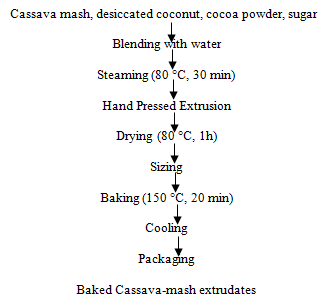
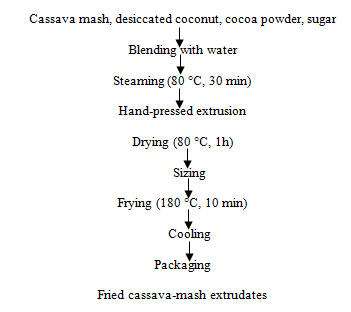
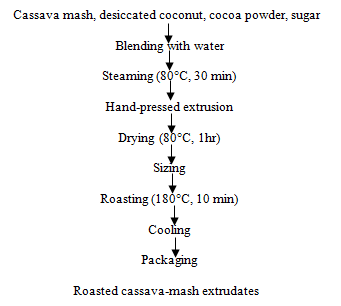
Atmospheric pressure in a mini deep fryer (model FF220040, Tefal), cooled, and packaged in a foil, while the third set of extrudates were roasted in an open pan at 120oC for 15 min, cooled, and packaged in a foil.
The blended samples were mixed thoroughly to get a homogenous mixture with a mixer (5L dough mixer, FM-W5L) for maximum expansion ratio and internal and apparent texture. The blended samples were cooked to gelatinise completely in a water bath (Model- SW22, Julabo Labortechnik Seedbach, Germany) at 80oC for 30 min [11]. The gelatinised samples were uniformly mixed in a dough mixer and were manually fed into a hand pressed extruder (Bottene, Model B, Italy) to manually extrude the gelatinised samples. The extrudates were labelled per blend, dried at 80oC for 8 h in hot air oven and cooled to ambient temperature (27oC).
The labelled extrudates were divided into three portions for baking, frying and roasting. The first set of extrudates were baked in hot-air oven at 150oC for 15 min, cooled, and packaged in a foil. The second set of extrudates were fried at 180°C for 10 min in hot oil oven and cooled to ambient temperature (27oC). The labelled extrudates were divided into three portions for baking, frying and roasting. The first set of extrudates were baked in hot-air oven at 150oC for 15 min, cooled, and packaged in a foil. The second set of extrudates were fried at 180°C for 10 min in hot oil under.
Storage Stability of Processed Cassava-Mash Extrudates
The cassava-mash extrudates were packaged (20g) in low polyethylene (LDPE) and alumium foil (AF) under aseptic conditions and were stored at ambient temperature conditions (27±2°C). The storage stability indices such as moisture content, peroxide and hardness values were monitored for the duration of four-weeks [12]. Data was used in different equations to establish a mathematical relationship between the variables (moisture contents peroxide value and time equations with the highest R2 values were used to predict the duration for up to thirty-two weeks.
Statistical Analysis
The statistical significance of the differences among the means of triplicate was evaluated using analysis of variance. Means were separated using Duncan’s multiple range test at 95% confidence level.
Results and Discussion
Moisture Content
The effects of storage time and packaging material on the moisture content of processed cassava-mash extrudates (PCE) were monitored for duration of four-week (Figure 4&6). Data from four-week were injected into different equations to predict the relationship between moisture and time till 32 weeks (Figure 5 & 7). The moisture contents of PCE stored in AF (Figure 4&5) and LDPE packs (Figure 6&7) ranged between 3.35-5.5 and 3.55-10.12% respectively. In AF packs, the baked, fried and roasted extrudates ranged between 4.33-5.47%, 3.35-4.48% and 4.55-5.5% respectively. These results suggest a maximum percentage increase of 20.8, 25.2 and 17.2% respectively (Figure 4-7).
In LDPE packs, the baked, fried and roasted extrudates ranged between 4.53-9.88%, 3.55-8.50% and 4.85-10.12% respectively. These results suggest a percentage increase of 54.1, 58.2 and 52% respectively. The effect of storage time revealed that MC of extrudates increased over 32 weeks of storage in LDPE and AF packs. However, during four week of storage, there was no significant increase in the moisture absorption of extrudates stored in LDPE (Figure 5) and AF (Figure 7). The slow moisture absorption of the extrudates stored for four-week in LDPE and AF may be due to the loss of moisture during the processing of baked, fried and roasted snacks.
This agreed with the observation described by Gautam and Gupta for homemade extruded product prepared from Malted Composite Flour. Toluwase, et al. [13] reported a similar value of moisture content (4.1%) during the storage (4-week) of cassava strips. This agreed with the observation described by Gautam and Gupta for homemade extruded product prepared from Malted Composite Flour. Toluwase et al. [13] reported a similar value of moisture content (4.1%) during the storage (4-week) of cassava strips. The effect of enrichment on the storage stability of PCE showed that the moisture absorption of extrudates produced with desiccated coconut (CB, CF, CR, DB, DF and DR) was significant different (p < 0.05) from extrudates produced without desiccated coconut (AB, AF, AR, BB, BF and BR). In AF and LDPE packs, the largest increase (10.12%) in moisture absorption were observed in extrudates produced with desiccated coconut, while extrudates produced without desiccated coconut
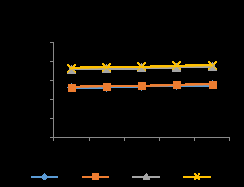
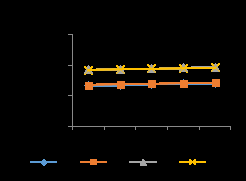
Figure 4: Moisture uptake of baked cassava-mash extrudates, fried cassava-mash and roasted cassava-mash extrudates in AF packs for 4 weeks. AB-Baked Cassava-based extrudates; BB-Baked Cassava-based extrudates with 2% cocoa powder; CB-Baked Cassava-based extrudates with 16% desiccated coconut; DB-Baked Cassava-based extrudates with 2% cocoa powder and 16% Desiccated Coconut Powder; AF-Fried Cassava-based extrudates; BF-Fried Cassava-based extrudates with 2% cocoa powder; BR- Roasted Cassava-based extrudates with 2% cocoa powder, CF-Fried Cassava-based extrudates with 16% desiccated coconut; DF-Fried Cassava-based extrudates with 2% cocoa powder and 16% desiccated coconut; AR-Roasted Cassava-based extrudates; CR- Roasted Cassava-based extrudates with desiccated coconut; DR-Roasted Cassava-based extrudates with 2% cocoa powder and 16% desiccated coconut.
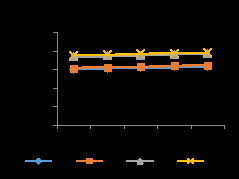
had the least moisture uptake (5.47%). In this study, the influence of desiccated coconut in the moisture absorption of extrudates produced with desiccated coconut (CB, CF, CR, DB, DF and DR) was significantly different (p < 0.05) from extrudates produced without desiccated coconut.
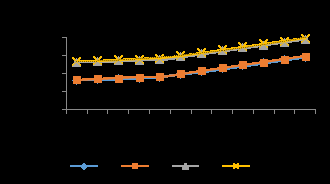
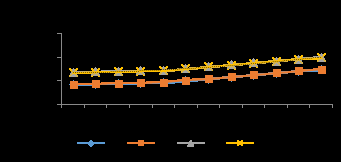
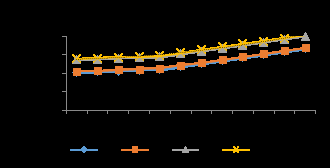
Figure 5: Moisture uptake of baked cassava-mash, fried cassava-mash and roasted cassava-mash in AF packs for 32 wks AB-Baked Cassava-based extrudates; BB-Baked Cassava-based extrudates with 2% cocoa powder; CB-Baked Cassava-based extrudates with 16% desiccated coconut; DB-Baked Cassava-based extrudates with 2% cocoa powder and 16% Desiccated Coconut Powder; AF-Fried Cassava-based extrudates; BF-Fried Cassava-based extrudates with 2% cocoa powder; BR- Roasted Cassava-based extrudates with 2% cocoa powder, CF-Fried Cassava-based extrudates with 16% desiccated coconut; DF-Fried Cassava-based extrudates with 2% cocoa powder and 16% desiccated coconut; AR-Roasted Cassava-based extrudates; CR- Roasted Cassava-based extrudates with desiccated coconut; DR-Roasted Cassava-based extrudates with 2% cocoa powder and 16% desiccated coconut.
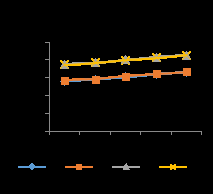
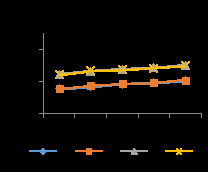
Figure 6: Moisture uptake of baked cassava-mash extrudates, fried cassava-mash and roasted cassava-mash in LDPE packs for 4 wks. AB- Baked Cassava-based extrudates; BB- Baked Cassava-based extrudates with 2% cocoa powder; CB-Baked Cassava-based extrudates with 16% desiccated coconut; DB-Baked Cassava-based extrudates with 2% cocoa powder and 16% Desiccated Coconut Powder; AF- Fried Cassava-based extrudates; BF-Fried Cassava-based extrudates with 2% cocoa powder; BR- Roasted Cassava-based extrudates with 2% cocoa powder, CF-Fried Cassava-based extrudates with 16% desiccated coconut; DF- Fried Cassava-based extrudates with 2% cocoa powder and 16% desiccated coconut; AR-Roasted Cassava-based extrudates; CR- Roasted Cassava-based extrudates with desiccated coconut; DR-Roasted Cassava-based extrudates with 2% cocoa powder and 16% desiccated coconut.
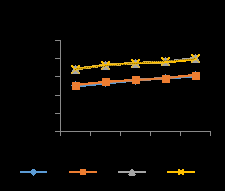
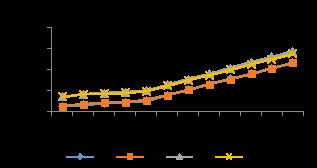
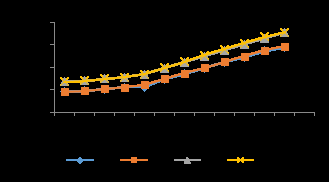
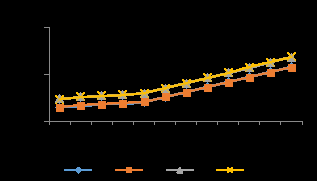
AB-Baked Cassava-based extrudates; BB-Baked Cassava-based extrudates with 2% cocoa powder; CB-Baked Cassava-based extrudates with 16% desiccated coconut; DB-Baked Cassava-based extrudates with 2% cocoa powder and 16% Desiccated Coconut Powder; AF-Fried Cassava-based extrudates; BF-Fried Cassava-based extrudates with 2% cocoa powder; BR- Roasted Cassava-based extrudates with 2% cocoa powder, CF-Fried Cassava-based extrudates with 16% desiccated coconut; DF-Fried Cassava-based extrudates with 2% cocoa powder and 16% desiccated coconut; AR-Roasted Cassava-based extrudates; CR- Roasted Cassava-based extrudates with desiccated coconut; DR-Roasted Cassava-based extrudates with 2% cocoa powder and 16% desiccated coconut (AB, AF, AR, BB, BF and BR).
In AF and LDPE packs, the largest increase (10.12%) in moisture absorption were observed in extrudates produced with desiccated coconut, while extrudates produced without desiccated coconut had the least moisture uptake (5.47). Shakhawat [14] reported that the addition of coconut flour increased the moisture content in baked sample. He concluded that the baked samples containing 30% coconut flour gave the maximum moisture content around 20.5%. In this study, the influence of desiccated coconut in the moisture absorption of extrudates may be attributed to higher water retention and water-binding capacity of desiccated coconut which retains higher MC in the packaged extrudates [14]. In AF packs, water absorption of extrudates increased marginally from week 8 to week 32, while a sudden increase in water absorption was observed in LDPE packs from week 4 to week 32 (Figure 5 & Figure 7). Butt, et al. [15] observed an increase in moisture content in breakfast cereals during a storage period of six months. He concluded that aluminium foil have higher moisture barrier properties than polyethylene packs This agreed with the result described by Abong, et al., [16] for the moisture content of crisps stored in AF packs at different temperature. Purohit, et al. [17] cited evidence that the higher moisture absorption of extrudates stored in polyethylene packs may be due to the moisture absorption of the packaging film. In this study, the results showed that extrudates stored in AF packs maintained lower moisture levels (3.55-5.55 %) than extrudates stored in LDPE packs (3.55-10.12%).
The effect of processing on the storage stability of PCE showed that the fried extrudates had the least MC compared to baked and roasted extrudates. This may be due to moisture loss during frying as compared to baking and roasting of extrudates. The effect of heat treatment on the moisture content of fried extrudates during processing requires higher heat transfer co-efficient as compared to dry heat treatment, thereby increasing moisture loss by evaporation Esturk, et al. [18]. Shyu, et al. [19] concluded that during deep fat frying, there is rapid removal of unbound water in fried food as boiling point of oil and water in food is reached. LDPE packs are hygroscopic and porous, which tends to absorb moisture, both from external and internal environment of the packaged product [20]. In this study, the moisture absorption of extrudates was significantly affected by storage time (p < 0.05), type of ingredients and packaging use. Extruded snacks have very low moisture content between 4 to 6% making them shelf stable [21]. In this study, extrudates stored in AF packs maintained moisture levels till week 32 as opposed to the transparent polyethylene packs, which maintained moisture levels till week 8. AF packs were found to be effective in controlling the moisture absorption.
R2-Polynomial R2; R12-Linear R2; R22-Exponential R2; R32-Logarithmic R2; R42-Power of extrudates compared to LDPE packs. The mathematical relationships between the variables were found to be polynomial of the second order (Table 2&3). This was because the R-squared (R2) values of the regression equation was found to, be the highest (much closer to unity) when compared to other regression relationships such as linear exponential, logarithmic and power. The R2 values for the moisture content of PCE stored in AL was found to be 0.9937, while the R2 values of PCE stored in LDPE were found to be in the range of 0.9928 and 0.9934 respectively. The R2 values are used for describing the effect of variables on the responses. Joglekar & May [21] reported values greater than 80% indicate the fitness of polynomial models. In this study, the models have agreeable levels of R2 of above 80%. There was no significant lack of fit in all the response variables. The regression equation (Table 2&3) for control samples (AB, AF and AR) and control samples enriched with cocoa powder (BB, BF and BR) were similar due to their formulation. The same observation was observed between control samples enriched with desiccated coconut (CB, CF, CR) and control samples enriched with desiccated coconut and cocoa powder (DB, DF, DR).
| Sample | Polynomial Regress equation | R2 | R12 | R22 | R33 | R44 |
|---|---|---|---|---|---|---|
| AB | y = 0.0042x2 + 0.0066x + 4.31 | 0.9937 | 0.9519 | 0.9568 | 0.7344 | 0.7449 |
| BB | y = 0.0042x2 + 0.0066x + 4.31 | 0.9937 | 0.9519 | 0.9568 | 0.7344 | 0.7449 |
| CB | y = 0.0042x2 + 0.0066x + 4.81 | 0.9937 | 0.9519 | 0.9563 | 0.7344 | 0.7439 |
| DB | y = 0.0042x2 + 0.0066x + 4.81 | 0.9937 | 0.9519 | 0.9563 | 0.7344 | 0.7439 |
| AF | y = 0.0042x2 + 0.0066x + 3.33 | 0.9937 | 0.9519 | 0.9581 | 0.7344 | 0.7478 |
| BF | y = 0.0042x2 + 0.0066x + 3.33 | 0.9937 | 0.9519 | 0.9581 | 0.7344 | 0.7478 |
| CF | y = 0.0042x2 + 0.0066x + 3.82 | 0.9937 | 0.9519 | 0.9574 | 0.7349 | 0.7461 |
| DF | y = 0.0042x2 + 0.0066x + 3.82 | 0.9937 | 0.9519 | 0.9574 | 0.7344 | 0.7462 |
| AR | y = 0.0042x2 + 0.0066x + 4.53 | 0.9937 | 0.9519 | 0.9566 | 0.7344 | 0.7445 |
| BR | y = 0.0042x2 + 0.0066x + 4.53 | 0.9937 | 0.9519 | 0.9566 | 0.7344 | 0.7445 |
| CR | y = 0.0042x2 + 0.0066x + 4.87 | 0.9937 | 0.9519 | 0.9563 | 0.7344 | 0.7438 |
| DR | y = 0.0042x2 + 0.0066x + 4.87 | 0.9937 | 0.9519 | 0.9563 | 0.7344 | 0.7438 |
Table 2: Mathematical relationship for moisture content at different storage period of processed cassava mash extrudates in AF fo
Table 2: Mathematical relationship for moisture content at different storage period of processed cassava mash extrudates in AF for 32 weeks. AB-Baked Cassava-based extrudates; BB-Baked Cassava-based extrudates with 2% cocoa powder; CB-Baked Cassava-based extrudates with 16% desiccated coconut; DB-Baked Cassava-based extrudates with 2% cocoa powder and 16% Desiccated Coconut Powder; AF-Fried Cassava-based extrudates; BF-Fried Cassava-based extrudates with 2% cocoa powder; BR- Roasted Cassava-based extrudates with 2% cocoa powder, CF-Fried Cassava-based extrudates with 16% desiccated coconut; DF-Fried Cassava-based extrudates with 2% cocoa powder and 16% desiccated coconut; AR-Roasted Cassava-based extrudates; CR- Roasted Cassava-based extrudates with desiccated coconut; DR-Roasted Cassava-based extrudates with 2% cocoa powder and 16% desiccated coconut. R2- Polynomial R2; R12-Linear R2; R22-Exponential R2; R32-Logarithmic R2; R42-Power R2.
| Sample | Polynomial Regress equation | R2 | R12 | R22 | R33 | R44 |
|---|---|---|---|---|---|---|
| AB | y = 0.0276x2 + 0.0445x + 4.4241 | 0.9928 | 0.9517 | 0.9716 | 0.7359 | 0.7861 |
| BB | y = 0.0276x2 + 0.0445x + 4.4241 | 0.9928 | 0.9517 | 0.9716 | 0.7359 | 0.7861 |
| CB | y = 0.0291x2 + 0.0470x + 5.2970 | 0.9937 | 0.9617 | 0.9701 | 0.7361 | 0.7321 |
| DB | y = 0.0291x2 + 0.0470x + 5.2970 | 0.9937 | 0.9617 | 0.9701 | 0.7361 | 0.7321 |
| AF | y = 0.0266x2 + 0.0427x + 3.4443 | 0.9934 | 0.9517 | 0.974 | 0.7358 | 0.7937 |
| BF | y = 0.0266x2 + 0.0427x + 3.4443 | 0.9934 | 0.9517 | 0.974 | 0.7358 | 0.7937 |
| CF | y = 0.0263x2 + 0.0426x + 4.3423 | 0.9932 | 0.9616 | 0.9711 | 0.7362 | 0.7857 |
| DF | y = 0.0263x2 + 0.0426x + 4.3423 | 0.9932 | 0.9616 | 0.9711 | 0.7362 | 0.7857 |
| AR | y = 0.0228x2 + 0.0993x + 4.6046 | 0.9923 | 0.9625 | 0.9776 | 0.7548 | 0.7993 |
| BR | y = 0.0228x2 + 0.0993x + 4.6046 | 0.9923 | 0.9625 | 0.9776 | 0.7548 | 0.7993 |
| CR | y = 0.0248x2 + 0.1082x + 5.4694 | 0.9932 | 0.9625 | 0.977 | 0.7522 | 0.7971 |
| DR | y = 0.0248x2 + 0.1082x + 5.4694 | 0.9932 | 0.9625 | 0.977 | 0.7522 | 0.7971 |
Table 3: Mathematical relationship for moisture content at different storage period of processed cassava mash extrudates in LDPE
Table 3: Mathematical relationship for moisture content at different storage period of processed cassava mash extrudates in LDPE for 32 weeks. AB-Baked Cassava-based extrudates; BB-Baked Cassava-based extrudates with 2% cocoa powder; CB-Baked Cassava-based extrudates with 16% desiccated coconut; DB-Baked Cassava-based extrudates with 2% cocoa powder and 16% Desiccated Coconut Powder; AF-Fried Cassava-based extrudates; BF-Fried Cassava-based extrudates with 2% cocoa powder; BR- Roasted Cassava-based extrudates with 2% cocoa powder, CF-Fried Cassava-based extrudates with 16% desiccated coconut; DF-Fried Cassava-based extrudates with 2% cocoa powder and 16% desiccated coconut; AR-Roasted Cassava-based extrudates; CR- Roasted Cassava-based extrudates with desiccated coconut; DR-Roasted Cassava-based extrudates with 2% cocoa powder and 16% desiccated coconut.
Peroxide Value of Processed Cassava-Mash Extrudates
The effects of storage time and packaging material on the peroxide value (PV) of PCE were monitored for duration of four-week (Figure 8 & 10). Data from four-week were injected into different equations to predict the relationship between peroxide and time till 32 weeks (Figure 9 and 11). The PV of PCE stored in AF ranged (Figure 8 & 9) between 0-3.85 mEq kg-1, 0-4.65 mEq kg-1 and 0-3.85 mEq kg-1, for the baked, fried and roasted extrudates respectively. The PV of PCE stored in LDPE (Figure 10&11) ranged between 0-5.57 mEq kg-1, 0-6.12 mEq kg-1 and 0-5.61 mEq kg-1, for the baked, fried and roasted extrudates. In AF and LDPE packs, the effect of storage time revealed that there was no significant change (p < 0.05) in PV during 4 weeks storage. Toluwase, et al. [13] cited evidence that there were no changes in the PV of cassava strips during 4 week of storage at ambient temperature. The result obtained for PV could be attributed to the lower moisture content of samples stored for 4 weeks in AF and LDPE.
The effect of packaging material on the storage of PCE showed that extrudates stored in LDPE had a significant (p < 0.05) higher increase in PV from week 4 compared to those stored in AF.
Similar studies was done by Abong et al. [16] for deep fried potato snacks stored in AF and polyethene bag for 24 weeks storage at ambient temperature, and reported peroxide value in the range between 0.00 to 7.44 meq/1000 g and 0.00 to 2.98 meq/1000 g respectively. These results clearly indicate that the keeping quality of extrudates stored in polyethylene and aluminium foil was influenced by the packaging material and storage time [22].
The effect of enrichment on the storage stability of PCE showed that PV was minimum (3.85 mEq kg-1) in extrudates produced without desiccated coconut and maximum (4.65%) in extrudates produced with desiccated coconut. The value of PV present in desiccated coconut may reflect its oxidative level. Obibuzor [22] reported that during the processing of dehydrated coconut, milling ruptures more oil bearing cells and predisposes the coconut mash to oxidation.
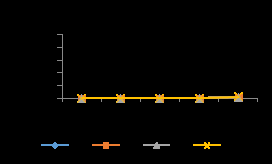
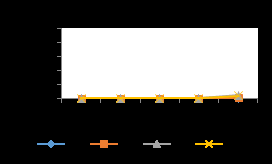
Figure 8: Peroxide value of baked cassava-mash extrudates (a), fried cassava-mash (b) and roasted cassava-mash (c) in AF packs for 4 weeks storage. AB-Baked Cassava-based extrudates; BB-Baked Cassava-based extrudates with 2% cocoa powder; CB-Baked Cassava-based extrudates with 16% desiccated coconut; DB-Baked Cassava-based extrudates with 2% cocoa powder and 16% Desiccated Coconut Powder; AF-Fried Cassava-based extrudates; BF-Fried Cassava-based extrudates with 2% cocoa powder; BR- Roasted Cassava-based extrudates with 2% cocoa powder, CF-Fried Cassava-based extrudates with 16% desiccated coconut; DF-Fried Cassava-based extrudates with 2% cocoa powder and 16% desiccated coconut; AR-Roasted Cassava-based extrudates; CR- Roasted Cassava-based extrudates with desiccated coconut; DR-Roasted Cassava-based extrudates with 2% cocoa powder and 16% desiccated coconut.
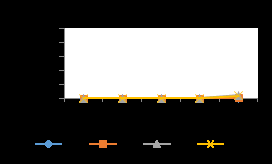
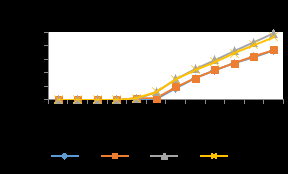
Figure 9: Peroxide of baked cassava-mash (a), fried cassava-mash (b) and roasted cassava-mash (c) in AF packs for 32 weeks storage. AB-Baked Cassava-based extrudates; BB-Baked Cassava-based extrudates with 2% cocoa powder; CB-Baked Cassava-based extrudates with 16% desiccated coconut; DB-Baked Cassava-based extrudates with 2% cocoa powder and 16% Desiccated Coconut Powder; AF-Fried Cassava-based extrudates; BF-Fried Cassava-based extrudates with 2% cocoa powder; BR- Roasted Cassava-based extrudates with 2% cocoa powder, CF-Fried Cassava-based extrudates with 16% desiccated coconut; DF-Fried Cassava-based extrudates with 2% cocoa powder and 16% desiccated coconut; AR-Roasted Cassava-based extrudates; CR- Roasted Cassava-based extrudates with desiccated coconut; DR-Roasted Cassava-based extrudates with 2% cocoa powder and 16% desiccated coconut.
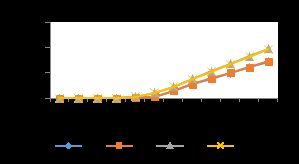
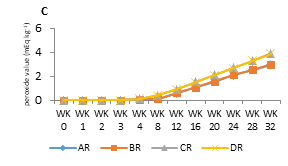
Figure 10: Peroxide value of baked cassava-mash extrudates (a), fried cassava-mash (b) and roasted cassava-mash (c) in LDPE packs for 4 weeks storage. AB-Baked Cassava-based extrudates; BB-Baked Cassava-based extrudates with 2% cocoa powder; CB-Baked Cassava-based extrudates with 16% desiccated coconut; DB-Baked Cassava-based extrudates with 2% cocoa powder and 16% Desiccated Coconut Powder; AF-Fried Cassava-based extrudates; BF-Fried Cassava-based extrudates with 2% cocoa powder; BR- Roasted Cassava-based extrudates with 2% cocoa powder, CF-Fried Cassava-based extrudates with 16% desiccated coconut; DF-Fried Cassava-based extrudates with 2% cocoa powder and 16% desiccated coconut; AR-Roasted Cassava-based extrudates; CR- Roasted Cassava-based extrudates with desiccated coconut; DR-Roasted Cassava-based extrudates with 2% cocoa powder and 16% desiccated coconut.

Figure 11: Peroxide value of baked cassava-mash, fried cassava-mash and roasted cassava-mash in LDPE for 32 weeks storage. AB-Baked Cassava-based extrudates; BB-Baked Cassava-based extrudates with 2% cocoa powder; CB-Baked Cassava-based extrudates with 16% desiccated coconut; DB-Baked Cassava-based extrudates with 2% cocoa powder and 16% Desiccated Coconut Powder; AF-Fried Cassava-based extrudates; BF-Fried Cassava-based extrudates with 2% cocoa powder; BR- Roasted Cassava-based extrudates with 2% cocoa powder, CF-Fried Cassava-based extrudates with 16% desiccated coconut; DF-Fried Cassava-based extrudates with 2% cocoa powder and 16% desiccated coconut; AR-Roasted Cassava-based extrudates; CR- Roasted Cassava-based extrudates with desiccated coconut; DR-Roasted Cassava-based extrudates with 2% cocoa powder and 16% desiccated coconut.
The effect of processing on the storage of PCE showed that PV of fried extrudates was significantly affected (p < 0.05) by presence of oil. As a result, the increase in peroxide value was minimum (5.57 mEq kg-1) in baked and roasted extrudates (5.61 mEq kg-) and maximum in fried extrudates (6.12 mEq kg-1), indicating the fried samples had higher fat content and peroxide value than baked and roasted extrudates.
Enzyme activity and oxidation or use of high frying temperature may influence the formation of PV [23]. The free fatty acids in frying oil may result from the hydrolysis of the frying oil [24]. The peroxide index is the most common parameter used to characterize oils and fats in a product [25]. At low oxidation state, PV is between 1 and 5 meq/kg.
At moderate oxidation, PV is classified at low oxidation state; while at high oxidation state, PV is above 10 meq/kg [25, 26, 27, 28, 29, 30, 31, 32, 33, 34, 35, 36, 37].
In this study, it is evident that PV of all the samples remained within the safe limit. Above all, the AF was more effective in maintaining PV than those stored in LDPE.
The mathematical relationship for PV at different storage period of PCE in AF and LDPE are shown in Table 4&5 respectively. The R12 and R44 values for the peroxide value of extrudates stored in LDPE and AL were found to be 0. The R2 values for the peroxide values (PV) of extrudates stored in AL and LDPE were found between 0.9769-0.9930 and 0.9871- 0.9905 respectively. R2 values obtained in this study described the effect of variables on the responses.
| Sample | Polynomial Regress equation | R2 | R12 | R22 | R33 | R44 |
|---|---|---|---|---|---|---|
| AB | y = 0.0343x2-0.1693x + 0.1389 | 0.9883 | 8648 | 0 | 0.5963 | 0 |
| BB | y = 0.0343x2-0.1693x + 0.1389 | 0.9883 | 8648 | 0 | 0.5963 | 0 |
| CB | y = 0.0422x2-0.1789x + 0.1120 | 0.993 | 0.8648 | 0 | 0.6221 | 0 |
| DB | y = 0.0422x2-0.1789x + 0.1120 | 0.993 | 0.8648 | 0 | 0.6221 | 0 |
| AF | y = 0.0401x2-0.1549x + 0.0534 | 0.9769 | 0.8787 | 0 | 0.6187 | 0 |
| BF | y = 0.0401x2-0.1549x + 0.0534 | 0.9769 | 0.8787 | 0 | 0.6187 | 0 |
| CF | y = 0.0425x2-0.087x-0.11580 | 0.9808 | 0.91 | 0 | 0.6611 | 0 |
| DF | y = 0.0425x2-0.087x-0.11580 | 0.9808 | 0.91 | 0 | 0.6611 | 0 |
| AR | y = 0.0365x2-0.1882x + 0.1680 | 0.9892 | 0.8589 | 0 | 0.5893 | 0 |
| BR | y = 0.0365x2-0.1882x + 0.1680 | 0.9892 | 0.8589 | 0 | 0.5893 | 0 |
| CR | y = 0.0422x2-0.1789x + 0.1120 | 0.993 | 0.8853 | 0 | 0.5893 | 0 |
| DR | y = 0.0422x2-0.1789x + 0.1120 | 0.993 | 0.8853 | 0 | 0.5893 | 0 |
| AB | y = 0.0411x2-0.1074x-0.0466 | 0.9886 | 0.9098 | 0 | 0.6576 | 0 |
| BB | y = 0.0411x2-0.1074x-0.0466 | 0.9886 | 0.9098 | 0 | 0.6576 | 0 |
| CB | y = 0.0474x2-0.0673x-0.1669 | 0.9894 | 0.925 | 0 | 0.6811 | 0 |
| DB | y = 0.0474x2-0.0673x-0.1669 | 0.9894 | 0.925 | 0 | 0.6811 | 0 |
| AF | y = 0.0437x2 + 0.0403x-0.319 | 0.9881 | 0.944 | 0 | 0.7221 | 0 |
| BF | y = 0.0437x2 + 0.0403x-0.319 | 0.9881 | 0.944 | 0 | 0.7221 | 0 |
| CF | y = 0.0319x2 + 0.2909x-0.6975 | 0.9876 | 0.9706 | 0 | 0.7819 | 0 |
| DF | y = 0.0319x2 + 0.2909x-0.6975 | 0.9876 | 0.9706 | 0 | 0.7819 | 0 |
| AR | y = 0.0397x2-0.0981x-0.0589 | 0.9871 | 0.9112 | 0 | 0.66 | 0 |
| BR | y = 0.0397x2-0.0981x-0.0589 | 0.9871 | 0.9112 | 0 | 0.66 | 0 |
| CR | y = 0.0466x2-0.0544x-0.1831 | 0.9905 | 0.9286 | 0 | 0.6868 | 0 |
| DR | y = 0.0466x2-0.0544x-0.1831 | 0.9905 | 0.9286 | 0 | 0.6868 | 0 |
Table 4: Mathematical relationship for peroxide value at different storage period of extrudates stored in AF.
The result (Table 4&5) shows that the models have agreeable levels of R2 of above 80% [21]. There was no significant lack of fit in all the response variables. The regression equation for control samples (AB, AF and AR)
and control samples enriched with cocoa powder (BB, BF and BR) were similar due their formulation. The same observation (Figure 5 & 7) were observed between control samples enriched with desiccated coconut (CB, CF, CR) and control samples enriched with desiccated coconut and cocoa powder (DB, DF, DR).
Table 5: Mathematical relationship for peroxide value at different storage period of extrudates stored in LDPE. AB-Baked Cassava-based extrudates; BB-Baked Cassava-based extrudates with 2% cocoa powder; CB-Baked Cassava-based extrudates with 16% desiccated coconut; DB-Baked Cassava-based extrudates with 2% cocoa powder and 16% Desiccated Coconut Powder; AF-Fried Cassava-based extrudates; BF-Fried Cassava-based extrudates with 2% cocoa powder; BR- Roasted Cassava-based extrudates with 2% cocoa powder, CF-Fried Cassava-based extrudates with 16% desiccated coconut; DF-Fried Cassava-based extrudates with 2% cocoa powder and 16% desiccated coconut; AR-Roasted Cassava-based extrudates; CR- Roasted Cassava-based extrudates with desiccated coconut; DR-Roasted Cassava-based extrudates with 2% cocoa powder and 16% desiccated coconut. R2- Polynomial R2; R12-Linear R2; R22-Exponential R2; R32-Logarithmic R2; R42-Power R2.
Hardness Value
The effects of storage time and packaging material on the hardness value (HV) of PCE were monitored for duration of four-week (Figure 12&14). Data from four-week were injected into different equations to predict the relationship between hardness values and time till 32 weeks (Figure 13&15). The HV of extrudates stored in AF packs (Figure 12 and 13) ranged between 5.43-5.37 N/mm, 3.43- 3.37

Figure 12: Hardness value of baked cassava-mash, fried cassava-mash and roasted cassava-mash in AF for 4 weeks storage. AB-Baked Cassava-based extrudates; BB-Baked Cassava-based extrudates with 2% cocoa powder; CB-Baked Cassava-based extrudates with 16% desiccated coconut; DB-Baked Cassava-based extrudates with 2% cocoa powder and 16% Desiccated Coconut Powder; AF-Fried Cassava-based extrudates; BF-Fried Cassava-based extrudates with 2% cocoa powder; BR- Roasted Cassava-based extrudates with 2% cocoa powder, CF-Fried Cassava-based extrudates with 16% desiccated coconut; DF-Fried Cassava-based extrudates with 2% cocoa powder and 16% desiccated coconut; AR-Roasted Cassava-based extrudates; CR- Roasted Cassava-based extrudates with desiccated coconut; DR-Roasted Cassava-based extrudates with 2% cocoa powder and 16% desiccated coconut.
N/mm and 4.77- 4.68 N/mm, for the baked, fried and roasted extrudates respectively. These results suggest a percentage increase of 1.1, 1.7 and 1.8% respectively. The HV of extrudates stored in LDPE (Figure 14 and 15) were 5.48 -5.24 N/mm, 3.48-3.24 N/mm and 4.84-4.47N/mm, for the baked, fried and roasted extrudates respectively. These results suggest a percentage decrease of 4.5, 6.8 and 7.6% respectively (Figure 12-15).
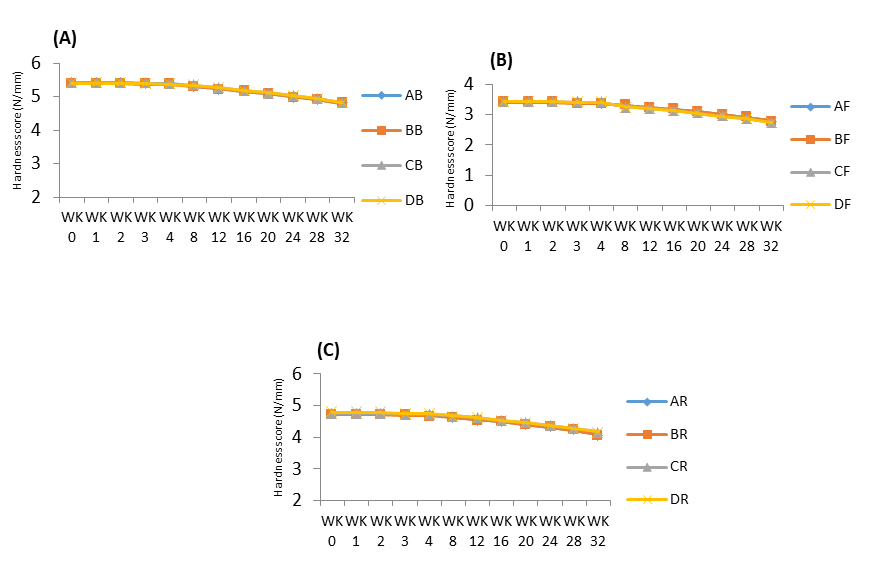
Figure 13: Hardness value of baked cassava-mash, fried cassava-mash and roasted cassava-mash in AF for 32 weeks storage. AB - Baked Cassava-based extrudates; BB - Baked Cassava-based extrudates with 2% cocoa powder; CB - Baked Cassava-based extrudates with 16% desiccated coconut; DB - Baked Cassava-based extrudates with 2% cocoa powder and 16% Desiccated Coconut Powder; AF - Fried Cassava-based extrudates; BF – Fried Cassava-based extrudates with 2% cocoa powder; BR- Roasted Cassava-based extrudates with 2% cocoa powder, CF - Fried Cassava-based extrudates with 16% desiccated coconut; DF - Fried Cassava-based extrudates with 2% cocoa powder and 16% desiccated coconut; AR - Roasted Cassava-based extrudates; CR - Roasted Cassava-based extrudates with desiccated coconut; DR - Roasted Cassava-based extrudates with 2% cocoa powder and 16% desiccated coconut.
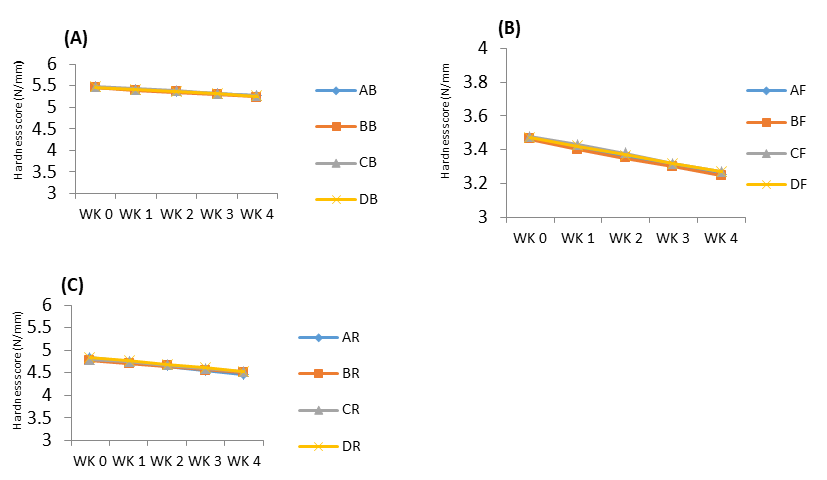
Figure 14: Hardness value of baked cassava-mash, fried cassava-mash and roasted cassava-mash in LDPE for 4 week storage. AB - Baked Cassava-based extrudates; BB - Baked Cassava-based extrudates with 2% cocoa powder; CB - Baked Cassava-based extrudates with 16% desiccated coconut; DB - Baked Cassava-based extrudates with 2% cocoa powder and 16% Desiccated Coconut Powder; AF - Fried Cassava-based extrudates; BF – Fried Cassava-based extrudates with 2% cocoa powder; BR- Roasted Cassava-based extrudates with 2% cocoa powder, CF - Fried Cassava-based extrudates with 16% desiccated coconut; DF - Fried Cassava-based extrudates with 2% cocoa powder and 16% desiccated coconut; AR - Roasted Cassava-based extrudates; CR - Roasted Cassava-based extrudates with desiccated coconut; DR - Roasted Cassava-based extrudates with 2% cocoa powder and 16% desiccated coconut.

Figure 15: Hardness value of baked cassava-mash, fried cassava-mash and roasted cassava-mash in LDPE for 32 week storage. AB-Baked Cassava-based extrudates; BB-Baked Cassava-based extrudates with 2% cocoa powder; CB-Baked Cassava-based extrudates with 16% desiccated coconut; DB-Baked Cassava-based extrudates with 2% cocoa powder and 16% Desiccated Coconut Powder; AF-Fried Cassava-based extrudates; BF-Fried Cassava-based extrudates with 2% cocoa powder; BR- Roasted Cassava-based extrudates with 2% cocoa powder, CF-Fried Cassava-based extrudates with 16% desiccated coconut; DF-Fried Cassava-based extrudates with 2% cocoa powder and 16% desiccated coconut; AR-Roasted Cassava-based extrudates; CR- Roasted Cassava-based extrudates with desiccated coconut; DR-Roasted Cassava-based extrudates with 2% cocoa powder and 16% desiccatedcoconut.
Enrichment with cocoa powder and desiccated coconut did not affect the HV of the entire samples. The results clearly indicate that HV of extrudates stored in LDPE and AF packs were not significantly affected (p < 0.05) by the type of ingredient used. The maximum change (7.6%) in HV was observed in extrudates stored in LDPE, and minimum change (1.1%) was observed in extrudates stored in AF. In AF and LDPE packs, HV of extrudates decreased marginally from week 8 to week 32 and from week 4 to week 32 respectively. The moisture absorption of packaged extrudates during the storage period might have influenced the HV of the extrudates (Figure 5 and 7). The influence of moisture absorption in the HV of extruded snacks was reported by Charunuch, et al. [26]. He observed a decrease in the HV of extruded thai rice stored for 4 months. Heidenreich, et al. [27] concluded that changes in starch-protein matrix of dry snack product
can alter the hardness values of the product. There were significant (p < 0.05) differences among the hardness scores of the cassava-mash snacks (baked, fried and roasted) across the storage period in LDPE and MPN. The hard texture of baked and roasted extrudates might have influenced the HV of samples stored for 32 weeks. Moreover, frying has a higher heat transfer coefficients (associated with hot frying oil) than baking. The effect of cooking method on the quality attributes of potato chips was investigated by Tuta & Palazoğlu [28].
They reported the hardness scores of baked (2.33- 3.90 N/mm) and fried potato chips (0.99-2.85 N/mm), and concluded that fried potato chips was more flexible or brittle than baked potato chips. In this study, samples stored in AF packs were found to be effective in controlling the HV of extrudates as opposed to LDPE packs.
| Sample | Polynomial Regress equation | R2 | R12 | R22 | R33 | R44 |
|---|---|---|---|---|---|---|
| AB | y = -0.0029x2 + 0.0091x + 5.404 | 0.9429 | 0.8 | 0.8 | 0.6125 | 0.6124 |
| BB | y = -0.0029x2 + 0.0091x + 5.404 | 0.9429 | 0.8 | 0.8 | 0.6125 | 0.6124 |
| CB | y = -0.0029x2 + 0.0091x + 5.404 | 0.9429 | 0.8 | 0.8 | 0.6125 | 0.6124 |
| DB | y = -0.0029x2 + 0.0091x + 5.404 | 0.9429 | 0.8 | 0.8 | 0.6125 | 0.6124 |
| AF | y = -0.0029x2 + 0.0091x + 3.414 | 0.9429 | 0.8 | 0.8 | 0.6125 | 0.6124 |
| BF | y = -0.0029x2 + 0.0091x + 3.414 | 0.9429 | 0.8 | 0.8 | 0.6125 | 0.6124 |
| CF | y = -0.0029x2 + 0.0091x + 3.414 | 0.9429 | 0.8 | 0.8 | 0.6125 | 0.6124 |
| DF | y = -0.0029x2 + 0.0091x + 3.414 | 0.9429 | 0.8 | 0.8 | 0.6125 | 0.6124 |
| AR | y = -0.0029x2 + 0.0091x + 4.704 | 0.9429 | 0.8 | 0.8 | 0.6125 | 0.6124 |
| BR | y = -0.0029x2 + 0.0091x + 4.704 | 0.9429 | 0.8 | 0.8 | 0.6125 | 0.6124 |
| CR | y = -0.0029x2 + 0.0091x + 4.764 | 0.9429 | 0.8 | 0.8 | 0.6125 | 0.6124 |
| DR | y = -0.0029x2 + 0.0091x + 4.764 | 0.9429 | 0.8 | 0.8 | 0.6125 | 0.6124 |
| AB | y = 0.0007x2-0.0573x + 5.525 | 0.9992 | 0.9989 | 0.9987 | 0.9991 | 0.9538 |
| BB | y = 0.0007x2-0.0573x + 5.525 | 0.9992 | 0.9989 | 0.9987 | 0.9991 | 0.9538 |
| CB | y = 0.0007x2-0.0573x + 5.525 | 0.9992 | 0.9989 | 0.9987 | 0.9991 | 0.9538 |
| DB | y = 0.0007x2-0.0573x + 5.525 | 0.9992 | 0.9989 | 0.9987 | 0.9991 | 0.9538 |
| AF | y = 0.0007x2-0.04873x + 3.530 | 0.9992 | 0.9989 | 0.9986 | 0.9379 | 0.9337 |
| BF | y = 0.0007x2-0.04873x + 3.530 | 0.9992 | 0.9989 | 0.9986 | 0.9379 | 0.9337 |
| CF | y = 0.0007x2-0.04873x + 3.530 | 0.9992 | 0.9989 | 0.9986 | 0.9379 | 0.9337 |
| DF | y = -0.0007x2-0.0487x + 3.530 | 0.9992 | 0.9989 | 0.9986 | 0.9379 | 0.9337 |
| AR | y = -0.0007x2-0.0725x + 4.915 | 0.9996 | 0.9995 | 0.9992 | 0.9994 | 0.9357 |
| BR | y = -0.0007x2-0.0725x + 4.915 | 0.9996 | 0.9995 | 0.9992 | 0.9994 | 0.9357 |
| CR | y = -0.0007x2-0.0727x + 4.915 | 0.9996 | 0.9995 | 0.9992 | 0.9994 | 0.9357 |
| DR | y = -0.0007x2-0.0727x + 4.915 | 0.9996 | 0.9995 | 0.9992 | 0.9994 | 0.9357 |
Table 5: Mathematical relationship for hardness value at different storage period of extrudates stored in AF.
Table 7: Mathematical relationship for hardness value at different storage period of extrudates stored in LDPE. AB-Baked Cassava-based extrudates; BB-Baked Cassava-based extrudates with 2% cocoa powder; CB-Baked Cassava-based extrudates with 16% desiccated coconut; DB-Baked Cassava-based extrudates with 2% cocoa powder and 16% Desiccated Coconut Powder; AF-Fried Cassava-based extrudates; BF-Fried Cassava-based extrudates with 2% cocoa powder; BR- Roasted Cassava-based extrudates with 2% cocoa powder, CF-Fried Cassava-based extrudates with 16% desiccated coconut; DF-Fried Cassava-based extrudates with 2% cocoa powder and 16% desiccated coconut; AR-Roasted Cassava-based extrudates; CR- Roasted Cassava-based extrudates with desiccated coconut; DR-Roasted Cassava-based extrudates with 2% cocoa powder and 16% desiccated coconut R2- Polynomial R2; R12-Linear R2; R22-Exponential R2; R32-Logarithmic R2; R42-Power R2 used. The extrudates stored in AF across the storage period were more effective in maintaining the hardness values, moisture absorption and peroxide formation than the extrudates stored in LDPE. AF was most accepted and recommended for packaging of processed cassava-mash snacks with desiccated coconut and cocoa powder.
The mathematical relationship for hardness values at different storage period of PCE in AF and LDPE are shown in Table 5 and 6 respectively. The R2 values for the peroxide value of the extrudates stored in AF was found to be 0.9937 (Table 6), while the R2 values of PCE stored in LDPE were found to be in the range of 0.9928 and 0.9934 respectively (Table 7). R2 values obtained in this study described the effect of variables on the responses.
The result (Table 6&7) shows that the models have agreeable levels of R2 of above 80% [21]. There was no significant lack of fit in all the response variables. The regression equation was the same in baked, fried and roasted samples. This may be due to the composition of cassava mash (66-84%) in the hardness values of extrudates.
Conclusion
The study describes the conventional method of producing cassava-mash extrudates with desiccated coconut and cocoa powder. The effects of storage stability on the quality attributes of processed cassava-mash extrudates in LDPE and AL were investigated. The moisture content and peroxide value of extrudates stored in LDPE and AL were influenced by storage time, type of ingredients and packaging used, while the hardness values were only influenced by the storage time and packaging.
Acknowledgments
We wish to thank Kehinde Taiwo, K.A, and Ikujenlola, V.A, for their thorough reviews and insightful suggestions for the article.
Author Contributions
K.O: Akinwotu conducted the data analysis for this publication with the assistance of the coauthors. He wrote the 1st draft of the paper and made revisions as suggested by the co-authors. KA: Professor Taiwo designed the study She revised the manuscript and approved of its content. VA: Dr. Ikujenlola was involved in the design of the study and made significant revisions to the paper.
Declaration of Conflicting Interests
The author(s) declared no conflicts of interest with respect to the research, authorship, and/or publication of this article.
Funding
No funding
References
-
Shaw DA, Ray EE, Gardner FR., Valle D, Rakow A (1994) Properties of an extruded, expanded snack food containing mechanically separated beef (MSC) and potato flour. Journal of Food Quality 17(2): 143-157.
-
Brennan JG (2013) Food processing handbook EDICION. Wiley‐VCH, Gmb, Germany.
-
Charles AL, Sriroth K, Huang T (2005) Proximate composition, mineral contents, hydrogen cyanide and phytic acid of 5 cassava genotypes. Food Chemistry 92(4): 615-620.
-
Brennan MA, Monro JA, Brennan CS (2008) Effect of inclusion of soluble and insoluble fibres into extruded breakfast cereal products made with reverse screw configuration. International Journal Food Science Technology 43: 2278-2288.
-
Sangamithra A, Swamy GJ, Sorna PR, Chandrasekar V, Sasikala S, et al. (2013) Coconut: An extensive review on value added products. Indian Food Industry 32(6): 29- 36.
-
National Library of Medicine (2003) Dietary Recommended Intake. Guiding principles for nutrition labeling and fortification. Washington DC, The National Academies Press, pp: 79.
-
Barden L, Decker E (2013) Lipid Oxidation in Low- moisture Food: A Review. Critical reviews in food science and nutrition 56(15):2467-2482.
-
Opara U, Mditshwa A (2013) A review on the role of packaging in securing food system: Adding value to food products and reducing losses and waste. African journal of agricultural research 8(22): 2621-2630.
-
Marsh K, Bugusu B (2007) Food Packaging, Roles, Materials, and Environmental Issues. Journal of food science 72(3): R39-R55.
-
Obadina AO, Oyewole OB, Williams OE (2013) Improvement in the traditional processing method and nutritional quality of traditional extruded cassava-based snack (modified Ajogun). Food science and nutrition 1(4): 350-356.
-
Shinde BG (2005) Isolation and characterization of starch horse grain. Rahuri (India): Unpublished M.Sc. Thesis. Mahatma Phule Krishi Vidyapeeth, pp: 16-17.
-
Dar AH, Sharma HK, Kumar N (2014) Effect of extrusion temperature on microstructure, textural and functional attributes of carrot pomace-based extrudates. J Food Process Preserv 38(1): 212-22.
-
Toluwase AD, Lucretia IB, Lubanza N, Mulunda M (2018) Formulation, sensory evaluation, proximate composition and storage stability of cassava strips produced from the composite flour of cassava and cowpea. Food Science Nutrition 6(2): 395-399.
-
Shakhawat H, Mohammad RI, Shishir S, Shahidullah K, Samshad WT, et al. (2016) Incorporation of Coconut Flour in Plain Cake and Investigation of the Effect of Sugar and Baking Powder on Its Baking Quality. International Journal of Nutrition and Food Sciences 5(1): 31-38.
-
Butt MS, Nasir M, Akhtar S, Sharif K (2004) Effect of moisture and packaging on the shelf life of wheat flour. Int J Food Safaty 4:1-6.
-
Abong GO, Okoth MW, Imungi JK Kabira JN (2011) Losses of ascorbic acid during storage of fresh tubers, frying, packaging and storage of potato crips from Kenyan potato cultivars. Am J Food Technology 6: 753-762.
-
Purohit C, Rajyalakshmi P (2010) Quality of products containing defatted groundnut cake flour. Journal of food science and technology 48: 26-35.
-
Esturk O, Kayacier A, Singh RK (2000) Reduction of oil uptake in deep fried tortilla chips. Reducción de la absorción de aceite en la fritura de tiras de maíz 6(5): 425-431.
-
Shyu SL, Hau LB, Hwang LS (2005) Effects of processing conditions on the quality of vacuum-fried carrot chips. Journal of Science, Food and Agric 85: 903-1908.
-
Faiz-ul-Hassan S, Mian KS, Shahid B, Fasiha A (2019) Role of healthy extruded extrudates to mitigate malnutrition, Food Reviews International 35(4): 299-323.
-
Joglekar AM, May AT (1987) Product excellence through design of experiments. Cereal Foods World 32: 857-868.
-
Obibuzor JU (2005) Storage Stability of Grated and Milled Desiccated Coconut Meat. Global Journal of Biotechnology and Biochemistry 10(4): 131-134.
-
Ullah F, Ahmad S, Wahab S, Zeb, A, Khan Khattak M, et al. (2016) Quality Evaluation of Biscuits Supplemented with Alfalfa Seed Flour. Foods 5(4): 68.
-
Mariod A, Omer N, Al, El, Mariod,, Mokhtar M (2007) Chemical Reactions Taken Place During deep-fat Frying and Their Products: A review. Sudan University of Science & Technology SUST. Journal of Natural and Medical Sciences. Supplementary issue, pp: 1-17.
-
O’Brien RD (2004) Fats and oils formulating and processing for applications, Boca Raton, CRC, pp: 616.
-
Chuansin S, Verasilp S, Srichuwong S, Pawelzik E (2006) Selection of packaging materials for soybean seed storage. Tropentag 2006. University of Bonn, Bonn, October 11-13, 2006. Conference on International Agricultural Research for Development.
-
Heidenreich S, Jaros D, Rohm R, Ziems A (2004) Relationship between water activity and crispness of extruded rice crisps. J Texture Stud 35(6): 621-633.
-
Tuta S, Palazoğlu T (2017) Effect of baking and frying methods on quality characteristics of potato chips. Gıda 42(1): 43-49.
-
Andrew N, Jean CD (2019) Storage Stability Assessment of Extruded Rice and Maize Based Extrudates Enriched with Fish. American Journal of Food Science and Technology 7(5): 152-156.
-
Charunuch C, Tangkanakul P, Rungchang S (2008) Application of mulberry (Morus alba L.) for supplementing antioxidant activity in extruded Thai rice snack. Acta Hort 42: 79-87.
-
Falade KO, Akingbala JO (2008) Improved Nutrition and National Development hrough the Utilization of Cassava in Baked Foods. International Union of Food Science Technology, pp: 1-12.
-
Gunathilake KD, Abeyrathne YM (2008) Incorporation of coconut flour into wheat flour noodles and evaluation of its rheological, nutritional and sensory characteristics. Journal of Food Processing and Preservation 32(1): 133- 142.
-
Kumar N, Sarkar, BC, Sharma HK (2010) Development and characterization of extruded product of carrot pomace, rice flour and pulse powder. African Journal Food Science 4(11): 703-717.
-
Larsen H, Per L, Rodbotten M (2005) Sensory changes in extruded oat stored under different packaging, light and temperature conditions. Food Quality and Preference 16: 573-584.
-
Misael LM, José MA (2006) Structure and Texture Properties of Fried Potato Products. Food Reviews International 22(2): 173-201.
-
Puyed S, Begum K, Saraswathi G, Prakash J (2010) Shelf stability and sensory attributes of a deep‐fried product incorporated with pre‐treated soy flour. Journal of Food Processing and Preservation 34(3): 439-459.
-
Heidenreich S, Doris J, Harald R, Annette Z (2004) Relationship between water activity and crispness of extruded rice crisps. Journal of Texture Studies 35: 621- 633.
- The Role of Podocyte Apoptosis and the Involvement of SIRT1 in Diabetic Nephropathy
- Dealcoholization of Beer by Osmotic Distillation for the Beverage Industry
- Biopolymer-Based Edible Packaging- Biomaterials, Methods, and Applications in Food Industry: An Updated Review
- Influence of Bioprocessing Methods on 'China Rice' (Gawal R1), and Soyabean Supplementation on the Quality of Complementary Food
- Cassava (Manihot esculenta) Varietal Growth, Yield and Cyanide Content Performance in Three Sites in the South- Eastern Semi Arid Regions of Kenya
- Food Waste Treatment, Recycling, Management and Production of Value-Products-An Update on Methodologies and Current Trends