
School Feeding in N’Djamena – Chad: Characteristics of Sellers and Sales Framework
School feeding is a main feature of schools in every country around the world. This activity constitutes an essential nutritional source for the health, development and academic performance of schoolchildren. However, when hygiene rules are not respected during handling, the quality of the food offered is greatly compromised. The objective of this work was to define the main characteristics of the sellers, the types of food sold as well as the sales environment. From June 2021 to May 2022, twentytwo (22) schools in all categories (public and private) were targeted for the surveys. In total, 101 food sellers, 57 schoolchildren and 22 teachers were interviewed during the study period. The overall proportions of female sellers and married sellers were 90.10% and 61.39%, respectively (p < 0.001). Local Arabic was the language of communication for 73.27% of sellers. The vast majority of respondents (85.15%) had not received any training in good hygiene and manufacturing practices. The vast majority of respondents (85.15%) had not received any training in good hygiene and manufacturing practices. The most consumed foods were those prepared from cereals (36%) and fruits (31%). Furthermore, 51.49% of sellers displayed their food in the open air and 47.52% displayed it under trees. The fact that the lack of training of sellers on good hygiene and manufacturing practices, and the exposure of food to the open air by the majority of sellers constitute dangers for consumers. In light of these worrying shortcomings, the corrective approach should integrate training and awareness raising for stakeholders in order to raise the level of understanding of the risks.
Introduction
The issue of school feeding has been the subject of discussion throughout the world [1]. In developed countries the institutional framework organizing school feeding is well developed [2], schools have canteens, spaces in which the meals consumed by students are prepared in conditions that comply with health standards.
Water, sanitation and hygiene are among the essential needs of the person [3]. Numerous studies have revealed that the availability of a healthy and balanced diet in schools is essential for keeping children healthy [4, 5]. In low-income countries, students miss 500 million days of school due to health problems often linked to preventable conditions [6]. Diseases linked to water, the absence of a sanitation system and a lack of hygiene therefore continue to represent an enormous burden in many developing countries, particularly in the educational environment [7]. Chad is a Central African country doubly landlocked both internally and externally. Due to its geographical position, Chad is marked by increased continentally, the economic slump of which is one of the consequences.
Access to drinking water, hygiene and sanitation in Chad is a major problem within educational establishments. According to school statistical data from Chad for the 2014- 2015 academic years, 32% of primary school children do not have access to drinking water and 82% of the population practices defecation in the open [8]. The situation is alarming with 78% of establishments not having toilets, hence the high rate of open defecation recorded in schools. Likewise, existing drinking water, hygiene and sanitation facilities are sometimes poorly managed and not maintained, including the food sold in schools which is poorly protected [9]. Likewise, existing drinking water, hygiene and sanitation facilities are sometimes poorly managed and not maintained, including the food sold in schools which is poorly protected [9]. However, the school food sector is very poorly regulated (non-existence of regulatory texts) and organized around sellers who often operate in the informal sector. Also, the results of a study carried out on the assessment of the quality of food in schools in N’Djamena showed that overall, the safety and hygiene of the food offered are not adequate [10]. The objective of this study was to define the main characteristics of sellers, the types of food sold as well as the sales environment.
Materials and Methods
Study Framework
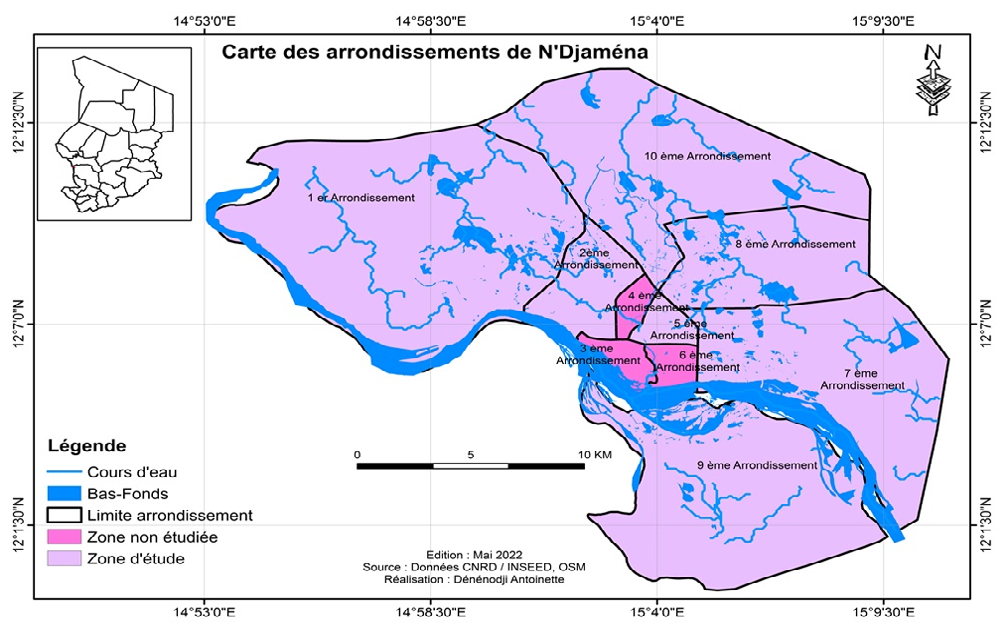
The study was carried out in the 10th, 9th, 8th, 7th and 5th districts of the city of N’Djamena out of the ten (10) existing districts. This is a prospective and transversal study which was conducted from June 2021 to May 2022 in 22 schools of all categories (public and private) from the different inspections (A, B, C, D) of the delegation of education in N’Djamena. The city of N’Djamena has the largest number of public establishments spread across the 10 districts. Some primary schools have more than 1000 schoolchildren. The choice of schools was justified by the intensity of the food marketing activity in the surrounding area (Figure 1).
Investigations
Survey participants were chosen randomly. The surveys were carried out among 101 food sellers, 57 schoolchildren and 22 teachers in the 22 schools selected for the study. The observation sheets and questionnaires made it possible to collect information relating to the socio-demographic characteristics of the actors, the types of food sold, the sales environment, good preparation and sales practices and personal and collective hygiene. The variables collected were: marital status, educational level, gender, age, language spoken, training received, types of food sold, water quality, packaging and consumption, the method of food preservation, the condition of the utensils, personal hygiene and clothing, the hand washing system. For each session, a meeting with the head of the school took place in order to explain and present the objectives of the study and obtain his prior authorization.
Data Processing
The survey data was entered and processed using Excel 2023 software. In the processing of statistical data, for a level of significance p < 0.05, the results obtained were considered significant.
Results
Sociodemographic Characteristics of Sellers
Table 1 presents the sociodemographic characteristics of the sellers such as gender, age and marital status. The results showed that 90.10% of the sellers surveyed were women compared to only 9.90% of men. The surveys also revealed that the most represented age groups were 8 to 20 years old and 21 to 30 years old with 18.81% and 25.75% respectively. Married respondents were the largest with a proportion of 61.39%.
| Frequency | Percent | |
|---|---|---|
| Sex | ||
| Female | 91 | 90.1 |
| Male | 10 | 9.9 |
| Total | 101 | 100 |
| Age in years | ||
| 08 – 20 | 19 | 18.81 |
| 21 – 30 | 26 | 25.75 |
| 31 – 40 | 18 | 17.82 |
| 41 – 50 | 18 | 17.82 |
| 51 – 60 | 5 | 4.95 |
| 61 – 70 | 4 | 3.96 |
| 71 – 80 | 1 | 0.99 |
| Without answer | 10 | 9.9 |
| Total | 101 | 100 |
| Marital Status | ||
| Married | 62 | 61.39 |
| Single | 17 | 16.83 |
| Widower | 16 | 15.84 |
| Without answer | 6 | 5.94 |
| Total | 101 | 100 |
Table 1: Socio-demographic characteristics.
Category of Sellers, Level of Education and Training Received
Table 2 provides information relating to the category of sellers, the training in good hygiene and manufacturing practices received by the sellers, the language of communication of the sellers as well as the level of education of the sellers. The majority of sellers, i.e. 86.14%, were in the semi-fixed seller category. Our surveys revealed that 85.15% of sellers had not received any training in good hygiene and manufacturing practices. Local Arabic was the language of communication for 73.27% of the sellers surveyed. Our surveys revealed that 53.46% of sellers were not educated.
| Frequency | Percent | |
|---|---|---|
| Category of sellers | ||
| Fixed | 0 | 0 |
| Semi-fixed | 87 | 86.14 |
| Ambulance | 9 | 8.91 |
| Without answer | 5 | 4.95 |
| Total | 101 | 100 |
| Training in good hygiene and manufacturing practices | ||
| No training | 86 | 85.15 |
| Without answer | 15 | 14.85 |
| Total | 101 | 100 |
| Language of communication | ||
| French | 26 | 25.74 |
| Local Arabic | 74 | 73.27 |
| Other national language | 1 | 0.99 |
| Total | 101 | 100 |
| Educational status | ||
| No formal education | 54 | 53.46 |
| Primary school | 17 | 16.83 |
| Secondary school | 21 | 20.8 |
| Higher study | 5 | 4.95 |
| Without answer | 4 | 3.96 |
| Total | 101 | 100 |
Table 2: Category of sellers, training received and language of communication.
Personal Hygiene, Sellers’ Clothing and Hygiene Practices During Service
According to Table 3, 100% of the sellers did not wear gloves, blouses or aprons and used the same hand to serve the food and collect the money. However, 89.11% of sellers wore a headscarf. Only 3.96% of sellers claimed to have regular medical monitoring. Inspection of the sellers’ hands and fingers revealed that 98.02% did not have any wounds on their hands and 92.08% did not take care of their nails.
| Frequency | Percent | |
|---|---|---|
| Wearing a blouse | ||
| Yes | 0 | 0 |
| No | 101 | 100 |
| Total | 101 | 100 |
| Wearing an apron | ||
| Yes | 0 | 0 |
| No | 101 | 100 |
| Total | 101 | 100 |
| Wearing gloves | ||
| Yes | 0 | 0 |
| No | 101 | 100 |
| Total | 101 | 100 |
| Wearing a scarf | ||
| Yes | 90 | 89.11 |
| No | 11 | 10.89 |
| Total | 101 | 100 |
| Wound on the hand | ||
| Presence | 2 | 1.98 |
| Absence | 99 | 98.02 |
| Total | 101 | 100 |
| Nail care | ||
| Yes | 8 | 7.92 |
| No | 93 | 92.08 |
| Total | 101 | 100 |
| Regular medical follow-up | ||
| Yes | 4 | 3.96 |
| No | 97 | 96.04 |
| Total | 101 | 100 |
| Money handling | ||
| Same hand used to serve food | 101 | 100 |
| Other hand than the one used to serve food | 0 | 0 |
| Total | 101 | 100 |
Table 3: Hygiene practices during service.
Main Foods Found in Primary Schools
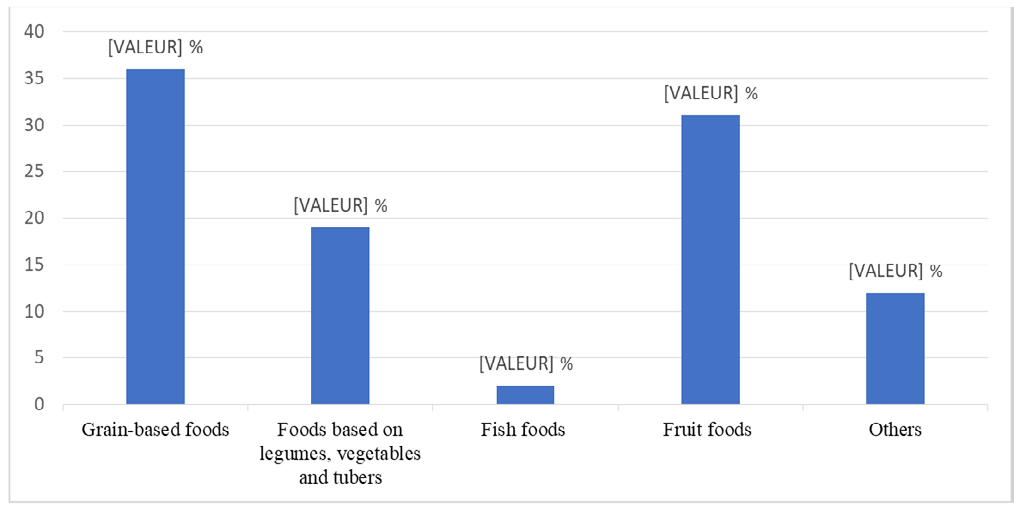
The enumeration of foods in the 22 schools selected for this study made it possible to list 31 types of foods. During the investigations, it was established that the different raw materials used were legumes (alelé), cereals and derived products (dawakhé), meat and derived products (sandwiches), eggs (omelette sandwich), vegetables (tomatoes, raw cucumbers, eggplants), fish (kanda, soup) and others (dried fruits : baobab seeds, jujubes, tamarinds) (Table 4). However, the most consumed foods were those prepared from cereals and fruits with 36% and 31% respectively (Figure 2).
| Popular Food Name | Description of the Food | |
|---|---|---|
| Grain-Based Foods | ||
| 1 | Fangassou | Donut (processed wheat flour) |
| 2 | Shrimp | Shrimp fritter, Industrial products fried in oil |
| 3 | Sandwich | Minced meat sandwich, omelettes |
| 4 | Couscous | Semolina (milling product obtained by coarse grinding of moistened durum wheat grains) |
| 5 | Bélilé | Boiled and sweetened millet grains |
| 6 | Popcorn | Popcorn or popcorn produced by heavily heating corn kernels |
| 7 | Dawankhé | Small balls of millet or wheat flour dough boiled in water and eaten with seasoned Ceratotheca sesamoides leaf sauce |
| Foods Based on Legumes and Tubers | ||
| 8 | Allèle | Processed beans |
| 9 | Kebkebé | Legumes boiled with salt |
| 10 | Mandawa | Salted processed peanuts |
| 11 | Engalgalla | Ground peas |
| 12 | Bakouri (Wiliwili) | Processed peanuts (meals) |
| 13 | Tania | Processed peanuts cooked as a sauce |
| 14 | Fagouss | Raw cucumber eaten as such |
| 15 | Siguètte | Dry sweet nuts eaten as such |
| Fish Foods | ||
| 16 | Kanda | Crushed fish with pistachio, shaped into a small ball and fried |
| Fruit-Based Foods | ||
| 17 | Mango | Fresh, dried |
| 18 | Nabak | Dried jujube fruits |
| 19 | Ardep | Dried tamarind fruits |
| 20 | Angara | Hibiscus flower juice |
| 21 | Mango juice | Industrial products in sachets diluted in water |
| 22 | Apple juice | Industrial products in sachets diluted in water |
| 23 | Lemon juice | Industrial products in sachets diluted in water |
| 24 | Cocoa juice | Industrial products in sachets diluted in water |
| 25 | Kalakouka | Baobab seeds |
| 26 | Mato | Nere Powder |
| Others | ||
| 27 | Crickets/birdies | Crickets/birdies fried in oil and seasoned |
| 28 | Ice cubes | Industrial products in sachets diluted in water then frozen |
| 29 | Yogurt | Curd + milk powder + sugar and frozen |
| 30 | Powdered milk | Mixed with sugar and served in sachets |
| 31 | Candies/Lollipops | Industrial products |
Table 4: Description of the most consumed food groups.
Framework and Sales Environment
The food sales points are located in the school grounds which are sometimes not fenced and do not have a dedicated premises. Fifty-one point forty-nine percent (51.49%) of respondents are exposed to the open air and 47.52% sell under trees. Food sales generally took place in a clean environment (83.17%). The vast majority of these sales took place in the absence of flies (91.09%), in the absence of nearby gutters (98.02%) and without stray animals (98.02%) (Table 5).
| Frequency | Percent | |
|---|---|---|
| Sales Framework | ||
| Under a tree | 48 | 47.52 |
| Under a shed | 1 | 0.99 |
| Exposed to the open air | 52 | 51.49 |
| Total | 101 | 100 |
| Sales Environment (Permanent Dust and Garbage Nearby) | ||
| Clean (absence of dust and garbage nearby) | 84 | 83.17 |
| Dirty (presence of dust and garbage nearby) | 17 | 16.83 |
| Total | 101 | 100 |
| Flies Around and an Food | ||
| Presence | 9 | 8.91 |
| Absence | 92 | 91.09 |
| Total | 101 | 100 |
| Presence of Gutters and Latrines Nearby | ||
| Presence | 2 | 1.98 |
| Absence | 99 | 98.02 |
| Total | 101 | 100 |
| Stray Animals Nearby | ||
| Presence | 2 | 1.98 |
| Absence | 99 | 98.02 |
| Total | 101 | 100 |
Table 5: Framework and sales environment.
Discussion
It was observed during this study that the gender most present in this activity is the feminine gender (90.10%). This result could be explained by the fact that in Chadian culture, women are generally more involved in culinary activities and especially in serving children. Our result undeniably aligns with those of previous work carried out in Chad, Nigeria, and Mali which revealed a strong presence of women in food sales respectively at 63.04%, 68%, 76% and 100% [1, 11, 12, 13].
The most frequent age groups in this activity of selling food in primary schools in N’Djamena are between 8 to 20 years old and 21 to 30 years old with a cumulative percentage of the age group from 8 to 30 years of 44.56%. This could be explained by the fact that some women entrust the sale to their children and take care of the household and also some single mothers are obliged to carry out an activity to support their households. Despite the accumulation of our two age groups, this result is slightly lower than that of the study carried out in Bangladesh which reported for the age group of 10 to 20 years alone a proportion of 50% [14].
According to the results of this study, married people are the most numerous (61.39%). This strong presence of married couples could be explained by the predominance of women who for the most part are unskilled and often obliged to find their own pocket money to meet their needs. The overall proportions of female sellers and married sellers were 90.10% and 61.39%, respectively (p < 0.001). Our results thus agree with those of work carried out in Nigeria and Benin which showed that respectively 67.2% and 56% of food sellers in schools and public roads were married [12, 15].
Food sellers in primary schools in N’Djamena mainly belong to the category of semi-fixed sellers (86.14%), that is to say the food is prepared at home before being sent to school for sales. This situation could be explained by several reasons including, schools do not offer an appropriate setting for preparation, the quantities prepared are small and easily transportable and also the very temporary nature of the service. During their study relating to the inventory of the feeding system in some primary schools in the city of Yaoundé (Cameroon), Annie-Claude et al. revealed that 92% of sellers prepare at home [16].
At the end of our surveys, with regard to training in good hygiene and manufacturing practices, our results revealed that 85.15% of sellers had not received any training. Training in good hygiene and manufacturing practices requires good organization, however, despite the demands sometimes made by school managers, social constraints end up influencing and certain sellers display their food in total ignorance of the rules of ‘hygiene. The results of this study confirm those of studies carried out in schools in Nigeria by Andy, et al. [13] and Afolaranmi, et al. [12] which revealed that respectively 81.5% and 88.5% of handlers of these foods did not had received no training in good hygiene and manufacturing practices.
Regarding the language of communication of sellers, 73.27% of respondents used local Arabic for exchanges. In Chad, local Arabic is the language best shared by the population and constitutes a language of integration in all socio-economic environments.
The level of education of sellers remains very low because 53.46% of the sellers surveyed had not been educated. According to MICS6-Chad 2019, the proportion of children who do not attend school exceeds on average 62% for age groups from 3 to 17 years old, and on average 55% for children aged 6 to 15 years [17], this justifies our results which remain highly faithful to the national situation. Contrary to our results, surveys carried out in Cameroon [16] and Nigeria [12] on food vendors in primary schools showed that 100% and 98% respectively. 9% of these sellers were educated. This strong difference could be explained by the overall schooling rate in these countries. It should be noted that all the sellers surveyed wore neither blouses, aprons nor gloves. This observation could easily be explained by the lack of training in good hygiene and manufacturing practices for sellers (85.15%). Wearing a headscarf was observed in 89.11% of respondents. In Chad, women regularly cover their hair to avoid reproaches from men. Furthermore, surveys carried out in Cameroon in primary schools revealed that only 7% wore white blouses and 30% wore hats or scarves [16].
No seller had regular medical monitoring. Generally, it is when school and health police officials are more present that sellers feel obliged to carry out medical examinations. Contrary to our results, the surveys conducted by Uzoama, et al. [18] in 2023 in Nigeria determined a significantly higher proportion of medical visits (37.5%) [18].
For service, everyone used the same hand to serve the food and collect the money. This act could be doubly explained by ignorance of the risks and local habits which do not tolerate the use of left hands for service.
Observation of the sellers’ hands revealed that 98.02% did not have wounds but also 92.08% did not take care of their nails. Impurities accumulated on the nails could be harmful to the quality of the food served and thus expose consumers. Impurities accumulated on the nails could be harmful to the quality of the food served and thus expose consumers. However, a precarious health situation compromises the cognitive development of children and their chance of having a good education [19].
The most consumed foods are foods based on legumes, tubers and cereals “alelé”, “dawakhé”, “sandwich, eggs (omelette sandwich), vegetables (tomatoes, raw cucumbers, eggplants), and other foods based on fruit (dried fruits: baobab seeds, jujubes, tamarinds). These are national eating habits and the availability of products on the market. According to the results of the 2021 Global Survey on School Feeding Programs, cereals and legumes are the most common foods at 87% and 75%, respectively [20].
The sales framework for these foods was located under the tree at 47.52% compared to 51.49% exposed to the open air, some of which are dirty with the presence of flies (8.91%), stray animals (1, 98%) see the presence of dust and garbage nearby (16.83%). Pial, et al. [16] reported that in primary schools in Yaoundé in Cameroon, 85% of sellers display their food in the open air. However, Dioume, et al. [1] also reported that in Bamako, the environment in which the school food sales service took place was unsanitary in 86.50% of cases.
Conclusion
This study, as prospective as it is, comprehensively presents the main actors, the framework and the environment in which food is sold to schoolchildren in some primary schools in the city of N’Djamena. Indeed, it appears from our study that the activity of selling food in primary schools is carried out largely by women, mostly young, with a very low level of education.
Hygienic conditions of sale remain relatively worrying. Good hygiene and manufacturing practices constitute the essential means to guarantee the health quality of food sold in schools; for this, the managers of the establishments and the city hygiene service must provide an adequate framework for the exercise of this activity.
In light of our results, there is no doubt about the need to supervise these women and men who are responsible for feeding these young people in order to have a healthy environment to preserve the health of these schoolchildren.
Acknowledgements
The authors like to sincerely thank the school officials, teachers, food sellers and schoolchildren for their collaboration.
Competing Interest
The authors have declared that no competing interests exist.
References
-
Dioume C, Souncalo TM, Mouctar C (2015) L’offre alimentaire dans les établissements scolaires du quartier de Sabalibougou en commune V du district de Bamako. Mali Medical, Tome XXX N°2, pp: 1-7.
-
Programme Alimentaire Mondial (PAM) (2013) La situation de l’alimentation scolaire dans le monde. Rapport, pp: 125.
-
Njoh ME (2010) The Cholera Epidemic and Barriers to Healthy Hygiene and Sanitation in Cameroon. Epidemiology and Public Health 13(1): 81-87.
-
Jomaa LH, McDonnell E, Probart C (2014) School feeding programs in developing countries: impacts on children’s health and educational outcomes. Nutrition Review 69(2): 83-98.
-
Oot L, Kavita S, Ross J, Sommerfelt AE (2016) The Effect of Chronic Malnutrition (Stunting) on Learning Ability, A Measure of Human Capital: A Model in Profiles for Country-Level Advocacy. FHI 360/FANTA, Washington, DC, USA, pp: 1-8.
-
Bundy DAP, Schultz L, Sarr B, Banham L, Colenso P, et al. (2017) The School as a Platform for Addressing Health in Middle Childhood and Adolescence. In: Bundy DAP, et al. (Eds.), Child and Adolescent Health and Development 3rd (Edn.), The World Bank, Washington (DC).
-
Freeman MC, Clasen T, Dreibelbis R, Saboori S, Greene LE, et al. (2014) The impact of a school-based water supply and treatment, hygiene, and sanitation programme on pupil diarrhoea: a clusterrandomized trial. Epidemiology and Infection 142(2): 340-351.
-
UNESCO (2019) Stratégie Nationale de l’eau, de l’assainissement et de l’hygiène en milieu scolaire (2018-2030). Ministère de l’éducation nationale et de la promotion civique, Chad, pp: 64.
-
UNICEF (2018) Suivi de l’approvisionnement en eau, de l’assainissement et de l’hygiène. Rapport, pp: 84.
-
Naibe MS (2019) Appréciation de la qualité des aliments en milieu scolaire dans la ville de N’Djamena au Tchad. Mémoire Master. Université de Montréal, pp: 127.
-
Mayoré AD, Tidjani A, Bessimbaye N, Assèta K, Kuan AT, et al. (2017) Characteristics of the Street Food Sector in N’Djamena, Chad. Food Sci Nutr Technol 2: 1-7.
-
Afolaranmi TO, Hassan ZI, Bello DA, Misari Z (2015) Knowledge and practice of food safety and hygiene among food vendors in primary schools in Jos, Plateau State, North Central Nigeria. J Med Res 4(2): 16-22.
-
Andy E, Mangai JM, Kayong EA, Afoi BB, Goshit JD, et al. (2015) Assessment of Practice of Food Safety and Hygiene among Food Vendors within Jos North Local Government Area of Plateau State, Nigeria. International Journal of Medical and Health Research 1(2): 83-86.
-
Islam A, Shafique KMA, Islam T, Rajib SI (2020) Knowledge and practice on food hygiene among food handlers of selected restaurants in sylhet city, Bangladesh. International Journal of Technical Research & Science 5(1): 5-12.
-
Janvier A (2021) Restauration de rue : Effets socio- économiques et risques sanitaires dans la ville de Djougou (nord-ouest Bénin). International Journal of Innovation and Applied Studies 34(2): 276-285.
-
Pial AC, Mboupaing M, Majesté MP, Germain N (2017) Etat Des Lieux Du Dispositif D’alimentation Dans Quelques Écoles Primaires De La Ville De Yaoundé (Cameroun). European Scientific Journal 13(18): 314-327.
-
UNICEF (2022) Rapport Pays-Tchad: MICS-EAGLE Tchad 2022. Rapport, pp: 66.
-
Uzoama JO, Kimm H, Konlan KD (2023) Factors associated with food safety practices among food handlers in Abuja municipal area council, Nigeria. J Glob Health Sci 5(1): 1-14.
-
UNICEF (2013) Politique Nationale de Nutrition et al. Alimentation 2014 - 2025. Rapport, pp: 61.
-
Global Child Nutrition Foundation (2022) Programmes de repas scolaires dans le monde : Résultats de l’enquête mondiale 2021 sur les programmes d’alimentation scolaire. Rapport, pp: 1-9.
- The Role of Podocyte Apoptosis and the Involvement of SIRT1 in Diabetic Nephropathy
- Dealcoholization of Beer by Osmotic Distillation for the Beverage Industry
- Biopolymer-Based Edible Packaging- Biomaterials, Methods, and Applications in Food Industry: An Updated Review
- Influence of Bioprocessing Methods on 'China Rice' (Gawal R1), and Soyabean Supplementation on the Quality of Complementary Food
- Cassava (Manihot esculenta) Varietal Growth, Yield and Cyanide Content Performance in Three Sites in the South- Eastern Semi Arid Regions of Kenya
- Food Waste Treatment, Recycling, Management and Production of Value-Products-An Update on Methodologies and Current Trends