
Heavy Metal Phytoremediation Potentials of Laportea Aestuans and Sclerocarpus Africana, In Makurdi, Nigeria
Industrialization is on the increase and so is global warming, the adverse effect of man’s quest for a stress free life. The pollutants associated with industrialization are numerous including heavy metals (HM). Worrisome is the alarming increase and non-biodegradability of HM in the environment. Other methods of decontamination are relatively cost intensive, tasking and require technical knowledge. The need to reclaim the environment calls for a green approach. Laportea aestuans and Sclerocarpus africana prove promising as phytoremediators. This study employed Laportea aestuans and Sclerocarpus africana as test decontaminants of HM at a mechanic workshop (site 1) comparative to a physically non-contaminated site (site 2-control). Findings show high level of HM in site 1 and that the plants especially Sclerocarpus Africana is good for remediation of HM contaminated sites in Benue state. The test plants accumulated more HM in leaves and roots suggesting they use Phytoextraction, phytostabilization and phytovolatilization as mechanisms of remediation. Using the classification scale of phytoaccumlators, both Laportea aestuans and Sclerocarpus africana are considered Hyperaccumulators. The plants and HM generally presented an order of concentration and bioaccumulation as: Sclerocarpus africana > Laportea aestuans and Zn > Fe > Pb > Cu > Cd > Cr > Ni was the highest concentrating metals. Though promising, further studies involving isotopic labeling to determine mechanism of remediation is necessary.
Introduction
Industrialization and other development related activities though beneficial have witnessed pollution as one of the adverse effects [1, 2]. Despite the wide range of these pollutants with combustibles and putrescible substances, Hazardous waste, explosives, petroleum products and heavy metal (HM) as examples, organic and inorganic compounds is a common classification for them. HM which belong to the inorganic class has witnessed a great patronage from the scientific research community due to challenges associated with its decontamination from polluted sites.
Physicochemical and biological approaches have been the general process used by researchers to decontaminate the environment i.e to remove, contain or render pollutants harmless. Whereas the physicochemical approaches use non-living organisms to clear pollutants, the biological approaches use only living things such as microorganisms and plants. When the latter is utilized, the process is called phytoremediation [3, 4]. It involves the use of special type of plants to decontaminate soil by inactivating metals in the rhizosphere or trans-locating them in the aerial parts. It is new, cheaper, eco-friendly and highly promising than physicochemical approaches [4, 5, 6]. Depending on the underlying processes, applicability, and type of contaminant, Phytoremediation can be broadly categorized as: phytodegradation, phytostimulation, phytovolatilization, Phytoextraction, rhizofiltration, and phytostabilisation. Any of these mechanism or more can be adopted by a plant per time in contaminated soil or water to either stabilize or remove the metals from the soil and groundwater [5, 6].
Bioaccumulation refers to the increase in the level of xenobiotic (a particular chemical) in any organism overtime especially when compared to the level of the xenobiotic in the environment. Bioaccumulation factor (BAF) and translocation factor (TF) are good example among many parameters used to evaluate plant phytoremediation potential. A BAF value higher than one indicates that a plant is a hyperaccumulator, whereas a value less than one is indicative of an excluder. TF value determines plant efficiency in heavy metals translocation from the root to the shoot. A plant is considered efficient in metal translocation from root to shoot when TF is higher than one; this is due to an efficient metal transport system. TF values less than one, however, indicate ineffective metal transfer suggesting that these types of plants accumulate metals in the roots and rhizomes more than in shoots or the leaves [3, 7].
Laportea Aestuans and Sclerocarpus Africana are common plants to Africa and Asia and have proven to be of great benefit to man in various ways such as animals pasture, folk medicine, pest control, horticulture. Both plants have been reported to strive under varied conditions including polluted sites. However there is paucity of knowledge on their ability as phytoremediators of HM contaminated soil [8, 9, 10, 11, 12, 13]. Hence, this study is aimed at ascertaining if Laportea aestuans and Sclerocarpus africana can be utilized as phytoremediators of HM polluted sites.
Materials and Methods
Study of Sites
a. Site 1 is the Apir auto mechanic workshop located along the Makurdi-Otukpo road.
b. Site 2 is an open field which is located at the commissioner’s quarters along Makurdi-Otukpo road. (control)
Sample Collection and Preparation
Laportea aestuans and Sclerocarpus africana samples were collected from sites 1 and 2 and washed under running tap water to remove adhered soil and were then separated into parts including leaves, roots, and stem. Oven drying with a thermal electrostatic oven (DHG-9202-40) was done at 80°C for 48 h. The dried sample were ground using a Linsan® blending machine (Lin 319), and sieved with 2 mm mesh sieve before transferring to polyethylene bags for storage on till further analyses. Surface soil sample (0–15 cm depth) was sampled by hand auger (2.5 cm diameter) from sites 1 and 2. The collected soil sample taken to the laboratory for oven drying (DHG-9202-40) comprised of a composite of three sub samples obtained from a 1 x 1 meter square distance.
Determination of Heavy metals in Plant Species and soil at sample site 1 and 2
The concentration of HM in the soil samples was determined using Atomic Absorption Spectrophotometer (AAS) at the National Institute for Chemical Research Technology, Zaria. Before triplicate analysis of samples with the AAS, the samples were digested and preserved for further analysis. An aqua regia wet method of digestion as described by Ang and Lee [14] was used. To 1 g of dried and sieved sample, 18 ml of a fresh mixture of hydrochloric acid and nitric acid in the ratio of 3:2 was added and the mixture was boiled over a water bath (95°C). After complete digestion, the residue was made up to 50 ml with distilled water.
Bioaccumulation factor (BAF)
BAF in this study was determined as the ratio of the concentration of each HM in plant to the concentration in soil and plant organ HM concentration to whole plant HM concentration (Eqn 1).
Concentration of Chemical in Organism or Tissue BAF = Concnetration of the Chemical in the environment ------------ (Eqn 1) Source: [1, 3]
Statistical Analysis
Results of HM concentration were reported as mean ± standard deviation (Mean ± SD) after data analyses using SPSS version 2020. Values were considered statistically significant at P ≥ 0.05 by one way analysis of variance (ANOVA)
Results
Lapoitea Aestuans
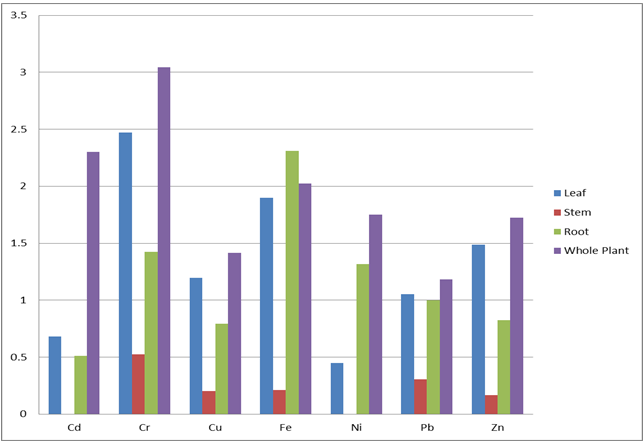
Table1 presents mean concentration of metals in leaves, stems, roots, whole plants of L. aestuans and soil sample from site 1. Results show the least concentrating metal to be Cd (0.000 ± 0.000) and Ni (0.000 ± 0.000) which was observed in the stems while the highest concentration was that of Zn metal (24.525 ± 0.469) in the leaves. Generally for the plant organs, concentration of metals was highest in the leaves followed by the roots with the stems being the least in metal concentration. Metal concentration in plant organs followed. A general order: Zn > Fe > CU > Cr > Cd > Pb > Ni from sample site 1. In the whole plant Zn was the most concentrated (28.448 ± 0.484) while Pb was the least (2.070 ± 0.046). Soil samples maintained Zn as the most concentrated (16.487 ± 0.024) and Pb as the least concentrated (1.749 ± 0.045). Figure 1 presents the results of bioaccumulation factors of HM in leaves, stem and whole plant of L. aestuans in sample site 1. The results show that the whole plant had the highest bioaccumulation factor (3.100) which was observed in Cr, Cd and Ni were the least bioaccumulated in the plant samples, recording (0.00) as bioaccumulation factor.
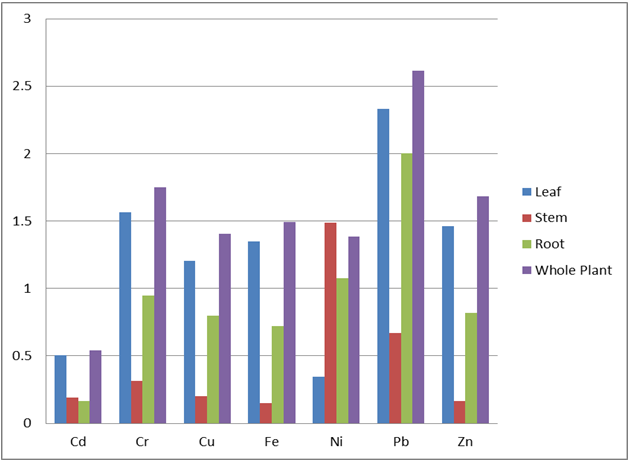
Table 2 presents mean concentration of metals in leaves, stems, roots, whole plants of L. aestuans and soil sample from control site 2. Result show that Zn with the concentration of 4.907 ± 0.064 was the highest concentration in the plant while Ni with the concentration of 0.0067 ± 0.001 was the least recorded in the plant organs (leaves, stem respectively). Whole plant recorded Zn as the highest concentrated metal (5.641 ± 0.615) while Pb (0.407 ± 0.001) was the least. Conversely, Cd (7.115 ± 0.002) was the highest metal concentrated in the soil while Ni was least (0.448 ± 0.09). In figure 2 the bioaccumulation of HM leaves, stem, roots and whole plant is presented. Results show that Pb was the most bioaccumulated metal while cd was the least. Whole plant also recorded the highest bioaccumulation factor while the stem was observed to be the least bioaccumulated for the plant L. aestuans in control site 2.
| Sample | Cd | Cr | Cu | Fe | Ni | Pb | Zn |
|---|---|---|---|---|---|---|---|
| Leaf | 2.320 ± 0.019b | 4.281 ± 0.122d | 14.725 ± 0.050d | 15.092 ± 0.107c | 0.8137 ± 0.115b | 1.840 ± 0.019b | 24.525 ± 0.468d |
| Stem | 0.000 ± 0.000a | 0.9063 ± 0.040a | 2.481 ± 0.028a | 1.690 ± 0.0190a | 0.000 ± 0.000a | 0.5307 ± 0.010a | 2.727 ± 0.686a |
| Root | 1.749 ± 0.043b | 2.464 ± 0.157c | 9.731 ± 0.140b | 18.375 ± 0.071e | 2.380 ± 0.063c | 1.569 ± 0.030b | 13.580 ± 0.232b |
| Whole Plant | 7.818 ± 0.038d | 5.272 ± 0.207e | 17.385 ± 0.140e | 16.077 ± 0.005d | 3.157 ± 0.048d | 2.070 ± 0.046c | 28.448 ± 0.484e |
| Soil | 3.409 ± 0.189c | 1.731 ± 0.036b | 12.284 ± 0.147c | 7.950 ± 5.747b | 1.805 ± 0.059b | 1.749 ± 0.045b | 16.487 ± 0.024c |
Table 1: Mean concentration of heavy metal ± standard deviation in leaves, stem, root, whole plant and soil of laportea aestuans
| Sample | Cd | Cr | Cu | Fe | Ni | Pb | Zn |
|---|---|---|---|---|---|---|---|
| Leaf | 1.064 ± 0.006b | 0.8657 ± 0.010c | 2.963± 0.012c | 3.011 ± 0.001d | 0.1560 ± 0.002b | 0.3633 ± 0.002b | 4.907 ± 0.064c |
| Stem | 00.0400 ± 0.006a | 0.1750 ± 0.001a | 0.4937 ± 0.002a | 0.3350 ± 0.001a | 0.0067 ± 0.001a | 00.1043 ± 0.002a | 0.5460 ± 0.005a |
| Root | 0.3523 ± 0.006b | 0.5230 ± 0.002b | 1.970 ± 0.000b | 1.661 ± 0.023b | 0.4817 ± 0.016c | 0.3117 ± 0.002b | 2.744 ± 0.004b |
| Whole Plant | 1.1590 ± 0.031c | 0.9673 ± 0.010d | 3.459 ± 0.024d | 3.333 ± 0.015d | 0.6203 ± 0.006d | 0.4070 ± 0.001c | 5.641 ± 0.615d |
| Soil | 7.1150 ± 0.002d | 0.5533 ± 0.003b | 2.464 ± 0.001c | 2.230 ± 0.015c | 0.4480 ± 0.010c | 0.1557 ± 0.002a | 3.355 ± 0.010c |
Table 2: Mean concentration of heavy metal ± standard deviation in leaves, stem, root, whole plant and soil of _laportea aestuans
Sclerocarpus Africana
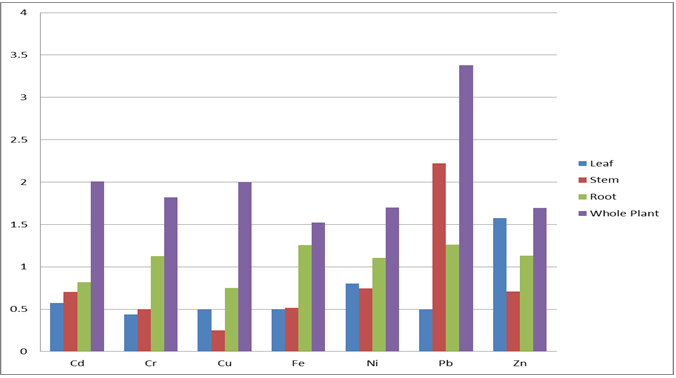
The results of mean concentration of metals in leaves, stems, roots, whole plants of S. africana and soil sample from sample site 1 are presented in table 3. Zn with a concentration of 30.406 ± 0.008 was observed to be the highest metal in concentration as recorded in the leaves, while Pb with a concentration of 0.526 ± 0.005 was recorded as the least concentration and was observed in the leaves. Generally for the plant organs like with other sampled sites, the stem recorded the least concentration of metals while the leaves were the highest. Zn maintained the highest concentration in the whole plant analysis of metal (32.810 ± 0.196). However, Ni was the least concentrated in the whole plant. Soil analysis showed Zn and Ni as the highest and least concentrating metals (19.355 ± 0.041 and 1.049 ± 0.047) respectively. Figure 3 present the bioaccumulation factors of HM in leaves, stem and whole plant of S. Africana in sample site 1. Pb was observed to be the most bioaccumulated. While whole plant was the sample with the highest bioaccumulation factor. Although Cu was generally the least bioaccumulated metal in the plant organs (leaves, stems and roots), it was the third most bioaccumulated metal in the whole plant (2.95).
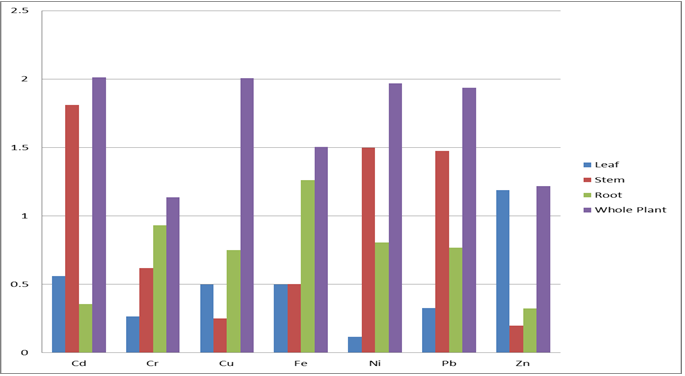
Cd (0.002 ± 0.001) and Cr (0.002 ± 0.001) recorded the least metal concentration for plant organ analysis as presented in table 4 for the concentration of S. africana in control site 2, while Zn (16.485 ± 0.001) was the highest which were all observed in the plant leaves. Specific to individual metal concentration across the three organs, Cr was the least concentrated (0.002 ± 0.001, 0.005 ± 0.002 and 0.701 ± 0.002) for leaves stems and roots respectively. Like with other plant species and sites, Zn was the most concentrated (16.877 ± 0.029 and 13.856 ± 0.009) respectively, while Pb (0.317 ± 0.002) and 0.614 ± 0.001) was the least concentrated in the sample site and whole plant respectively. Control site 4 recorded Cd as the metal with the highest bioaccumulation factor (2.02) as observed in the whole plant (figure 4). The whole plant was observed to have higher bioaccumulation factor than all plant organs analysed. Bioaccumulation factor for Ni in the leaves was the least observed. The leaves also maintained this least bioaccumulation factor for other metals as well except in the case of Zn (1.23) which was close to that of whole plant (1.25) and in Cu (0.50) where it was higher than stem (0.25).
| Sample | Cd | Cr | Cu | Fe | Ni | Pb | Zn |
|---|---|---|---|---|---|---|---|
| Leaf | 1.020 ± 0.013b | 1.253 ± 0.020c | 4.888 ± 0.090c | 3.366 ± 0.031d | 0.08433 ± 0.005b | 0.5260 ± 0.005b | 30.406 ± 0.008c |
| Stem | 1.255 ± 0.021a | 1.27 ± 0.008a | 2.468 ± 0.039a | 3.470 ± 0.034a | 0.7780 ± 0.009a | 2.351 ± 0.047a | 13.745 ± 0.053a |
| Root | 1.464 ± 0.011b | 3.202 ± 0.520b | 7.405 ± 0.090b | 8.494 ± 0.190b | 1.160 ± 0.043c | 1.337 ± 0.056b | 21.861 ± 0.101b |
| Whole Plant | 3.573 ± 0.022c | 5.180 ± 0.018d | 19.658 ± 0.054d | 10.268 ± 0.060d | 1.781 ± 0.050d | 3.578 ± 0.020c | 32.810 ± 0.196d |
| Soil | 1.785 ± 0.014d | 2.847 ± 0.050b | 9.850 ± 0.051c | 6.746 ± 0.107c | 1.049 ± 0.050c | 1.059 ± 0.036a | 19.355 ± 0.041c |
Table 3: Mean concentration of heavy metal ± standard deviation in leaves, stem root, whole plant and soil of Sclerocarpus africa
| Sample | Cd | Cr | Cu | Fe | Ni | Pb | Zn |
|---|---|---|---|---|---|---|---|
| Leaf | 0.002 ± 0.001 | 0.002 ± 0.001 | 0.983 ± 0.004 | 0.6670 ± 0.002 | 0.0037 ± 0.000 | 0.104 ± 0.001 | 16.485 ± 0.001 |
| Stem | 6.00467 ± 6.001 | 0.00467 ± 0.002 | 0.494 ± 0.001 | 0.6657 ± 0.003 | 0.467 ± 0.010 | 0.467 ± 0.01 | 2.747 ± 0.001 |
| Root | 0.170 ± 0.012 | 0.7007 ± 0.002 | 1.478 ± 0.001 | 1.673 ± 0.000 | 0.255 ± 0.108 | 0.264 ± 0.003 | 4.481 ± 0.164 |
| Whole Plant | 0.716 ± 0.006 | 0.853 ± 0.006 | 3.942 ± 0.001 | 2.006 ± 0.001 | 0.623 ± 0.002 | 0.614 ± 0.001 | 16.88 ± 0.029 |
| Soil | 0.356 ± 0.005 | 0.752 ± 0.001 | 1.965 ± 0.013 | 1.337 ± 0.002 | 0.317 ± 0.001 | 0.317 ± 0.002 | 13.850 ± 0.010 |
Table 4: Mean concentration of heavy metal ± standard deviation in leaves, stem, root, whole plant and soil of Sclerocarpus afric
Discussion
The results obtained from the atomic absorption experiments show that, metal concentrations varied sample site, plant species, plant organ and HM. A numbers of factors have been identified to be responsible for metal availability which determines concentration. They include pH, soil texture, soil organic matter, redox potential of metals and root zone [6, 15]. Zn, Fe, Pb and Cu frequented in higher concentrations regardless of the site be it control or auto-mechanic workshop. Frequent use in coating/ plating of other metals and general use due to their ductility could be implicated for this effect. Particularly for lead, its presence in both the control and test site may be the result of contamination arising from car exhaust, dust gases from various industrial sources, leaded fuels old lead plumbing pipes, or even old orchard sites in production where lead arsenate was used [16].
The results of bioaccumulation in this study revealed that L. aestuans accumulated more metals than S. africana particularly in the “above ground level” parts. i.e the stem and leaves as observed in the metal Cr. On the other hand S. africana accumulated more Pb in the stem than L. Aestuans in the same site 1. Based on these patterns of bioaccumulation exhibited by L. Aestuans and S. Africana, suggestion is made that both plants utilize phytoextraction phytostabilization and/or phytofiltration as mechanisms of remediating soils of HM contamination considering the plant organs that recorded the highest HM concentration. Leave were generally observed to be more concentrated with metals more than the other organs with the stem being the least in HM concentration. This is an expected trend for most plants due to the uptake of metal contaminated fluids and nutrients and the function of leave as the plant kitchen [4, 17]. The mechanism of phytoremediation utilized by a plant may also determine longevity of that plant on a soil regardless of the pollutant in the soil [6]. For example phytostabilizers and phytovolatilizers are often not that affected by contaminants because volatilizers take off contaminants into the atmosphere by transpiration while stabilizers prevent uptake, whereas phytoextractors take up the contaminant into the plant tissue [15]. Furthermore using the >1< classification of HM accumulators [3], we consider these plants to fall under the hyperaccumulators class seen that they both plants have >1 value of HM bioaccumulation factors.
The concentration of HM in S. africana whole plant analysis was always higher than that of the soil from which plant was collected. We suggest that this is an indication of the remediating activity of these plants in the polluted site with the view that high concentrations in plants must have been the result of high uptake from the polluted soil. The accumulation of Cd in plant stem than in leaves and in some cases root may be due to its binding in cell walls, compartmentalization in vacuoles and complexation with metal binding proteins and peptides, especially phytochelatin and metallothioneins. These processes are strategies employed by plants, at least in part, to face unavoidable stress conditions [18]. The nutrient content of foods can greatly be affected by HM concentration which at high levels may lead to toxicity [17]. For example glycolytic pathway is upregulation under heavy metal stresses. Conversely Cd for instance has been reported to have a decreasing effect in carbohydrate metabolism [19].
Despite the fact that Cu, Zn and Ni are HM and cause toxicity they are classified as essential metals in plant biological systems hence they have ready ligands for their uptake and may determine same. The low levels of Ni could be accounted for, by the fact that Ni concentration in the soil was lower than Zn and Cu, thus bio-transforming organisms for decontamination of Cu and Zn would be more populated than that of Ni from a point of organism requirement. Secondly, Cu and Zn are strong competitors of Ni for uptake which caused low concentrations in the plants [20, 21]. Research has shown the antagonistic activity of Zn to Cu in cells where Cu is utilized as a cofactor or in cases of ligand banding. These may be the reason for its high levels than that of Cu in the analyzed plants [20, 22, 23].
Conclusion
Findings of this study, it is concluded that there was a high level of heavy metals in the mechanic workshop site and the control site (sites 1 and 2) respectively. Both Laportea aestuans, and Sclerocarpus africana are considered hyperaccumulators hence good for remediation of HM contaminated sites in Benue state most especially in Makurdi, with better results in Sclerocarpus africana. Phytoextraction, phytostabilization and phytovolatilization are the possible mechanisms of remediation employed by the plants considering the high accumulation of HM in the leave and roots. The plants species and HM showed a general order of concentration and bioaccumulation as follows: whole plants > leaf > stem > roots and Zn > Fe > Pb > Cu > Cd > Cr > Ni. We therefore recommend that the two (2) plants used in this study have good phytoremediation capacity and are therefore recommended for used in the remediation of HM contaminated sites most especially in Makurdi. This research can be advanced by studying the mechanism of phytoremediation employed by the plants using isotopic atoms. Finally, HM contamination levels can be prevented or reduced by proper regulatory laws, constant monitoring and control of mine site and mechanic workshops and prosecution of offenders.
References
-
Akyengo O, Inalegwu B, Ogo AO, Jato JA (2019) Heavy Metal Bioaccumulation Potential of Liquid Habitat from River Challawa to _Tillapia zilli_. International Journal of Life Science Research 7(3): 100-109.
-
Inalegwu B, Akyengo O, Ogo OA, Jato JA (2020) Differential Bioaccumulation Of Heavy Metals In Tissues Of Tilapia Zilli Exposed To Liquid Habitat From River Challawa In Kano, Nigeria. Scholars International Journal of Biochemistry 3(12): 238-245.
-
Usman K, Al-Ghouti MA, Abu-Dieyeh MH (2019) The assessment of cadmium, chromium, copper, and nickel tolerance and bioaccumulation by shrub plant _Tetraena_ _qataranse_. Sci Rep 9(1): 5658.
-
Yan A, Wang Y, Tan SN, Yusof MlM, Ghosh S, et al. (2020) Phytoremediation: Promising Approach for Revegetation of Heavy Metal-Polluted Land. Fron Plant Sci 11: 359.
-
Wuana RA, Okieimen FE (2011) Heavy Metals in Contaminated Soils: A Review of Sources, Chemistry, Risks and Best Available Strategies for Remediation. Ecology 20: 1-21.
-
Laghlimi M, Baghdad B, El Hadi H, Bouabdli A (2015) Phytoremediation Mechanisms of heavy metal contaminated soils: A review. Open Journal of Ecology 5(8): 375-388.
-
Gupta V (2013) Mammalian Feces as Bio-Indicator of Heavy Metal Contamination in Bikaner Zoological Garden, Rajasthan, India. Res J. Animal, Veterinary and Fishery Sci 1(5): 10-15.
-
Panero JL, Funk VA (2002) Toward a Phylogenetic Subfamilial classifcation for the Compositae (Asteraceae). Proceedings of the Biological Society of Washington 115(4): 760-773.
-
Hsu TW, Chiang TY, Chung NJ (2003) _Laportea aestuans_ (L.) Chew (Urticaceae), a Newly Recorded Plant in Taiwan. Taiwania 48(1): 72-76.
-
Moro MF, Souza VC, Oliveira-Filho AT, Queiroz LP, Fraga CN, et al. (2012) Alienígenas na sala: o que fazer com espécies exóticas em trabalhos de taxonomia, florística e ftossociologia? Acta Bot Bras 26 (4): 991-999.
-
Arakaki D, Lao C (2012) _Laportea aestuans_ (L.) Chew West Indian woodnettle. New Pest Advisory 12(2): 1-1.
-
Ayo RG, Ndiombueze JA, Tor-Anyiin TA (2014) Phytochemical and anti-microbial screening of the leaves and twigs of _Sclerocarpus africanus_ (Jacq). European Journal of Medicinal Plants 4(4): 473-482.
-
Alves M, Roque N (2016) First Record of _Sclerocarpus_ _Africana_ Jacq. (Asteraceae, Heliantheae) for South America. Journal of Biodiversity Data 12(6): 1-4.
-
Ang HH, Lee KL (2005) Analysis of Mercury in Malaysian Herbal Preparation. A Peer Review journal of Biomedical Sciences 4(1): 31-36.
-
Edao HG (2017) Heavy Metals Pollution of Soil; Toxicity and Phytoremediation Techniques. International Journal of Advanced Research and Publications 1(1): 19-40.
-
Tangahu BV, Sheikh Abdullah SR, Basri H, Idris M, Anuar N, et al. (2011) A review on heavy metals (As, Pb, and Hg) uptake by plants through phytoremediation. International Journal of Chemical Engineering 2011: 31.
-
Khan A, Khan S, Khan MA, Qamar Z, Waqas M (2015) The uptake and bioaccumulation of heavy metals by food plants, their effects on plants nutrients, and associated health risk: a review. Environ Sci Pollut Res Int 22(18): 13772-13799.
-
John R, Ahmad P, Gadgil K, Sharma S (2009) Heavy metal toxicity: Effect on plant growth, biochemical parameters and metal accumulation by Brassica juncea L. International Journal of Plant Production 3(3): 65-76.
-
Rodríguez-Celma J, Rellán-Álvarez R, Abadía A, Abadía J, López Millán AF (2010) Changes induced by two levels of cadmium toxicity in the 2-DE protein profile of tomato roots. J Proteomics 73(9): 1694-1706.
-
Chen C, Huang D, Liu J (2009) Functions and Toxicity of Nickel in Plants: Recent Advances and Future Prospects. Clean-Soil Air water 37(4–5): 304-313.
-
Asati A, Pichhode M, Nikhil K (2016) Effect of Heavy Metals on Plants: An Overview. International Journal of Applications or Innovations in Engineering & Management 5(3): 56-66.
-
Souza Silva ML, Vitti GC, Trevizanm AR (2014) Heavy Metal Toxicity in Rice and Soybean Plants Cultivated in Contaminated Soil. Revista Cares 61(2): 248-254.
-
Zhu T, Li L, Duan Q, Liu X, Chen M (2021) Progress in our understanding of plant responses to stress of heavy metal cadmium. Plant signal behave 16(1): 1-7.
- Superposition of Cryo-EM and AlphaFold Predictions of Dengue Antigen-Antibody Complexes
- Jugular-Applied Coherent Low-Level Laser Therapy Enhances Systemic Mitochondrial Metabolic Function and Antioxidant Response
- Role of OMC32 Polypeptide in Acrosin-Mediated Exocytosis during the Bovine Sperm Acrosome Reaction
- Association of Galectin-3 but not Laminin in Tamoxifen-Induced Growth Suppression in Breast Cancer MCF-7 Cells
- Effect of Different Wavelengths of Light on the Rate of Photosynthesis
- Nutritional, Therapeutic, and Environmental Effect of Oyster Mushrooms: An Editorial