
Breakfast, a must for Individuals with Type 2 Diabetes Mellitus
Several metabolic processes take place following a meal. These processes are enhanced during the early hours of the day, resulting in a better glycemic response to meals during the morning hours. The balance between internal clocks and meals is crucial for optimal health. Disruption of the circadian clock, such as skipping breakfast, can lead to abnormal metabolic responses, weight gain, elevated HbA1c levels, an increased risk of type 2 diabetes, and cardiovascular complications. Consuming a high-energy breakfast in the morning can have positive effects on weight loss, appetite reduction, and postprandial hyperglycemia in individuals with type 2 diabetes. This effect occurs independently of total energy intake throughout the day. A long-term study on patients with Type 2 diabetes Mellitus found that a whey protein breakfast led to a greater reduction of HbA1C and body weight. Disturbance in the circadian rhythm can result in ineffective metabolic functions and postprandial hyperglycemia. Adults, particularly those with T2D, should consume a protein-rich high-energy breakfast and avoid skipping meals and high-energy dinners to maintain a healthy lifestyle.
Abbreviations
T2D: Type 2 Diabetes Mellitus; NCDs: Non-Communicable Diseases; PPHG: Postprandial Hyperglycemia; SCN: Suprachiasmatic Nucleus.
Introduction
Inquiries about dietary choices dominate discussions, yet the timing of meals often remains overlooked. In ancient times, humans synchronized their eating patterns with the natural light cycle: rising at dawn and concluding all meals by sunset. Our ancestors adhered to their internal circadian clock, which is influenced not only by meal timing and food availability but also by exposure to sunlight. This clock governs a majority of our metabolic processes [1, 2]. In scientific terms, breakfast (breaking fast) represents the initial meal after an overnight fasting period. Ideally, it should provide higher energy content compared to dinner. Additionally, for healthy adults and individuals with type 2 diabetes mellitus (T2D), breakfast should contain a significant proportion of protein [3, 4].
Lifestyle changes, the industrial revolution, and the introduction of ‘fad diets’ have changed our eating habits. They are affecting metabolic processes and leading to non-communicable diseases (NCDs). This editorial looks into understanding the mechanism of the clock genes, the circadian rhythm, and how it affects metabolic processes, and the importance of meal timing.
What Happens when we Consume Food
After a meal, several important processes take place in response to increased nutrients and insulin secretion; these include β-Cell Responsiveness, Insulin Sensitivity, GLUT-4 Activity, and Muscular Glucose Uptake. Insulin secretion by pancreatic β-cells increases in response to elevated blood glucose levels (β- Cell Responsiveness). This helps regulate blood sugar and prevent excessive hyperglycemia.
Insulin binds to its receptor in skeletal muscle, activating the Akt/PKB pathway (Insulin Sensitivity). This leads to the translocation of GLUT4 glucose transporters from intracellular stores to the plasma membrane, enhancing glucose uptake by muscle cells [5]. GLUT4, an insulin- responsive glucose transporter, plays a crucial role (GLUT-4 Activity). It is expressed in adipose tissue, skeletal muscle, and cardiac muscle cells. Insulin-dependent glucose homeostasis relies on GLUT4 expression levels. Insulin action in muscle triggers the translocation of GLUT4 from intracellular compartments to the cell membrane, allowing increased glucose uptake by muscle cells (Muscular Glucose Uptake) [6]. These processes are enhanced during the early hours of the day, resulting in a better glycemic response to meals during the morning hours. The same carbohydrate content consumed in the evening would yield a lesser response. This highlights the importance of optimizing the morning hours to consume a good meal and the night hours (after sundown) for fasting and sleeping.
Internal Clocks and Meals – Working in Unison
We function upon the balance between two internal clocks. The Master clock is found in the hypothalamus in the suprachiasmatic nucleus (SCN), and the Peripheral clock is located in peripheral tissue. The clock genes located in SCN are synchronized by light signals, and the clock genes located in peripheral tissues are coordinated by signals coming from the SCN as well as the time and availability of food [7]. The initial exposure to daylight triggers the activation of the master circadian clock, which subsequently sends signals to peripheral clocks (Figure 1). When food is available during this early period, it aligns the central and peripheral clocks, leading to harmonious synchronization. Conversely, the absence of food during this time can result in misalignment. Notably, the first meal of the day, specifically breakfast, exerts a more potent resetting effect on the circadian network compared to other meals.
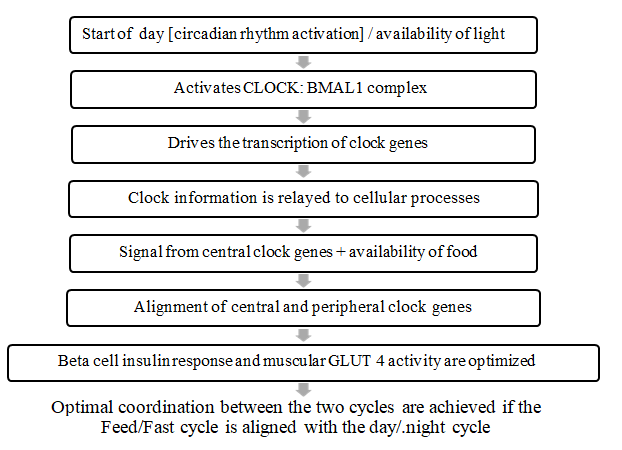
Figure 1: Synchronization between central and peripheral clock genes. What Happens in Circadian Misalignment Chronic misalignment between circadian rhythms and daily behaviors occurs due to long-term changes in scheduling. This phenomenon is observed in shift workers, individuals who skip breakfast, consume late- night snacks, or engage in continuous snacking throughout the day.
complications [9].
T2D and the Circadian Clock
The dysregulation of the circadian clock plays a central role in the pathophysiology of type 2 diabetes (T2D). Reduced expression of clock genes in T2D is associated with insulin resistance, delayed β-cell secretion, decreased β-cell proliferation, postprandial hyperglycemia (PPHG), and elevated HbA1c levels. Notably, omitting breakfast in T2D patients exacerbates the disruption in clock gene expression, further contributing to PPHG and impaired early insulin and GLP-1 responses following subsequent meals. Additionally, T2D is characterized by declining β-cell function and deficient early postprandial insulin release. Therefore Breakfast is detrimental in a person with T2D [10, 11].
What do we eat in the Morning?
Now that it has been established that, eating in the morning and eating in line with your circadian rhythm is important, it is necessary to take a look at what should be consumed for breakfast.
Research has shown that consuming a higher energy content during the morning/day, compared to the evening/ night, can have several positive effects. These include resetting clock gene oscillations and promoting weight loss, reducing appetite, and improving postprandial hyperglycemia (PPHG) in individuals with type 2 diabetes [4]. This effect occurs independently of the total energy intake throughout the day. Therefore, starting the day with a hearty breakfast may have significant health benefits. Consuming a high-energy breakfast has a dual effect on circadian clock gene expression: it resets and synchronizes these genes. As a result, it enhances glucose metabolism, reduces postprandial glycemic excursions, and promotes weight loss in both individuals with type 2 diabetes and healthy individuals [12, 13].
A long-term study was carried out on patients with Type 2 Diabetes. Participants consumed either a whey protein breakfast diet, a high protein (Protein from sources other than whey) breakfast, or a carb-heavy breakfast. While both the protein-heavy breakfast meals displayed low postprandial hyperglycemia, the whey protein breakfast in T2D patients led to a greater reduction of HbA1C and body weight compared to the other two groups [14].
Conclusion
Disturbance in the circadian rhythm and desynchronization of central and peripheral clocks can result in ineffective metabolic functions and consequently, postprandial hyperglycemia. It is advisable for adults, particularly those with T2D, to consume a protein-rich high- energy breakfast. Furthermore, individuals with T2D should steer clear of skipping meals, late-night snacking, and high- energy dinners to maintain a healthy lifestyle. In a period marked by the widespread occurrence of non-communicable diseases and irregular eating habits observed not only in developed nations but also in developing regions, the dissemination of information and education plays a crucial role.
References
-
Malin SK (2021) Timing Is Everything, Right? Meal Impact on Circadian Related Health. The Journal of Clinical Endocrinology & Metabolism 106(2): e1050-e1051.
-
Peters B, Vahlhaus J, Pivovarova-Ramich O (2024) Meal timing and its role in obesity and associated diseases. Front. Endocrinol 15: 1359772.
-
Xiao K, Furutani A, Sasaki H, Takahashi M, Shibata S (2022) Effect of a High Protein Diet at Breakfast on Postprandial Glucose Level at Dinner Time in Healthy Adults. Nutrients 15(1): 85.
-
Jakubowicz D, Wainstein J, Tsameret S, Landau Z (2021) Role of High Energy Breakfast “Big Breakfast Diet” in Clock Gene Regulation of Postprandial Hyperglycemia and Weight Loss in Type 2 Diabetes. Nutrients 13(5): 1558.
-
Hulett NA, Scalzo RL, Reusch JE (2022) Glucose Uptake by Skeletal Muscle within the Contexts of Type 2 Diabetes and Exercise: An Integrated Approach. Nutrients 14(3): 647.
-
Vlavcheski F, Baron D, Vlachogiannis IA, MacPherson RE, Tsiani E (2018) Carnosol Increases Skeletal Muscle Cell Glucose Uptake via AMPK-Dependent GLUT4 Glucose Transporter Translocation. International Journal of Molecular Sciences 19(5): 1321.
-
Balsalobre A (2002) Clock genes in mammalian peripheral tissues. Cell Tissue Res 309(1): 193-199.
-
Markwald RR, Wright KP (2012) Circadian Misalignment and Sleep Disruption in Shift Work: Implications for Fatigue and Risk of Weight Gain and Obesity. In: Shiromani P (Eds.), Sleep Loss and Obesity. Springer, New York, NY, pp: 101-118.
-
Chellappa SL, Qian J, Vujovic N, Morris CJ, Nedeltcheva A, et al. (2021) Daytime eating prevents internal circadian misalignment and glucose intolerance in night work. Science Advances 7(49): eabg9910.
-
Tiwari A, Rathor P, Trivedi PK, Ratnasekhar CH (2023) Multi-Omics Reveal Interplay between Circadian Dysfunction and Type2 Diabetes. Biology 12(2): 301.
-
Corella D, Asensio EM, Coltell O, Sorli JV, Estruch R, et al. (2016) CLOCK gene variation is associated with incidence of type-2 diabetes and cardiovascular diseases in type-2 diabetic subjects: dietary modulation in the PREDIMED randomized trial. Cardiovasc Diabetol 15: 4.
-
Schusdziarra V, Hausmann M, Wittke C, Mittermeier J, Kellner M, et al. (2011) Impact of breakfast on daily energy intake - an analysis of absolute versus relative breakfast calories. Nutr J 10: 5.
-
Jakubowicz D, Barnea M, Wainstein J, Froy O (2013) High Caloric intake at breakfast vs. Dinner differentially influences weight loss of overweight and obese women. Obesity 21(12): 2504-2512.
-
Jakubowicz D, Froy O, Ahrén B, Boaz M, Landau Z, et al. (2014) Incretin, insulinotropic and glucose-lowering effects of whey protein pre-load in type 2 diabetes: A randomised clinical trial Diabetologia 57(9): 1807-1811.
- Superposition of Cryo-EM and AlphaFold Predictions of Dengue Antigen-Antibody Complexes
- Jugular-Applied Coherent Low-Level Laser Therapy Enhances Systemic Mitochondrial Metabolic Function and Antioxidant Response
- Role of OMC32 Polypeptide in Acrosin-Mediated Exocytosis during the Bovine Sperm Acrosome Reaction
- Association of Galectin-3 but not Laminin in Tamoxifen-Induced Growth Suppression in Breast Cancer MCF-7 Cells
- Effect of Different Wavelengths of Light on the Rate of Photosynthesis
- Nutritional, Therapeutic, and Environmental Effect of Oyster Mushrooms: An Editorial