
Thin Layer Chromatographic Separation of Diacetylmorphine (Heroin) and its Excipients: An Experimental Study
Background: Heroin is a well-known drug of abuse that is usually administered intravenously. However, smoking heroin has gained popularity in many parts of the world since it was first described in Shanghai in the 1920s. Material and Method: A total of 6 exhibits were examined in laboratory, New Delhi for research work and the physical appearances were noted for the samples as a part of the preliminary examination. The samples were received in sealed transparent plastic containers for qualitative analysis of heroin and its excipients. Result: Out of 16 systems, 11 systems are capable of resolving opium and its alkaloids, 9 systems are capable of resolving opium alkaloids in illicit heroin and 8 systems are capable of resolving opium alkaloids and adulterants in illicit heroin. Conclusion: In our study the best solvent systems are Ethyl acetate: benzene: acetonitrile: ammonia (25:30:40:5) and Toluene: acetone: ethanol: ammonia (20:20:3:1) for separation of opium alkaloids and adulterants.
Introduction
Historically, and more recently it has been a common practice that illicit drugs such as heroin typically contain other disturbances in addition to the purported active ingredients that can have serious adverse health consequences or even cause premature death [1].
Heroin is a well-known drug of abuse that is usually administered intravenously. However, smoking heroin has gained popularity in many parts of the world since it was first described in Shanghai in the 1920s [2]. In a procedure called ‘‘chasing the dragon’’ addicts typically inhale heroin fumes resulting from heating heroin powder on aluminum foil with a cigarette lighter until it melts and evaporates. Heroin is administered in several ways. These include sniffing or snorting, smoking, subcutaneous injection and intravenous injection [3]. The great advantage of heroin, from the point of view of illicit traffickers, is that it seems capable of almost unlimited dilution with other substances, while still the addict obtains from it some gratification for his desire [3]. Nearly every small peddler who resells heroin first mixes his supply with at least an approximately equal amount of lactose or powdered sugar. As his heroin is usually highly adulterated and diluted even before he gets it, it frequently reaches the final user containing no more than five per cent of the actual alkaloid, or even sometimes as little as one per cent [4]. An illicit heroin sample may contain a number of natural and synthetic opiate alkaloids as well as adulterants and diluents. Additional substances may be added to bulk, dilute, complement or enhance the effects of the drug or mimic the effects of illicit drugs or that will facilitate the administration of the illicit drug such as caffeine in heroin and in cocaine to facilitate smoking. Diluents are chemicals added to controlled substances that are used as fillers like lactose, mannitol, corn starch, dextrose, sucrose, sodium bicarbonate, sodium carbonate, magnesium sulphate, sodium chloride, caffeine, etc [4]. Adulterants commonly encountered in heroin include quinine, procaine, acetaminophen, caffeine, diphenhydramine, aspirin, phenobarbital, strychnine, diazepam, methaqualone and lidocaine and quinine, procaine [4]. Mono-acetyl morphine and morphine remain from imperfect acetylation as consequences of impurity of manufacture. Codeine, papaverine and meconic acid prove that their presence is a result of crude process being used not only to manufacture but for purification of heroin as well [4]. Chemical examination of narcotic and psychotropic substance requires the use of instruments as confirmatory techniques. After preliminary examination, we switch on to instrumental techniques with thin layer chromatography (TLC) being the most convienent and rapid method of separation & identification followed by HPTLC which minimizes the chances of human error caused by evaluating TLC. The use of sophisticated instruments like GC, GC-MS, UV permits high accuracy and efficient results and are the last resort of identifying compounds in an unknown sample.
In examining a "Heroin" sample the primary necessity is to identify the diacetylmorphine with complete certainty, or to identify the narcotic substances present [3]. The present study was to determine best solvent systems for the separation of diacetylmorphine (Heroin) along with other opium alkaloids and adulterants present in samples of illicit heroin by using chromatographic techniques.
Material & Methods
A total of 6 exhibits were examined in the laboratory, New Delhi for research work and the physical appearances were noted for the samples as a part of the preliminary examination. The samples were received in sealed transparent plastic containers for qualitative analysis of heroin and its excipients. The samples were weighed. The weight of each sample was 10gm approx. Each of approximately 0.5gm of each sample was taken for analysis in test tubes which were marked with sample number. Pre-coated plates were obtained from Merck (20 x 20 cm aluminum backed; silica gel 60 GF 254; 0.2 mm layer thickness). Developed plates were visualized under UV at 254nm and with spray reagents (DragendoRF reagent, Iodoplatinate reagent, Marquis reagent, Froehde reagent, Libermann‘s reagent & Potassium ferrocyanide +ferric chloride). The individual standards were dissolved in methanol to a concentration of 1 mg/ml. The mixture was prepared by mixing equal volumes of the standards. A spotting volume of 2 µl was applied. The TLC tanks were pre-equilibrated with the solvent system 15 minutes before use. Spray reagents were prepared according to E. C. G. Clarke [5].
Standard Drugs
Opium, heroin, monoacetylmorphine, narcotine, papaverine, thebaine, codeine, acetyl codeine, lidocaine, caffeine, diphenhydramine, nitrazepam, diazepam, paracetamol, methadone, dexmetorphan, alprazolam
Chemicals
Cyclohexane, Benzene, Diethyl amine, Ethyl acetate, methanol, Ammonia, Acetone, Toluene, Ethanol, Methanol, Chloroform, Diethyl ether, Diethyl amine, Ethyl acetate, Acetonitrile, n-butanol( HPLC Grade, purchased from Merck & Spectrochem)
Method for Processing TLC Plates
1. The TLC tanks were pre-equilibrated with the desired solvent system one hour before use, and were made up to 50ml, thoroughly mixed and then left for equilibration.
2. The individual standards were dissolved in methanol to a concentration of 1 mg/ml. The mixture was prepared by mixing equal volumes of the standards.
3. The spotting line of the TLC plate was kept 1.5cm from the bottom of the plate.
4. A spotting volume of approx. 2 µl was applied 1.5cm
from the edge of the plate to overcome edge effect and 2mm in diameter approximately. The spreading of spots was restricted to the maximum.
5. The distance between subsequent spots was fixed to
1cm.
6. The plate was allowed to run for a distance of 10cm
from the starting line of the plate.
7. After the complete run, the plates were taken out of the chamber and air dried.
8. Developed plates were visualized under UV light and spraying with chromogenic reagents
TLC Systems
| S. No. | TLC System | References | ||||||
|---|---|---|---|---|---|---|---|---|
| I | Cyclohexane: benzene: diethyl amine (70:25:10)- | [6] | ||||||
| II | Ethyl acetate: methanol: ammonia (85:10:5)- | [7] | ||||||
| III | Toluene: acetone: ethanol: ammonia (20:20:3:1) | [8] | ||||||
| IV | Cyclohexane: chloroform: diethyl amine (70:25:10) | [8] | ||||||
| V | Benzene: acetone: ammonia (50:50:2) | [8] | ||||||
| VI | Benzene: ethanol (4:1) | [9] | ||||||
| VII | Ethyl acetate: benzene: acetonitrile: ammonia (25:30:40:5) | [10] | ||||||
| VIII | Cyclohexane: toluene: diethyl amine (70:25:10) | [8] | ||||||
| IX | Benzene: methanol (4:1) | [11] | ||||||
| X | Diethylether: acetone: diethyl amine (85:8:7)- | [12] | ||||||
| XI | Diethylether (water saturated): acetone: diethylamine (85:8:7) | [13] | ||||||
| XII | n-butanol: acetic acid: water (35:3:10) | [14] | ||||||
| XIII | Chloroform: diethyl ether: methanol: ammonia (75:25:5:1) | [8] | ||||||
| XIV | Benzene: ethylacetate: methanol: ammonia (80:20:6.5:0.1) | [14] | ||||||
| XV | Chloroform: methanol: diethyl amine (16:3:1) | [15] | ||||||
| XVI | Glacial acetic acid: water: methanol: ethyl acetate (1:15:20:80) | [16] |
Table 1: Listing the solvent systems to be evaluated for thin layer chromatograph.
Factors which May Affect the RF Values
Nature of adsorbent: Different adsorbents will give different RF value for same solvent system because of their different adsorbing phenomenon. It is also affected by the substance on which the adsorbent is coated. For e.g.- plates coated using glass plates and commercially available plates give different values for the same solvent system [17].
The mobile phase: The purity of solvents and quantity of solvent mixed also affect RF value. The chemicals should be always of HPLC grade for proper separation. If the solvent is too old or has gained colour due to chemical reaction, it will lead to improper results. Activity: Temperature and storage conditions of adsorbent also affect RF value. Adsorbents should be placed in cool environment and should be protected from unwanted vapors of lab as it may cause contamination. Thickness of layer: The layers may be of higher or lower thickness which also varies RF value. Thickness should be fixed=0.25mm. thicker plates usually alter RF values and spots don’t come up properly as the compounds are unable to move. Equilibrium: Equilibrium of chamber used for development is important in TLC and hence saturation of atmosphere with the solvent vapor is important. The appropriate minimum time for saturation is 30min, more time would lead to better saturation and hence better results. The Temperature: Constant temperature must be maintained to carry out separation in order to avoid changes in solvent composition. The solvent chambers must be kept in cool environment; as higher temperature leads to change in composition of RF values. Thus room temperature should be ambient. Loading: Loading of sample must be small and appropriate about 10 micro grams. If loading is more the spreading of spot and tailing may occur which leads to increase in RF. Dipping zone: Distance of starting point from the solvent suRFace is also an important factor. Leave 1.5cm from the bottom of the plate to ensure correct dipping of the plate. Side effect: Plates should be marked by leaving 1.5 cm from both the edges of the plate to eliminate side effect which leads to shifting of RF values. Development distance: 10cm is minimum run required for a plate to be developed effectively as within this distance all spots can be easily visualized. The appropriate ratios of solvent system are another important step that affects the RF of a compound.
Observation & Result
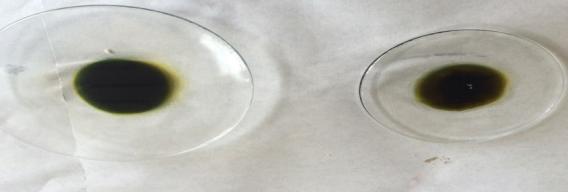
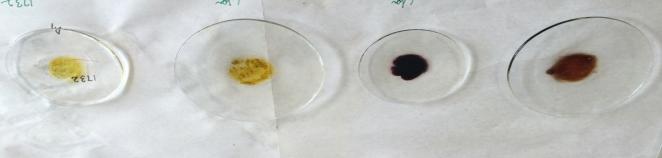
The following observations were made from the study undertaken in which colour tests were performed as a part of preliminary examination for indicating the presence of the alkaloid group.
| SAMPLE’s | MARQUIS | FROEHDE’s | ||||
|---|---|---|---|---|---|---|
| SAMPLE A | +VE(purplish- red) | +VE (olive green) | ||||
| SAMPLE B | +VE(dark purple) | +VE (olive green) | ||||
| SAMPLE C | +VE (Purple) | +VE (olive green) | ||||
| SAMPLE D | +VE (Orange Red) | +VE (dark green) | ||||
| SAMPLE E | +VE(purple) | +VE (green) | ||||
| SAMPLE F | +VE(dark purple) | +VE (green) |
Table 2: Showing color tests performed for the samples.
| S | .No of TL | C | |||||||||||||||||||||||||||||||||||||||||||||||||
|---|---|---|---|---|---|---|---|---|---|---|---|---|---|---|---|---|---|---|---|---|---|---|---|---|---|---|---|---|---|---|---|---|---|---|---|---|---|---|---|---|---|---|---|---|---|---|---|---|---|---|---|
| M | O | R | MAM | DAM | COD | A | .CO | D | NAR | PAP | THE | CAF | F | DPH | NITR | A | DIAZ | E | LIDO | PCM | A | LPRE | X | MET | DEX | ||||||||||||||||||||||||||
| system | |||||||||||||||||||||||||||||||||||||||||||||||||||
| I | 2 | 7 | 18 | 7 | 27 | 29 | 13 | 32 | 5 | 68 | - | - | 85.3 | 0 | - | 55 | 40 | ||||||||||||||||||||||||||||||||||
| II | 20 | 65 | 16 | 35 | 54 | 80 | 69 | 71 | 71 | - | 83.7 | 72 | 73.1 | 70 | - | 49 | 45 | ||||||||||||||||||||||||||||||||||
| III | 21 | 48 | 48 | 33 | 56 | 85 | 72 | 53 | 61 | 72 | 82 | 72 | 65 | 57 | - | 78 | - | ||||||||||||||||||||||||||||||||||
| IV | 5 | 18 | 18 | 41 | 56 | 62 | 54 | 50 | 32 | 71 | - | 80.4 | 84 | 0 | - | 74 | - | ||||||||||||||||||||||||||||||||||
| V | 8 | 19 | 19 | 20 | 48 | 80 | 77.5 | 50 | 67 | - | 75 | 87.5 | 94 | 64 | 3 | - | - | ||||||||||||||||||||||||||||||||||
| VI | 11 | 40 | 40 | 23 | 50 | 89 | 76 | 48 | 57 | 80 | 74 | 88 | - | 47 | - | 87 | - | ||||||||||||||||||||||||||||||||||
| VII | 6 | 14 | 14 | 24 | 59 | 82 | 73 | 59 | 54 | - | 74.1 | - | - | 43.6 | - | - | - | ||||||||||||||||||||||||||||||||||
| VIII | 6 | 40 | 40 | 37 | 58 | 62 | 57 | 48 | 15 | - | 72.8 | 81.4 | - | 50 | - | - | - | ||||||||||||||||||||||||||||||||||
| IX | 9 | 19 | 19 | 8 | 25 | 82 | 74 | 48 | 55 | 88 | - | - | - | 21 | - | - | - | ||||||||||||||||||||||||||||||||||
| X | 10 | 25 | 25 | 43 | 52 | 96 | 80 | 87 | 62 | 96 | 73 | 84 | - | 45 | 4 | - | - | ||||||||||||||||||||||||||||||||||
| XI | 18 | 57 | 57 | 45 | 82 | 70 | 58 | 70 | 35 | - | - | 86 | 95.1 | - | - | - | |||||||||||||||||||||||||||||||||||
| XII | 20 | 57 | 57 | 48 | 69 | 80 | 64 | 69 | 42 | - | - | - | - | - | - | - | |||||||||||||||||||||||||||||||||||
| XIII | 11 | 15 | 15 | 10 | 20 | 58 | 58 | 23 | 40 | - | - | - | - | - | - | - | |||||||||||||||||||||||||||||||||||
| XIV | 5 | 22 | 22 | 15 | 40 | 75 | 70 | 40 | 48 | - | 76 | 82 | 84 | 52 | - | - | - | ||||||||||||||||||||||||||||||||||
| XV | 37 | 47 | 47 | 50 | 55 | 85 | 83 | 58 | 90 | - | - | - | - | - | - | - | - | ||||||||||||||||||||||||||||||||||
| XVI | 5 | 34 | 46 | 60 | 50 | 95 | 93 | 88 | 82 | - | - | - | - | - | 95 | - | - |
I. System X and XV is good for caffeine as it comes at a higher RF value which is beneficial as caffeine is the most encountered impurity in heroin. System II is suitable for PCM (Acetaminophen). Dexmetorphan is the new class of adulterant found in heroin these days and can be separated in system II along with opium alkaloids. Alprex can be separated with opium alkaloids in system XVI. Diphenylhydramine can be separated in system X but with interference of narcotine.
| S.No of TLC System | A | B | C | ||||||
|---|---|---|---|---|---|---|---|---|---|
| I | - | + + | + + + | ||||||
| II | - | + + | + + + | ||||||
| III | + | + + | + + + | ||||||
| IV | - | - | - | ||||||
| V | + | + + | + + + | ||||||
| VI | + | - | + + + | ||||||
| VII | + | - | - | ||||||
| VIII | + | + + | + + + | ||||||
| IX | - | - | - | ||||||
| X | + | + + | + + + | ||||||
| XI | + | + + | - | ||||||
| XII | + | - | - | ||||||
| XIII | + | ++ | - | ||||||
| XIV | - | - | + + + | ||||||
| XV | + | ++ | - | ||||||
| XVI | + | - | - |
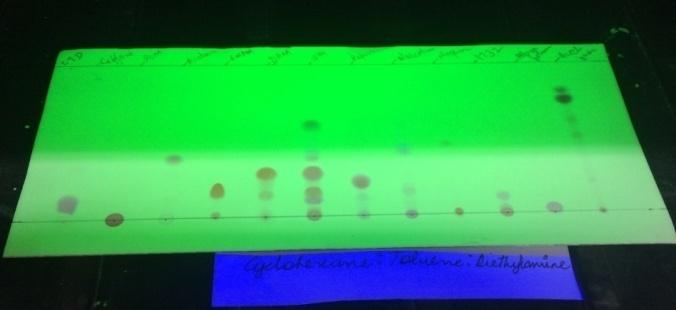
Table 4 shows system III, V, VIII and X are capable of resolving opium and its alkaloids, opium alkaloids in illicit heroin and opium alkaloids and adulterants in illicit heroin, however TLC system VII and XVI are only capable for of resolving opium and its alkaloids. Out of 16 systems, 11 systems are capable of resolving opium and its alkaloids, 9 systems are capable of resolving opium alkaloids in illicit heroin and 8 systems are capable of resolving opium alkaloids and adulterants in illicit heroin.
Discussion
The study undertaken is divided into two parts, with the first aimed at resolving the best solvent systems for the separation of opium alkaloids in crude opium samples, separation of opium alkaloids in illicit heroin samples which are commercially viable and separation of opium and its alkaloids along with its excipients in commercially available diacetylmorphine(heroin) samples. The separation of opium and its alkaloids was best seen in Ethyl acetate: benzene: acetonitrile: ammonia (25:30:40:5), which is in accordance to literature cited by John A Steele [10], who also mentions, separation of 5 opium alkaloid is achieved in this solvent system. Next second system is Benzene: ethanol (4:1) which is also in accordance to the literature cited by Mary& Brochmann [18]. Benzene: ethanol (9:1) is the best binary solvent system which separates all 5 alkaloids simultaneously is also seen as mentioned by Nagaraj R. Ayyangar, Sujata S. Biswas [9]. Butanol: methanol: acetic acid (70:20:10), showed marked distinction between morphine & codeine, which is in accordance with the literature cited in Clarke [5]. While resolving alkaloids of opium in heroin, the main problem encountered is the separation of acetyl codeine & DAM, which have almost same coinciding RF values in almost all solvent systems, to overcome this problem- Chloroform: methanol (9:1) is used, in which Diacetylmorphine (DAM) & Acetyl codeine have different RF values. According to literature, chloroform: methanol (9:1) is good for the separation of morphine, codeine, thebaine, which is in accordance with the result obtained [18, 19].
Another problem encountered while separating alkaloids of opium is the separation of papaverine and narcotine, for resolving this issue, an attempt to use the solvent system –Toluene: acetone: ethanol: ammonia (20:30:3:1) was made which came out to be successful i.e papaverine and narcotine come at different RF’s. Benzene ethanol (4:1) can also be used for the separation of papaverine, narcotine, which is in accordance with Nagaraj RA et al study [9]. Narcotine gave red colour in all benzene systems when sprayed with iodoplatinate spray reagent, thus this differentiation of colour in iodoplatinate proved beneficial for the identification of papaverine and narcotine. Thebaine, though present in invariably small amounts also pose as a problem while separating opium alkaloids, thus a system exclusively for thebaine was also found out- cyclohexane: chloroform: diethylamine, (70:20:10), Monoacetylmorphine(MAM), diacetylmorphine (DAM) papaverine, narcotine are not found in the surrounding of thebaine. The entire focus of the experimental study was to isolate a solvent system which enables best separation of diacetylmorphine from monoacetylmorphine(MAM) and morphine which was achieved by using the solvent system – Cyclohexane: benzene: diethyl amine (70:25:10). This system can be used to separate the three most important components of an illicit heroin. Benzene: ethanol (4:1) also separates DAM & MAM. The separation of opium alkaloids in heroin along with its diluents and adulterants i.e. Illicit heroin, which is the most common type sent to forensic labs for analysis in case of a narcotic seizures. Paracetamol (PCM) & caffeine are the most commonly used adulterants in illicit heroin due to similar effects produced as by the drug. For confirming the presence of caffeine, -Chloroform: methanol (9:1) should be used as caffeine moves up with the solvent phase and can be distinguished as it alone moves up in the system. Benzene: acetone: ammonia (50:50:2) can be used to resolve the adulterants along with Toluene: acetone: ethanol: ammonia (20:20:3:1) which is in accordance with the literature [20]. Dexmetorphan is the new class of adulterant found commonly in heroin samples these days. To separate dexmetorphan, a two system approach proved beneficial namely-Cyclohexane: benzene: diethyl amine (70:20:10) & Ethyl acetate: methanol: ammonia. (85:10:5). Cyclohexane: benzene: diethyl amine (70:25:10) makes a total little over 100 and hence an attempt to reduce its ratio to (70:20:10) was made, and it turned out to be futile as all the spots remained on the bottom line and refused to travel up with the mobile phase showing more affinity towards the stationary phase. Iodoplatinate is the only spray reagent that reacts with nitrogenous bases present in the alkaloids to give different colors while dragendorf is a universal reagent used to confirm the presence of alkaloid in a sample [11]. Dragendorf gives bright orange spots on reacting with a nitrogenous base present in the alkaloids. It was observed that using 0.1 N ammonical silver nitrate solutions on dragendorf, enhances the intensity of colours produced by spray. A new spray reagent, 1% (w/v) aqueous solution of ferric chloride, was used which has been developed for the detection and identification of heroin (diacetylmorphine) [21]. A red spot was observed for heroin when the high-performance TLC plate was sprayed with the reagent and heated at 100°C. Similar spots were observed for morphine, codeine, and thebaine (opiates containing the phenanthrene group) which is in accordance with the result obtained. It did not react with papavarine and narcotine (opiates containing the benzoisoquinoline group). The reagent was specific, sensitive, and can be used for the detection and identification of heroin in forensic samples [21]. In our study we found that narcotine gives red colour in iodoplatinate spray reagent, lidocaine gives a yellow colour in iodoplatinate, these two make marked difference while spraying plates and thus make identification easy thereby making spraying reagents an important step. Paracetamol (Acetaminophen) reacts with none of the above mentioned reagents and thus Ferric chloride + Potassium Ferro cyanide is used to identify paracetamol. It gives blue spots on white background. Similarly we also observed that PCM does not run in system I & system IV. Adulterants are added very meticulously so as to feign the same effects as that of a molecule and also reducing the effective cost and serving same or more benefits than the parent compounds. They are added as to the convenience of the illicit drug manufactures to increase the volume and benefit delivered to them. Lidocaine is an important adulterant that is added in illicit heroin as it mimics the effects of heroin and sometimes shows, much stronger effects. Caffeine, another important diluents is added as it vapourises at the same temperature as heroin [1]. Procaine is added as it emits the same anesthetic activity as morphine derivatives, thus keeping the sanctity of the compound.
Paracetamol is added because of similar boiling point to heroin, and also produces same analgesic effects [1]. The percentage of heroin that is vaporised also depends on the presence and type of impurities (e.g., the alkaloid impurities noscapine and papaverine) and added compounds like pharmacologically inactive diluents or cutting agents such as sugars, or pharmacologically active adulterants such as caffeine) as given in literature [20]. Only 4 adulterants were used in heroin base sample seized from 2002-2003, while 11 adulterants were used in 1992-1993. Usage of the two most common heroin adulterants, caffeine and paracetamol increased in frequency from 78% to 99% and from 62% to 97% respectively [22]. Approximately 50% of heroin base samples confiscated from 1992-1993 were diluted with sugar, however only 5 % of the samples from 2002-2003 contained sugar (mannitol & sucrose), that is low in concentration over the years, which can be seen in the present study samples also. Nothing can be commented about the origin of country while dealing with narcotic and psychotropic substances because until and unless the standard of that particular region is present, it cannot be ascertained whether it belongs to that particular region or not, though as per UNODC, heroin synthesized in Afghanistan, typically contains caffeine, chloroquine phenolphthalein & paracetamol [8].
Dexmetorphan is a new class of adulterants belonging to benzodiazepines like compounds which is added these days in drugs to cause a sedative effect as it belongs to antitussive class. It gives black colour in Liebermann’s reagent and orange colour in marquis [5]. In our study we were able to successfully identify dexmetorphan in cyclohexane: benzene: diethyl amine (70:25:10) system. New solvent system glacial acetic acid: water: methanol: ethyl acetate (1:15:20:80) was also found to be useful for the separation and identification of alprazolam from diacetylmorphine along with other opium alkaloids as mentioned in literature [16].
Amidst all the odds, dealing with so many classes of adulterants, and also resolving opium alkaloids in illicit heroin along is a tedious job & is a major concern of narcotics laboratory, but using the results of the study, success could be achieved. The adulterants and opium alkaloids were successfully separated and identified on thin layer chromatography. Almost all kinds of adulterants can be separated and identified with the aforementioned solvent systems.
Conclusion
TLC has an important role to play in the screening and analysis of opiate compounds, particularly in less- developed countries. For many applications, this approach is more cost-effective than the analysis of samples directly on multi-column GLC or HPLC. In the experimental study following conclusions are drawn:
- The best solvent systems for the separation of opium and its alkaloids are -5,7 Benzene:acetone:ammonia & Ethyl acetate:benzene:acetonitrile:ammonia
- The best solvent systems for the separation of opium alkaloids in illicit heroin-1,8,10 Cyclohexane:benzene: diethyl amine Cyclohexane:toluene:diethyl amine, Diethylether: acetone: diethyl amine
- The best solvent system for the separation of opium alkaloids along with its adulterants in illicit heroin- 2,3,6 Ethyl acetate: methanol:ammonia, Toluene: acetone:ethanol: ammonia, Benzene:ethanol
- Best solvent system for DAM- 1 Cyclohexane: benzene:
diethyl amine, no acetyl codeine or adulterants are seen in the surrounding.
References
-
Claire Cole, Lisa Jones, Jim McVeigh, Andrew Kicman, Qutub Syed (2010) A guide to adulterants, bulking agents & other contaminants found in illicit drugs. CUT pp: 1-59.
-
Klous MG, Nuijen B, Van den Brink W, Van Ree JM, Beijnen JH (2004) Process characterisation, optimisation and validation of production of diacetylmorphine/caffeine sachets: a design of experiments approach. Int J Pharm 285(1-2): 65-75.
-
Klous MG, Nuijen B, Van den Brink W, Van Ree JM, Beijnen JH (2004) Development and manufacture of diacetylmorphine/caffeine sachets for inhalation by 'chasing the dragon' by heroin addicts. Drug Dev Ind Pharm 30(7): 775-784.
-
https://www.unodc.org/unodc/en/data-and- analysis/bulletin/bulletin_1953-01- 1_2_page008.html
-
Clarke ECG (1978) Isolation and Identification of Drugs. London, Pharmaceutical Press.
-
Mari F, Bertol E, Tosti M (1982) Heroin in the Florence area, Italy. Bull Narc 34(1): 37-44.
-
Laboratory Procedure Manual, Directorate of Forensic Science, Ministry of Home Affairs, Forensic Toxicology (2005) Selective and Scientific books.
-
Nair NK, Navaratnam V, Rajananda V (1984) Analysis of illicit heroin: 1. An effective TLC system for separating 8 opiates and 5 adulterants, National Drug Research Centre.
-
Nagaraj RA, Sujata SB, Amruta ST (1991) Separation of opium alkaloids by thin-layer chromatography combined with flame ionization detection using the peak pyrolysis method. Journal of Chromatography A 547: 1-567.
-
Steele JA (1965) Solvent systems for the identification of opiates in narcotic seizures by thin-layer chromatography. Journal of Chromatography 19: 300 -303.
-
Egon Stahl (1969), Thin layer chromatography- A laboratory handbook 2nd (Edn.), 437.
-
Report of the expert group to co-ordinate research on the physical and chemical characteristics of heroin to trace its origin and movement in the illicit traffic. (E/CN.7/1983/2/Add.4, annex II).
-
Vignoli L (1966) Chromatographic Separation on Thin Layers of Opium Alkaloids and of Some of Their Acetylated Derivatives. I. Clarification of Experimental Records. Ann Pharm Fr 24(6): 461-468.
-
Misra AL, Pontani RB, Mule SJ (1972) Separation of thebaine, some of its metabolites and congeners on glass fibre sheets. Journal of Chromatography 71(3): 554-556.
-
Gough TA, Baker PB (1982) Identification of major drugs of abuse using chromatography. Journal of Chromatographic Science 20: 289-329.
-
More BP, Doundkar PB, Toche RB, Shinde DB (2013) Seperation and indentification of Alprazolam from diacetylmorphine along with other opium alkaloids by HPTLC_._ International Journal of Pharmacy and Biological Sciences 3(3): 204-208.
-
Bele A Archana, Khale Anubha (2011) An overview on thin layer chromatography. International Journal of Pharmaceutical Sciences & Research 2(2): 256-267.
-
Mary NY, Brochmann-Hanssen E (1963) Determination of the principal alkaloids of opium by thin layer chromatography. Lloydia 26: 223.
-
Clark CC (1977) A study of procedures for the identification of heroin. Journal of Forensic Sciences. 22(2): 418-428.
-
Huizer H (1982) Analytical studies on illicit heroin. I. The occurrence of mono-acetylmorphine. Journal of Forensic Sciences 28: 32-39.
-
Dongre VG, Kamble VW (2007) HPTLC detection and identification of heroin (diacetylmorphine) in forensic samples part III. J planar chromatography 16(6): 458-460.
-
Andreasen MF, Lindholst Christian, Kaa Elisabet (2009) Adulterants and Diluents in Heroin, Amphetamine, and Cocaine Found on the Illicit Drug Market in Aarhus. Denmark 2: 16-20.
- Narcotics and Digital Forensics: Bridging Crimes in the Digital Age
- Ethics in Forensic Psychiatry: Principles, Dilemmas, and Human Rights
- Impact of Acute Stress on Attentional Orienting to Social Cues
- Head Injury and Intracranial Hemorrhage in Western Region of Libya
- A Forensic Study on Handedness: Examination of Handwriting Features in Right and Left Handed Writers
- Techniques for Latent Fingerprint Development Using Natural and Synthetic Powders: A Review