
Detection and Characterization of Phorate and its Metabolites in Visceral Matrices by Mass Spectrometry
Phorate is an Organophosphate insecticide that inhibits acetyl cholinesterase activity and is a systemic and contact insecticide and acaricide. Phorate is prone to undergo hydrolysis and oxidation in biological and environmental matrices. Consequently, screening, identification and characterization of the hydrolyzed, oxidized products of phorate in biological samples such as viscera and blood is an important task in the area of forensic toxicology. In a case study, Phorate and its major four metabolites Phorate sulfoxide, Phorate sulfone and Diethyl Dithiophosphoric were detected in the visceral matrices by Gas Chromatography Mass Spectrometry. Here we report successful detection and characterization of the Phorate and its major metabolites under positive ion Electron Ionization (EI) mass spectrometry. The EI mass spectra of the target compounds showed the molecular ion [M+•] in addition to the other diagnostic product ions that enable unambiguous identification of phorate and its metabolites. General fragmentation pattern of these compounds are discussed in detail. Phorate showed an ion at m/z 75 as the base peak corresponds to ethylthiomethylium (C2H4SCH2 +) ion. The Mclafferty rearrangement was also observed in Phorate and its metabolites. The identification of these compounds will be an invaluable support during investigation and in conviction of criminal cases in courts of law in phorate poisoning cases.
Introduction
Since the last decade, usage of pesticides and insecticides has increased extensively in the world. Pesticides are used intentionally for the purpose of assassination some kind of life. Ideally pesticides should be highly selective, abolishing objective organism though leaving non target organisms unhurt. However, in reality most pesticides are not so selective. Depending on what a substance is formed to do, pesticides have been sub classified into a various categories. The major classes of pesticides in use today are herbicides, fumigants, fungicides, and insecticides. Since the usage of some of pesticides has been banned and some were restricted to use [The Insecticides Act, 1968 (Act No.46 of 1968)], the involvement of these compounds in case of poisoning has been declined. However, cases of accidental or suicidal poisoning deaths are still reported due to surreptitious use of pesticides. Nowadays, many household insecticides consist of carbamates and pyrethroids and thus poisoning involving them are on the rise, mostly among children. Poisoning due to other pesticides is also possible among individuals who are occupationally exposed. Owing to easy availability, pesticides such as organophosphates and carbamates have always been extremely popular in India for the purpose of suicidal or homicidal deaths.
Phorate is a popular Organophosphate insecticide in India, chemically known as phosphorothioic acid, O,- diethyl S-(ethyl thio) methyl ester, which is an organophosphate insecticide that inhibits acetylcholinesterase activity and is a systemic and contact insecticide and acaricide [1, 2]. Phorate is used against insects, leafhoppers, leaf miners, mites, some nematodes and rootworms, in order to protect a variety of crops. Phorate is mainly formulated as granules to be applied at planting in a band or directly to the seed furrow. Phorate is the most widely used pesticide even though it is highly toxic and the poisoning may occur due to the ingestion of phorate either accidentally or deliberately. In suspected poisoning cases; sometimes the ingested poison gets metabolized very quickly in visceral matrices and may not be present in its original form. Hence it is very important to identify the metabolites of the phorate. The presence of the phorate metabolites in visceral matrices conform the prior presence of its parent compounds. Phorate is prone to undergo hydrolysis and oxidation in biological and environmental matrices [2, 3, 4, 5]. Detection, identification and characterization of the phorate and its metabolites play a vital role in forensic toxicology, which will be an invaluable support to the investigation agencies and in conviction of criminal cases in courts of law. Gas Chromatography Mass Spectrometry (GC-MS) combined with electron ionization technique has been well established for identification and characterization of various insecticides and their metabolites [6, 7, 8, 9, 10]. In a case study, Phorate and its major metabolites Phorate sulfoxide, Phorate sulfone, Diethyl and Dithiophosphoric acid were detected in the visceral matrices. Therefore, we have carried out a detail mass spectral study of phorate and its metabolites by (GC-MS) under electron ionization conditions. The metabolites formed were separated, identified and characterized by using GC-MS method.
Materials and Methods
Chemicals
(S.D. Fine chem. Pvt. Ltd., Mumbai, India) were used. The solvents n-Hexane and Acetonitrile were purchased from Sd-Fine chemicals (Mumbai, India). For mass spectrometric analysis analytical grade solvents were obtained from E-Merck (Mumbai, India).
Gas Chromatography Mass spectrometry
The EI mass spectra were recorded on the Clarus 600 GC equipped with a model clarus 600 mass selective detector (Perkin Elmar, USA). A capillary column Elite-5 MS (length, 30m; film thickness, 0.25µm; i.d., 0.32mm) was used, and the column oven was programmed initially from 90oC with 0.7 min hold up time with 35oC/min ramp up to 240 and then 8oC/min upto 290 and then 25oC/min to the final temperature 300oC hold for 7 min (Total run time 18.64). The GC interface temperature was maintained at 280oC. Helium was used as the carrier gas at a flow rate of 1ml/min. The typical EI-MS conditions were: electron energy 70eV; ion source temperature, 150°C; inlet temperature, 150°C; interface temperature, 260°C; quadrupole analyzer, 150°C. The mass spectrometer was scanned from a mass range of m/z 40- 600.
Sample Preparations
50 gm of tissues sample was macerated into fine slurry by adding an equal amount of anhydrous sodium sulphate and transferred into a conical flask. The sample subjected for an organic extraction. Briefly 50 ml of n-Hexane was added to the flask and heated on a hot water bath for an hour. The contents are cooled and filtered. The residual slurry is extracted twice again with 25 ml of n-Hexane and filtered. The filtered n-Hexane portions were combined taken into a separating funnel. This hexane layer is vigorously shaken with 15ml, 10ml and 10ml portions of acetonitrile which was previously saturate with n-Hexane. The acetonitrile layers were mixed and taken into another separating funnel and diluted 10 times with water and extracted thrice with 25ml portions of n-Hexane. The hexane layers were combined and concentrated to 2ml and used for the analysis.
Results and Discussion
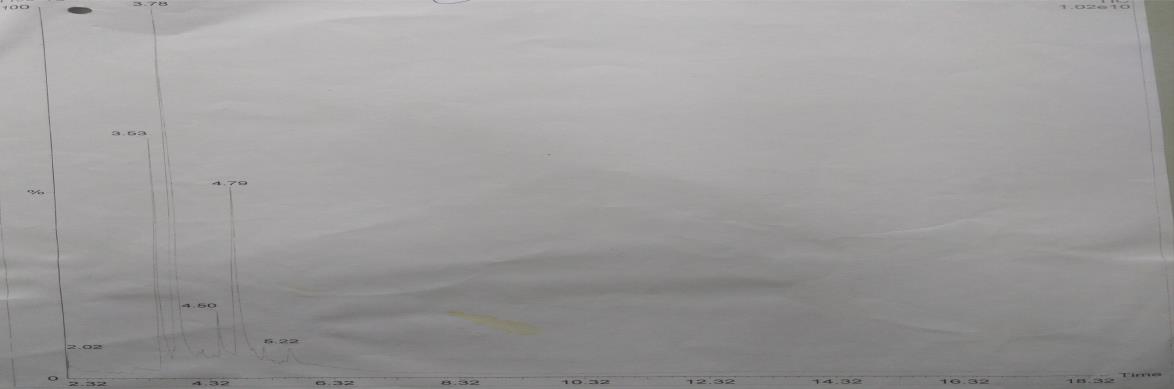
The purpose of current study was to detect and characterize phorate and its metabolites by GC-MS analysis. The GC-MS total ion chromatogram (TIC) of the sample was shown in Figure 1. A total of three metabolites were detected in visceral matrices and characterized by GC-MS. The metabolites were identified as Phorate sulfoxide, Phorate sulfone, and Diethyl Dithiophosphoric acid. The molecular structures of the phorate and its metabolites are shown in Scheme 1. Phorate and its three metabolites were well separated and the compounds were eluted as a single peak in the Dithiophosphoric acid were at 5.64 min, 4.79 min, 4.5 min and 3.789 respectively.
S
S S
P
P
O
O H2C
O
S
m/z 75 m/z 260 m/z 185
Mclafferty
-C2H4 P
O
O
P O
S SH
S
S S O
P
O
-SCH2C2H5 O
m/z 153 -C2H5 S
SH
P
S O
S P
S O S
-C2H4 O
O
Mclafferty
m/z 121 m/z 231 m/z 203
Mclafferty
-C2H4 -S P HO S SH
O
m/z 129 O m/z 79
-H2O P HO SH
-S O P HO
H
m/z 97 O
m/z 65 Scheme 1: GC-EI-MS fragmentation pattern of Phorate.
Characterization of Phorate and its metabolites
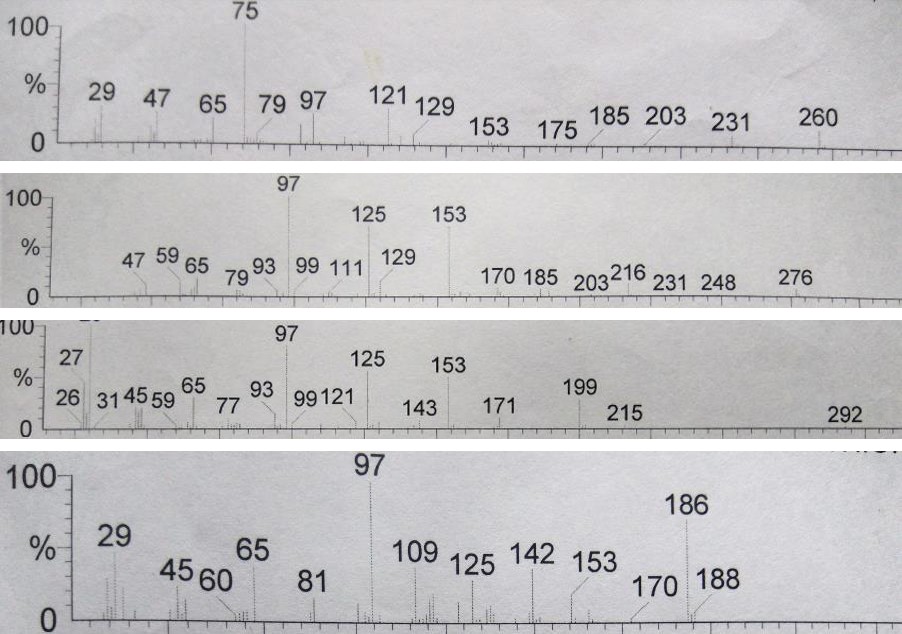
Under EI conditions, Diethyl Dithiophosphoric acid showed abundant molecular ion, but Phorate, Phorate sulfoxide and Phorate sulfone were showed low abundant molecular ions. The EI mass spectra of the phorate and its metabolites showed structure related fragment ions that enable unambiguous identification of these compounds (Figures 2a, 2b, 2c and 2d).
a)
b)
c)
d) Figure 2: GC-EI-MS spectra of a) Phorate b) Phorate sulfoxide c) Phorate sulfone and d) Diethyl dithiophosphoric acid.
GC-EI-MS analysis of Phorate
Phorate showed low abundant molecular ion ([M]+•) ion at m/z 260 under positive ion EI-MS conditions. The EI mass spectrum (Figure 2a) of [M]+• ion shown a major product ion at m/z 75(ethyl thiomethylium ion) which corresponds to the loss of C4H10O2PS2 and this ion confirms the presence of an ethyl thiomethylene in Phorate. The spectrum also showed an ion at m/z 153 corresponds to the loss of ethyl thiomethylene group. In addition to this, Phorate showed characteristic Mclafferty fragmentation (γ hydrogen transfer to hetero atom followed α, β bond homolytic cleavage) at m/z 157 which corresponds to the loss of ethylene (C2H4) group conform the presence of the ethyl group in the molecule [11].
Further loss of ethylene group from the ion at m/z 157 (i.e. Double Mclafferty fragmentation) was observed and showed the ion at m/z 129 which conform the presence of the second ethyl group in the molecule. In addition to these, the spectrum also showed minor fragment ions with m/z 231 (loss of •C2H5 from m/ z 260), 203 (Mclafferty fragmentation i.e. loss of C2H4 from m/z 231), m/z 97 (loss of S from m/z 129), m/z 79 (loss of H20 from m/z 97), m/z 65 (loss of S• from m/z 97 or loss of S2 molecule from m/z 129) were also formed and these ions confirms the presence of ethyl group and sulphur in the molecule. All these proposed fragmentation pathways were depicted in scheme 2.
Scheme 2: GC-EI-MS fragmentation pattern of Phorate sulfoxide.
Phorate sulfoxide could be formed by the oxidation of phorate. Phorate sulfoxide showed low abundant [M]+
- ion at m/z 276 under positive ion EI-MS conditions. There is a clear cut mass shift by +16 m/z units compared to the parent phorate (m/z 260) compound that confirms formation of oxide from parent phorate. The EI mass spectrum (Figure 2b) of [M]+
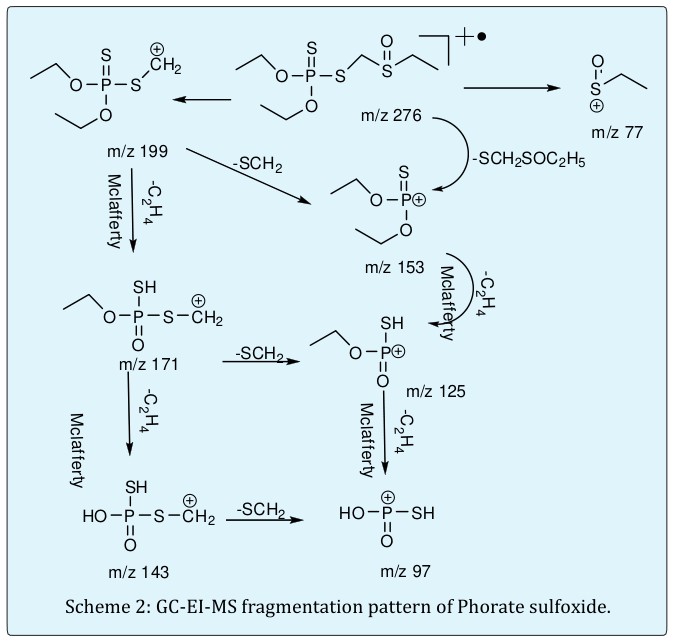
- ion shown a major product ion at m/z 153(diethoxy(thioxo)phosphonium ion) which corresponds to the loss of SCH2SOC2H5 group. The spectrum also showed an ion at m/z 77 and this ion confirms the presence of an ethyl sulphur monoxide group in Phorate sulfoxide. The spectrum also showed an ion at m/z 199 corresponds to the loss of ethyl sulphur monoxide group. Further loss of ethylene (C2H4) group from the ion at m/z 199, i.e. the characteristic Mclafferty fragmentation was observed at m/z 171, which confirm the presence of the ethyl group in the molecule. Further loss of ethylene group from the ion at m/z 171 (i.e. Double Mclafferty fragmentation) was observed and showed the ion at m/z 143 which conform the presence of the second ethyl group in the molecule. The spectrum showed an ion at m/z 97 as a base peak, which may be formed by the loss of ethanethial (SCH2) group from the ion m/z 143. In addition to these, the spectrum also showed other fragment ion at m/z 125 (loss of C2H4 from m/ z 153), which was formed due to the Mclafferty fragmentation. All these proposed fragmentation pathways were depicted in scheme 2.
GC-EI-MS Analysis of Phorate Sulfone
Phorate sulfone could be formed by the oxidation of phorate. Phorate sulfone showed low abundant [M]+
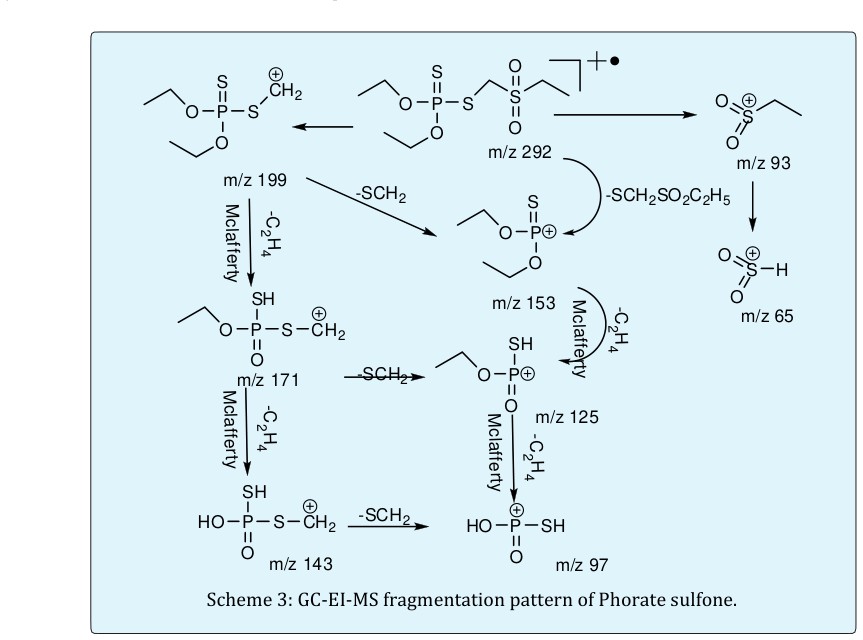
- ion at m/z 292 under positive ion EI-MS conditions. The mass difference between phorate and phorate sulfone is +32 m/z units, which evident the oxidation of phorate to phorate sulfone. The EI fragmentation pattern of phorate sulfone was similar to phorate sulfoxide. The EI mass spectrum (Figure 2c) of [M]+
- ion shown an ion at m/z 199 which corresponds to the loss of ethyl sulfonyl group. The same ion was formed due to the loss of ethyl sulphur monoxide group in the case of phorate sulfoxide. This evident the presence of sulfone group in the molecule. to the loss of SCH2SOC2H5 group. The spectrum also showed an ion at m/z 93, which also confirms the presence of an ethyl sulfone group in the molecule. Loss of ethylene (C2H4) group from the ion m/z 199, i.e. the characteristic Mclafferty fragmentation was observed at m/z 171, which confirm the presence of the ethyl group in the molecule. Further loss of ethylene group from the ion m/z 171 (i.e. Double Mclafferty fragmentation) was observed and showed the ion at m/z 143 which conform the presence of the second ethyl group in the molecule. The spectrum showed an ion at m/z 97 as a base peak, which may be formed by the loss of ethanethial (SCH2) group from the ion m/z 143. In addition to these, the spectrum also showed other fragment ion at m/z 125 (loss of C2H4 from m/ z 153 or loss of ethanethial (SCH2) group from the ion m/z 171), which was formed due to the Mclafferty fragmentation. All these diagnostic fragment ions confirm the structure of Phorate sulfone molecule. The proposed EI-MS fragmentation pathways of Phorate sulfone were depicted in scheme 3.
Scheme 3: GC-EI-MS fragmentation pattern of Phorate sulfone.
Diethyl dithiophosphoric acid showed an abundant [M]+
- ion at m/z 186 under positive ion EI-MS conditions. Phorate can undergo hydrolysis in various matrices and forms Diethyl dithiophosphoric acid as a metabolite. The EI mass spectrum (Figure 2d) of [M]+
- ion shown a major product ion at m/z 153, which corresponds to the loss of SH radical and this ion confirms the presence of -SH group in the molecule. The spectrum also showed characteristic Mclafferty fragmentation from the ion at m/z 125, which corresponds to the loss of ethylene (C2H4) group from the ion m/z 153, confirm the presence of the ethyl group in the molecule. Further loss of ethylene group from the ion m/z 125 (i.e. Double Mclafferty fragmentation) was observed and showed the ion at m/z 97 as a base peak which confirm the presence of the second ethyl group in the molecule. The spectrum also showed an ion at m/z 142 corresponds to the loss of C2H4O from the molecular; prove the presence of an O-ethyl group in the molecule. Further loss of SH radical was also observed at m/z 109 from the ion m/z 142. In addition to these, the spectrum also showed other fragment ions with m/z 158 (Mclafferty fragmentation i.e. loss of C2H4 from m/z 186), m/z 125 (loss of -SH radical from m/z 158), m/z 81 (loss of C2H4O from m/z 125), m/z 81 (Mclafferty fragmentation i.e. loss of C2H4 from m/z 109) and m/z 65 (loss of C2H4O from m/z 109) were also formed and these ions confirms the presence of ethyl, -SH, O-ethyl groups in the molecule. All these diagnostic fragment ions confirm the structure of Diethyl dithiophosphoric acid molecule. The EI-MS fragmentation pathways of Diethyl dithiophosphoric acid were depicted in scheme 4.
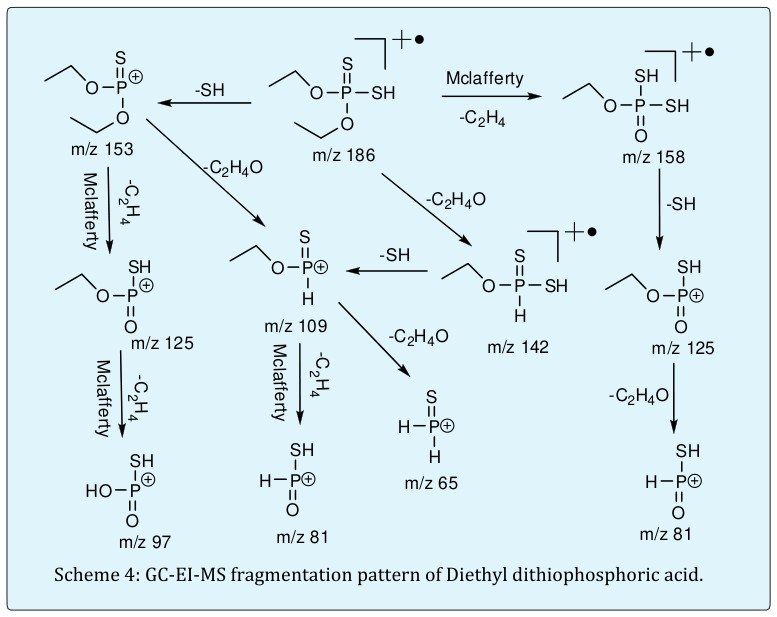
Scheme 4: GC-EI-MS fragmentation pattern of Diethyl dithiophosphoric acid.
In India most of the poisoning cases were occurred due to the ingestion of organophosphorous insecticides either accidentally or deliberately. Correct identification of an individual insecticide will be an invaluable support both during investigation and in conviction of criminal cases in courts of law. Qualitative analysis of the insecticides existing in the visceral samples restricts the usage of classical analytical methods for their identification. GC-MS technique has been used in present study to deal with very low quantity of the samples which may be present even in complex matrices. Most of the pesticides were prone to undergo metabolic process in different matrices. Hence, the screening, identification and characterization of the metabolites are an important task in the area of forensic toxicology. Here we detected phorate and its metabolites in viscera matrices by GC-MS, in an organophosphorous suspected poisoning case. Further we identified the metabolites as Phorate sulfoxide, Phorate sulfone and Diethyl Dithiophosphoric acid. Here we also studied the EI-MS fragmentation pattern of phorate and its metabolites of study in details and fragmentation pathways were proposed. The EI mass spectra of phorate and its metabolites showed the abundant molecular ion [M+•] in addition to the other structure related product ions that enable unambiguous identification of these compounds. The present study plays a vital role in the detection and identification of phorate and metabolites and it will be an invaluable support during investigation and in conviction of criminal cases in courts of law in phorate poisoning cases.
Acknowledgements
The authors thank, Director, CFSL, Hyderabad for facilities and encouragement and allowing for publication.
References
-
Hong F, Pehkonen S, Brooks E (2000) Pathways for the Hydrolysis of Phorate: Product Studies by 31P NMR and GC-MS. J Agri Food Chem 48(7): 3013-3017.
-
Rani R, Lal R, Kanade GS, Juwarkar A (2009) Isolation and characterization of a phorate degrading bacterium. Letters in Applied microbiology 49(1): 112-116.
-
Roberts TR, Huston DH (1999) Metabolic pathways of agrochemicals. Part 2: Insecticides and Fungicides. JSC International Ltd pp: 1475.
-
Hodgson E (2012) Pesticide Biotransformation and disposition. pp: 195-208.
-
Wang CY, Yuan Y, Wang Q, Li MX, et al. (2017) Detection of 11 Organophosphate Pesticides and Atrazine in Water by Dispersive Liquid-Liquid Microextraction Combined with Gas Chromatography Mass Spectrometry. Sichuan Da Xue Xue Bao Yi Xue Ban 48(5): 763-778.
-
Feo ML, Eljarrat E, Barcelo D (2011) Performance of gas chromatography/tandem mass spectrometry in the analysis of pyrethroid insecticides in environmental and food samples. Rapid communication in Mass spectrometry 25(7): 869- 876.
-
Lee J, Kim L, Shin Y, Lee J, Lee J, et al. (2017) Rapid and Simultaneous Analysis of 360 Pesticides in Brown Rice, Spinach, Orange, and Potato Using Microbore GC-MS/MS. Journal of Agricultural and Food Chemistry 65(16): 3387-3395.
-
Wu Z, Peng X, Chen S, Zeng Z (2018) Determination of 19 Organochlorine Pesticides Residues in Milk Powder by GPC-GC-MS. International Journal of Nutrition and Food Sciences 7(4): 129-133.
-
Ravikumar Ch, Srinivas P, Seshaiah K (2013) Determination of pyrethroid pesticide residues in rice by gas chromatography tandem mass spectrometry. Journal of Chemical and Pharmaceutical Research 5(4): 175-180.
-
Nasiri A, Amirahmadi M, Mousavi Z, Shoeibi S, Khajeamiri A (2016) Multi Residue GC-MS Method for Determination of 12 Pesticides in Cucumber. Iranian Journal of Pharmaceutcal Research 15(4): 809-816.
-
Nibbering NM (2004) The McLafferty rearrangements: A personal recollection. Journal of American Society for Mass Spectrometry 15(7): 956- 958.
- Narcotics and Digital Forensics: Bridging Crimes in the Digital Age
- Ethics in Forensic Psychiatry: Principles, Dilemmas, and Human Rights
- Impact of Acute Stress on Attentional Orienting to Social Cues
- Head Injury and Intracranial Hemorrhage in Western Region of Libya
- A Forensic Study on Handedness: Examination of Handwriting Features in Right and Left Handed Writers
- Techniques for Latent Fingerprint Development Using Natural and Synthetic Powders: A Review