
Biomechanics and Methodology for the Analysis of Injuries Related to Forensic Technical Correlations
The paper describes the definition of biomechanics and methodologies to identify injuries, injury sources and injury causation. Different questions raised from the police, persecution, or judge needs special demands for analyzing traffic accident circumstances. Experts are educated for accident reconstruction, i.e. speed calculation and accident causation, but experts for injury assessment are very rare and most of the requests are answered by isolated involved experts. This concept can be optimized by interdisciplinary consultant groups, as exist in Germany. Biomechanics is the field explaining what kind and level of load is required for the injury pattern. Kind, location and injury severity is a key information for the understanding of injury severity and injury pattern and the movement trajectories called as kinematics. Based on the detailed information of injuries and existing pains related to the accident severity parameter, the probability of accident relation can be assessed by the experts.
Introduction
Biomechanics
Biomechanics is the field between technical and medical knowledge about injury occurrence and injury mechanisms, explaining what kind and level of load is required for the injury pattern regarding accident injuries. On one hand the circumstances of the accident and the behavior of the vehicle before, during and after impact, as well as the deformation characteristics are important to know for finding explanations for causation. On the other Investigation Paper hand the kind, location and injury severity is a key information for the understanding of injury severity and injury pattern and the movement trajectories as called as kinematics. A combined interdisciplinary work between different experts of involved research fields is important for an optimized process in analyzing the case.
Which Questions and Issues are Important in the Forensic Field
Different questions raised from the police, persecution, or judge needs special demands for analyzing accident circumstances and speeds of vehicles during impacts with other vehicles, pedestrians or bicyclists. Very often there are questions regarding: - sitting position in the accident vehicle, for example who was the driver - if no seatbelt was worn, what injuries could have been reduced or avoided entirely if a seatbelt had been used - if a motorcyclist or bicyclist was not wearing a crash helmet, or protective clothing was not used, what injuries could have been reduced or avoided entirely if these safety options had been used - were the injuries and symptoms attributable to the accident event (e.g. whiplash, individual injuries sustained in the accident and long-term effects) The term whiplash injuries refers to pain symptoms which typically occur after dynamic strain on the neck muscles. The term HWS-distorsion (cervical spine distortion) is used exclusively in German-speaking areas as the diagnosis for a set of symptoms and denotes specific characteristic findings and pain. This term does not exist in English or American terminology, there the term whiplash-associated disorders is used, where “disorder” can be translated into German as Gesundheitsstörung. There is general agreement that without evidence of objective signs of injury, which include lacerations, dislocations and fractures, the term distortion should be used, which here is almost exclusively “minor injuries” [1, 2, 3]. In the case of distortions, depending on the nature and scope of the clinical findings, minor, moderate or severe distortions can be assumed. The German term Schleudertrauma on the other hand is rejected as inaccurate and even in medical nomenclature in line with medical associations it is not recommended since it misleadingly does not describe a diagnosis but rather a mechanism, knowledge of which the doctor should not assume when establishing findings.
The mechanism of injury has already been the subject of comprehensive scientific research. It consists of a combination of powerful translational motion of the cervical vertebrae with hyperextension (backward overextension) and hyperflexion (forward overextension) of the cervical spine, resulting in axial compressive and tensile forces which can lead to specific injuries [4, 5]. In the case of less serious accidents and rotational movement of the vehicle there is often only muscular dysfunction, resulting in pain and restricted movement of the head and neck. Oblique relative movements of the vehicle occupants resulting in frontolateral bending of the neck can also be the cause of pain in the cervical spine [6]. Experiments on the biomechanics of the cervical spine have shown that what is known as S-form bending occurs between the vertebrae which can result in compression of the facet joints [7]. Relevant facet compression generally occurs only from accelerations above 3.5g and damage to joint capsules only from accelerations of above 6.5g. The effective acceleration in the case of emergency braking is approx. 1g. Significant hyperextension has only been identified in accelerations of over 5g. From this it can be concluded that the facet joints can play an important role in the development of pain, but only in the case of more serious accidents. It is thus adequately shown that dynamic bending movements of the cervical spine can cause pain in the neighboring neck and shoulder muscles and that horizontal relative movements between the vertebrae can also cause muscle traction which produces dynamic activation of the muscle strains in the neck and can thereby result in slight or even severe straining of the muscles and nerves on the stretched side in the case of a rear-end collision with backward bending of the ventral sections and forward movement of the ventral sections as a systemic compensation reaction [8, 9, 10, 11, 12]. Tensile force within the articular processes of the vertebrae also cause muscle reactions. Braking events on the other hand are decelerations with a lasting and relatively constant deceleration force of less than 1g (acceleration of gravity) and in a separate study show no relevance for any resulting cervical spine symptoms. The severity of cervical spine distortion is expressed in medical terms according to various classifications (Table 1):
| t | Severity | n | |||||||||||||||
|---|---|---|---|---|---|---|---|---|---|---|---|---|---|---|---|---|---|
| G | rad | e | Grade | Grade | Grade | G | rad | e | |||||||||
| According | |||||||||||||||||
| 0 | 1 | 2 | 3 | 4 | |||||||||||||
| o Erdman | |||||||||||||||||
| Clinical presentation | No cervical spine symptoms, no objective dysfunction | Cervical spine symptoms in the form of pain, stiffness or tenderness, no objective dysfunction | as under I plus musculoskeletal signs (restricted movement, tenderness to touch) | as under I plus neurological signs (weakened or absent muscle reflexes, paresis, loss of feeling) | as under I plus cervical spine fracture or dislocation |
Table 1: Severity of cervical spine distortion according to Erdmann, approximate values: Erdmann 0 = QTF 0, Erdmann I = QTF I/II,
In order to establish forensic evidence that injuries sustained are the result of an accident it is first necessary to reconstruct the accident scenario and establish the relative movements of the vehicle occupants in order to recognize the forces exerted during the accident. For this it is necessary to carry out a multibody simulation to establish the forces on the cervical spine with their force parameters in directions x, y and z and the neck torques. This requires the correlation of the symptoms reported and their medical and biomechanical evaluation.
The opinion now is that, although changes in speed (delta-v) caused by collisions are a significant indicator for the likelihood of cervical spine distortion, this parameter is not important in isolation; instead the condition is influenced by the sequential progression of the impact force and above all by the actual physiological conditions of the vehicle occupants and the movement range of their cervical spines and any degenerative changes, the specific vehicle conditions, such as seat design, the position of head rests, and also the specific psychological parameters of the persons involved.
In terms of biomechanics and collision kinematics, the various likelihoods of occurrence can then be shown on the basis of existing scientific results which are applied to each individual case and which must above all take account of a medical evaluation of the symptoms and circumstances. Thus, scientific studies on the likelihood of occurrence of cervical spine distortion (Figure 1) show an approx. 10% likelihood of cervical spine distortion in the case of both frontal collisions and side-on impacts, but a 35% likelihood in the case of rear-end collisions [14]. Both these percentages increase further with increasing collision-related changes of velocity (delta-v), thus necessitating individual evaluation based on each specific case.
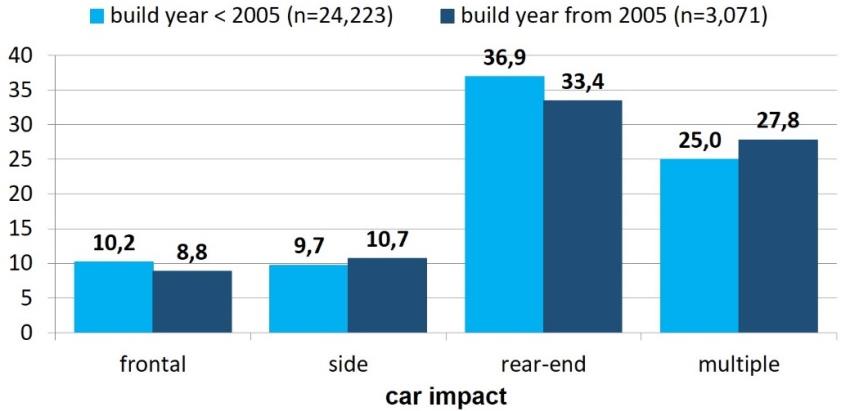
injuries are the highest for rear-end collisions, followed by side collisions and frontal collisions. Additionally it can be seen that the percentages of whiplash injuries are rising with increasing accident severity delta-v for all collision types.
![Figure 2: Percentages for likelihood of whiplash injuries for car occupants as result of vehicle collisions dependent on accident severity delta-v (construction year of the cars > 2005) [15].](/fulltextimages/3218/fig_2.jpeg)
Basics and Importance of Biomechanics for typical Forensic Questions
The evaluation of established injuries is done in conjunction with the kinetics of the vehicle and the resulting relative movements of the vehicle occupants or riders. Biomechanics consists of the technical-mechanical explanation of injury causation. For this it is necessary to know the nature and details of the injury and then to allocate a mechanical force. In addition the extent of the required force must be determined.
Thus in a collision of two vehicles an acceleration or deceleration results in a relative movement of the person forwards, sideways or backwards. So for an analysis it is first necessary to analyze the collision configuration as accurately as possible in order to track the vehicle movements that occurred as a result. Based on this, the relative movements inside the vehicle, or in the case of two-wheeler accidents the trajectories of the follow- through movement of bike and person, are determined. These are shown by the possible points of impact in the vehicle or outside at the collision site. For instance, in the case of a collision involving a vehicle occupant not wearing a seatbelt, the relative motion forwards will result in the thorax impacting the dashboard and steering wheel and the head impacting the windscreen. With a seatbelt in place the body’s forward deflective motion is reduced and the head moves downwards within the confines of the remaining level of freedom. The only effect can be a minor bumping of the knees on the steering wheel or the dashboard. So the different kinematics between use and non-use of a seatbelt, or in the case of motorcyclists between wearing or not wearing a crash helmet, enable an evaluation of the injuries sustained with regard to whether or not a seatbelt or crash helmet was used. Also, the injuries of two persons can be used and allocated using this type of complex accident analysis to establish beyond doubt the sitting positions in a badly deformed vehicle. In the case of collision between a pedestrian or bicycle and a car or lorry the pattern of injuries on the body in conjunction with the vehicle damage and the final positions of the person and two- wheeler enable an evaluation to be made as regards direction of travel and collision speed.
Biomechanics thus involves the evaluation of an injury or pattern of injuries sustained. It therefore requires specialist assessment with a wealth of comprehensive experience on the part of an expert who has a knowledge of accident analysis from scientific accident research, but also an understanding of anatomical and accident mechanisms. Often in order to address these questions, an expert report is requested which erroneously covers just one specialist field, these include vehicle reports and specialist medical reports; however, the advantage of an interdisciplinary technical medical report on the causal relationships lies in the joint assessment of experts from different specialist disciplines. This is the only way to assess the nature and extent of injuries consistently across accidents and also to properly recognize the reported effects, such as duration of symptoms and the inability to work as a result of the accident. As a rule the expert witnesses involved and their tasks are as follows (Table 2):
| Assessment tasks | |
| Technical expert generally expert for accident reconstruction and biomechanics | Accident scenario and vehicle kinematics and accident forces EES, delta-V, Vrel Assessment of impact circumstances of the body Assessment of protective factors, incl. safety belt, crash helmet, protective clothing |
| Medical expert generally specialist in trauma surgery / orthopedics | Analysis of the symptoms medically established and reported Interpretation of the injuries as regards nature, localization and extent or severity, recognizable mechanism of injury |
| Specialist in ENT | In the case of tinnitus, ear sounds, etc. |
| Specialist in neurology | In the case of nerve dysfunction, neurological symptoms |
| Specialist in psychosomatics / psychology | In the case of post-traumatic stress disorder, anxiety, etc. |
Table 2: Tasks of the experts to be consulted for interdisciplinary biomechanics report.
Within the work process the comprehensive knowledge is to be handled as follows:
Understanding and limitations of biomechanics (definition, methodologies)
Importance and interpretation of accident traces on scene Systematical explanation of methodologies of technical reconstruction regarding impact speed determination, vehicle and human body movements Introduction of usable software for reconstruction and simulation Interpretation and classification of injuries, right way of using AIS for injury scoring, possibilities of statistical use for injury risk probabilities Explanation of Research on accident traces on scene, as well on the vehicle and importance of injuries for the analysis of injury mechanisms and load limits on injury occurrence. Special issues on injury severity grades and influence factors.
Human Autopsy Biomechanics test methodology Special issues on assessment of driver and passenger positions, seatbelt use and Airbag related injuries. Injury analysis of vulnerable road users for getting impact trajectories, speed relation and kinematics.
Importance of details on injury analysis, observation and documentation will be described with special focus differentiated on fatal subjects, trauma intensive care patients and standards hospitalized persons.
Accident injury mechanism
Basic Biomechanics can be used for answering questions on injury occurrence in all kind of accidents, road traffic as well as household or sport activities and also from door closing in trains or coaches.
Accident injury risks and criteria (not limited to the risk and criteria themselves, but how the risks and criteria initiated the process of criteria accepted by industry) In-depth accident investigation methodology for getting optimized results Experienced in data collection on scene to explain injuries and injury severities in relation to different accident severity parameter i.e. delta-v, EES, deformation depth measurements.
Overview of Technical Tools which are needed for an Optimized Outcome Regarding Biomechanics for typical Forensic Questions
It is acknowledged that a comprehensive accident analytical description of the motion pattern of a vehicle requires accurate reproduction of all traces at the accident site as well as the road conditions. Therefore a scale drawing is a basic requirement. Various procedures can be used for this, with different levels of accuracy (Table 3).
| Preparation of Scale Drawings using | Quality and Limitations | ||||
|---|---|---|---|---|---|
| Measurements by hand | Simple and requires few materials Measuring wheel and tape measure needed Inaccuracies in recording and transfer to graphic plane | ||||
| Orthogonal aerial photographs | Reproduction of image content not sufficiently accurate. Shadows on photos restrict ability for evaluation | ||||
| Evaluation of photographs using distortion correction | Reference points must be placed on the road, requires evaluation of many follow-up photos, inaccurate overall particularly in the case of horizontal unevenness | ||||
| Stereo photography | Very exact, but very laborious involving reference points and follow-up photos Retrospective evaluation of all details in 3D mode | ||||
| 3D laser measurements | Simple to handle on site and also using existing software in the evaluation, high accuracy (< 5 mm) Retrospective evaluation of all details in 3D mode |
Table 3: Overview of possible measuring procedures at the accident site to record the accident traces.
In addition cameras and measuring devices are needed to record deformations and contact points inside the vehicles. Observations as to damaged clothing and externally visible injuries such as lacerations, bruises or abnormalities on the body should also be recorded. These give indications of actual points of contact and impact.
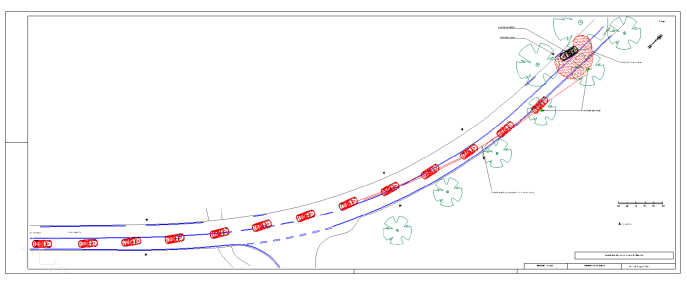
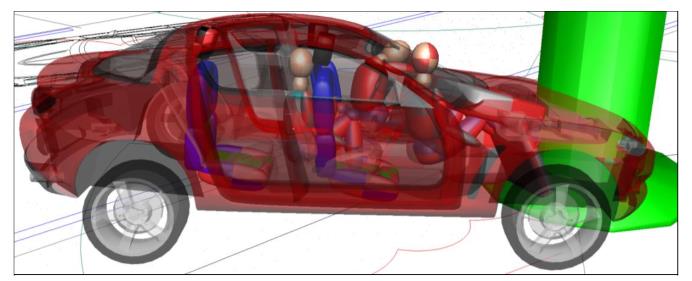
After recording and analysis of the accident situation, accident reconstruction should be used to reconstruct the course of vehicle movements on the basis of the accident drawing prepared. For this the final positions in which the vehicles are found and traces on and beside the carriageway are used. The accident forces in play can be calculated in terms of impact mechanics using computer- supported collision analysis. Vehicle movement and force values can be verified using PC-Crash Reconstruction Software (License: Steffan DSD Graz Austria) (Figure 3).
Assessment of Injury Causation based on Scientific Research
Literature sources can be used for interpretation of case related injuries. The task and study frames of the used literature must be known for the interpretation of given quality of the used data. To explain possibilities of right use an example will be given here:
In the course of the accident the right-hand side of the claimant’s body suffered a significant impact with the body of the vehicle near the B-pillar with resulting acceleration of the lower right arm obliquely and as a support. The claimant’s right foot became trapped between the motorcycle and the body of the vehicle with resulting high acceleration of the foot. His lower right leg was also trapped between the motorcycle and body of the vehicle with resulting high acceleration of the lower leg forwards and to the side.
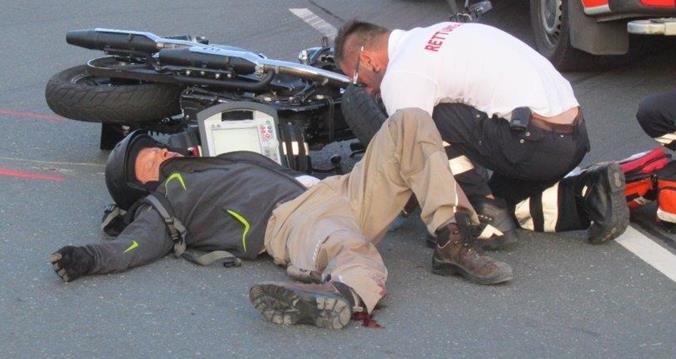
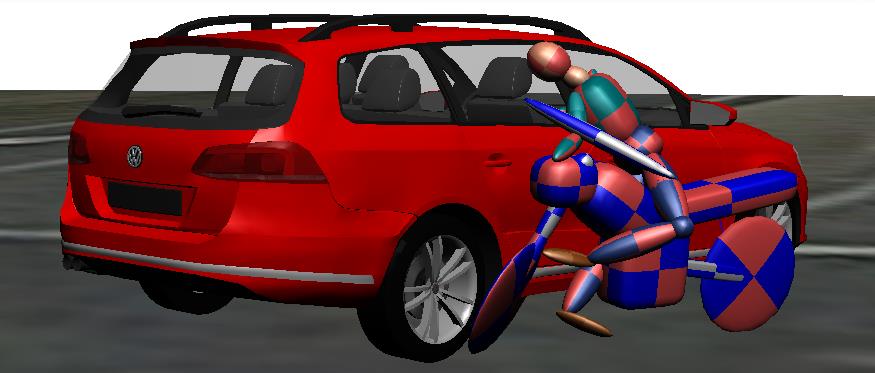
Figure 4 shows the motorcyclist (with standard clothes and half shell helmet) in his final position after the accident, the damaged opposing vehicle as well as the collision situation with right foot trapped between the motorcycle and the body of the vehicle.
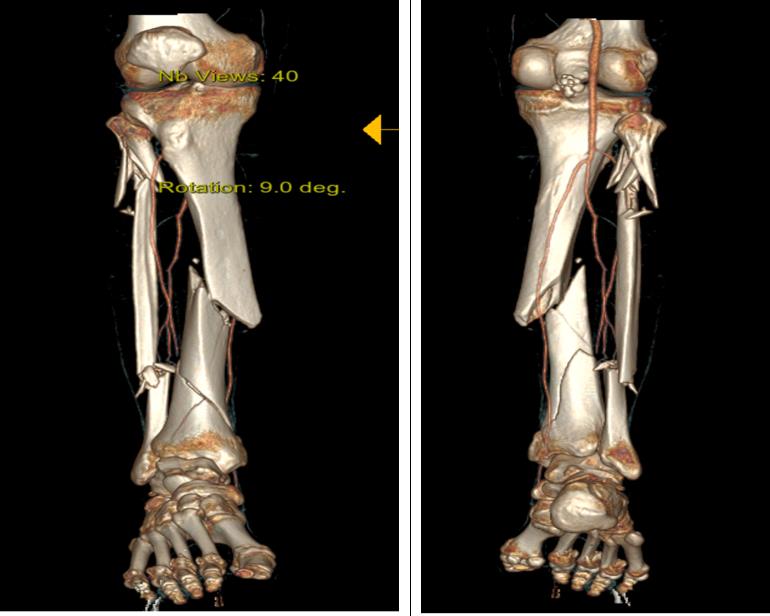
Safety clothing for motorcyclists in the form of suits, jackets and trousers are equipped with protectors. These protect the shoulders, lower arms, hips, knees and lower legs, they are tested and certified in line with CEN 1621-1 and EN 1621-1 and must conform to CEN EN 13634. So here experts must undertake a critical analysis of the forces and injuries of the specific accident event to analyse the possibilities for protective clothing. With regard to the complex lower leg fracture in Figure 5, the results are as follows:
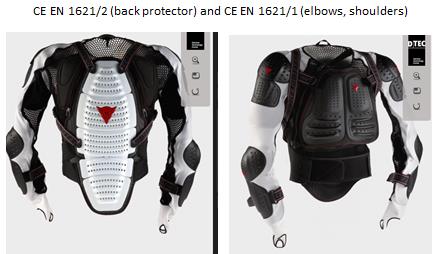
Protectors offer impact protection by force reduction through insertion of a plate (force distribution) and by impact dampening due to the flexible elastic material structure (Figure 6). An overview about existing motorcycle clothes concerning CEN certificates can be found in https://www.vergleich.org/motorrad- lederkombi/ tested in 2018. Even the weight of a whole garment with protectors is much more than without, but the protective effect is not to underweighted by the user.
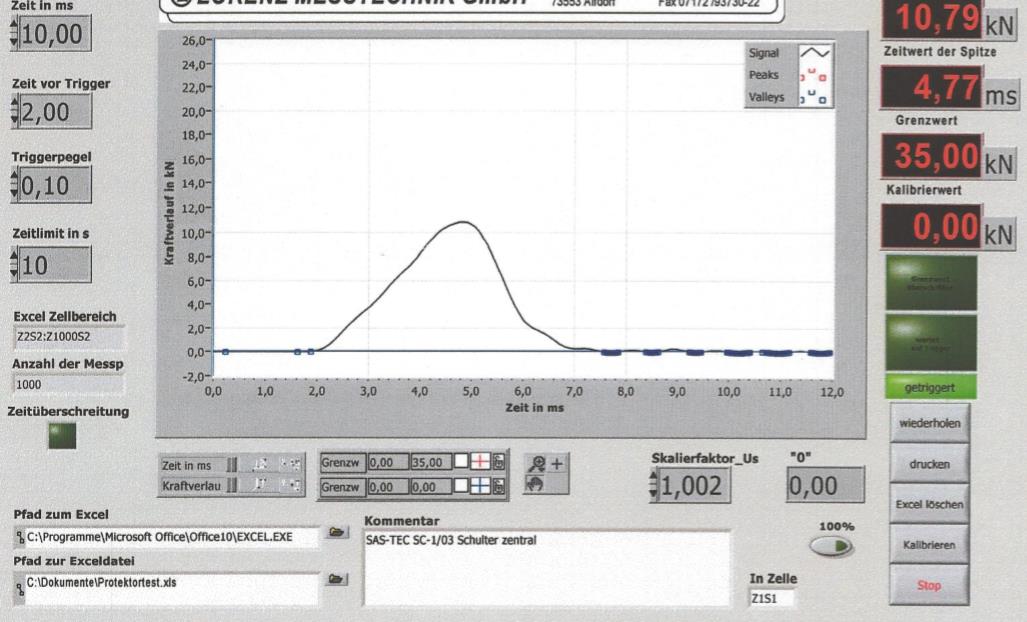
According to current designs such a protector can reduce an impact force of 50 KN to around 10 KN (corresponds to 80%). However what is important here is that, depending on construction, it can also dampen a relatively brief peak force by dissipation, as can be seen by the rounded force/time progression in Figure 7.
In an independent study the protective effect of what are known as protectors was able to be studied in greater detail [16]. Here it was shown that there is a protective effect above all in terms of the type of fracture sustained, which can be reduced with protectors from complex third level fractures to simpler transverse or oblique fractures according to statements in the presentation. Real collisions also revealed the protective effect of protective clothing. Thus it can be stated in the above case that there is a protective effect in terms of the open multiple fracture, such that with a high level of probability this complex type of fracture would have been avoided and instead of this a simpler fracture with considerably less long-term effects would have been sustained.
The example clearly shows the possibilities offered by a detailed accident analysis, given awareness of the scientific likelihood of injury and interdisciplinary technical-biomechanical and medical collaboration in forensic procedures.
Conclusion
Biomechanics is an interdisciplinary science which describes, examines and evaluates the muscoloskeletal systems of biological systems and the movements they produce using the terms, methods and principles of mechanics, anatomy and physiology. Applied to the issues which arise in forensic police procedures and expert reporting activities, this interdisciplinary processing can help to achieve a high quality in the presentation of results and causal conclusions. Evidence that an injury was caused by an accident always requires investigation of the accident scenario with collision situation and accident severity as well as the relative movements of the persons inside or outside the vehicles. In addition the impact situations must be assessed in conjunction with the injuries suffered. This inevitably requires specialist medical evaluation of the injuries and symptoms sustained or reported.
References
-
Kamieth H (1990) Das Schleudertrauma der HWS. Die Wirbelsäule in Forschung Praxis, Stuttgart, Hippokrates-Verlag.
-
Jenzer G, Walz F Die Schwere des Schleudertraumas der Halswirbelsäule. Z Unfallchir Vers med 84(1): 7- 19.
-
Dvorak J, Ettlin T (1994) Standortbestimmung zum Zustand nach Beschleunigungsmechanismus an der Halswirbelsäule. Z Unfallchir Vers med 87(2): 86-901.
-
Ivancic PC, Panjabi MM, Ito S (2006) Cervical spine loads and intervertebral motions during whiplash. Traffic Inj Prev 7(4): 389-399.
-
Kathrein A, Pathomorphologie der HWS (1998) Distorsion. 62. Jahrestagung der Deutschen Unfallchirurgischen Gesellschaft für Unfallchirurgie pp: 88-92.
-
Richter M, Ferrari R, Otte D, Kuensebeck HW, Blauth M, et al. (2004) Correlation of clinical findings, collision parameters, and psychological factors in the outcome of whiplash associated disorders J Neurol Neurosurg Psychiatry 75(5): 758-764.
-
Ono K, Kaneoka K, Inami S (1998) Influence of Seat Properties on Human Cervical Vertebral Motion and Head/Neck/Torso Kinematics During Rear-end Impacts. Proc IRCOBI pp: 303-318.
-
Chen C, Lu Y, Kallakuri S, Patwardhan A, Cavanaugh JM (2006) Distribution of A-delta and C-fiber receptors in the cervical facet joint capsule and their response to stretch. J Bone Joint Surg Am 88(8): 1807-1816.
-
Ito S, Ivancic PC, Panjabi MM, Cunningham BW (2004) Soft tissue injury threshold during simulated whiplash: a biomechanical investigation. Spine 29(9): 979-987.
-
Pearson AM, Ivancic PC, Ito S, Panjabi MM (2004) Facet joint kinematics and injury mechanisms during simulated whiplash. Spine 29(4): 390-397.
-
Carlson EJ, Tominaga Y, Ivancic PC, Panjabi MM (2007) Dynamic vertebral artery elongation during frontal and side impacts. Spine J 7(2): 222-228.
-
Panjabi MM, Maak TG, Ivancic PC, Ito S (2006) Dynamic intervertebral foramen narrowing during simulated rear impact. Spine 31(5): E128-E134.
-
Keidel M (1998) Schleudertrauma der Halswirbelsäule. _In_: Brandt T, Dichgans J, Diener HC (Eds.), Therapie und Verlauf neurologischer Erkrankungen, 3. Aufl. Stuttgart: Kohlhammer pp: 69- 84.
-
Otte D, Facius T, Johannsen H, Hüfner T (2018) Estimation of Injury Risk of the Cervical Spine of Car Occupants after Emergency Braking. SAE Technical Paper, WCX World Congress Experience.
-
Otte D (2012) HWS-Distorsionen nach Verkehrsunfällen und deren Beschwerdesymptomatik aus Sicht wissenschaftlicher Unfallerhebung, Praxiskonferenz Heckaufprall-Sitze-Whiplash, Landsberg am Lech.
-
Otte D, Schröder G, Richter M (2002) Possibilities for load reduction using garment leg protectors for motorcyclists-a technical, medical and biomechanical approach. Annu Proc Assoc Adv Automot Med 46: 367-385.
- Narcotics and Digital Forensics: Bridging Crimes in the Digital Age
- Ethics in Forensic Psychiatry: Principles, Dilemmas, and Human Rights
- Impact of Acute Stress on Attentional Orienting to Social Cues
- Head Injury and Intracranial Hemorrhage in Western Region of Libya
- A Forensic Study on Handedness: Examination of Handwriting Features in Right and Left Handed Writers
- Techniques for Latent Fingerprint Development Using Natural and Synthetic Powders: A Review