
Critical Analysis of Errors in Medical Certification of Cause of Death [MCCD] in a Teaching Hospital
Medical certificate of cause of death is a document to be filled in case of death, by a medical practitioner after examining the body and confirming that the person is dead. It is the responsibility of the treating physician to issue MCCD in the correct manner and as per the prevailing rules and regulations. The primary aim of the project is to be aware of the extent of errors occurring while filling up Medical Certificates of Cause of Death [MCCD]. A Retrospective, cross sectional study was undertaken at a rural teaching hospital in Karnataka, using 104 causes of death certificates issued between January 2016 and December 2016. At the time of death, the concerned departments will issue two copies of the cause of death certificates out of which one is sent to the registrar of births and deaths and the other copy will be sent to the Medical Records Department. The detailed analysis of the MCCD’s and autopsy reports of all the deaths which occurred in our hospital in the year 2016 yielded the following results. Out of a total of 104 certificates analysed, only 19(18%) of the 104 certificates were found to be completely filled and correct. A high incidence of errors was found in the study conducted which is an alarming but expected outcome. The incidence of errors needs to be minimized in order for the certificates to serve its purpose of being an important tool to obtain scientific and reliable information in terms of causes of mortality. The confusion regarding the terms ‘Cause of death’, ‘Manner of death’ and ‘Mode of death’ has been the major area of errors.
Introduction
Medical certificate of cause of death is a document to be filled in case of death, by a medical practitioner after examining the body and confirming that the person is dead. It is the responsibility of the treating physician to issue MCCD in the correct manner and as per the prevailing rules and regulations [1].
The medical certificate of cause of death [MCCD] (Form 4 for Institutional deaths and 4A for Non-Institutional deaths) is as per the ICD-10 format [2]. Mortality statistics obtained play a vital role in launching health programmes, planning control measures for epidemic control and provide a database for scientific research. MCCD gives an insight into epidemiology and is a tool to assess the impact of health services and health indicators like Life span Infant Mortality Rate [IMR], Maternal Mortality Rate [MMR] etc.
The MCCD may be useful to know how many persons had peritonitis at the time of death, but it is far more important to ascertain the frequency and nature of clinical conditions producing the peritonitis, viz., “appendicitis”, etc. It is the doctor’s opinion regarding this underlying condition that the questions relating to cause of death are designed to secure [3]. Incomplete or inaccurate entry in these certificates poses difficulty in obtaining reliable information pertaining to causes of mortality. The errors occurring in the MCCD maybe intentional or unintentional. Inaccuracy may occur with intentions of monetary benefits with respect to life insurances, inheritance of property or to show a different outcome of a health programme or service launched and to escape criminal charges by changing the manner of death. To overcome this, Medical certification of cause of death [MCCD] scheme was introduced; which is basically a part of International Statistical Classification of Diseases [ICD] and health related problems [4].
Aim
The primary aim of the project is to be aware of the extent of errors occurring while filling up Medical Certificates of Cause of Death [MCCD].
Primary Objectives
1. To determine incidence of non-agreement in clinical based cause of death and autopsy based cause of death. 2. To determine how frequently errors are occurring, and what types of errors are being committed by the physi- cians while filling up the cause of death certificates.
Secondary Objectives
1. To help Medical colleges and hospitals impart proper training to house surgeons and doctors regarding filling up of cause of death certificate. 2. To increase the accuracy of MCCD, which will help health care sector to to provide better services.
Materials and Methods
A Retrospective, cross sectional study was undertaken at a rural teaching hospital in Karnataka, using 104 causes of death certificates issued between January 2016 and December 2016. At the time of death, the concerned departments will issue two copies of the cause of death certificates out of which one is sent to the registrar of births and deaths and the other copy will be sent to the Medical Records Department. A copy of these certificates was obtained from the Medical Records department after clearance was obtained from Institutional Ethical Committee and Medical Superintendent of the hospital grants permission. Only those cases in which the death has occurred in-hospital (i.e. Only form 4) and post mortem autopsy has been performed in our hospital was used for analysis. The cause of death certificates were analysed to see if they were filled according to the guidelines in the Physicians’ Manual on Certification of Cause of Death [MCCD] [1]. Autopsy reports were also obtained and compared with clinical cause of death certificates.
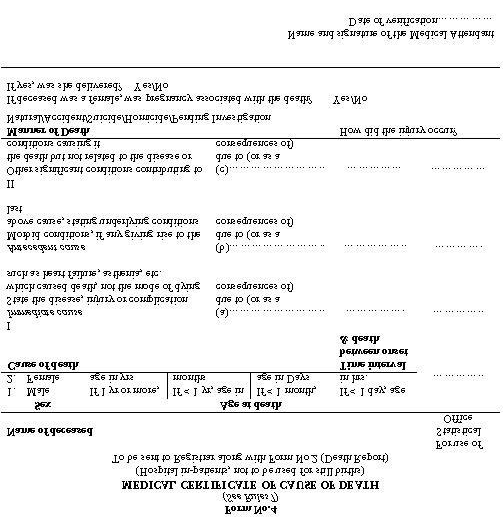
Errors will be classified into
Type-1 errors including: • Non-agreement of the cause stated in clinical and autopsy based cause of death.
Type 2 errors which are further divided into major and mi- nor errors.
Major errors include
- Incomplete certificates
- Unacceptable cause of death Eg: Old age, Natural
- Mentioning manner/ mode of death instead of the cause of death Eg: Cardiac arrest, Respiratory failure/ Suicide, Homicidal
- Errors in personal information like Name, Sex, Age
- Not mentioning Immediate, Intermediate and Underlying cause in the right order
- Competing and unrelated causes mentioned in the same certificate.
Minor errors include
- Not mentioning duration between onset of the cause and death
- Not mentioning Name of The Doctor, Registration num- ber of The Doctor and putting seal of The Doctor.
- The obtained data will be entered and analyzed using computer software SPSS 17 version. Complete confiden- tiality will be maintained throughout the process. I will not be using any interventional methods in my study.
Observation and Result
The detailed analysis of the MCCD’s and autopsy reports of all the deaths which occurred in our hospital in the year 2016 yielded the following results. Out of a total of 104 certificates analysed, only 19(18%) of the 104 certificates were found to be completely filled and correct.
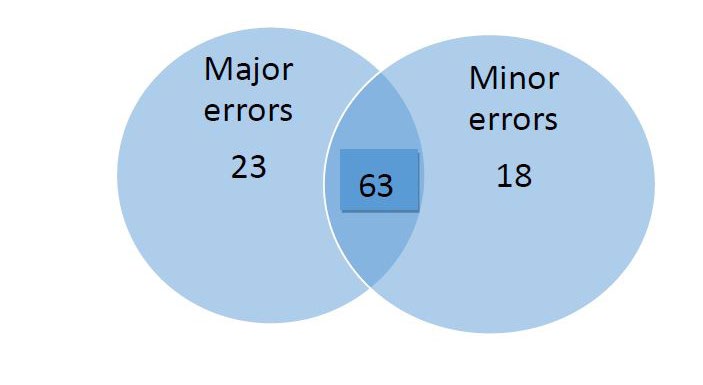
A B Figure 3: (A) Correct & Incorrect/Incomplete Certificates. (B)Major & Minor Errors.
A Total of 86(82%) certificates contained major errors and 81(77%) contained minor errors. 63(60%) certificates contained both major and minor errors.
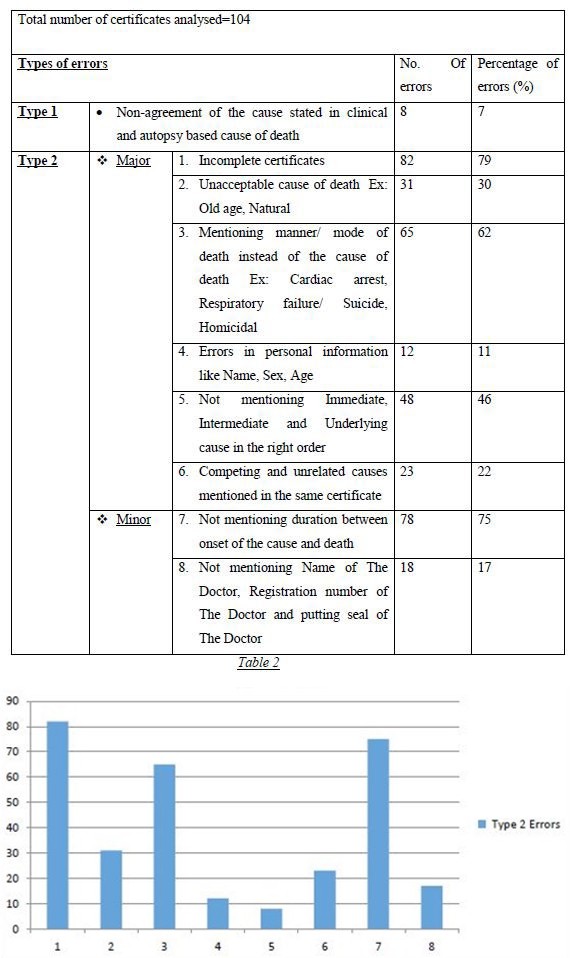
8(7%) of certificates showed a different cause of death when compared to the cause of death stated in the autopsy report. Out of the 82 incomplete certificates, 78 certificates didn’t contain the duration between onset of the cause of death and death. The antecedent cause was not mentioned in 32 certifi- cates. It was observed that manner or the mode of death had been mistaken for the cause of death and had been entered in lot of cases.
Discussion
In our study, we found that only 18% of the certificates were completely filled. It was observed that confusion regarding the terms ‘cause of death’, ‘manner of death’, and ‘mode of death led to a number of errors in the first part of the certificate. Our study showed that 62% of the certificates had the manner or mode of death written which is very shocking since the MCCD guidelines clearly states that the Manner or mode of death should not be confused with cause of death. In a similar study conducted by Swapnil SA et.al. they found that 63% of the certificates had mode of death mentioned instead of cause of death [4]. They were of the opinion that such errors may be occurring is that most physicians would be referring Surgery and Medicine textbooks which do not clearly state the difference between cause of death and mode of death. The differences are clearly stated in the Forensic Medicine textbooks which are taught in the 2nd MBBS curriculum [5].
Another area of concern is the filling up of antecedent and underlying cause of death in the right order. Our study showed 22% of the certificates have the antecedent and underlying cause of death columns left empty or incorrectly filled. In a study conducted in Vadodara municipal corporation, Gujarat, it was also noted that antecedent cause was filled in only 27% of certificates and underlying cause was filled only in a mere 0.8% of certificates [6]. Similarly, in a study conducted in an intensive care unit of Kathmandu, Nepal, highest error rate in Underlying cause of death (46%). As stated earlier the reason for this could be multiple co-morbid conditions present in a single patient or the fact that the physician who gives the certificate hasn’t been the treating physician and hasn’t gone through the records of the patient thoroughly [7, 8].
Our study showed that only 25% of the certificated had the interval between onset of the cause of death and death. A study conducted by Swapnil SA et. al. Showed that 37% of the certificates had that column correctly filled [4]. The main reason behind these errors is the patient is usually brought to the hospital in the terminal stage. Another reason which I assume could cause these errors is the incorrect history which is obtained which may be a mistake on the part of the doctor’s side or patient’s side. The certificates which were analyzed by us were only the ones which were a part of a Medico Legal Case (MLC), hence the interval isn’t of much importance and the reasons for errors could not be pin pointed accurately [9].
Conclusion
A high incidence of errors was found in the study conducted which is an alarming but expected outcome. The incidence of errors needs to be minimized in order for the certificates to serve its purpose of being an important tool to obtain scientific and reliable information in terms of causes of mortality. The confusion regarding the terms ‘Cause of death’, ‘Manner of eath’ and ‘Mode of death’ has been the major area of errors. The next sphere which had maximum errors was the antecedent and underlying cause of death followed by the interval between onset of cause of death and occurrence of death. The errors can be mainly attributed to lack of training and experience of physicians in filling the MCCD. The other causes to which may have caused the errors is time constraints, heavy work load, and unfamiliarity with the deceased. Complexity of the cases is another major factor contributing to the errors. Proper training to house surgeons and physicians is emphasized to enhance the accuracy of the certificates.
Summary
Medical certificate of cause of death is a document to be filled in case of death, by a medical practitioner after examining the body and confirming that the person is dead. Incomplete or inaccurate entry in these certificates poses difficulty in obtaining reliable information pertaining to causes of mortality. To overcome this, Medical certification of cause of death [MCCD] scheme was introduced.
The primary aim of this project was to be aware of the extent of errors occurring while filling up Medical Certificates of Cause of Death [MCCD].
The main objectives were to determine non agreement of clinical based cause of death and autopsy based cause of death, find out how frequently errors are occurring and what types of errors are occurring and indirectly help medical collages and hospitals impart proper training to house surgeons and doctors regarding filling up of death certificate. The above aims and objectives were taken with the interest of improving the accuracy of MCCD which will make the valuable document serve its purpose.
A Retrospective, cross sectional study was undertaken at a rural teaching hospital in Karnataka, using 104 causes of death certificates issued between January 2016 and December 2016. Out of a total of 104 certificates analysed, only 19(18%) of the 104 certificates were found to be completely filled and correct. 8 (7%) of certificates showed a different cause of death when compared to the cause of death stated in the autopsy report. A Total of 86(82%) certificates contained major errors and 81(77%) contained minor errors. 63(60%) certificates contained both major and minor errors.
Out of the 82 incomplete certificates, 78 certificates
didn’t contain the duration between onset of the cause of death and death. The antecedent cause was not mentioned in 32 certificates. It was observed that confusion regarding the terms ‘cause of death’, ‘manner of death’, and ‘mode of death led to a number of errors in the first part of the certificate.
It was observed the main reasons for the occurrence of such a high number of errors were multiple co-morbid conditions in a single patient, lack of proper training to medical professionals, heavy work load and unfamiliarity with the deceased. Proper training to house surgeons and physicians has been emphasized.
References
-
Physicians Manual on Medical Certification of cause of death.5th edition. New Delhi. Office of the Registrar General, India.2012.77p.
-
World Health Organization. International statistical classification of diseases and related health problems, tenth revision (ICD-10), Geneva: World Health Organisation, 2004;2(2):23-24.
-
Hardisty AS. Common Errors In Certifying The Cause Of Death On The Medical Certificate. The Canadian Medical Association Journal. Nov 1938.468p.
-
Swapnil SA, Vijay KAG, Lavlesh K, Binay KB, Krishnadutt HC. A Study on Appraisal of Effectiveness of the MCCD Scheme. J Indian Acad Forensic Med 2011;32(4):318-20.
-
World Health Organization: Civil registration: why counting births and deaths is important. World Health Organization; 2014, at: http://www.who. int/ mediacentre/factsheets/fs324/en/.
-
6.Ganasva S, Bariya BR, Shringarpure K, Damor JR. Assessment of medical certificate of cause of death(MCCD) in Vadodara Municipal Corporation, Gujarat, India. IJCRR.2015;7(24): 18-23.
-
Pritt BS, Hardin NJ, Richmond JA, Shapiro SL. Death certification errors at an academic institution. Arch Pathol Lab Med.2005;129(11):1475-79
-
Maharjan L, Shah A, Shrestha KB, Shrestha G. Errors in cause-of-death statement on death certificates in intensive care unit of Kathmandu, Nepal. BMC Health Serv. Res 2015;12(15):507.
-
Fernando R. Medical certification of cause of death in the General Hospital, Colombo. Ceylon Med J. 1990;35(2):71–74.
- Narcotics and Digital Forensics: Bridging Crimes in the Digital Age
- Ethics in Forensic Psychiatry: Principles, Dilemmas, and Human Rights
- Impact of Acute Stress on Attentional Orienting to Social Cues
- Head Injury and Intracranial Hemorrhage in Western Region of Libya
- A Forensic Study on Handedness: Examination of Handwriting Features in Right and Left Handed Writers
- Techniques for Latent Fingerprint Development Using Natural and Synthetic Powders: A Review