
Head Space-GC Analysis of N, N-Diethyl-M-Toluamide (DEET) in Human Postmortem Specimens: A Forensic Case Report
In India, self-poisoning through pesticides is an increasingly common form of suicide. Although deleterious insect repellents (sub-classification of pesticides) are regulated or interdicted, but significant data related to misuse can be procured. Meanwhile, the emergence of novel commercially manufactured products containing insect repellant as a prime ingredient without public and scientific apprehension regarding detrimental impacts has exacerbated the circumstances. Forensic examination of the viscera of the deceased discerned that the death was attributable to Diethyltoulamide intoxication. As no conspiracy behind the death was evident, hence it was pellucid to comprehend that the insect-repellant product was self-administered. Headspace GC analysis of viscera showed noteworthy results in concern to the identification of Diethyltoulamide. This study attempts to identify the most appropriate pesticide and determine whether it is present in biological matrices. The samples were received from the hospital and processed in the Forensic Science Laboratory for testing on possible poisoning. The pesticides Malathion, Dicholorovos, Baygon, and Lindane were utilised as a kind of control. The extraction of pesticides from various biological matrices was done using the solvent extraction method.
Introduction
The term Pesticides is often comprehensible as the chemical substance that destroy pesticide nevertheless it’s a wide term that encompasses substances that do not destroy pest alike insect repellants [1]. The WHO estimates that about a million people worldwide suffer from acute poisoning brought on by pesticide exposure. The annual death rate ranges from 0.4% to 1.9%. [2, 3]. Most deaths result from self-poisoning by ingestion, rather than occupational or accidental exposures, which are typically topical or inhalational [2].
Human health risk assessment reported the fact that DEET has no toxic effect and is relatively safe for dermal application with no dietary or other exposures. According to Jeffrey Bloomquist, an expert on pesticide toxicology, DEET has no significant health risks to use as an insect repellent in general, including children. Internationally, ambiguity exists on the safety measures of DEET and is still undebated as it lacks scientific data on the lethality of substance use. India has massive indigenous repellant manufacturers in the commercial market and its practice outranks net use with 0.6 to 3.0% of per capita income from household practice exclusively [4]. Indian media sources reported the fact that DEET toxicity can impair neurological function. DEET is the most commonly used mosquito repellent, and it reported along with the fact focusing its potency that its solvent form can damage plastic-type synthetic material hence scientific laboratories aims to develop an alternative effective repellant with the least toxicity [5].
Until now, discrepancy prevailed regarding the toxic or safe use of DEET nevertheless this forensic case examination made this noticeable that it can cause mortality rending its misuse. There aren’t many literature sources that describe a comparable situation, and there isn’t enough study to scrutinize chemicals legally. This discrepancy is essential to eradicate because the statistical data for India that depicts the ground reality is frightening as more than 50% of mortality is caused due to pesticides. Misuse of insect repellent products containing Diethyltoulamide (DEET), chemically known as “N, N-diethyl-meta-toluamide” as an active ingredient has been reported in Forensic Science Laboratory, New Delhi on examination of post-mortem specimen of the deceased.
Case Presentation
Information was received telephonically that a man was found in an unconscious state in a park. Investing officer (IO) reached the spot and the victim was taken to the hospital. The doctor declared the man dead and a post-mortem examination was conducted in the same hospital. Visceral exhibits were forwarded to the Forensic science laboratory to discern the cause of death.
Postmortem examination revealed that externally an abrasion (1cm×0.5cm) is present over the posterior region of the right forearm that is 5cm proximal to the right wrist joint. Another two abrasions of dimension (3cm×1.2cm) and (0.5cm×0.5cm) were present over the right side of the face, 3cm lateral to the right angle of the mouth, and over the lateral region of the forehead, 1.5cm lateral angle of right elbow respectively. Internal examination revealed that 500 ml of yellowish fluid was present in the stomach.
Materials and Methods
Toxicological viscera samples containing stomach, small intestine, liver, spleen, human plasma, kidney, and blood were received from the hospital after the postmortem examination of the deceased and were sent to the Chemistry Division, Forensic Science Laboratory for the examination. All the chemicals and reagents were used of analytical grade for the analysis [6].
In this investigation, we use solid-phase extraction (SPE) and gas chromatography to analyze the DEET concentration in the stomach, blood, small intestine, liver, spleen, human plasma, and kidney. We report just one instance of an adult intentionally ingesting insect repellant containing DEET, which resulted in death.
Sample Preparation
Samples (viscera such as stomach, small intestine, liver, spleen, human plasma, kidney, and blood) retrieved for examination were gathered, labeled, and then prepared for extraction.
Extraction Process
Before the examination, cleaned samples properly. All the undesired components like fat, broken-down proteins, and colouring matter in the matrices were removed through an appropriate extraction procedure to avoid tampering with the results. The extraction process was performed in three steps for pesticide extraction i.e., Solvent extraction, Digestion, and Filtration.
Solvent Extraction Method
Extraction from Viscera: An equivalent amount of anhydrous sodium sulphate was mixed with 50gm of tissue materials to create a fine slurry, which was then put into a conical flask with an air condenser. The flask was then filled with 50 ml of n-hexane and heated in a hot water bath for an hour followed by filtration. Two extractions of the remaining slurry were performed using a 25ml amount of n-hexane. The layers of n-hexane that had been filtered were mixed and put into a funnel for separation. The layers of acetonitrile were combined, transferred to a different, spotless separation funnel, and diluted ten times with distilled water. It was then treated with 25ml of saturated sodium sulphate solution and extracted three times using 25ml of n-hexane.
5gm of anhydrous sodium sulphate was added after the n-hexane layer was mixed, condensed, and evaporated in a water bath. As and when it was necessary for analysis, the extract was evaporated.
Extraction in Blood: 20 ml of blood were mixed with 10 ml of a 10% sodium tungstate solution and 15 ml of 1N sulfuric acid, agitated for 2 minutes, filtered, put into a separating funnel, and extracted three times with 20 ml sections of n-hexane. After combining the layers of n-hexane and passing them through anhydrous sodium sulphate, a stream of air was used to evaporate the solvent. Following the extraction procedure, the extracted sample was allowed to concentrate in sunlight.
GC-MS Analysis
The extracted samples were analyzed on GC-MS- QP2020NX (SHIMADZU), JAPAN coupled with a mass spectrometer (SHIMADZU Technologies) for unknown compound analysis. A DV-5MS capillary column (30 m ×0.25 mm × 0.25 µm) was used to separate compounds. High-purity helium was applied as the carrier gas. The following conditions were used: column flow rate: 1.0 mL/ min; split injection, split ratio: 100: 1; injection volume: 1 µL; and injection port temperature: 280°C. The temperature procedure was as follows: 0–5 min, 150–150°C; 3–16 min, 120–280°C and 16–20 min, 280–280°C.
The MS working conditions were as follows: the electron ionization energy was 70 eV, the full-scan acquisition was used in the range of 45–550 m/z, the ion source temperature was 230°C, the transmission ion temperature was 280°C, and the four-stage pole temperature was 150°C. The identification of each peak in the total ion flow chromatogram was automatically retrieved from the National Institute of Standards and Technology (NIST) MS search 2.4 as the standard mass spectrometry database and verified with standard mass spectrometry. Some components were confirmed with the retention value of a standard sample.
Results and Discussion
The probable time since death calculated through Postmortem examination of the diseased was near about two weeks. After preliminary examination analysis, Headspace GC was utilized for confirmatory analysis of viscera exhibits that indicated the presence of Diethyltoulamide.
Each TIC peak’s mass spectra were properly examined and searched using electronic commercial or approved in- house spectral libraries.
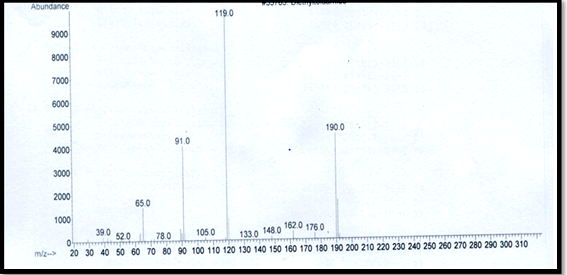
Twelve compounds were identified in the analyzed viscera samples by using GC-MS analysis shown in Figure 1. The GC-MS examination of the sample in the Forensic Science Laboratory concluded that the exhibit results revealed the highest specific surface area for the compound Diethyltoulamide. at the retention time (TR) of 119 (Figure 1). Identification of components was achieved based on their retention indices and interpretation of the mass spectrum was conducted using the database.
Forensic examination of the case has provided substantial evidence for the toxicity of DEET. It has the potential to cause the death of a person. However, it’s strenuous to deduce the mode of death was suicide or homicide. It is cognizable that in the process of making humans defensive against insect attacks, various chemicals are accessible for public usage that can be employed inappropriately.
Animal studies and individual case reports comprise the majority of the safety data on DEET [7, 8]. When administered in accordance with acceptable product labels, DEET is safe, according to two sizable investigations utilizing data from the US Poison Centre that examined over 29,000 human exposures [9, 10]. However, when DEET-containing products were used even in recommended dosages, case reports revealed numerous hazardous consequences such as encephalopathy [11], seizure [12], cardiovascular toxicity [13, 14] and dermatitis [11, 15]. These toxicity reports are still infrequent, mostly involving topical application and the pediatric population. Reports of toxicity brought on by excessive DEET consumption are even rarer [9].
Conclusion
We as a part of the scientific community prudently disseminate the certainty of DEET lethality on the account of the fact that it is relevant for public awareness to circumvent its undeliberate exposure. Authentic scientific evidence or inputs are required to eradicate the discrepancies existing in the literature regarding the safety concern of the substance. Research studies must be conducted to gather optimum data to put forward the chemical substance to the notice of regulatory bodies. Regulating the toxic chemical exclusively is not an ample measure to curb the alarming concern rather the scrutinization of manufacturing industries will serve as a supplementary measure to contradict the arising menace. Law enforcement agencies must watch the clandestine production of such synthetic substances for monetary gains as the Indian climate is prone to the extensive use of insect repellants particularly in rainy seasons. Various research institutes must develop alternatives for insect repellants will less toxic chemicals as active ingredients [16].
References
-
Hassaan MA, Nemr AE (2020) Pesticides pollution: Classifications, human health impact, extraction and treatment techniques. The Egyptian Journal of Aquatic Research 46(3): 207-220.
-
Eddleston M (2020) Poisoning by pesticides. Medicine (Abingdon) 48 (3): 214-217.
-
Jia ZQ, Zhang YC, Huang QT, Jones AK, Han ZJ, et al. (2020) Acute toxicity, bioconcentration, elimination, action mode and detoxification metabolism of broflanilide in zebrafish, Danio rerio. Journal of Hazardous Materials 394: 122521.
-
Van Eijk AM, Ramanathapuram L, Sutton PL, Peddy N, Choubey S, et al. (2016) The use of mosquito repellents at three sites in India with declining malaria transmission: Surveys in the community and clinic. Parasites and Vectors 9: 418.
-
Mittal PK, Sreehari U, Razdan RK, Dash AP, Ansari MA (2011) Efficacy of Advanced Odomos repellent cream (N, N-diethyl-benzamide) against mosquito vectors. Indian Journal of Medical Research 133(4): 426-430.
-
(2005) Manual of Forensic Toxicology, Directorate of Forensic Science, Ministry of Home affairs, Govt of India, New Delhi, India.
-
Feldmann RJ, Maibach HI (1970) Absorption of some organic compounds through the skin in man. Journal of Investigative Dermatology 54(5): 399-404.
-
Selim S, Hartnagel RE, Osimitz TG, Gabriel KL, Schoenig GP (1995) Absorption, metabolism, and excretion of N, N-diethylm-toluamide following dermal application to human volunteers. Fundamental and Applied Toxicology 25(1): 95-100.
-
Bell JW, Veltri JC, Page BC (2002) Human exposures to N,N-diethyl-m-toluamide insect repellents reported to American Association of Poison Control Centers (1993- 1997). International Journal of Toxicology 21(5): 341- 352.
-
Veltri JC, Osimitz TG, Bradford DC, Page BC (1994) Retrospective analysis of calls to poison control centers resulting from exposure to the insect repellent N,N- diethyl-m-toluamide (DEET) from 1985-1989. Clinical Toxicology 32(1): 1-16.
-
Briassoulis G, Narlioglou M, Hatzis T (2001) Toxic encephalopathy associated with use of DEET insect repellents: a case analysis of its toxicity in children. Human & Experimental Toxicology 20(1): 8-14.
-
Osimitz TG, Murphy JV, Fell LA, Page B (2010) Adverse events associated with the use of insect repellents containing N,N-diethyl-m-toluamide (DEET). Regulatory Toxicology and Pharmacology 56(1): 93-99.
-
Clem JR, Havermann DF, Raebel MA (1993) Insect repellent (N, N-diethyl-m-toluamide) cardiovascular toxicity in an adult. Annals of Pharmacotherapy 27(3): 289-293.
-
Fraser AD, MacNeil A, Theriault M, Morzycki W (1995) Analysis of diethyltoluamide (DEET) following intentional oral ingestion of Muscol. Journal of Analytical Toxicology 19(3): 197-199.
-
Tenenbein M (1987) Severe toxic reactions and death following the ingestion of diethyltoluamide-containing insect repellents. The Journal of American Medical Association 258(11): 1509-1511.
-
Roberts C (2021) Insect Repellent Buying Guide.
- Narcotics and Digital Forensics: Bridging Crimes in the Digital Age
- Ethics in Forensic Psychiatry: Principles, Dilemmas, and Human Rights
- Impact of Acute Stress on Attentional Orienting to Social Cues
- Head Injury and Intracranial Hemorrhage in Western Region of Libya
- A Forensic Study on Handedness: Examination of Handwriting Features in Right and Left Handed Writers
- Techniques for Latent Fingerprint Development Using Natural and Synthetic Powders: A Review