
Death and Beyond: Recent Insights and Technological Approach in Artificial Intelligence
Artificial intelligence (AI) is a field of computer science that focuses on developing cognitive computing systems capable of mimicking human-like behavior. AI is a man-made technology that enables machines or software applications to learn from real-world experiences or patterns to make predictions and generate new valuable insights through precise computations. In recent advancements in forensic medicine, devices and machines have been developed to measure, diagnose, and characterize virtual autopsies and biological omics data using AI algorithms. These technologies enable various forensic applications, including ballistic wound age estimation and postmortem interval (PMI) prediction by analyzing different biomarkers. Additionally, electronic noses have been designed to replicate the mammalian olfactory system for the purpose of detecting and classifying odor mixtures, which can also aid in estimating the PMI. While artificial intelligence offers valuable tools and insights to forensic pathologists, its implementation raises important ethical and legal concerns. It has the potential to impact the criminal justice system, and the integrity of these technologies must be carefully considered in future legal investigations. The implications of AI in law enforcement are profound, as "intelligent" algorithms are used to make critical determinations about individuals' guilt or innocence, necessitating the collection of unbiased and accurate data. The frameworks that underpin these algorithms, as well as the individuals responsible for their development, play a pivotal role in shaping the future of AI in forensic science and the legal system.
Introduction
Artificial Intelligence (AI), a subfield of computer science, focuses on developing cognitive technologies capable of simulating human abilities. This encompasses the creation of computers that can engage in human-like cognitive functions, such as acquiring, analyzing, responding, self-correcting, and more, while also responding logically. The use of innovative methods to mimic cognition provides fundamental insights into virtual human behavior. In the 21st century, significant progress has been made in developing high-quality learning algorithms [1]. Criminal justice has evolved significantly thanks to intelligent criminal investigations, advanced forensic analysis, and fair judicial systems. The software add- in was designed with this computational objective in mind, and it is expected that the computer system will achieve this goal through trial and error, continually attempting to identify content with varying ratios. Previous research in this area has significant implications for stakeholders in the AI domain.
Firstly, even though AI is primarily designed for legitimate purposes, scientists and engineers should be mindful of the potential for misuse due to AI’s dual-use nature [2]. Therefore, addressing crimes, such as sexual assault, harassment, or murder, and detecting evidence of tampering with recordings often requires ongoing efforts by law enforcement to solve the crimes and identify the perpetrators. This task is as physically demanding and exhausting as it is Cybercrime forensics is a rapidly evolving field that necessitates the development of innovative decryption techniques to address a wide range of unpredictable challenges arising from the analysis of vast datasets. This is akin to forensic medicine, where occasionally a deceased body undergoes complete decomposition due to adverse weather conditions, making it impossible to accurately estimate the postmortem interval
Towards Artificial Intelligence-the Next Step
(PMI) using traditional methods. In such cases, the precision and accuracy offered by artificial intelligence become indispensable for obtaining more reliable estimates. In the case of a mass disaster, as in more cases, we can’t identify the victim, but through artificial intelligence, we can get a clue to their identification, and, moreover, we would be able to solve the crime as soon as possible. As a result, forensic medicine has become more accessible and linked to the standard of using sophisticated and manual approaches, which have proven ineffective when confronted with challenges and interferences. An expert in forensic medicine, an exhausted or biased examiner, or professional prejudice, awkwardness, or zeal during the evaluation procedure. This frequently results in increasing inaccuracies or falsified data. Findings that indicate the inadequacy or incompatibility of the investigation and the untimely execution of justice Can you conjure up an instance in which a computer algorithm executes each of the following tasks: software that behaves astutely [1].
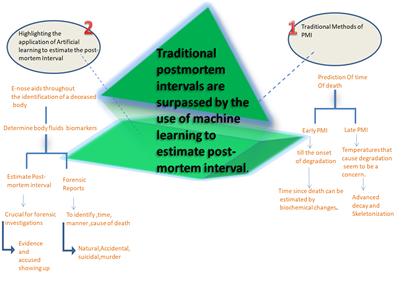
Figure 1 illustrates the application of artificial learning, particularly through the use of machine learning techniques, has significantly advanced the estimation of post-mortem intervals (PMI) in forensic science. Electronic noses (E-noses) play a crucial role in this context by aiding in the identification of deceased bodies and the determination of body fluid biomarkers. Traditionally, estimating PMI relied on methods such as assessing the state of decomposition or relying on environmental factors like temperature.
However, machine learning has surpassed these traditional methods, providing a more accurate and data-driven approach to PMI estimation. By analyzing biochemical changes in the body and considering various stages of decomposition, including advanced decay and skeletonization, machine learning models can provide valuable insights into the time since death. This technological advancement is instrumental in forensic investigations, helping to determine critical details about the manner and cause of death, whether natural, accidental, suicidal, or homicidal, ultimately aiding in the preparation of forensic reports and supporting evidence in criminal cases. Recently, ground-penetrating radar (GPR) and manual searching methods, especially trained “cadaver dogs,” are indeed frequently used to find buried mass graves. Although the precise compounds that sniffer dogs exploit to identify carcasses are not fully known, the substantial accuracy among trained sniffer dogs has shown that using scent trails as a probe of detection is a legitimate strategy [2]. Trained dogs have proven to be highly effective with distinguishing odors, locating offenders, missing people by foot, bombs, incendiary devices, drugs, and other narcotic substances. Unfortunately, because of the significant expenditures involved in the acquisition, training, and maintenance of these animals, sometimes they learn and sometimes they don’t. It is important to keep in mind that integrating new practices into the medical-legal system won’t be easy [3]. The use of artificial intelligence has recently advanced with the invention of the electric nose (e-nose) in forensic medicine, following years of development in several applications in the associated sectors of medicine and pharmaceuticals [4]. The four tasks performed by the human e-nose or sniffer dog’s nose—order perception, detection, recording, retrieval, and recognition—are mimicked by machines [5]. This device, known as an “e-nose,” is equipped with chemical sensing for gathering, recording, and analyzing. Additionally, AI software like artificial neural networks (ANN) enables recollection, retrieval, and recognition [6]. So, one of the main functions that E-nose sensors would probably provide and serve for forensics and specimen analysis in the future is biochemical profiling-type studies to predict the post-mortem interval. So, one of the main functions that E-nose sensors would probably provide and serve for forensics and specimen analysis in the future is biochemical profiling-type studies to predict the post-mortem interval [7].
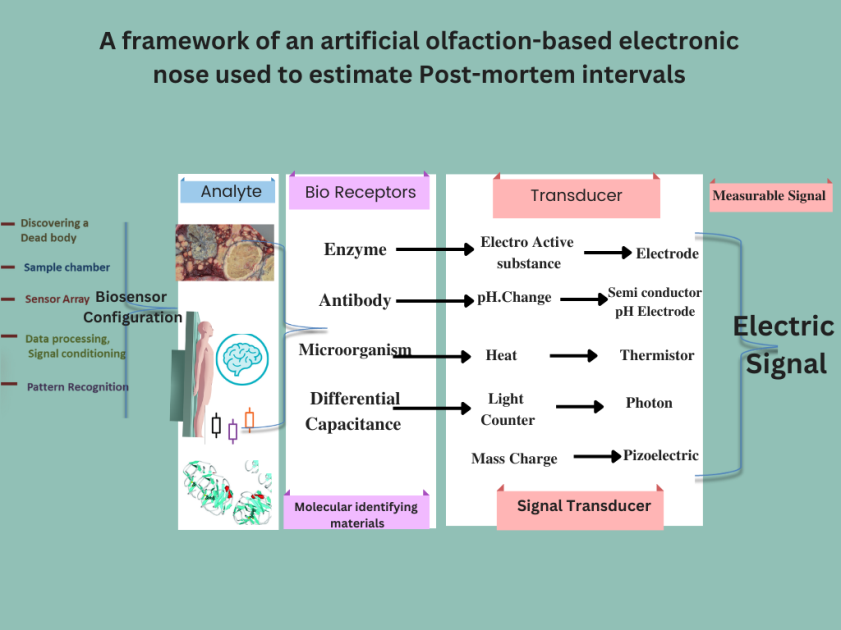
Figure 2 provides information that outlines the framework of an artificial olfaction-based electronic nose used for estimating post-mortem intervals, which are the time elapsed since death. This electronic nose comprises various key components, including bioreceptors (such as enzymes and antibodies), a sample chamber, a sensor array biosensor, and signal transducers (like pH electrodes and piezoelectric transducers).The system is designed to detect and analyze analytes (substances of interest) by measuring changes in pH, heat, differential capacitance, and other factors. Data processing, signal conditioning, and pattern recognition are crucial for interpreting the collected information. The system can be applied in forensics to discover deceased individuals by sensing specific odors associated with death, making it a valuable AI tool in criminal investigations. In the field of criminal investigation, estimating the post-mortem interval is crucial. In the field of criminal investigation, estimating the post-mortem interval is crucial. Body fluids such as blood, plasma, serum, vaginal secretions, saliva, and others contain a variety of biomarkers that can be utilized to estimate the time since death. After death, the body undergoes biodegradation, leading to fluctuations in the concentrations of these biomarkers over time. These biomarkers can be evaluated using AI systems to provide a more precise estimate of the post-mortem interval. Some of the biomarkers that may be assessed include pH levels in body fluids, concentrations of salts, fatty acids, amino acids, lactate dehydrogenase (LDH), mRNA, miRNA, microbiome, and metabolomics [8]. By processing changes in the concentrations of these biomarkers using AI algorithms and leveraging the available statistical data, it becomes possible to estimate the post-mortem interval more accurately. This advancement in forensic science can significantly enhance the accuracy and reliability of determining how long someone has been deceased [9].
AI encompasses the development of intelligent machines that can carry out activities similar to those performed by human intelligence. A forensic pathologist conducting a medico legal autopsy must consider a number of factors depending on the circumstances of the case in order to formulate an accurate conclusion concerning the cause of death and respond to the investigative firm’s questions. It included establishing a person’s identity, externally evaluating different stains on clothing or the body, identifying and gathering samples of bodily fluids, examining wounds, etc. In order to determine the cause of death, the forensic expert must perform an inside examination of the body. They must also look for tiny fractures and injuries that are typically missed by a naked-eye examination but may have contributed to the person’s demise. Conventional autopsies have a slew of drawbacks, including the need for skilled personnel throughout every instance, the inability to detect fine details with the unaided eye, and the possibility of inter- person variance in judgments at certain critical moments. The use of cutting-edge technologies in the right criminal justice system is now necessary to carry out an autopsy in an adequate manner. A more recent development in the area of criminal justice systems would be its use for AI-enhanced virtual autopsies [10]. ML algorithms would use a computed tomography or magnetic resonance device to take detailed images. When correlating such photos with the enormous quantity of raw information provided to such an algorithm, the process would independently determine a body’s diseased status. The algorithm will analyses the information and reach a verdict on that organ’s illness status, allowing the specific cause or manner of death to be determined. It is possible to formulate expert comments about inflammatory responses, minor fractures, and extensive injuries [11]. The machine learning algorithm can also shed light on the type of weapon used by comparing the size of such a wound to the various patterns of injuries inflicted by other types of weapon. The approach would also assist in obtaining data as well as the precise organs with pathological conditions, and it might aid in making a precise diagnosis of the illness. Research conducted in the field of forensic medicine could make use of a wide range of data sources, data processing techniques, and computational model based on omics advancements. For instance, the antiquity of the impact injury can be determined using genome sequencing datasets and the time-dependent mRNA expression in avulsed injury [12].
Artificial Intelligence in Court Room
AI applications are extremely useful in the context of law. They have the capability of taking over tasks that were previously solely done by human. In some situations, they can perform exploits that are impossible for humans. This has given rise to definitive statements that AI will complement, if not completely replace, attorneys in many contexts. Legal research is one area where AI has proven to be helpful. Laws and court decisions provide evidence that forensic medicine is one area where AI has proven to be useful [13]. Today, AI technologies would examine certain sources of evidence from legislation and legal precedent in a court of law. Researchers using AI-enabled technologies can identify pertinent laws more efficiently and precisely. Numerous legal services provide queries in layman’s terms together with a score indicating how confident they are in the accuracy of the response. Such technologies could also include a summary of the references that the result is dependent on. Such a tool could be instructed to continuously search for better information and provide modifications around the clock if any pertinent alternative sources are added to the databases. The organization and significance of legal advice should be improved. As the repository of legal information develops, AI technology will offer advice and suggestions. Courts must continuously assess the performance of their system and make changes as needed. Such initiatives represent a significant increase in responsibility for court and judiciary systems, which are typically established and operated in a systematic manner [14].
Technological Limitation
In order to provide machines with critical results, conclusions, and other information, forensic medicine experts must first manually annotate photos and papers. Forensic scientist will be required to put forth a significant amount of initial approach throughout this regard. AI is a potent technology that can increase effectiveness as well as precision. However, such execution raises ethical concerns and calls into question the current legal framework regarding the trial. There are several claims that applying AI would interfere with the conventional use of subjective judgments. Building trust with customers and other parties is important for medicolegal professionals [15]. They must demonstrate to the general public the accuracy and reliability of their work. It will be major worry whether the judicial system, investigating agency, and general public would recognize the perspective provided by the technology. The judicial system and the investigative agency are the client that forensic scientists must convince that the AI- derived conclusion is reliable and precise. To apply AI, forensic medical professionals require the appropriate tools and infrastructures. Massive data storage systems and high- performance computer infrastructure are examples of this. The expense of each step will be high. The affordability of such systems for developing countries is another major concern [16].
Discussion
For those working in the fields of forensic medicine and toxicology, AI holds out a number of advantages.
Evidence gathered from standard analytical equipment used Post-mortem interval of forensic samples or from e-nose instruments may provide different sources of evidence and further details. E-nose sensors are comparatively new statistical techniques that may eventually be included in the repertoire of methods and procedures that forensic investigators and professionals use to recreate the scene of the crime. The AI tool may have a potential advantage in the field of forensic medicine to formulate varied conclusions of medico legal value, but, if the specialists from the forensic sector can get over these first obstacles.
Computer technology and AI algorithms will enhance forensic investigation techniques with greater accuracy and speed, according to a classical morphological perspective. The legal significance of AI in a court of law is a further area of worry. An AI-derived opinion may not be considered definitive evidence by the court, but it can serve as supporting evidence because any machine depends on the data it is provided with. Before rendering a decision, the judiciary itself must comprehend how the system operates. Magistrates would ask an expert to assess the machine’s reliability in this case. Yet, this advancement will come with the passage of time and the progression of AI applications.
References
-
O’Sullivan S, Holzinger A, Zatloukal K, Saldiva P, Sajid MI, et al. (2017) Machine learning enhanced virtual autopsy. Autops Case Reports 7(4): 3-7.
-
Lasseter AE, Jacobi KP, Farley R, Hensel L (2003) Cadaver Dog and Handler Team Capabilities in the Recovery of Buried Human Remains in the Southeastern United States. J Forensic Sci 48(3): 617-621.
-
Ruffell A, Powell N (2021) Search Strategy for Buried Objects in Water: Geophysics, Probes and Dogs. Forensic Sci 1(3): 130-137.
-
Barshick SA, Griest WH, Vass AA (1996) Electronic Aroma Detection Technology for Forensic and Law Enforcement Applications. Forensic Evid Anal Crime Scene Investig pp: 1-15.
-
Tong J, Zhang Z, Chen DH, Lan YB (2008) Electronic Nose with an Air Sensor Matrix for Detecting Beef Freshness. Journal of Bionic Engineering 5: 67-73.
-
Brudzewski K, Osowski S, Markiewicz T, Ulaczyk J (2006) Classification of gasoline with supplement of bio-products by means of an electronic nose and SVM neural network. Sensors Actuators B Chemical 113(1): 135-141.
-
Wilson AD, Baietto M (2011) Advances in Electronic-Nose Technologies Developed for Biomedical Applications. Sensors 11(1): 1105-1176.
-
Gautam K, Rawal R (2022) Microbial Clock: A review on forensic microbiology for crime scene investigations. International Journal of Forensic Research 3(1): 112- 120.
-
AD W (2014) Electronic-nose Applications in Forensic Science and for Analysis of Volatile Biomarkers in the Human Breath. Journal of Forensic Science & Criminology 1(1): 1-21.
-
Saini M, Kapoor AK (2016) Biometrics in Forensic Identification: Applications and Challenges. J Forensic Med 1(2): 1-6.
-
Chairat S, Chaichulee S, Dissaneewate T, Wangkulangkul P, Kongpanichakul L (2023) AI-Assisted Assessment of Wound Tissue with Automatic Color and Measurement Calibration on Images Taken with a Smartphone. Healthcare 11(2): 273.
-
Seo S, Kang J, Eom IH, Song H, Park JH, et al. (2023) Visual classification of pressure injury stages for nurses: A deep learning model applying modern convolutional neural networks. J Adv Nurs 79(8): 3047-3056.
-
Srajann (2023) Exploring the Legal Implications of Artificial Intelligence in Criminal Justice Systems.
-
(2023) AI in the Courtroom: Opportunities and Challenges. Clio.
-
Pathak M, Narang H (2021) Application of Artificial Intelligence in the Field of Forensic Medicine. Medico- legal Update 21(4): 56-65.
-
El-Din EAA (2022) Artificial Intelligence in Forensic Science : Invasion or Revolution? Egypt Soc Clin Toxicol J 10(2): 20-32.
- Narcotics and Digital Forensics: Bridging Crimes in the Digital Age
- Ethics in Forensic Psychiatry: Principles, Dilemmas, and Human Rights
- Impact of Acute Stress on Attentional Orienting to Social Cues
- Head Injury and Intracranial Hemorrhage in Western Region of Libya
- A Forensic Study on Handedness: Examination of Handwriting Features in Right and Left Handed Writers
- Techniques for Latent Fingerprint Development Using Natural and Synthetic Powders: A Review