
A Fatal Suicidal Knife-Cuttings on the Neck-From an Evidence Based Forensic Pathologist’s Point of View
A 42-year-old male was found dead inside his small trunk lying on the right back seat in a pool of blood by his father. A large single-edged utility knife was discovered on right hand of the back car seat nearby. On his neck, there were four sharp hesitate incisional cuts and two hesitate incisional cuts on his left forearm. The forensic bloodstain pattern compatible with possible to hypothesize a carotid artery injury of high-pressure blood exiting from a severed artery. One of four hesitated incisions on hist neck was deep enough to sever right common carotid artery and internal jugular vein. Death was attributed to hemorrhagic shock following right carotid artery severed injury on the neck. A suicide note was found at home by his father and disclosed a combined couple and financial relationship issue. From an evidence-based forensic pathological viewpoint, at first, a clean, detailed visual observation of the cut wounds on his neck and right forearm was a key feature of differential diagnosis of cause of death. Local inspection of incised depth and damaged great blood vessels on his neck, associated with other self-inflicted wounds on his accessible parts of left forearm. The blood spatter marks analysis could determine the dynamic mechanism of bleeding to death. Based on combined circumstantial evidence, terminal individual behavior and police and legal investigation of motivation and personality, the manner of death whether in nature of suicide or homicide or not would be determined. Furthermore, a complete, integrated medicolegal investigation was the milestone of evidence-based forensic pathology to elucidate the fact of death in modern forensics. For understand the individual's background disease for tendency of suicide and/or influenced of alcohol or abuse drug could be confirmed by performed autopsy findings and toxicological analysis.
Introduction
Recent advances of forensic pathology was devoted to scientific medicolegal investigation of death including personal identification, time of death, cause of death, manner of death, collection of biomedical information and evidence to clarify the fact or truth of death [1]. The applied methods and techniques were traditional forensic autopsy, assisted with biological and/or toxicological analysis, molecular biology and/or molecular pathology, virtual autopsy by using computerized tomographic scanning and three-dimensional (3D) reconstruction for medical imaging interpretation, as well as digital forensic pathology and/or molecular pathology [2].
In addition, the real time scene investigation and reconstruction, coupled with police interview of witness, and legal investigation or conference will discover what happens and how to occur. A pathological-scene correlation will conclude a truth of death and determine the manner of death.
If it is a criminal case, such as homicide or murder case, the court needs all the scientific criminal information, testimony of witness, complete autopsy findings, additional evidential toxicological data, and evaluation of psychological status for make a fair trial without false felony or miscarriage of justice. Based on forensic, case processing, and disposition data, Kelly Walsh et al, estimate, after weighting, that wrongful convictions in cases with a sexual assault component occurred at a rate of 11.6 percent, by used Federal funding provided by the U.S. Department of Justice in 2017 (Grant Award #: 2013-IJ-CX-0004.) [3].
Up to date, the modern forensic pathologist is evolute and progressive changes and needs more evidential by systemic collections of information of diseases, medical treatment, gross physical injury and virtual body injury, environmental scene, screen of therapeutic drugs and/or abuse drug, police and legal investigation as well as psychological evaluation, integrated into an accuracy legal issue. The accuracy forensic medicine is also increasing and can be listed as Table 1.
| Method or Technique | Accuracy | Evidence Preservation |
|---|---|---|
| Visual Examination of Body Only | 60%-70% | Poor |
| Medicolegal Investigation Only | 60%-70% | Poor |
| Toxicological Examination Only | 5%-10% | Poor |
| Laboratory Examination Only | 50% | Poor |
| Scene Investigation Only | 60%-70% | Poor |
| Forensic Autopsy | 95% | Excellent |
| Virtual Autopsy | 85%-90% | Poor |
| Scene-Correlated Autopsy | 85%-90% | Fair |
| Toxicology-Assisted Autopsy | 80%-90% | Fair |
| Integrated Medicolegal Investigation Assisted with Forensic Autopsy and/or Virtual Autopsy and/or Expert Witness | >95% | Excellent |
Table 1: The Forensic Methods and Techniques were Developed and Applied with Increase of Accuracy and More Excellent Preservation
Materials and Methods
A forensic case of injury death caused by using utility knife-cutting on the neck and left forearm was occurred in the early morning of October 16, 2023. He was a 42-year- old male private car mechanic. He was found dead inside his personal small trunk lying on the right back seat in a pool of blood by his father.
The body was lie on back at back seat just behind the driver’s seat of his small working truck. All the car doors were unlocked. No struggle or fighting was identified. The back seat was bloody with massive blood pooling and clotting from right side of neck. Focal bleeding from the two cut wounds on left forearm was observed. There were two blood-stained utility knives and a bladder lied near his right hand (Figure 1).
A large single-edged utility knife was discovered on right hand of the back car seat nearby. On his neck, there were four sharp hesitate incisional cuts. In addition, there were two hesitate incisional cuts on his left forearm.
To elucidate cause of death and manner of death, a duty prosecutor and an official coroner were charged this questionable forensic case.
Scene Investigation
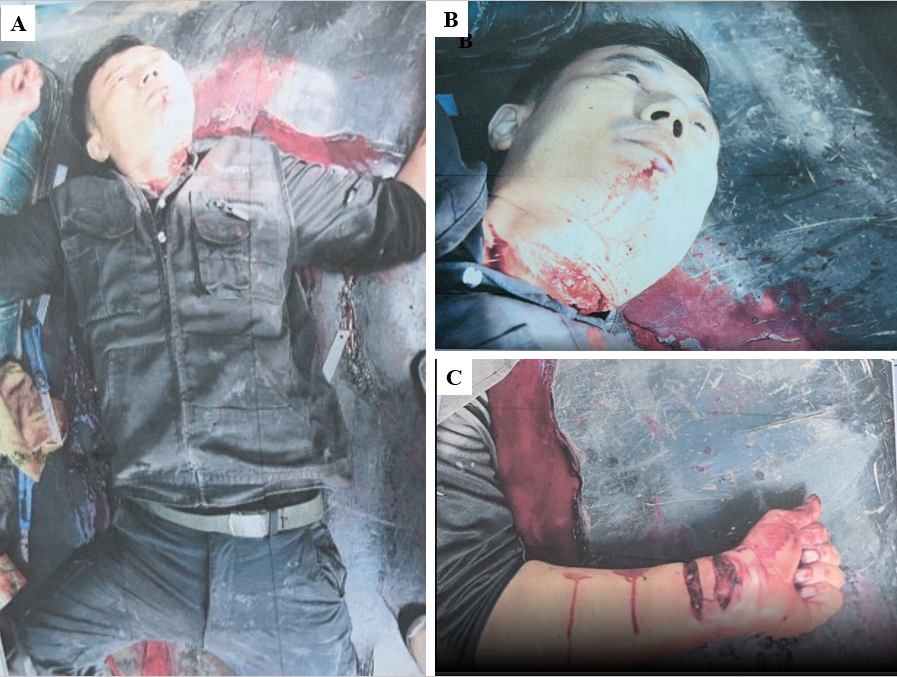
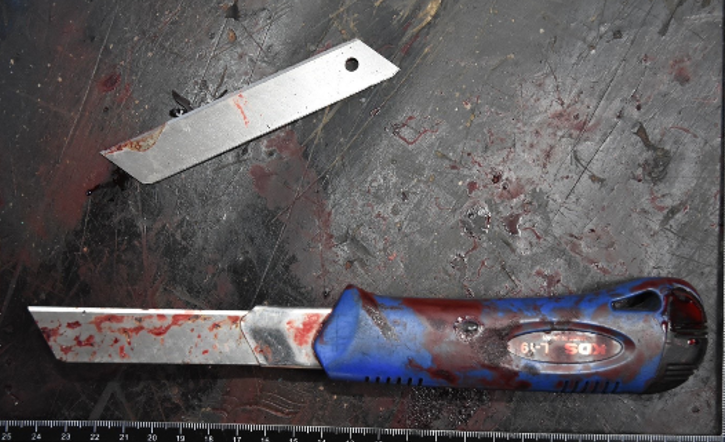
External Examination Body
External examination of the victim revealed 4 hesitate, simple cut-edged incision wounds on the neck, measuring up to 4.5 cm in length, with clear sharp cut wound tails and underlying soft tissue hemorrhage.
On closed inspection, right common carotid artery and right internal jugular vein were severed and active ejected into the right lateral door of the trunk. The travel path begins high on the left side of the neck below the angle of the mandible, and travel obliquely downwards to the front of the neck, ending at the low right side of the neck. The cause of death was multiple cut wounds on the neck, resulted in massive bleeding to death (Figure 3).
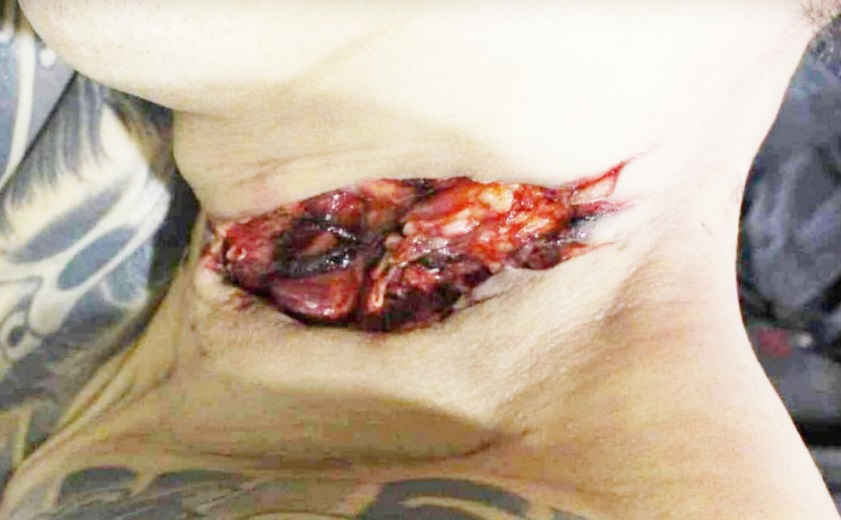
Police and Legal Investigations
The victim was a married, private car mechanic worker lived with his parents, a wife, and a son. He was right-handed. Recently, his work was fluctuating with decrease of income, together with financial crisis and couple quarrels. Exhausted of body, transform to burn-out syndrome, psychological depression with medication were developed. A suicide note was found by his father at home, and the writing characters were checked and consistent with done by himself. The double impacts of couple and family relationship issue plus critical financial issue, trigged him come to psychological burn-out syndrome and plugin suicide. Hence, the manner of death was contributed to suicide without possibility of homicide (Figure 4).

Discussion
The distinguish between suicidal and homicidal cut wounds on the neck and a difficult issue in the forensic pathology. Suicide wounds by knife or sharp cutting weapon are usually made on the neck via different individual behaviors.
In general, a right-handed person, suicide cut-throat wounds normally begin high on the left side of the neck below the angle of the mandible and travel obliquely downwards to the front of the neck, ending at the right side of the neck. In a left-handed person the directions are respectively changed. In addition, there are usually other self-inflicted wounds on accessible parts of the body. These wounds are deeper at their start and become shallow during their course, ending with tailing [4]. However, Knight and Saukko dispute this finding and note that many cut-throat wounds are horizontal with no variation in depth.
In this case, the travel pathway of knife cutting on the neck multiple with fitness of the common direction of a right-handed male and cut through depth of cut injury of the great vessels. It is not conclusive of accordance with the observation made by Knight and Saukko et al.
The suicide note of this male person disclosed double impacts of couple and family relationship issue and critical financial issue, progressive transform to burn-out syndrome, the leading 3 causes of committee suicide in the middle age of Chinese, Japanese and Korean populations.
Burn-out Syndrome is an occupational phenomenon caused by excessive and prolonged stress. Instead of being considered as a medical condition, it has been currently reclassified by the World Health Organization (WHO) to be an occupational phenomenon. Burn-out is a syndrome conceptualized as resulting from chronic workplace stress that has not been successfully managed. Burn-out specifically refers to phenomena in the occupational context and should not be applied to describe experiences in other areas of life. Since chronic stress in workplace largely disrupts quality of life, medical attention must be provided appropriately. Being aware of warning signs remain crucial, allowing treatment to be promptly given.
From a forensic pathologist’s point of view, precise, detailed observation, and documentation of characters of sharp cut wounds, number and distribution of the choice sites associated self-inflicted of other parts physical injury, dominant hand, scene investigation and reconstruction, confidential police and/or legal testimonies of witness, were the basis of distinguished differential diagnosis of committee suicide or criminal homicide.
Finally, for detection of prompt fatal cause disease, circulatory disturbance, associated comorbidity or medical malpractice, perform of a forensic autopsy is recommended. Furthermore, if there is consideration of influence or addictive of therapeutic drugs or drug abuse, toxicological analysis is needed. Sometimes, whether committed suicide or criminal homicide is obscure or controversial, a more detailed and integrated information and/or investigation, or forensic pathological consultation is the method of choice.
Conflicts of Interest
None
Acknowledgements
None
Funding
None
References
-
Spitz WU, Spitz DJ, Clark R (2006) Medicolegal Investigation of Death: Guidelines for the Application of Pathology to Crime Investigation, In: 4th (Edn.), Charles C Thomas Press, Springfield, USA.
-
Eriksson (2016) Forensic Epidemiology-Principles and Practice, Chapter 6. Academic Press pp: 151-177.
-
Walsh K, Hussemann J, Flynn A, Yahner J, Golian L (2017) Estimating the Prevalence of Wrongful Conviction. National Criminal Justice Reference Service pp: 1-15.
-
Yadav A, Raheel MS, Kumar LR, Sharma SK, Kanwar H (2016) Cut-throat wounds: Suicidal and homicidal-two case reports and review of literature. Med Sci Law 56(1): 53-57.
- Narcotics and Digital Forensics: Bridging Crimes in the Digital Age
- Ethics in Forensic Psychiatry: Principles, Dilemmas, and Human Rights
- Impact of Acute Stress on Attentional Orienting to Social Cues
- Head Injury and Intracranial Hemorrhage in Western Region of Libya
- A Forensic Study on Handedness: Examination of Handwriting Features in Right and Left Handed Writers
- Techniques for Latent Fingerprint Development Using Natural and Synthetic Powders: A Review