
Identification of Synthetic Cathinones in Unknown Substances in Sri Lanka
There is a high tendency of ‘legal highs’ entering the local drug market. Most of the countries including Sri Lanka have controlled these drugs, because of their adverse side effects. 4-Methyl methcathinone, (4-MMC, Mephedrone) and 3-Methyl methcathinone (3-MMC, Mataphedrone) are psychoactive substances categorized under the group of synthetic cathinones. These drugs are commonly available in powder forms and crystalline forms and produce effects similar to those of MDMA, amphetamines and cocaine. Three cases containing unknown substances were submitted to the Narcotics Laboratory of the Government Analyst’s Department of Sri Lanka for further examination to find out the presence of narcotic drugs if any. Comprehensive analytical scheme including TLC, UV- Visible spectroscopy, GC-MS and RAMAN spectroscopy was applied for the qualitative analysis. The results obtained from TLC, UV-Visible, GC-MS, and RAMAN spectroscopy, confirmed the presence of Mephedrone (4-MMC) and Metaphedrone (3-MMC) in the unknown substances, and 3-MMC and 4-MMC were identified for the first time in Sri Lanka at the Government Analyst’s Department. Even though, Mephedrone is a controlled substance in Sri Lanka, 3-MMC is still not included as a controlled substance. Therefore, it is high time for Sri Lankan legal authorities to pay more attention in controlling New Psychoactive Substances (NPS).
Introduction
New Psychoactive Substances (NPS) also known as “designer drugs”, “legal highs”, “herbal highs” and “bath salts”, have rapidly emerged in the drug market as alternatives to internationally controlled drugs. Synthetic cathinones which is a main group of NPS, have been developed from cathinone, which is the main active ingredient in the leaves of khat plant (Catha edulis). Synthetic cathinones have been sold as recreational drugs from mid of 2000’s [1].
4- Methylmethcathinone which is also known as mephedrone or 4-MMC was first synthesized in 1929, and its abuse was first detected in 2007 [2]. It is used in conjunction with cocaine and methamphetamine as an art of combined drug addiction, and has gained popularity among drug abusers as a recreational drug. Common street names of mephedrone among drug abusers are M CAT, Meow Meow, and Drone and available in the form of powder, tablets, crystals and injections [3]. Due to its adverse side effects and several reported deaths, European Union banned mephedrone in 2010. Mephedrone is also classified as a highly addictive drug in Schedule 1 in USA with extreme mental stimulation and euphoria (Figure 1) [4, 5].
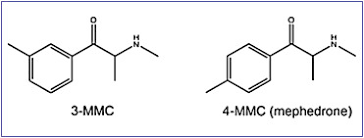
3-methylmethcathinone is another synthetic designer drug belonging to the synthetic cathinone group. It is known as metaphedrone or 3-MMC and banned in most of the countries due to the fact that it is a structural isomer of mephedrone (4-MMC) and its extensive use as a recreational drug Ferreira, et al. [6].
Due to their empathogenic and sympathomimetic stimulatory effects, 3-MMC has still appeared on the recreational drug market as alternation to mephedrone [2, 6]. The first emergence of 3-MMC was recorded in Sweden in 2012 and it was further observed that it re-emerged in Europe during 2020. There is no, known or reported medical use of 3-MMC and it contains a chiral center at the C-2 carbon.
Therefore, two enantiomers exist, the ‘R’ and ‘S’ enantiomers. It is assumed that the ‘S’ form is more potent due to its similarity to cathinone [7]. The most common form of 3-MMC is as a white crystalline powder or as solid crystals. It’s also sold as capsules filled with 3-MMC.
Generally, both 4- MMC and 3-MMC are taken via inhalation injection, insufflation or oral administration. Common adverse effects of synthetic cathinones are cardiovascular palpitation, chest pain gastrointestinal, neurological, psychiatric and musculoskeletal signs.
Case Studies
Three cases containing substance suspected to contain illicit drugs were submitted to the Narcotics Laboratory of the Government Analyst’s Department during the period of 2020-2021. Case 1 is a person with 13 grams of off-white powder suspected to be cocaine, was arrested by the special task force officers in August 2020. Case 2 involved a person who was arrested by the officers of Borella police station in February 2021 with 36 grams of white powder suspected to be cocaine, Case 3 was a person who was produced from the magistrate’s court, Galle in August 2020 with 100 grams of cubic shaped white crystalline substance suspected to be methamphetamine. Above three samples were submitted to the Narcotics Laboratory of the Government Analyst’s Department of Sri Lanka for further examination.
Methodology
Powders of the case 1 and case 2 and crystalline substance of the case 3 were subjected to a comprehensive analytical scheme including colour tests, Thin Layer Chromatography (TLC), UV-Visible spectroscopy, Gas Chromatography coupled with Mass Spectrometry (GC-MS) and Raman spectroscopy for the qualitative analysis.
Chemicals
Methanol (AR), Hydrochloric acid (AR), Acetaldehyde (AR), Platinic Chloride (AR) and Cobalt Thiocyanate were purchased from Sigma Aldrich, USA. Potassium Hydroxide (AR), Sulfuric acid (AR), Formaldehyde (AR), Acetic acid glacial (AR), and Chloroform (AR), were purchased from VWR, UK.. Sodium Carbonate, 1,3-Nitrobenzene and Sodium Nitroprusside were purchased from Fisher, UK, Ethanol absolute (AR), Ammonia (AR) and Ethyl acetate (AR)were purchased from Research lab, India. Analytical Standards of Mephedrone and 3-MMC were purchased from Lipomed, Switzerland.
Instruments
Analytical balance (Mettler, AE 100, Poland) was used for necessary weighing procedures while millipore filters (Nylon, 0.45 µm, Agilent Technologies, USA) were used to filter sample solutions. Digital vortex mixer (VELP, Scientifica) was used during the sample preparation to mix the solutions.
SILICA 60 F-254 purchased from Merck, Germany were used for Thin Layer Chromatography (TLC) procedures. UV- Vis spectrophotometer (Labomed INC-UVS-2800), GC-MS (Agilent technologies 7890 N gas chromatograph with 5975C mass spectrometer) and Raman spectroscopy (Rigaku Progeny ResQ handheld Raman analyser) were used for qualitative analysis.
Colour Tests
Colour Tests for opium alkaloids, cocaine, amphetamines and synthetic cathinones were performed using the marquis test, Scott test, Simons test and Zimmermann test respectively.
Simons Test for Amphetamines
Aqueous Sodium Carbonate solution (2%), 1% aqueous Sodium Nitroprusside solution and50% (v/v) Ethanolic acetaldehyde solution were prepared for the Simons test. Approximately 2 mg of the suspected material was placed in a depression on a spot plate. One drop of aqueous Sodium Carbonate was added and stirred. Then one drop of aqueous Sodium Nitroprusside solution was added and finally one drop of Ethanolic acetaldehyde solution was added. The colour change of the mixture was observed.
Zimmermann Test for Synthetic Cathinones
Approximately 1-2 mg of the suspected material placed in a well of a spotting tile. Two drops of 1% w/v 1,3-nitrobenzene in methanol and 2 drops of 15% w/v Potassium Hydroxide were added. Colour change was noted and observations made.
Thin Layer Chromatography-TLC
TLC for samples and primary standards of methamphetamine, Mephedrone, and 3-MMC was performed using the mixture of Ethyl Acetate, Methanol and 25% Ammonia in 89.5: 10: 0.5 (v/v/v) ratio and visualized under the UV light and then sprayed with 2% Ninhydrin (in ethanol Retardation factors were calculated to confirm the presence of Mephedrone and 3-MMC in the samples.
UV-Visible Spectrophotometry
The UV- Vis spectrophotometer Labomed INC- UVS-2800 with a spectral range of 190nm to 1100nm and light source of deuterium discharge lamp was used for the UV measurements and a tungsten-halogen lamp for visible and NIR measurements was used. Samples and standards of 3-MMC and 4-MMC were dissolved in 0.1N H2SO4 and Methanol seperately and filtered. Diluted samples were scanned with 0.1N H2SO4 and Methanol appropriately as blank solution under the UV /visible spectrophotometer.
Gas Chromatography-Mass Spectroscopy-GC-MS
Agilent technologies 7890 N gas chromatograph with 5975C mass spectrometer was used for confirmation purpose. HP-5 MS (5% phenyl methyl siloxane) column with dimensions 30 m x 0.250 mm x 0.25 µm was used. Carrier gas was Helium with the flow rate of 0.6 ml/min. Splitless Injection mode was used for the injection volume of 1.0 µl. Injector temperature was set to 280°C and the oven temperature program was set starting from 90°C for 2 minutes, then increased with a ramp of 14°C./ min up to 300°C and held for 10 minutes. The total run time was 27 minutes. Unknown samples were injected and analysed using the Retention time in TIC and the mass spectrum patterns obtained.
Raman Spectroscopy
Rigaku Progeny ResQ handheld Raman analyser was used to identify the compounds in the unknown samples.
Results and Discussion
Gradually developed blue colour for the Simons test indicated the presence of cathinones or its derivatives in powders in case 1 & 2 and the substance in cubic shape crystal. Purple colour change which turned to a dark purple with time for the Zimmermann test indicated the possible presence of synthetic cathinones in the samples of all three cases. Negative results for marquis test and scott test indicated the absence of opium alkaloids, methamphetamine and cocaine. Results of calculated retardation factors (Rf) and the purple coloured spots obtained for the TLC experiments which matched with the Rf values obtained for the standard 4-MMC (0.13) and 3-MMC (0.16), confirmed the presence of 4-MMC in the off white powders in case 1 and 2, and 3-MMC in the crystalline substance in the case 3.
Figure 2 illustrates the UV-Visible spectrums obtained with λ max 263 nm for case 1 and 2 while 259 nm for case 3 in acid. However, λ max for methcathinone, which does not contain any substitution on the aromatic ring, is 247 nm (in base) and 251 nm (in acid) [8]. Due to the electron donating methyl group on the aromatic ring in Mephedrone and 3-MMC, λ max is shifted to a longer wavelength than in methcathinone [9].
![Figure 2: UV Spectrums of [A] Mephedrone Standard and Sample 1 in Acidic Medium [B] 3-MMC Standard and Sample in Acid.](/fulltextimages/11620/fig_2.png)
GC-MS results confirmed the presence of 4-MMC in the off white powders in the case 1 and 2 (retention time 8.494 min.) and the presence of 3-MMC (retention time 7.134 min.) in the crystalline substance in the case 3. The peaks m/z at 58, 119, 91 and 65 which are characteristic for 4-MMC and H O+ O N CH3 H3C + H3C CH3
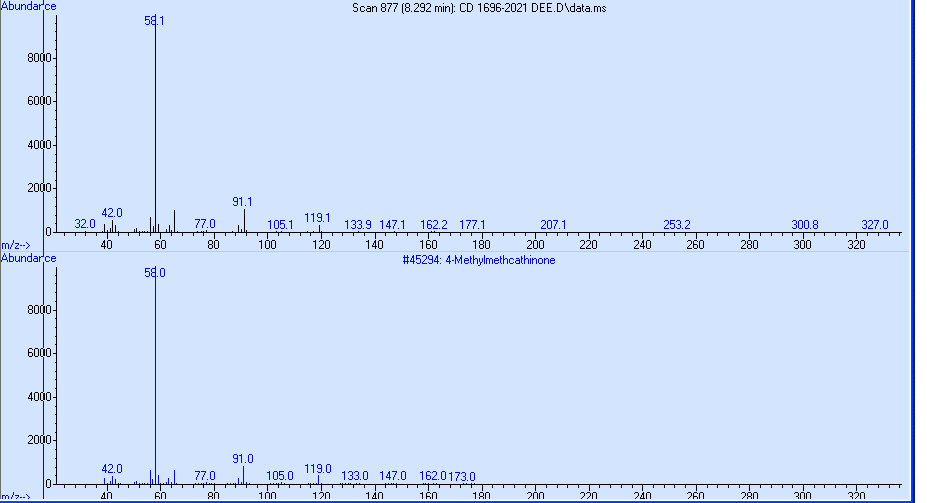
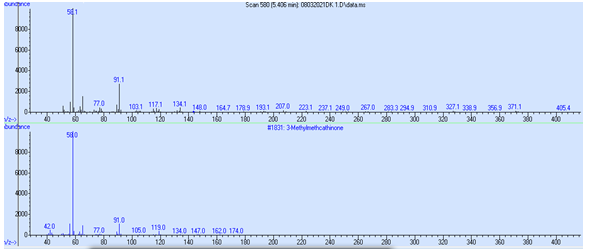
According to Recommended methods for the Identification and Analysis of Synthetic Cathinones in Seized materials by United Nations, 2020, the mass spectrum of both 4-MMC and 3-MMC are similar, however Retention times in TIC are different. This is a major limitation in identification of structurally similar isomers of methcathinones using GCMS. However Fourier Transform Infrared Spectroscopy (FTIR) can be applied for accurate identification of structurally similar isomers, 4-MMC and 3- MMC. When not in the pure form, preparatory TLC can be used to separate the samples, and then to identify the components.
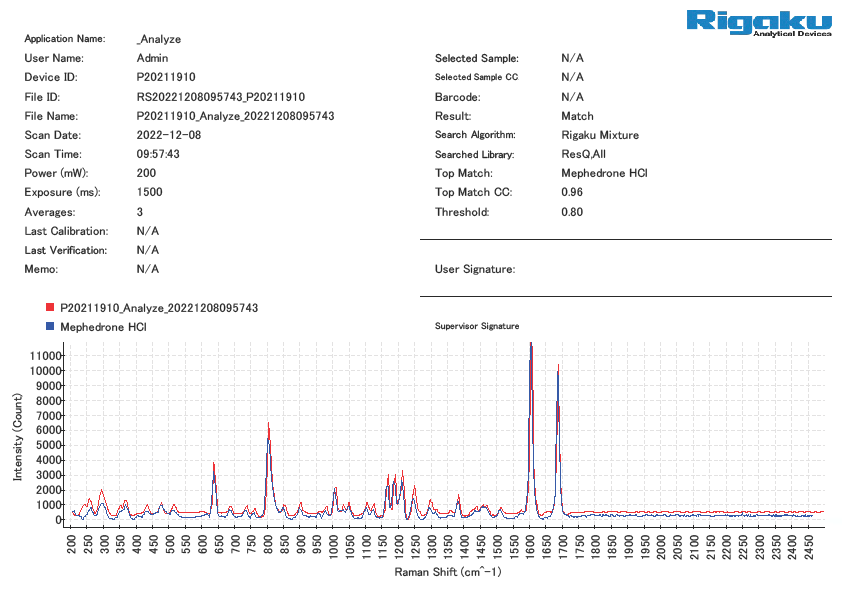
Raman spectroscopy match of 96% for Mephedrone was obtained for the off white powders in case 1 and 2.
Conclusion
Analytical results revealed the presence of Mephedrone in the off- white powder in both cases 1 and 2, while the presence of 3-MMC in the crystalline substance in the case 3. However, the complete functional group assignment of a molecule can be determined using the Nuclear Magnetic Resonance Spectroscopy (NMR). Therefore, further studies should be developed for complete structure elucidation.
4-MMC and 3-MMC were identified for the first time in the Narcotics Laboratory of the Government Analyst’s Department during the analysis of the unknown substances of the above three cases. Sri Lanka has also taken steps to include Mephedrone in the recent amendment (Amendment No.41 of 2022) to the poison, opium and dangerous drugs ordinance. It is high time for legal authorities to pay more attention in controlling Mephedrone, Mataphedrone and other “legal highs” in Sri Lanka.
Acknowledgement
We would like to express our gratitude to Mrs. Sakunthala Tennakoon (Government Analyst- retired) for her valuable guidance in the preparation of this manuscript.
References
-
United Nations Office on Drugs and Crimes (2013) The challenge of new psychoactive substances. Global Smart Programme, Austria.
-
Kelly PJ (2011) Cathinone derivatives: a review of their chemistry, pharmacology and toxicology. Drug testing and analysis 3(7-8): 439-453.
-
(2020) Recommended Methods for the Identification and Analysis of Synthetic Cathinones in Seized Materials. United Nations Office on Drugs and Crimes pp: 1-60.
-
Papierz GB, Poleszak E, Serefko A (2023) Mephedrone – a synthetic derivative of cathinone. Current Issues in Pharmacy and Medical Sciences 36(1): 54-64.
-
Drug Enforcement Administration (2019) 4-Methylmethcathinone (Mephedrone). US Department of justice.
-
Ferreira B, Silva DD, Carvalho F, Bastos MDL, Carmo H (2019) The novel psychoactive substance 3-methylmethcathinone (3-MMC or metaphedrone): A review. Forensic Science International 295: 54-63.
-
Green AR, King MV, Shortall SE, Fone KC (2014) The preclinical pharmacology of mephedrone; not just MDMA by another name. British Journal of Pharmacology 17(9): 2251-2268.
-
Moffat AC, Osselton MD, Widdop B, Watts J (2011) Clarke’s analysis of drugs and poisons : in pharmaceuticals, body fluids and postmortem material, In: 4th (Edn.), London, Pharmaceutical Press, London.
-
Berger J, Staretz ME, Wood M, Brettel T (2020) Ultraviolet absorption properties of synthetic cathinones. Forensic chemistry 21(6): 100286.
- Narcotics and Digital Forensics: Bridging Crimes in the Digital Age
- Ethics in Forensic Psychiatry: Principles, Dilemmas, and Human Rights
- Impact of Acute Stress on Attentional Orienting to Social Cues
- Head Injury and Intracranial Hemorrhage in Western Region of Libya
- A Forensic Study on Handedness: Examination of Handwriting Features in Right and Left Handed Writers
- Techniques for Latent Fingerprint Development Using Natural and Synthetic Powders: A Review