
Scorpions between Death and Ecstasy with Interest in Scorpions in Egypt
Scorpions represent very dangerous arachnids of the order Scorpiones (Phylum: Arthropoda, Kingdom: Animalia). Scorpion envenomation is a life-threatening health issue in tropical and subtropical regions. The Egyptian map can reveal many of these night-crawling creatures in different parts of the country. Scorpion venom has special characteristics that must be more studied to get the mysterious treasure inside. Also, the management of an envenomated person must have a widespread upto- date protocol around the world.
Introduction
Envenomation by scorpion stings (scorpionism)is a major public health issue in many tropical nations because of its frequency and potential severity, particularly among children, who suffer the most severe instances. There are roughly 1900 documented scorpion species worldwide, with just about 30 regarded as potentially harmful to humans [1, 2, 3].
Previous literature on scorpion taxonomy recognizes 16 scorpion families, and all scorpions hazardous to humans belong to the Buthidae family. However, among this family, the species belonging to the genera Androctonus and Leiurus are considered the most significant to humans, causing many envenomations in Africa and the Middle East [4].
“Leirus Quinquestriatus, known as the Egyptian scorpion, or ‘Deathstalker,’ has been isolated from upper Egypt [3].
Types of Scorpions in Egypt and their Geographical Distribution
Random samples were taken from different regions in Egypt, and it was found that there are 8 species of scorpions in Egypt that were classified into two families: Buthidae: its members are abundant in Egypt and Scorpionidae.
| Species | Picture | |
|---|---|---|
| Buthidae | Androctonus bicolor Present in Marsa- Matrough | Adapted from Salama and Sharshar, 2013. |
| Androctonus australias Present in borg EL- Arab, Present in Marsa-Matrough Sinai | Adapted from Salama and Sharshar, 2013. | |
| Androctonus amoreuxi Present in Baltim | Adapted from Salama and Sharshar, 2013. | |
| Androctonus crassicauda Present in east of sinai | Adapted from Salama and Sharshar, 2013. | |
| Leiurus quinquestriatus Present in Aswan | Adapted from Salama and Sharshar, 2013. | |
| Buthacusa arenicola Present in sinai | Adapted from Salama and Sharshar, 2013. |
Othochirus innesi Present in middle of sinai
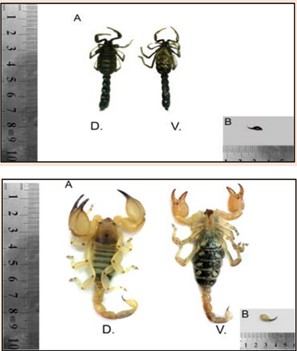
Adapted from Salama and Sharshar, 2013.
Scorpionidae Scorpio maurus palmatus Present in borg EL- Arab and south of Sinai
The Injectable Lethal Dose of 50% (LD50)
Vary according to the species and the affected human according to age but, mostly in children about (0.56 μg/kg) and in adults about (0.37 mg/kg) [5].
The Mechanism of Toxicity
Scorpion toxins are divided into two major types based on their target site and size: Short-chain toxins are composed of 30-40 amino acids and confined by 3 or 4 disulfide bridges that block the K+ channels, whereas long-chain toxins are composed of 60-75 amino acids and cross-linked by 4 disulfide bridges that impact exclusively Na+ channels [6, 7].
Scorpion poisons trigger massive release of neurotransmitters such as catecholamines, resulting in a cascade of events that can escalate to heart failure, pulmonary edema, arterial hypotension or hypertension, arrhythmia, tachycardia or bradycardia, unconsciousness, and death [8].
Abroug’s classification for grading Signs and Symptoms of scorpion sting cases [9, 10] Grade I: Pain and/or paresthesia at the scorpion sting site, tingling, numbness, and minor swelling in the skin area encompassing the sting (local symptoms); Grade II: Fever, chills, tremor, excessive sweating, nausea, vomiting, diarrhea, hypertension, and priapism (systemic symptoms ± local symptoms); Grade III: Cardiovascular, respiratory, and/or neurologic distresses (complications).
Scorpion Venom Applications in Medicine
Medically significant species belong to the genera Buthus, Androctonus, and Tityus Leiurus, and from the Buthidae family [11, 12].
Scorpion venom is used as an analgesic, antiepileptic drug (AED), antimalarial, positive inotropic, immunosuppressant in autoimmune diseases, anticancer in prostate and breast cancers, antidiabetic and antimicrobial [13].
Scorpion Venom as a Cheap High
In developing countries such as Egypt and India, one of the psychoactive faunas is scorpion venom.
As a substitute for heroin, abusers claimed to experience the distinct pleasurable effect of the scorpion sting that was more potent than heroin, without any report of hallucinations or loss of consciousness, the abuser experiences instantaneous anxiolytic effects that could last for about six hours [14]. Reports shows abusers in the interiors of Khyber Pakhtunkhwa (KP), India, also smoke the fume from dead scorpion for same purpose of ‘getting high’ where dead scorpion is dried in the sunlight and then burnt on coal to release smokes that is inhaled by the abuser [15].
Management of Scorpionism
A study by Abd El-Aziza, et al. [16] included 110 Scorpion sting cases that attended the General Hospital of Esna, Luxor, Egypt during scorpion activity months (spring and summer) of 2017 in the studied locality, the study revealed that; the incidence in children is high, females are more vulnerable than males, The most frequent local reactions are local pain, then redness, then swelling. Concerning systemic manifestations; vomiting was the most agonizing complaint, followed by headache and disturbed consciousness. About one-fifth of the cases showed abnormalities in ECG. There was a high recovery rate.
More than half of scorpion stings were due to scorpion- type Leiurus quinquestriatus. Regarding the occurrence of clinical manifestations and overall mortality; there was a higher occurrence of clinical manifestations among Leiurus quinquestriatus sting cases than (Androctonus crassicauda) [16].
Laboratory Evaluation: Laboratory tests are not required in individuals with modest (Grade I to II) envenomation. The following must be acquired from severely envenomed patients (grades III to IV):
- Serum electrolytes,
- Liver enzymes (AST and ALT),
- Blood urea nitrogen and serum creatinine,
- Serum lipase,
- Serum creatine kinase, and
- Urinalysis [17].The surprising news is that the antivenom is not lifesaving.
However, without antivenom, the patient will likely have a prolonged period of distressing symptoms.Most scorpion stings cause moderate envenomation (Grade I or II), with no symptoms. Pain relief with oral drugs (such as Ibuprofen® 10mg/kg; maximum single dosage 800mg), sting site washing, and tetanus prevention are usually sufficient. Patients must be followed for four hours to ensure no further symptom progression. Victims with severe systemic symptoms (e.g., restlessness, muscle fasciculations, hypersalivation, cranial nerve dysfunction, roving eye movements) are more likely to suffer respiratory compromise, myocardial infarction (in adults with ischemic heart disease), hyperthermia, rhabdomyolysis, and multiple organ failure. They require constant monitoring of these problems.
Pregnancy envenomation: Ates et al. (2018) in Turkey reported that Scorpion stings during pregnancy may not have a substantial negative impact on the fetus or mother [18]. The use of anti-venom in pregnant women should be carefully examined when only minimal safety information is available, especially in patients with just local symptoms [19]. Supportive interventions for these patients include frequent suctioning of oral secretions, endotracheal intubation for difficult airway maintenance or pulmonary edema with hypoxemia, and close monitoring for and treatment of myocardial ischemia and/or acute decompensated heart failure in those at risk. d) For pain, provide 1mcg/kg of intravenous fentanyl. Fentanyl was recommended for antivenom administration because, unlike morphine, it did not produce histamine production. If antivenom is not employed, intravenous benzodiazepines (lorazepam® or continuous midazolam infusion) can be titrated to achieve drowsiness and relieve muscle stiffness. When administering antivenom, benzodiazepines should be administered with caution or avoided altogether. Antivenom reverses the excitatory effects of scorpion venom, and children who have taken large doses of long-acting benzodiazepines (such as lorazepam®) may become too sedated, necessitating intubation [20]. To treat increased muscle activity and anxiety in pediatric patients, a short-acting benzodiazepine was selected (Midazolam®, beginning dose: 0.05 to 0.1mg/kg). After administering antivenom, clinicians should watch patients for signs of over- sedation and avoid administering further benzodiazepines. Antivenom caused symptoms to resolve quickly with no immediate or delayed hypersensitivity reactions, and it was advised that antivenom be made more widely available in areas where it is most required.
Before administering scorpion-specific F(ab’), make sure to have two antivenoms, medicines, and anaphylactic equipment readily available, such as IV fluids, epinephrine, and intubation equipment [21]. Allergic reactions should be treated by discontinuing the intravenous infusion of the antivenom and treating symptoms appropriately. Prompt intramuscular epinephrine injection in the mid-outer thigh. Prazosin blocks alpha receptors, which corrects the inappropriate hemodynamic and metabolic consequences of circulating catecholamines [22]. Prazosin is used in rural areas where antivenom may not be available as it is a very cheap physiological antidote.Prazosin Therapy-Prazosin 30 µg/kg/dose (1mg for adults, 500 µg for children) is given orally and then every 3h till extremities are warm, and dry and peripheral veins are visible [23].
Conclusion
Scorpion envenomation is a risky problem worldwide. The most dangerous clinical types in Egypt are Leiurus quinquestriatus and Androctonus crassicauda. The antivenom is not lifesaving but is given to neutralize the free venom and its amount is given according to the amount of the injected venom. Scorpion venom has many medical and non-medical uses.
References
-
Ahmed AE, Abdel-Baseer KA, Saad K, Hassan AF, El- Houfey AA (2015) Endocrinological and biochemical changes of scorpionism in children in Upper Egypt. Ther Adv Endocrinol Metab 6(5): 210-216.
-
Mohamad IL, Elsayh KI, Mohammad HA, Saad KA, Zahran AM, et al. (2014) Clinical characteristics and outcome of children stung by scorpion. Eur J Pediatr 173(6): 815- 818.
-
Amina R, Faiz A (2014) Scorpion Sting and Envenomation. Clinical Toxinology in Asia Pacific and Africa pp: 455- 482.
-
Saad K, Abd El-Hamed MA, Abo-Elela MGM, Ahmed AE, Abdel-Baseer KA, et al. (2017) Neurologic Complications in Children with Scorpionism: A Retrospective Study in Upper Egypt. Journal of Child Neurology 32(6): 537-542.
-
Saganuwan SA (2018) Determination of median effective dose (ED50) of scorpion antivenom against scorpion envenomation using a newly developed formula. Animal Model Exp Med 1(3): 228-234.
-
Ortiz E, Gurrola GB, Schwartz EF, Possani LD (2015) Scorpion venom components as potential candidates for drug development. Toxicon 93: 125-135.
-
Aboutorabia A, Naderi N, Vatanpour H, Pourbadie HG, Zolfagharian H (2016) Voltage-gated sodium channels modulation by Bothutous schach scorpion venom. Iranian journal of pharmaceutical sciences 12(3): 55-64.
-
Isbister GK, Bawaskar HS (2014) Scorpion envenomation. The New England journal of medicine 371(5): 457-463.
-
Abourazzak S, Achour S, El Arqam L, Atmani S, Chaouki S, et al. (2009) Epidemiological and clinical characteristics of scorpion stings in children in Fez, Morocco. J Venom Anim Toxins incl Trop Dis 15(2): 255-267.
-
Hmimou R, Soulaymani A, Mokhtari A, Arfaoui A, Eloufir G, et al. (2008) Risk factors caused by scorpion stings and envenomations in the province of Kelâa Des Sraghna (Morocco). J Venom Anim Toxins incl Trop Dis 14(4): 628-640.
-
Sadeghian H (2003) Transient ophthalmoplegia following envenomation by the scorpion Mesobuthus eupeus. Neurology 60(2): 346-347.
-
Ozkan O, Uzun R, Adiguzel S, Cesaretli Y, Ertek M (2008) Evaluation of scorpion sting incidence in Turkey. Journal of venomous animals and toxins including tropical diseases 14(1): 128-140.
-
Tobassum S, Tahir HM, Arshad M, Zahid MT, Ali S, et al. (2018) Nature and applications of scorpion venom: an overview. Toxin Reviews 39(3): 214-225.
-
Varghese ST, Balhara YPS, Mondal A (2006) Unconventional substances of abuse: Scorpions and lizards. J Postgrad Med 52(4): 325-326.
-
Jimoh AO, Chibuzor OS, Tukur UM, Abdulmajeed Y, Adamu AA, et al. (2022) Psychoactive Faunas: New Unconventional Substances of Abuse. International Journal of Innovative Science and Research Technology 7(3): 1550-1561.
-
Abd El-Aziz FEZ, El Shehabyb DM, Elghazally SA, Hetta HF (2019) Toxicological and epidemiological studies of scorpion sting cases and morphological characterization of scorpions (Leiurusquin questriatus and Androctonus crassicauda) in Luxor, Egypt. Toxicology Reports 6(1): 329-335.
-
Morsy TA, El Hadidy HA, Abdel-Fadeel EE (2021) Scorpion stings and management with reference to Egypt. J Egypt Soc Parasitol (JESP) 51(3): 459- 474.
-
Ates S, Karahan MA, Altay N, Akelci K, Ikiz N, et al. (2018) Approach to scorpion stings in pregnancy: A retrospective case series and literature review. Taiwan J Obstet Gynecol 57(5): 692-695.
-
Najafian M, Ghorbani A, Zargar M, Baradaran M, Baradaran N (2020) Scorpion stings in pregnancy: an analysis of outcomes in 66 envenomed pregnant patients in Iran. J Ven Anim Toxins Incl Trop Dis 26: e20190039.
-
Buysse DJ (2013) Insomnia. JAMA 309(7): 706-716.
-
Erickson TB, Cheema N (2017) Arthropod envenomation in North America. Emerg Med Clin North Am 35(2): 355- 375.
-
Rathod SG, Tambat SB (2013) Management of Severe Scorpion Sting at a Rural Hospital. Indian Pediatrics 50(6): 613-614.
-
Sahu P, Prafulla (2018) Toxicity of scorpion stings. World Journal of Pharmaceutical and Medical Research 4(4): 123 -126.
-
Salama and Sharshar(2013) Surveillance study on scorpion species in Egypt and comparison of their crude venom protein profiles. The Journal of basic and applied zoology. 66(2):76-86.
- Narcotics and Digital Forensics: Bridging Crimes in the Digital Age
- Ethics in Forensic Psychiatry: Principles, Dilemmas, and Human Rights
- Impact of Acute Stress on Attentional Orienting to Social Cues
- Head Injury and Intracranial Hemorrhage in Western Region of Libya
- A Forensic Study on Handedness: Examination of Handwriting Features in Right and Left Handed Writers
- Techniques for Latent Fingerprint Development Using Natural and Synthetic Powders: A Review