
Regional Differences in Arb Countries’ Young Female Radicalization
The research describes current states of radicalization among Arb youth women and investigates the regional differences in the levels of radicalization among young Arab women from 12 Arab states: the Levant, which includes Jordan, Lebanon, and Syria; North Africa, which includes Morocco, Tunisia, Libya, and Algeria; and the Gulf Cooperation Council (GCC), which includes Kuwait, the United Arab Emirates, Oman, Kuwait, Qatar, and Bahrain. As a sample, 2326 female students in their teen years were selected. Of these, the GCC comprises 1180 (50.7%), North Africa comprises 521 (22.4%), and the Levant comprises 625 (26.9%). We used a scale-appropriate questionnaire. The radicalization scale has a construct validity of (r = 0.73, α = 0.00) with the LSC scale., and the scale has high reliability (α = 0.96, N = 2326, items 44). Researcher founds a substantial impact of regional location on female radicalization in the GCC, North Africa, and Levant countries, as well as on each of the radicalization components individually.
Introduction
The Arab States region has the second-widest gender gap globally, behind South Asia, with women making 14% less progress in human development than men. This inequality hinders the region’s ability to achieve the 17 Sustainable Development Goals of the 2030 Agenda. Despite national policies and legislation to combat gender inequality, progress has been slower than the global average. The region’s legal systems deny women and girls equal rights and access to courts, preventing social and economic disempowerment [1].
The Arab world faces persistent gender discrepancies, particularly in employment, due to factors such as oil, patriarchal cultures, colonialism, and religious interpretations. Female unemployment in the region has only increased in recent years, rising from 18% in 2000 to nearly 22% in 2020. The unpaid workforce disproportionately includes Arab women, who outperform men in this crucial type of labor. The Arab world has the most restrictive gender norms, with restricted freedom of movement, workplace legislation, salary inequities, and limitations on women- led entrepreneurship. Women face significant obstacles in their pursuit of safe jobs, with only 20% of seats in national parliaments and fewer than 10% in affluent Gulf states. Public administration, education, health care, and agriculture employ over two-thirds of women, with the percentage of women in agriculture declining from 41% in 2000 to 23% in 2022. The services sector has seen a 20% increase in female employment over the last 20 years. The most gender-inequitable regions in the Arab world, such as the Gaza Strip, Yemen, and Syria, also have poor humanitarian results. Ensuring female participation does not guarantee peace or prosperity, but neglecting the viewpoint of half the population, who are disproportionately responsible for the survival and well-being of households and communities, is a mistake [2].
Along with more conventional forms of violence like sexual abuse and wife-battering, Arab women experience specific forms of domestic violence throughout their lives, including: disrespect, honor-related violence against married and unmarried women, carelessness, female genital mutilation, lack of education or access to education, confinement at home, sexual abuse, child marriages, forced marriages, temporary and polygamous marriages, and abuse by other family members (brothers, parents, and in-laws). They encounter many sorts of sexual assault and commercial exploitation when they are not at home [3].
People often perceive the issue of women becoming radicalized terrorists as a male-only problem, viewing them as powerless, passive, victims, and mothers in conflict situations. However, it is not inherently more dangerous than men, and terrorist organizations often exploit the image of a calm woman to attract new members. Raising awareness of violent extremist messaging and recruitment tactics is crucial, and the media should avoid perpetuating stereotypes about women’s roles. The misconception that women are not involved in violent extremism or terrorist radicalization, which exacerbates their underrepresentation in law enforcement and security personnel, requires further scientific investigation. Both parents and society must address the risk of terrorist radicalization, especially between the ages of 12 and 20, to prevent the spread of violent extremist narratives [4].
The role of gender in radicalization and the prevention and countering of violent extremism (PCVE) has not been fully discussed in academic research. In a study on women’s radicalization in Jordan, just 13% of respondents thought that women were under greater pressure than men to radicalize, 31% thought that men were under more pressure, and 53% thought that both men and women were equally affected by these influences. Intolerant remarks are seen by both men and women as a blatant sign of radicalism among Jordanians, but women respondents—particularly female university students—were significantly more likely to see conservative attire as a sign. Outside of metropolitan areas, women have also pointed to the marginalization of women’s roles in society as a sign of radicalism. Many believe that embracing more conservative religious beliefs and behaviors is correlated with signs of women being radicalized. The respondents listed a number of different factors as possible catalysts for the radicalization of women and girls. These included financial and economic pressures (69%) and social and family issues, such as domestic abuse and barriers preventing women from exercising their rights, like inheritance (34%) [5].
Studies reveal that women who joined Da’esh or ISIS have distinct backgrounds and sociodemographic compositions. A sense of adventure, the possibility of marriage, the desire to contribute to the establishment of an ideal Islamic state, the desire to be a part of something greater and more divine, and the felt moral obligation to assist their Muslim brothers and sisters are just a few of the reasons behind their actions. The problem of radicalization is intricate and multifaceted. Comprehending and addressing female radicalization necessitates an identical, multifaceted strategy. Moreover, it is advisable to use caution when incorporating findings about heightened susceptibility to radicalization into policies and initiatives, as posited by several experts. Categorizing particular groups as being more susceptible to radicalization may backfire since it exacerbates stigma and alienation [6]. Some studies found females were significantly higher than males on the violent extremist scale [7]. Studies in the region lack valid measures of radicalization [8] and showed that females are higher in radicalization than men, but it is rare to move from radicalization to terrorism [9]. Social macro- and individual micro factors attributed to radicalization for both males and females [10]. Males and females were victims of radicalization [11] and [12]. Causes of radicalization like isolation as a result of marginalization, inequality, alienation, and restrictions in public areas. Women and girls are frequently more vulnerable to radicalization and recruitment [13, 14, 15, 16]. Levels of radicalization for both males and females are at an alarming point in universities [17, 18]. Fears of future terrorism [19]. This study describes the levels of radicalization among Arb youth women and examines the regional variations in the levels of radicalization of young women in the Arab world among women from 12 Arab states.
Methodology
The study selected a sample of 2326 young female students. Of these, 1180 (50.7%) are from GCC countries, 521 (22.4%) are from North Africa, and 625 (26.9%) are from the Levant countries.
Research Tool
Violent radicalization and violent extremism are used interchangeably and regarded as the willingness to use violence, or to support the use of violence, to further particular beliefs of a political, social, economic, or ideological nature. The questionnaire developed by Al-Badayneh, Al-Badayneh, et al. [20, 21] used as a research tool, is composed of demographic information, and a radicalization scale (44 items).
Validity and Reliability
The construct validity is estimated. The construct validity of the scale was estimated by calculating the correlation between the radicalization scale and the low self-control scale and finding a significant positive relationship (0.73, α = 0.000), a sign of the validity of the scale. The reliability of the scale is strong and was estimated by Cronbach alpha at 0.96.
Findings
Regional Descriptive Comparison of Females’ General Radicalization
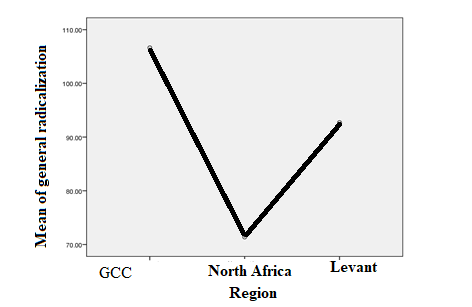
As can be seen from Table 1 & Figure 1, findings showed that females in GCC countries are more radicalized, followed by those in the Levant, and the least were females from North African countries. Most top radical statements center on some religious, social, and cultural taboos, like women’s honor. Elderly status, religious doctrines, religious and tribal commitment, and loyalty. However, females in GCC countries were higher than the grand mean in religious, social, and formal authority, whereas North African and Levant countries were higher in women’s honor and elderly status.
| All Countries | GCC Country | North Africa | Levant Countries | ||||||
|---|---|---|---|---|---|---|---|---|---|
| # | Statement | Mean | SD | Mean | SD | Mean | SD | Mean | SD |
| 1 | I consider the rape of a girl of my religion, as the rape of my sister. | 3.56 | 1.55 | 3.45 | 1.5 | 4.5 | 0.78 | 2.96 | 1.9 |
| 2 | I consider the offense to a man of religion, is be the offense to my father. | 3.31 | 1.62 | 3.27 | 1.54 | 4.1 | 1.2 | 2.4 | 1.8 |
| 3 | I believe the martyrs revive the religion. | 3 | 1.87 | 3.2 | 1.6 | 2.3 | 1.7 | 2.4 | 2.1 |
| 4 | I consider the trial of a young man of my religion, is a trial for my brother. | 2.85 | 1.67 | 3.2 | 1.5 | 2.1 | 1.6 | 2.2 | 1.8 |
| 5 | Muslims are treated unjust in this world. | 2.81 | 1.75 | 2.9 | 1.6 | 2.3 | 1.8 | 2.6 | 1.8 |
| 6 | Religious law should be the sole source of legislation. | 2.78 | 1.68 | 3.1 | 1.5 | 2.1 | 1.4 | 2.3 | 1.9 |
| 7 | The role of police is more important than freedom demand. | 2.69 | 1.76 | 3 | 1.6 | 1.8 | 1.4 | 2.1 | 1.9 |
| 8 | Committed to social norms in my life. | 2.69 | 1.69 | 2.9 | 1.5 | 3.2 | 1.9 | 2 | 1.8 |
| 9 | To obey all types of authority is what students should learn. | 2.55 | 1.67 | 2.8 | 1.6 | 3.6 | 1.5 | 2.2 | 1.8 |
| 10 | Learning by suffering | 3.56 | 1.55 | 2.8 | 1.6 | 2.6 | 1.5 | 2.5 | 1.7 |
| Females’ General Radicalization | 94.7 | 62 | 106 | 40 | 71.3 | 26 | 92.7 | 62 |
Table 1: Top Ten Women Radical Statements by Region.
Region Females’ General Radicalization Difference
Table 2 shows the ANOVA analysis to test the mean differences in females’ radicalization attributed to the region. As can be seen from Table 2, there are significant differences between the GCC countries, North African countries, and Levant countries in females’ radicalization.
| Source of Variance | Sum of Squares | df | Mean Square | F | Sig. |
|---|---|---|---|---|---|
| Between Groups | 45371.436 | 2 | 2268.218 | 112.13 | 0 |
| Within Groups | 469372.356 | 2320 | 2023.157 | ||
| Total | 514744.792 | 2322 |
Table 2: ANOVA Table for Females’ General Radicalization by Region.
Differences in Females’ Radicalization Dimensions Region
Table 3 shows significant differences in each dimension of radicalization scale.
Dimension Source of Variance Sum of Squares df Mean Square F Sig.
Women
Between Groups 3400.107 2 1700.053 107.908 0
Within Groups 36550.796 2320 15.755
Total 39950.903 2322
Exclusion
Between Groups 7324.822 2 3662.411 211.741 0
Within Groups 40128.276 2320 17.297
Total 47453.098 2322
Anti openness
Between Groups 6278.795 2 3139.397 219.797 0
Within Groups 33079.874 2316 14.283
Total 39358.668 2318
Jihad
Between Groups 1372.647 2 686.324 34.718 0
Within Groups 45863.489 2320 19.769
Total 47236.136 2322
Centrism
Between Groups 2544.764 2 1272.382 69.397 0
Within Groups 42499.875 2318 18.335
Total 45044.639 2320
Doctrine
Between Groups 1920.296 2 960.148 51.19 0
Within Groups 43459.247 2317 18.757
Total 45379.543 2319
Jihad Groups
Between Groups 3771.906 2 1885.953 115.35 0
Within Groups 37866.118 2316 16.35
Total 41638.024 2318
| Infidel (Takfeer) | Between Groups | 660.972 | 2 | 330.486 | 21.139 | 0 |
|---|---|---|---|---|---|---|
| Within Groups | 36177.576 | 2314 | 15.634 | |||
| Total | 36838.548 | 2316 | ||||
| USE of Force | Between Groups | 2824.637 | 2 | 1412.318 | 77.693 | 0 |
| Within Groups | 42064.395 | 2314 | 18.178 | |||
| Total | 44889.032 | 2316 | ||||
| USE of violence | Between Groups | 6275.008 | 2 | 3137.504 | 187.868 | 0 |
| Within Groups | 38695.229 | 2317 | 16.701 | |||
| Total | 44970.237 | 2319 | ||||
| Social Reference | Between Groups | 2911.883 | 2 | 1455.941 | 92.505 | 0 |
| Within Groups | 36388.86 | 2312 | 15.739 | |||
| Total | 39300.743 | 2314 | ||||
| kindship | Between Groups | 3096.977 | 2 | 1548.488 | 104.234 | 0 |
| Within Groups | 34317.039 | 2310 | 14.856 | |||
| Total | 37414.016 | 2312 | ||||
| Fascism | Between Groups | 1356.688 | 2 | 678.344 | 25.982 | 0 |
| Within Groups | 60413.943 | 2314 | 26.108 | |||
| Total | 61770.631 | 2316 | ||||
| Closure | Between Groups | 2723.11 | 2 | 1361.555 | 148.02 | 0 |
| Within Groups | 21220.851 | 2307 | 9.198 | |||
| Total | 23943.961 | 2309 | ||||
| Gravience | Between Groups | 534.801 | 2 | 267.401 | 28.017 | 0 |
| Within Groups | 22037.558 | 2309 | 9.544 | |||
| Total | 22572.359 | 2311 |
Table 3: ANOVA Analysis of the Differences in Females’ Radicalization Attributed to Location (The GCC Countries, North African Co
Discussion
Twelve Arab states (the Gulf Cooperation Council (GCC): Kuwait, United Arab Emirates, Oman, Kuwait, Qatar, Bahrain; Levant: Jordan, Lebanon, and Syria; North Africa: Morocco, Tunisia, Libya, and Algeria) participated in the study. This study reveals the prevailing levels of radicalization among Arab young females in three culturally different regions (the GCC, North Africa, and Levan countries). According to the European Commission, radicalization is a growing intolerantness towards democratic values and a tendency to use force to achieve political goals that undermine democracy [22]. The present study looks at regional differences in the degrees of radicalization of young women in the Arab world. Women in the GCC expressed a greater level of radicalization than women in the Levant, with women in North African countries having the lowest rates. Women in the Mediterranean and Africa are voicing their concerns against violence and Islamophobia, highlighting the role of radical Islam in promoting violence. They are advocating for women’s rights, Islamic feminism, resistance, challenging biases, and seeking justice.
Despite being in different regions, women in these areas are increasingly facing the same challenges.
Algerian women, for instance, faced societal discrimination and violence in the 1980s due to the 1984 Family Code and patriarchal society. Amnesty International declared that women have little hope for justice and redress for abuses, and current laws continue to perpetuate discrimination and violence [23].
The majority of the radicals thoughts and beliefs focused on three pillars: power (religious, social, and cultural), authority (family, tribe, and state), and status (men’s seniority, women’s reputation, taboos and women’s tribe honor). These pillars are governed by a holy shell, which makes them unquestionable and taken for granted. While women’s honor and senior tribal status were higher in North African and Levantine countries, women in GCC countries outperformed the grand mean in terms of religious, social, and formal authority.
Findings showed there are notable disparities in female radicalization between the three regions (GCC, North Africa, and Levant countries). Such differences can be explained by the differences in the above pillars and the power of each one of them as a behavioral reference in the life of women. The prevalence of high levels of radicalization is also due to Arab women’s status and socialization process. Women are socialized and educated formally and informally, with a heavy dose of power and authority over social, cultural, and religious taboos. This type of social environment can lead to radicalization, but it is rare for it to lead to terrorism. The findings of this study call attention to the importance of understanding women’s radicalization.
Recruiters exploit factors such as alienation, social marginalization, xenophobia, limited opportunities, and psychological issues to influence women’s radicalization. Due to certain “push” factors, like isolation as a result of marginalization, inequality, alienation, and restrictions in public areas, The rejection of Western feminism, online recruitment, peer influence, ISIS ideology, naivety, romantic optimism, and the opportunity to be part of something new influence young women in Western countries to join ISIS. Radicalization is often the culmination of economic, social, and political factors, and women’s normative expectations contribute to their decision to join ISIS. Men often use violence to advance their political, social, economic, or religious beliefs. Women have historically participated in extremist movements and played a crucial role in preventing and countering radicalization. Al-Badayneh, et al. [21] examine the sympathy and support for terrorist groups like ISIS among college students in Jordan. It found that 59% of students expressed radical thoughts, with 66% carrying extreme ideas and 90.7% accepting violence. More than half of the sample expressed conservative thoughts, including stoning adultery cases and segregation of women in the workplace. About 10% of students expressed behavioral and material support for ISIS, with the lowest justification being for seeing ISIS as a defender of Islam. The study found a significant relationship between radical thoughts, violent extremism beliefs, conservative beliefs, stress, victimization, and justification, explaining 56% of the variance in behavioral and material support for ISIS.
Conclusion
Women and girls are frequently more vulnerable to radicalization and recruitment. On the other hand, little is known about the causes of their radicalization and how they cope with it. How women become radicalized and how to empower them to prevent radicalization. Moreover, it is essential to include women in lawmaking, law enforcement, and deradicalization and radicalization preventive plans. The question of women’s bias and misconceptions often frames terrorist radicalization, portraying women as passive, victims, and helpless, thereby reinforcing gender stereotypes. However, we should not assume that women are more dangerous or prone to peace, dialogue, and cooperation than men. Terrorist groups use this image to recruit women. Women play a crucial role in countering violent extremism and radicalization that lead to terrorism (VERLT). Women can contribute significantly by shaping policies, educating the public, and promoting community engagement. They can provide feedback on international counter-terrorism efforts and identify counterproductive practices. Addressing specific political, social, economic, cultural, or educational concerns can help women’s organizations effectively combat violent extremism and terrorist radicalization. Families and society must address the terrorist radicalization risk by requiring parents to respond to their children’s questions about their religious, political, and cultural identities. Inability to openly discuss critical questions could lead to violent extremist narratives, affecting personalities and values between 12 and 20. Policymakers should involve women in prevention and intervention efforts for female radicalization and recruitment. This includes promoting local grassroots initiatives, avoiding demonizing specific groups, offering training to professionals, encouraging women’s participation, and ensuring the quality of prevention and intervention programs. Intervention programs should account for gender expectations and avoid stereotyping women as passive in radicalization. Governments should engage with grassroots women’s organizations to better understand and support vulnerable individuals. Grassroots movements have better access to vulnerable individuals and often have a more diverse viewpoint. Public authorities should identify key women activists and organizations, assess which state agency is best placed to engage with women, and maintain transparency for credibility in the eyes of broader communities and the public. Theoretical radicalization models for women Radicalization emphasizes the need for multilevel analysis, considering factors such as personal agency, identity, structural pressures, and organizational opportunities. Pull-and-pull factors include ideological messages, societal pressures, and enabling factors like charismatic preachers, radical mosques, prisons, and recruitment sites .
Criminal Law Implications
Arab countries need to update their legal and legislative systems to criminalize violent and radical behaviors by women. There is a need for a national plan to fight radicalization and violent radicalization. A broad range of actors, including youth (both male and female), women activists, women community members, religious leaders, tribal leaders, and local government officials (such as mayors, governors, and heads of governmental directorates), must come together to develop such a strategy. Give residents a secure way to report concerns and threats they receive from friends, relatives, or other neighbors to the police. Distribute resources to the locals through these channels so they may assist in reducing these threats and safeguarding their communities. More non-punitive measures, such as alternatives to jail, could support the growth of this type of reporting.
More research is necessary to explore the tactics used by these groups to radicalize and attract others, in order to better understand women’s radicalization, its causes, and consequences, and to design preventive programs. Researchers must question assumptions, methodologies, cultural context, gender-sensitive perspective, and critically evaluate questions on women’s terrorist radicalization, focusing on critical evaluation of sources and discussion. We need to conduct research on the conditions of women’s terrorist radicalization, taking into account historical, social, political, and personal contexts. Identifying common patterns and addressing underlying factors is crucial.
Increase awareness of women’s potential for terrorist radicalization and violent extremist propaganda, involving parents, teachers, social workers, police officers, journalists, and judges, and avoid stereotypical preconceptions of women’s roles and behavior.
Women have historically been involved in terrorist organizations, including the Liberation Tamil Tigers of Eelam (LTTE), the Kurdistan Workers’ Party (PKK), and Daesh. However, research on terrorism often neglects women’s participation in violent groups. Governments have not prioritized non-violent, supportive roles as much as they should. Additionally, women’s minority status in terrorist groups makes them less accessible as research groups. Furthermore, an insufficient gender focus in security institutions often results in bias against considering women, even when they are embedded in the roots of terrorist organizations. There is no common profile of women supporting jihadism, as women’s motivations range from a quest for belonging to an aspiration to build a utopian Islamic state, moral duty, adventure, or marriage. Radicalization is a complex phenomenon, and understanding and responding to it requires a multi-layered approach. The internet and social media play a role in female Islamist recruitment, with ISIS/ Da’esh presenting propaganda in a “traditionally feminine” manner but also attracting brutal and violent imagery.
Refrences
1. UNDP (2024) Gender Justice & the Law in the Arab region. Gender Justice & the Law in the Arab region.
2. Asi YM (2022) Women at Work in the Arab World: Trends, Gaps, and Effects on the Region. Arab Center Washington DC.
3. Doukim S, Ouali U, Ghachem R, Karray H, Issaoui I (2021) Violence Against Women in the Arab World: Eyes Shut Wide Open. In: Laher I (Ed.), Handbook of Healthcare in the Arab World pp: 207-255.
4. OSCE (2013) OSCE Secretariat-OSCE ODIHR Expert Roundtables. Preventing Women Terrorist Radicalization Vienna, The Role and Empowerment of Women in Countering Violent Extremism and Radicalization that Lead to Terrorism Vienna, 12 and 13 March 2012.
5. Aldertron (2016) Women And Violent Radicalization In Jordan. Un Women and the Jordanian National Commission for Women pp: 1-36.
6. Leede SD, Haupfleisch R, Korolkova K, Natter M (2017) Radicalization and violent extremism-focus on women: How women become radicalized, and how to empower them to prevent radicalization. Policy Department for Citizens’ Rights and Constitutional Affairs, Europian Department, pp: 1-100.
7. Al-Badayneh D, Al-Tarawneh ME, Lamchichi AA, Ellamey YM (2024) Religious Observance and Youth Violent Extremism Among Young Arab Students: Implications for Youth Religious Deradicalization. European Journal of Science and Theology 20(1): 1-17.
8. Al-badayneh DM, Al-Assasfeh RA, Ekici S (2023) Developing A Robust Legal System Through Scale for Youth Extremism Across Arab Cultures. International Journal of Criminal Justice Science 18(1): 29-51.
9. Al-Badayneh D, Al-Tarawneh ME, Lamchichi AA, Ellamey YM (2024) Religious Observance and Youth Violent Extremism Among Young Arab Students: Implications for Youth Religious Deradicalization. European Journal
of Science and Theology 20(1): 1-17.
10. Al-badayneh D (2016) Causes of radicalizing among Arab University’s students: Policy and preventive implications. Proceedings from Radicalization, Terrorism and Universities. Turkish Police Academy in Ankara.
11. Al-Badayneh DM, Shahin MM, Brik AB (2024) Strains and Maladaptive Behaviors among High School Students in Qatar: An Empirical Test of the General Strain Theory. Human and Social Sciences Journal.
12. Al-badayneh D Khasman A (2023) Testing Agnew’s stress theory in victims and perpetrators of violence. Journal of Studies in Health Psychology 8(2): 6-11.
13. Al-Badayneh DM, AlHassan K (2016) Religious behavior and radicalization among Arab Youth: Implications for Terrorism Recruitment and De-radicalization. In: Ekici S, Akdogan H, et al. (Eds.), Countering Terrorist Recruitments in the Context of Armed Counter-Terrorism Operations. IOS press.
14. Al-Badayneh D, Khelifa M, AlHassan K (2016) Radicalizing Arab University students: A global emerging threat. Journalism and Mass Communication 6(2): 67-78.
15. Al-Badayneh DM, Al-Assasfeh RA, Al-Bhri NA (2016) Social Causes of Arab Youth Radicalizing. Journalism and Mass Communication 6(12): 743-756.
16. Al-Badayneh DM (2012) Radicalization incubators and Terrorism recruitment in the Arab world.
17. Al-Badayneh DM (2011) University under risk: The university as incubator for radicalization.
18. Al-Badayneh DM, Al-khattar A, Al Hassan K (2011) Fearing future terrorism: Perceived personal, national, regional and international threats of Terrorism. NATO Science for Peace and Security Series E: Human and Societal Dynamics, IOS Press pp: 30-44.
19. (1997) Algeria: Civilian Population Caught in a Spiral of Violence. Amnesty International pp: 1-43.
20. Sadiqi F, Reifeld H (2017) Women and resistance to radicalization. Konrad Adenauer Stiftung, pp: 1-187.
21. Al-Badayneh DM, Almawajdeh MA, Al-Enazi AT (2021) Radical Thoughts: Fears About and Supportin ISIS Among Jordanian College Students. Territorial Defeat to Global ISIS: Lessons Learned, pp: 139-156.
22. Praxl-Tabuchi F (2019) Gendered pathways to radicalization and desistance from violent extremism are lessons from early-intervention programs in the United Kingdom. global center on cooperative security, UN Women: New York, USA, pp: 1-18.
23. Pearson E, Winterbotham E (2017) Women, gender and daesh radicalisation: A milieu approach. The RUSI Journal 162(3): 60-72.
- Narcotics and Digital Forensics: Bridging Crimes in the Digital Age
- Ethics in Forensic Psychiatry: Principles, Dilemmas, and Human Rights
- Impact of Acute Stress on Attentional Orienting to Social Cues
- Head Injury and Intracranial Hemorrhage in Western Region of Libya
- A Forensic Study on Handedness: Examination of Handwriting Features in Right and Left Handed Writers
- Techniques for Latent Fingerprint Development Using Natural and Synthetic Powders: A Review