
Application of Ink Chemistry to Unveil Document Forgeries
The Examination of Questioned Documents (EQD) Laboratory in Sri Lanka is the sole institution authorized to issue case reports to courts of law and other law enforcement agencies. The EQD lab handles a wide range of cases involving questioned documents, including handwriting and signature analysis, counterfeit documents, typewritten documents, charred documents, and questioned rubber stamp impressions, among others. Questioned document cases often involve alterations, additions, and obliterations made with visually similar inks. Although these inks may appear alike, they can be distinguished due to differences in their chemical composition. The non-destructive physical examination of inks on documents typically involves microscopic examination under visible light, followed by analysis using other selective spectral regions, such as ultraviolet and infrared, available in the VSC 8000 (Foster+Freeman, UK). Writing inks with different chemical compounds react differently to various light sources, making this variation valuable for identifying forgeries in questioned documents.
Abbreviations
EQD: Examination of Questioned Documents; VSC: Video Spectral Comparator.
Introduction
Ballpoint inks consist of various chemical compounds, including dyes, pigments, solvents, and additives. The chemical composition of these components can vary between brands and even between different batches of the same brand. When exposed to various light wavelengths, the chemical components in pen ink react differently, producing distinct observational outcomes. This process enables the effective differentiation of inks that may have been fraudulently applied to alter a questioned entry.
One of the non-destructive techniques used to differentiate ballpoint pen inks is infrared luminescence. When the chemical molecules in ballpoint inks are excited by radiation in the visible or near-visible waveband of the spectrum, they emit energy in the far-red and infrared regions, a phenomenon known as infrared luminescence [1]. This technique is valuable in revealing subtle variations in inks and can be used to detect alterations, obliterations, overwriting, and erasures.
Thermochromic inks are well-known for their use in writing pens [2]. These special inks change color in response to temperature changes. When heat is applied, the ink can become transparent, making the writing invisible. Theromochromic inks consists of Leuco dyes [3], color developers and solvents. The principles of thermochromic ink involves a combination of chemistry and material science. At low temperature, when the solvent exists in solid state, dye forms a colored complex with dye-developer resulting in a visible color. At high temperatures, the solvent melts, and the interactions between solvent and developer dominate. As a result of that dye-dye developer colored complexes destroyed leading the system to coloreless state [2, 3].
According to literature review in 2006, Pilot pens inc developed a pen referred to as Frixion® rollerball pen with erasable ink that utilized thermochromic ink [4]. Each pen includes an eraser. When erasing, friction between the eraser and the paper generates heat, which decolorizes the colored ink, turning it colorless. At temperatures below 65°C, the ink remains in its colored form [4, 5].
Case Reports
Case No-1
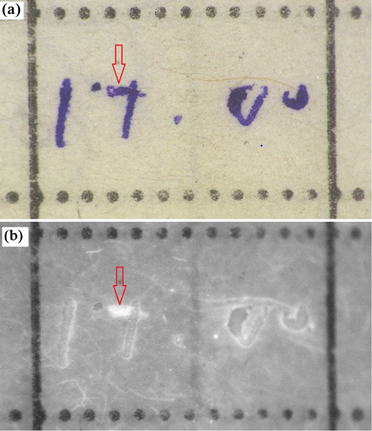
An attendance book with time records was submitted for examination by an institution claiming that its employees had allegedly altered their departure times to increase overtime payments. To the naked eye, there were no apparent discrepancies in the writings, so they wanted to determine whether the suspected time entries had indeed been altered.
Case No-2
A fraudulent check was submitted for examination
Results & Discussion
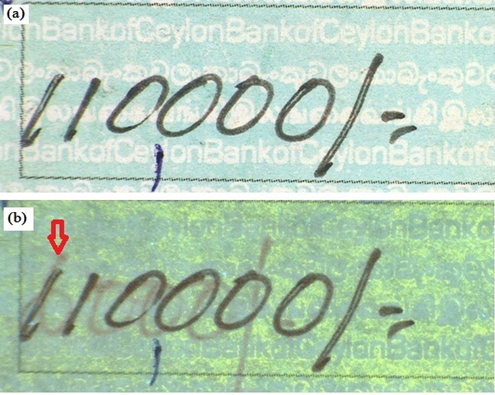
with the claim that the original value written on its surface had been altered. Along with the questioned check, a pen suspected of being used for the writing was also submitted. The complainant, who owned the checkbook, reported that, aside from her signature, the other writings on the check had been altered at a later stage. As part of her usual routine, she would only sign the check, while the other entries were typically completed by someone else.
Methodology
In case no: 1, The questioned time entry in the attendance book was examined under normal light and infrared radiation using suitable magnification with the VSC 8000 (Foster+Freeman, UK).
The suspected check in case no: 2 was examined under normal light and Ultra violet radiation (254 nm) using suitable magnification with the VSC 8000 (Foster+Freeman, UK). To the naked eye, no visible changes were observed on the check’s surface. However, when the check was viewed under UV light of VSC 8000 (Video spectral comparator 8000, foster+ Freeman UK) (Figure 2), the previous writings written under current value ‘110000/=’, became visible. The pen submitted for the examination was a Frixion® rollerball pen made in Japan. The writing made by this particular pen was then physically erased using the eraser on the pen to determine whether this physical erasure could actually remove the writings (Figure 3).
Case No-1
To the naked eye, no differences in the ink were observed. However, under infrared (IR) radiation, the newly added stroke emitted luminescence differently, revealing that the original entry was “11:00.” The time had been altered to “17:00” by adding an extra stroke to the “1” using a different type of ink. Due to differences in chemical composition, inks behave differently under infrared (IR) radiation, allowing for the discrimination between two inks.
Case No-2
The figure that was initially written on the check was ‘6000/=’. The initial writings were erased using the eraser on the top of the pen, which decolorizes the writing through heating. The current entry was then written in the same location.
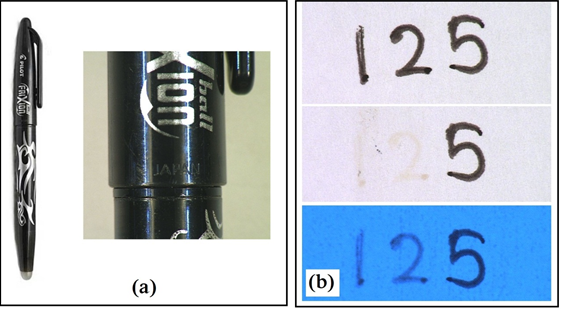
As mentioned earlier, when erasing the heat generated through friction destroy the colored form dye-dye developer complex. This process causes the ink to transform into a colorless form at high temperatures [3]. As a result, the writing disappears.
Conclusion
Writing ink plays a crucial role in detecting forgery by revealing discrepancies in the authenticity of documents. Due to differences in the chemical composition of inks, they behave differently under UV and IR radiation, which can be important for building scientific evidence. On the other hand, although thermochromic ink is designed to disappear with heat, its chemical compounds may leave faint traces that are invisible under normal light but fluoresce or react under UV light. This makes UV light useful for detecting erased thermochromic ink. When inks are involved in the execution of suspected writing on a questioned document, the chemistry of the ink can reveal hidden details to a certain extent.
Conflicts of Interests
There are no conflicts of interest.
References
-
Chowdhry R, Gupta SK, Bami HL (1973) Ink differentiation with infrared techniques. J Forensic Sci 18(4): 418-433.
-
Khatami A, Prova SS, Bagga AK, Ting MYC, Brar G, et al. (2017) Detection and imaging of thermochromic ink compounds in erasable pens using desorption electrospray ionization mass spectrometry. Rapid Communications in Mass Spectrometry 31(12): 983- 990.
-
Kulcar R, Gunde MK, Knesaurek N (2012) Dynamic colour possibilities and functional properties of thermochromic printing inks. Acta Graphica 23(1-2): 25-36.
-
Welch J (2008) Erasable ink: Something old, something new. Science & Justice 48(4): 187-191.
-
Das A, Suneet K, Sudhir K, Sayeed A (2022) Visualization of thermochromic ink and disappearing ink through various techniques on different paper surfaces. International Journal of Medical Toxicology & Legal Medicine 25(1-2): 101-107.
- Narcotics and Digital Forensics: Bridging Crimes in the Digital Age
- Ethics in Forensic Psychiatry: Principles, Dilemmas, and Human Rights
- Impact of Acute Stress on Attentional Orienting to Social Cues
- Head Injury and Intracranial Hemorrhage in Western Region of Libya
- A Forensic Study on Handedness: Examination of Handwriting Features in Right and Left Handed Writers
- Techniques for Latent Fingerprint Development Using Natural and Synthetic Powders: A Review