
Deadly Night Shadows: The Shooting Scene
The triple homicide occurred in the early evening of October 4, 2009, in the rural town in Phelan, California, USA. It was the culmination of years of hostility between the owners of the two adjoining properties. The defendant was tried for three counts of first-degree murder of his neighbor and two of her associates. The prosecutor charged, based on an account of a single witness, poor processing of evidence and lack of expert crime scene analysis that the victims were shot during an argument while they were on the unpaved road in front of the defendant’s house. The defense showed, however, that the defendant was approached on his driveway by his neighbor and her two associates who were intent on harming him. The jury concluded self defense and acquitted the defendant of all charges. This is the first time in American history a man was found not guilty of a triple homicide in a jury trial.
Introduction
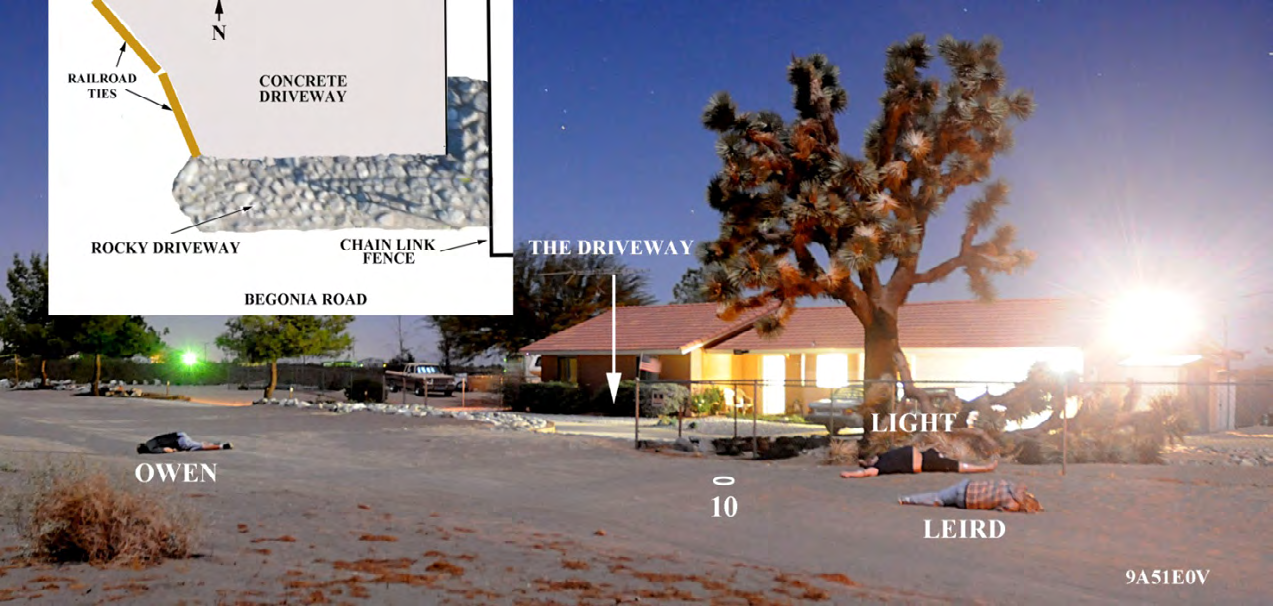
The triple homicide occurred in the unincorporated town of Phelan, San Bernardino County, California, USA, on October 4, 2009, at 1940 h and was the culmination of a 12- year dispute between neighbors Dennis Flechtner and Angela Leird. Over those years, there were frequent exchanges of insults and complaints filed against each other with the San Bernardino County Sheriff’s Office. Angela Leird and her house residents, Adam Owen and Robert Light, claimed that Flechtner would paint insulting signs on the fence facing her property and later paint over them. Images of these signs were not produced. Leird, Owen, and Light died from gunshot wounds on the dirt road in front of Flechtner’s house (Figure 1).
Toxicology revealed that Leird was positive for fentanyl and alcohol and Owen and Light for methamphetamine. Dennis Flechtner, the shooter, claimed he had consumed several drinks before the shooting.
Whitney Telliano, a 22-year-old visitor to the Leird house and friend of Robert Light, claimed prior to the shooting that there was a verbal confrontation between Flechtner and Owen in front of Flechtner’s house. Leird, Light, and Telliano allegedly approached Flechtner’s house to “retrieve Owen.” In one version of Telliano’s account, Leird and Light subsequently succumbed to Flechtner’s alleged taunts and joined Owen in the attack on Flechtner’s driveway in the front of his house. In a later version of her account, the argument and shooting occurred on the dirt road. Whatever the circumstances preceding the shooting, the victims did not realize that Flechtner had a revolver tucked inside his belt. The San Bernardino County District Attorney filed three murder-one charges against Dennis Flechtner. The prosecution’s case relied on the version of the shooting from witness Telliano, that Flechtner and the victims were on the street when he shot them. However, the physical evidence described in this article and presented in court showed that the victims were shot on defendant Flechtner’s driveway (Figure 1, insert) while the victims were in close proximity to him, which supported his claim of self-defense.
Witness Telliano’s credibility was destroyed in court, and the prosecutor’s case collapsed with the testimonies of the defense experts.
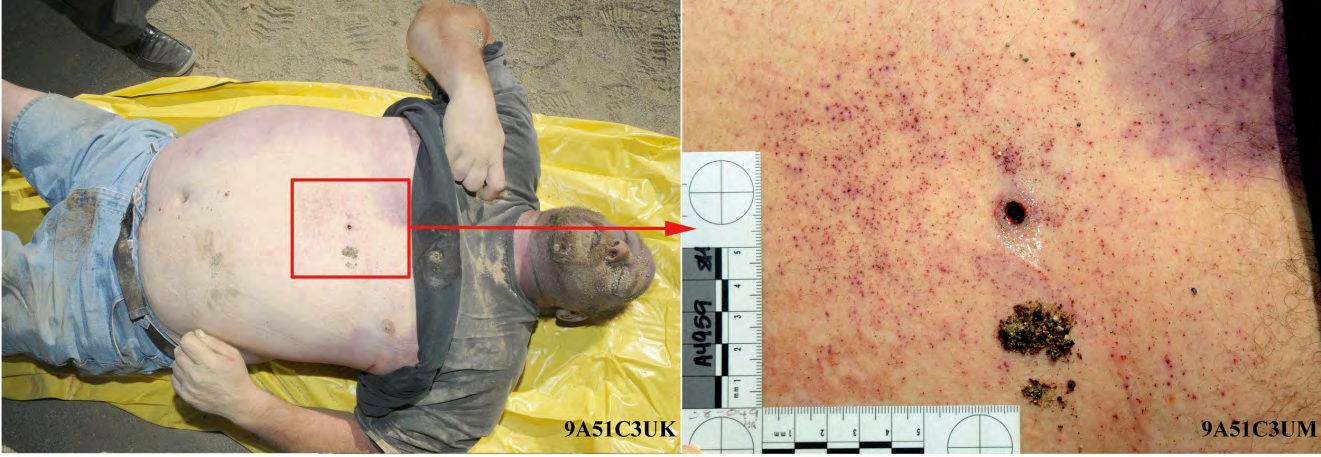
Figure 2. Left, deceased Adam Owen at the scene. Right, close-up image of the bullet wound in Owen’s chest showing gunpowder stippling around the entrance wound, which indicates the muzzle was at an intermediate range to him when fired; the S&W revolver and ammunition require test firing at different target distances to estimate the muzzle-target distance.
Defendant Flechtner testified that one of the three victims, Adam Owen, grabbed his hair in an attempt to pull him to the ground. It was at that time, according to Flechtner, that he pulled the revolver from inside his belt and shot Owen in the chest at close range. Important for the defense presentation in trial in support of Flechtner’s testimony of self defense was to estimate the distance of the revolver muzzle to Owen’s chest at discharge. A feature of close or intermediate range discharge of a firearm’s muzzle to skin is that high momentum gunpowder fragments accompany the bullet to penetrate skin creating small punctate wounds (stippling) [1]. Stippling can occur with the firearm muzzle as much as 24 inches (61 cm) from exposed skin, but usually much less, which depends on the firearm caliber, barrel length, and ammunition type [1]. Owen had stippling around the bullet entrance wound in his chest (Figure 2).
Gary Wenkle Smith, Flechtner’s defense attorney, published an account of the case and trial, Deadly Night Shadows [2] through transcripts of witness Telliano and crime scene reconstruction expert Bryan Burnett are included in Smith’s book.
Materials and Methods
Constrained by the Court
A court-ordered constraint that evidence released to the defense, specifically the victims clothing, should not be altered to prevent further analysis. The defense needed to estimate the distance of the firearm to the victims when discharged, since the crime lab failed to do this critical testing. The standard tests for such measurements are the Modified Griess (tests for gunpowder-derived nitrites) and sodium rhodizonate (tests for lead), both of which rely on an initial acid treatment [3]. The revolver and box of cartridges used in the homicides were provided for the defense tests.
The Murder Book
Discovery was provided to the defense by the prosecution [4].
The Revolver and Ammunition
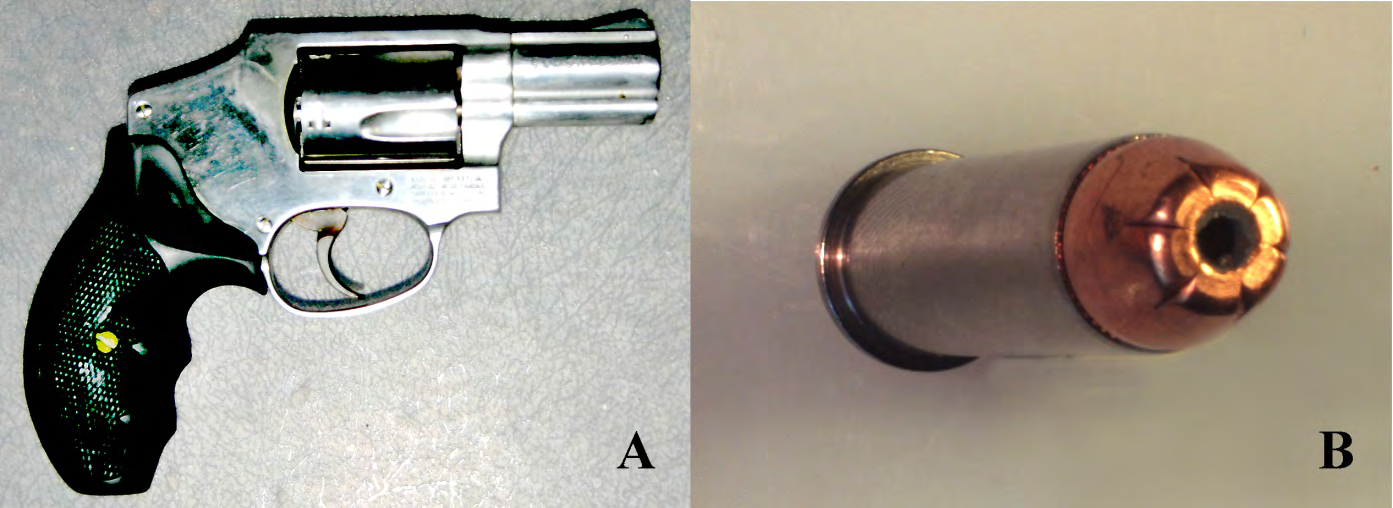
A 5-cartridge Smith and Wesson (S&W) Model 640- 1 .357 caliber revolver (Figure 3A) and Hornady Frontier XTP 158-gr jacketed .357 caliber hollow point (Figure 3B) cartridges were used in this shooting and tested. Duncan’s Gun Works (San Marcos, California) employee “Hugo” noted that these Hornady cartridges had been discontinued and the $10.99 price on the ammunition box that these cartridges were likely purchased in the mid- to late 1970s.
![Figure 4: The test fabric was a worn t-shirt that was similar in weave and fabric thickness to Adam Owen’s t-shirt; the test fabric was fastened over Benchkote paper [3], which was attached to plywood and then shot with the .357 caliber Hornady cartridges in the S&W revolver.](/fulltextimages/13502/fig_4.png)
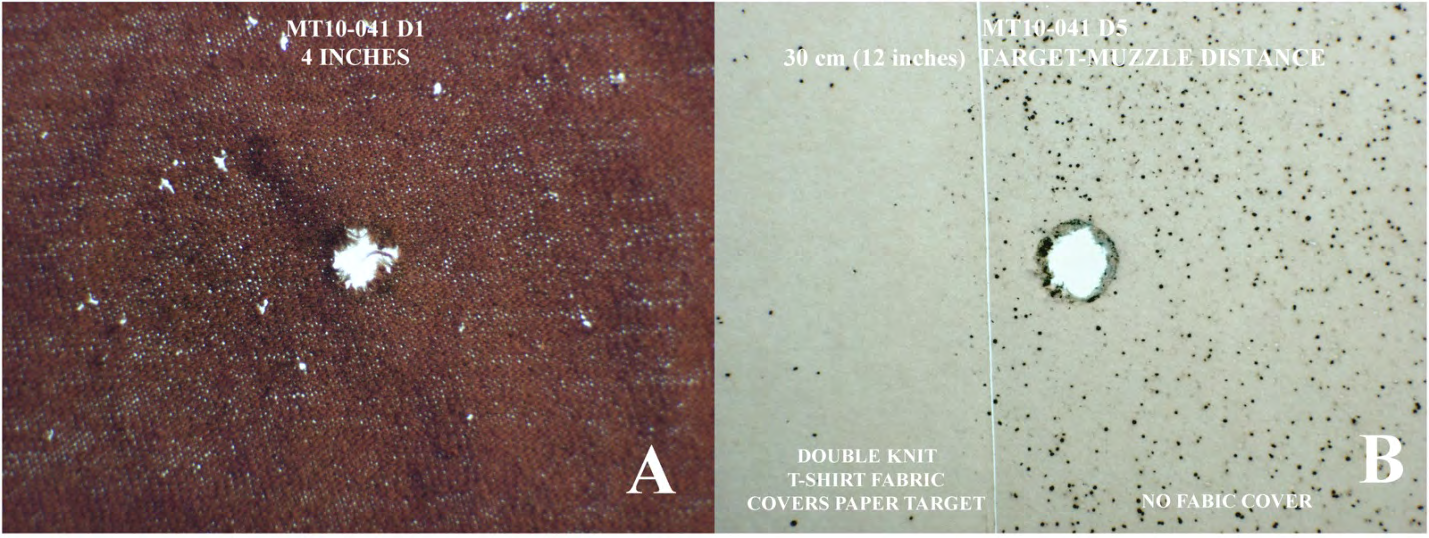
Figure 5. A. Backlit test fabric shot with the.357 caliber revolver muzzle 4 inches (10 cm) from the fabric; penetration of gunpowder fragments produced small holes around the bullet hole. B. The backlit target was shot at 12 inches (30 cm); the left part of the Benchkote material was covered with fabric, and the right part was uncovered. The gunpowder particles appear as dark stipples on the backlit paper. Most of the powder particles were prevented from penetrating the fabric, which covered the left part of the target.
Test Firing of the S&W .357 Caliber Revolver
The S&W revolver (Figure 3A) and Hornady (Figure 3B) ammunition were fired multiple times at Iron Sights indoor range, Oceanside, California, using targets constructed from double knit fabric from a worn t-shirt mounted on Whatman Benchkote paper [3] (Figure 4). The fabric was similar weave and thickness to the t-shirt worn by Adam Owen. Test firings with the revolver and ammunition were also conducted using the Benchkote paper without the fabric covering. The distances between the muzzle and targets ranged from 2 to 23.5 inches (5 to 60 cm) in these tests.
Defendant Flechtner testified that Adam Owen “blindsided” him by grabbing his hair in an attempt to pull him to the ground which was thwarted when Flechtner produced his revolver. In this scenario, Owen would be quite close to Flechtner prior to being shot, which was required to be validated by determining muzzle-target distance. But the Court ordered that testing by the defense of evidence cannot be modified such that future testing would not be possible. The Modified Greiss and sodium rhodizonate tests [3] cannot be used on the victim’s clothing since these tests require acid mobilization of nitrites and lead, essentially destroying the evidentiary value clothing (i.e., the victim shirts) for future testing.
Three nondestructive tests to estimate the muzzle-target distance:
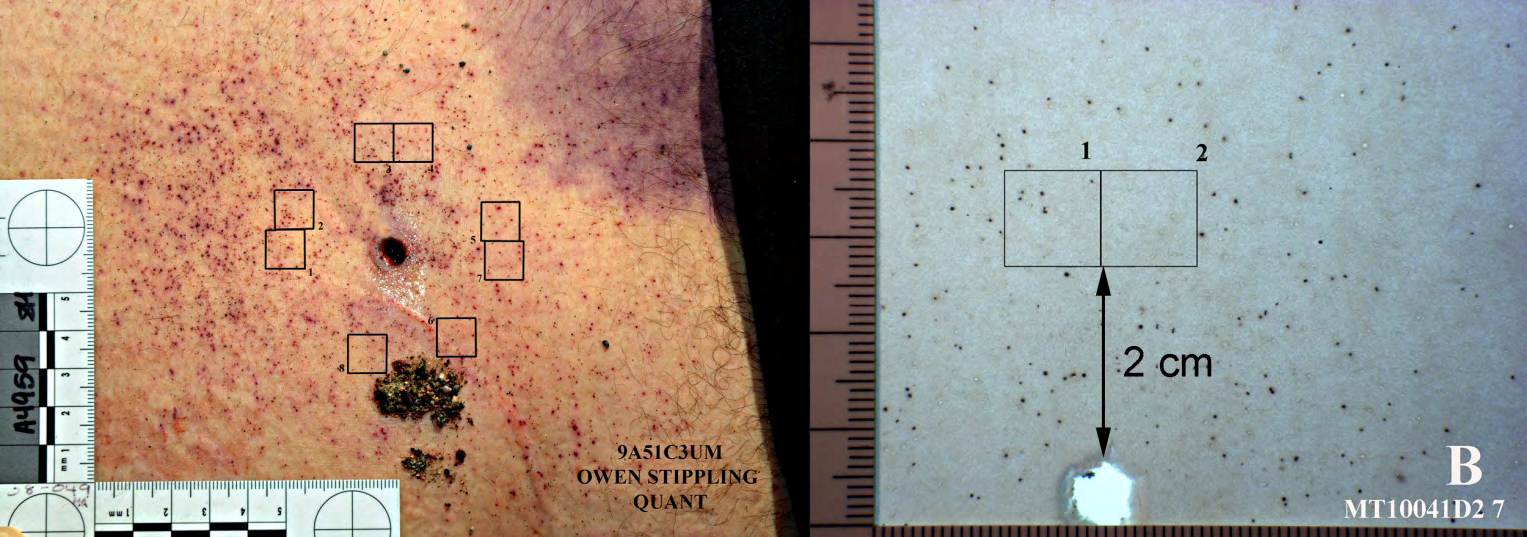
1) Eight 1 cm squares were drawn on the Owen autopsy image 9A51C3UM in Photoshop at a distance of 2 cm from the bullet wound edge. Two squares each were drawn at 0, 90, 180 and 270 degrees (Figure 6A) degrees. The number of skin punctate wounds (stipples) observed within each square were counted.
The test panels, constructed with worm t-shirt fabric over the Whatman Benchkote paper [3] were shot at 2 and 4 inches (5 and 10 cm) muzzle to target. The gunpowder fragments on the Benchkote targets upon removing the fabric were similarly counted within the eight 1 cm squares, 2 cm from the bullet hole edge (e.g., Figure 6B)
2) The average of four radius measurements take at 0, 90 180 and 270 degrees of the skin stipples on Owen’s chest from the bullet wound edge to the border of the stippling pattern were compare to the same measurements on t-shirt fabric covered Benchkote targets shot at 2, 4, 8, 12 inches (5, 10, 20, 30 cm). Benchkote targets without covering t-shirt fabric were shot 4, 6, 12, 12, 16, 19.5, 22.5 inches (10, 15, 20, 30, 30, 40, 50, 60 cm).
3) Small 1 cm square patches of fabric 1 cm from the bullet hole from the victims’ shirt fabric were mounted on an aluminum stub for analysis by scanning electron microscopy/energy dispersive X-ray spectroscopy (SEM/EDS) [5]. Blood was removed from the fabric pieces using a solution of sodium/ calcium hypochlorite (bleach) [6] and the piece examined by backscatter electron imaging in the SEM. This procedure was reported not to affect the adherence of GSR particles to the fabric fibers [6, 7]. The densities of the GSR particles are compared to those of the test fabric samples shot with the same gun and ammunition.
Results and Discussion
Adam Owen: Bullet Trajectory
The Owen autopsy report states, “The bullet path from the entry wound in the front of the torso passes into the upper part of the epigastrium, grazing the upper surface of the left lobe of the liver and continues through the dome of the diaphragm along the posterior inferior aspect of the heart, lower esophagus, through the left lower lung lob, exiting the chest cavity. The wound through the heart is about 10 cm in length, passes through the full thickness of the free wall of the right ventricle” [4]. Previous experience with a similar wound and overlying clothing (t-shirt) [8] and the location of the start of his bloodstains on the rocky part of the driveway indicated that Owen started dripping blood from his entrance and exit bullet wounds within seconds after being shot.
![Figure 7: Adam Owen’s bullet wounds and trajectory. A. Left, anterior view of the autopsy drawing showing the location of the entrance wound and associated stippling; right, posterior view showing the location of the exit wound. From the Adam Owen autopsy report [4]. B. Estimated trajectory (from A and B) through Owen’s body, indicating that Owen was rotating counterclockwise when he was shot, assuming that he initially faced Flechtner.](/fulltextimages/13502/fig_7.png)
Figure 7. Adam Owen’s bullet wounds and trajectory. A. Left, anterior view of the autopsy drawing showing the location of the entrance wound and associated stippling; right, posterior view showing the location of the exit wound. From the Adam Owen autopsy report [4]. B. Estimated trajectory (from A and B) through Owen’s body, indicating that Owen was rotating counterclockwise when he was shot, assuming that he initially faced Flechtner.
Figure 7 illustrates the trajectory of the bullet through Adam Owen’s body. He was rotating counterclockwise when he was shot.
Adam Owen: Muzzle Distance-Target Distance
Adam Owen was shot with a muzzle was close enough to him to produce skin stippling through his t-shirt (Figure 4).
The locations of gunpowder penetration through the test shirt were observable when the test shirt was backlit (Figure 5A). The fabric shielding effect can be seen in Figure 5B, where the left part of the fabric shot at 12 inches (30 cm) was covered; right part was not. The t-shirt fabric acts as a barrier to powder particles that would hit the shirt from an intermediate distance muzzle-target shot.
The gunpowder and stipple counts within 1-cm squares are shown in Table 1.
| Number Per 1cm Region | |||||||||
|---|---|---|---|---|---|---|---|---|---|
| 1 | 2 | 3 | 4 | 5 | 6 | 7 | 8 | X | |
| Owen Chest Stipple | 29 | 31 | 18 | 28 | 16 | 21 | 20 | 38 | 25.1 |
| D3 5cm/2inches | 25 | 29 | 13 | 16 | 21 | 22 | 18 | 15 | 19.9 |
| D2 10cm/4inches | 20 | 18 | 10 | 9 | 13 | 15 | 6 | 13 | 13 |
Table 1: Results of the stipple counts in 1 cm squares from Owen’s chest (top) and from the fabric-covered Benchkote paper shot a
The results of this analysis (Table 1) show that the density of the gunpowder stipples on Owen’s chest within in the 8 squares on average (mean = 25.1 particles/cm2) and the Benchkote target shot at 2 inches (5 cm) (mean = 19.9/cm2) indicating that the muzzle distance to the chest of Owen was less than 2 inches (5 cm). However, this puts in question the reliability of this test because if the muzzle was any closer to the target, the muzzle blast produced a large hole in the fabric and Benchkote paper.
| Target Muzzle Distance | r inches | ||
|---|---|---|---|
| Paper Target only | D7 10 cm/4 inches | 2.25 | |
| Paper Target only | D14 15 cm/6 inches | 4 | |
| Paper Target only | D8 20 cm/8 inches | 4.75 | |
| Paper Target only | D9 30 cm/12 inches | 5 | |
| Paper Target only | D13 30 cm/12 inches | 5.25 | |
| Paper Target only | D10 40 cm/16 inches | - | Gunpowder Pattern off Target |
| Paper Target only | D11 50cm/19.5 inches | - | Gunpowder Pattern off Target |
| Paper Target only | D12 60cm/22.5 inches | - | Gunpowder Pattern off Target |
| Fabric + Paper | D3 5 cm/2 inches | 1.24 | |
| Fabric + Paper | D2 10 cm/4 inches | 2.75 | |
| Fabric + Paper | D4 20cm/8 inches | 3.75 | Few Gunpowder Particles |
| Fabric + Paper | D5 30 cm/12 inches | ~4.75 | Few Gunpowder Particles |
| Fabric + Paper | Owen Chest Stipple | 3.2 | Few Gunpowder Particles |
Table 2: The mean of 4 radius (r) measurements taken at 0, 90, 180, and 270 degrees from the bullet hole margin for each muzzle-t
Table 2. The mean of 4 radius (r) measurements taken at 0, 90, 180, and 270 degrees from the bullet hole margin for each muzzle-target distance entry of the gunpowder stipple areas from Adam Owen and the test shots using the.357 caliber S&W revolver and the same ammunition used in the shooting; the Owen chest stipple mean radius for the 4 measurements is highlighted (taken from image 9A51C3UM (Figure 6A)). Target D5 is a rough estimated due to too few gunpowder particles on the Benchkote paper for a reliable radius estimate.
The pattern of stippling around Owen’s bullet entrance wound was not symmetrical (Figure 6A). The average radius of the stipple area around the bullet hole in the chest of Owen were 4 measurements at 0, 90, 180, and 270 degrees. Mean
measurements were made in the same manner for all test shots with Benchkote paper, both with and without fabric covers (Table 2). Owen’s average radius is 3.2 inches (8 cm), placing the muzzle distance to Owen’s chest from the muzzle, based on the Benchkote targets, at approximately 6 inches (15 cm). Without the fabric cover on the Benchkote target material, the mean was approximately 5 inches (12.5 cm).
The assumptions in these experiments are that the test t-shirt fabric simulated the Owen t-shirt and that Benchkote target paper was appropriate for the simulation. Although Haag and Haag [3] validated Benchkote paper for muzzle- target distance estimations, it appeared unreliable for the estimation of gunpowder penetration (Table 1). The distance of the revolver muzzle to Owen’s chest from these results, taking into account his overlying t-shirt, was less than 2 inches (5 cm) (Table 2). Discharge of the revolver with the muzzle any closer produced a large hole in the cotton fabric and Benchkote paper underneath. Either the test fabric was more resistant than Owen’s t-shirt fabric to gunpowder penetration or the Benchkote poorly simulates human skin.
Unfortunately, the SEM sample taken from Owen’s shirt near the bullet hole in addition to blood was heavily coated with dirt, which with the removal of the blood, remained obscuring GSR particles, if present, on the shirt.
![Figure 8: Robert Light’s bullet wounds and trajectory. A. Left, anterior view of the body in the autopsy drawing showing the location of the entrance wound in the chest after passing through his left arm; right, posterior view showing the exit wound location. From the Robert Light autopsy report [4]. B. Image before autopsy and after the body was cleaned shows the bullet path through the left arm; the position of the upper arm was perpendicular to the body, and the forearm was down, as shown by the arm position with the trajectory rod in place. C. The bullet trajectory through Light’s body (estimated from the drawings A and B); Light was rotating clockwise when he was shot. Robert Light: Bullet Trajectory The Light autopsy report states, “The bullet path from the left axilla passes through the lateral aspect of the left fourth rib, continues through the left upper lung lobe, across the mediastinum, grazing the left atrium and aortic arch, continuing through the right lung and through the posterolateral aspect of the right fifth rib to the exit wound in the back. The aortic arch, though grazed, is not perforated. There is equivocal perforation of the left atrial wall” [4]. The entrance and exit bullet wounds and bullet trajectory are illustrated in Figure 8. Since Light was wearing only a t-shirt, he, like Owen with a similar chest wound, started dripping blood within seconds of his wounding. The first blood drop occurred when he was on the rocky part of the driveway just off the concrete of the driveway. He likely stumbled to the chain link fence east of the driveway and then maneuvered along the fence to collapsing on the north side of the road (Figure 1).](/fulltextimages/13502/fig_8.png)
Figure 8. Robert Light’s bullet wounds and trajectory. A. Left, anterior view of the body in the autopsy drawing showing the location of the entrance wound in the chest after passing through his left arm; right, posterior view showing the exit wound location. From the Robert Light autopsy report [4]. B. Image before autopsy and after the body was cleaned shows the bullet path through the left arm; the position of the upper arm was perpendicular to the body, and the forearm was down, as shown by the arm position with the trajectory rod in place. C. The bullet trajectory through Light’s body (estimated from the drawings A and B); Light was rotating clockwise when he was shot. Robert Light: Bullet Trajectory The Light autopsy report states, “The bullet path from the left axilla passes through the lateral aspect of the left fourth rib, continues through the left upper lung lobe, across the mediastinum, grazing the left atrium and aortic arch, continuing through the right lung and through the posterolateral aspect of the right fifth rib to the exit wound in the back. The aortic arch, though grazed, is not perforated. There is equivocal perforation of the left atrial wall” [4]. The entrance and exit bullet wounds and bullet trajectory are illustrated in Figure 8. Since Light was wearing only a t-shirt, he, like Owen with a similar chest wound, started dripping blood within seconds of his wounding. The first blood drop occurred when he was on the rocky part of the driveway just off the concrete of the driveway. He likely stumbled to the chain link fence east of the driveway and then maneuvered along the fence to collapsing on the north side of the road (Figure 1).
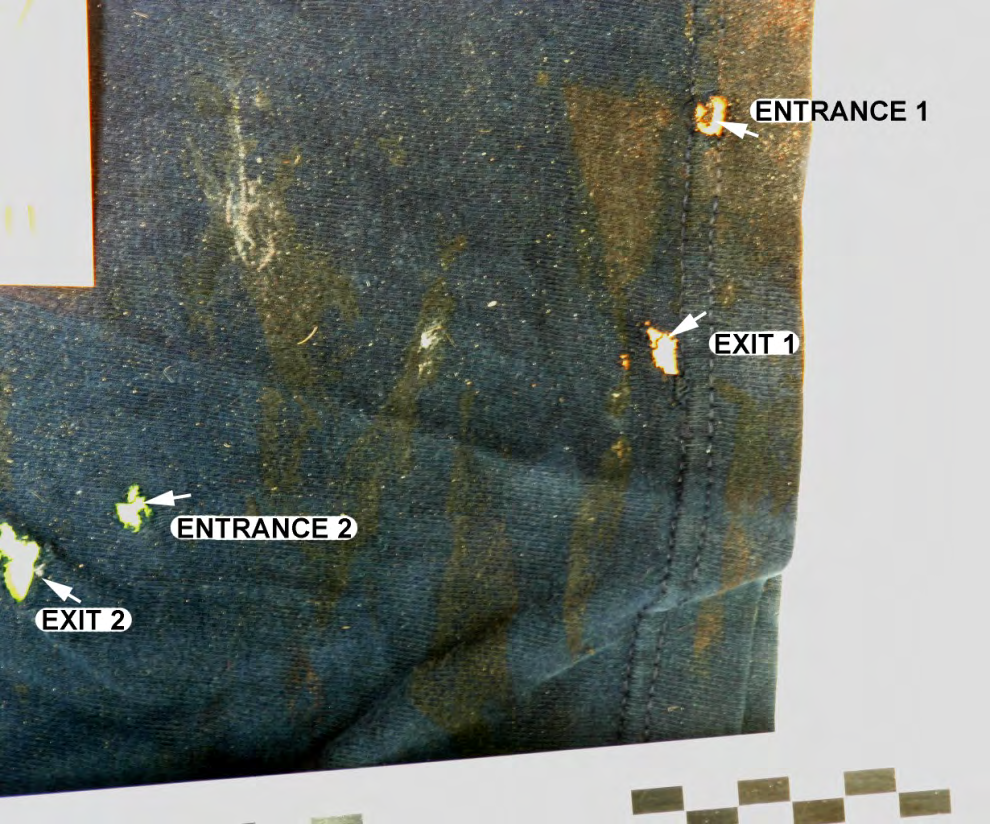
Figure 9. Robert Light’s left anterior t-shirt sleeve shows four bullet holes; entrance 1 was the first strike by the bullet through Light’s proximal forearm. The hole below was from the bullet exit. The other two holes to the left of the shirt in the image correspond to bullet entrance 2 and exit 2 which were consistent with the path of the bullet through his arm, where it entered the upper left arm and exited prior to entering the left anterior axilla and through Light’s thorax (Figure 8).
No stippling was noted on Light’s forearm (Figure 8B). A bullet hole was on the hem of the left sleeve of Light’s t-shirt (Figure 9), which corresponds to the bullet entrance 1 wound in the proximal forearm. There is an exit hole on the shirt sleeve near the entrance hole. A second bullet entrance hole on the sleeve has a nearby exit hole. These defects correspond the wounds on Light’s left arm (Figure 8B).
| GSR | ||||||
|---|---|---|---|---|---|---|
| Characteristics | Consistent | |||||
| PbSbBa | SbBa | PbBa | PbSb | Total | ||
| Light | Left Hand | 171 | 87 | 46 | 221 | 525 |
| Right hand | 9 | 2 | 0 | 14 | 25 | |
| Leird | Left Hand | 2 | 1 | 0 | 6 | 9 |
| Right hand | 39 | 22 | 14 | 146 | 221 |
Table 3: Gunshot residue quantitative results from the samples taken from the hands of Robert Light and Angela Leird [4]; these r
Table 3. Gunshot residue quantitative results from the samples taken from the hands of Robert Light and Angela Leird [4]; these results show that both victims were close enough to the shooter to receive muzzle-blast GSR. Pb = lead, Sb = antimony, Ba = barium. Victim Light appeared to have been closer to the muzzle at discharge than Leird, assuming an equivalent number of discharge GSR particles for each and wind from the west [11] had marginal effect on these depositions.
Robert Light: Gunshot Residue
Gunshot residue samples were collected from the left and right hands of Robert Light [4]. The heavy GSR burden detected on his left-hand sample (Table 3) was from being in range of the muzzle blast of the shot from the .357 caliber revolver, but was not close enough to embed gunpowder in his skin (stippling). The concentration of muzzle GSR on the targets decreased exponentially with distance from the muzzle ([5], Figure 12 therein). It is clear from the GSR burden on Light’s hands (Table 3) that the left side of his body was oriented towards the shooter when he was hit by the bullet. The trajectory of the bullet (Figure 8D) also shows that Light’s left side was oriented towards the shooter when he was shot.
Muzzle GSR was likely deposited on t-shirt if the muzzle was within 2 feet (60 cm) of the arm. No GSR was detected by SEM/EDS on the fabric sample taken 1 cm from the margin of the hole in Light’s left sleeve. Light’s left shoulder was likely more than 2 feet (60 cm) from the revolver muzzle when he was shot [10]. Gunshot residue deposition likely occurred on the shirt (Table 3), but the procedure that removed blood from the fabric [6] appears to have also removed GSR.
Angela Leird: Bullet Trajectory
The Leird autopsy report stated, “The bullet path after the deflection went into the left side of the chest, passing through the left lung along the interlobar fissure and hilus of the lung, exiting the chest cavity through the left fifth posterior intercostal space. At least 2 L of blood in the left pleural cavity. There is no blood in the pericardial cavity, right pleural cavity” [4].
![Figure 10: Angela Leird’s bullet wounds and trajectory. A. Drawings from the Angela Leird autopsy report [4]; left, anterior view of the body showing the location of the entrance wound in her chest. Right is the drawing of the posterior body. The bullet exit wound is at her upper left back. According to the autopsy report, the bullet deflected upward off Leird’s sternum. B. Estimated bullet trajectory (from A) on the horizontal plane through Leird’s body; she was rotating counterclockwise when shot. C. Image after the body was cleaned shows the bullet entry wound with an abrasion, which likely originated from the bullet’s contact with the strap between the bra cups. D. Leird’s bra; the strap between cups likely produced the abrasion associated with the bullet hole seen in C. Curiously, no damage to the strap was noted where the bullet contact likely occurred.](/fulltextimages/13502/fig_10.png)
Figure 10. Angela Leird’s bullet wounds and trajectory. A. Drawings from the Angela Leird autopsy report [4]; left, anterior view of the body showing the location of the entrance wound in her chest. Right is the drawing of the posterior body. The bullet exit wound is at her upper left back. According to the autopsy report, the bullet deflected upward off Leird’s sternum. B. Estimated bullet trajectory (from A) on the horizontal plane through Leird’s body; she was rotating counterclockwise when shot. C. Image after the body was cleaned shows the bullet entry wound with an abrasion, which likely originated from the bullet’s contact with the strap between the bra cups. D. Leird’s bra; the strap between cups likely produced the abrasion associated with the bullet hole seen in C. Curiously, no damage to the strap was noted where the bullet contact likely occurred.
Leird experienced heavy internal bleeding as noted. External bleeding and blood dripping were delayed after her chest bullet wound until she was well into retreating onto the unpaved road. Leird was also wearing a bra and two shirts that had also absorbed blood. Her first blood drip was on the dirt road (Figure 1, at placard 10) and the drip trail continued to where she collapsed.
Angela Leird: Gunshot Residue
Gunshot residue samples were taken from the left and right hands of Leird. The GSR burden detected on her right hand (Table 3) indicates she was within the muzzle blast of the revolver. She may have also received part of the muzzle- origin GSR from the shot at Light. The concentration loss of the muzzle GSR decreases exponentially with distance from the target ([5], Figure 12 therein). It is apparent from the GSR burden on Leird’s hands (Table 3) and by the trajectory of the bullet (Figure 10C) that her right side was oriented towards Flechtner when she was shot.
Only two consistent spherical GSR particles were found on the flannel sweatshirt sample by SEM/EDS. Apparently this technique is not viable for muzzle-target estimates when the shot is beyond the intermediate muzzle-target range.
Scene Measurements
Three detectives measured the shooting scene. “We used the southeast corner of the residence at 4554 Begonia as our reference point. We used a Leica ‘Diasto’ model A5 laser for the measurements (#1061650338).” There was no indication in the discovery of calibration to determine the accuracy and variability inherent in this laser system. Indeed, this laser system appeared to be erroneous for one or more measurements.
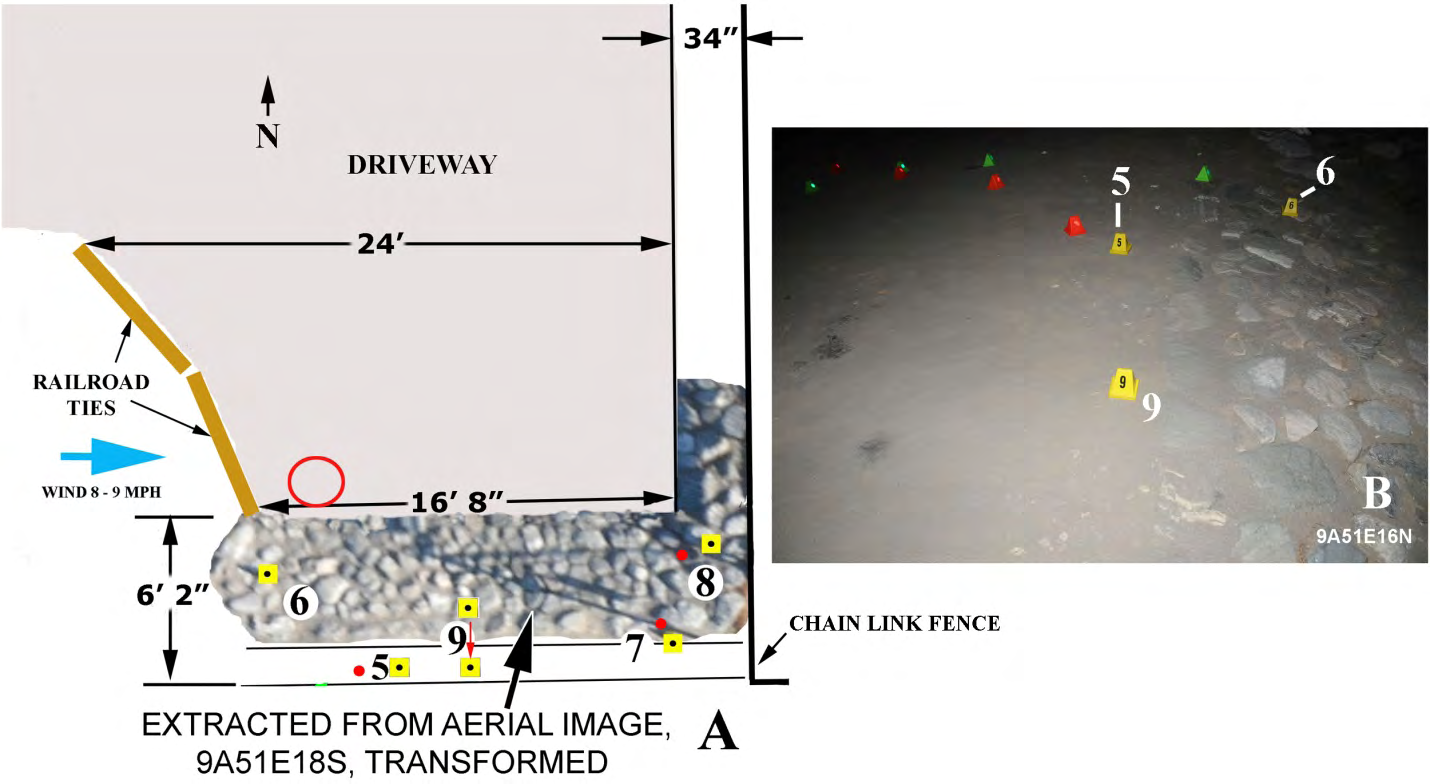
Figure 11. A. Scaled reconstruction using measurements taken at the shooting scene by laser and the author by tape measure; the stone area image overlay was obtained from an aerial image and transformed in Photoshop to compensate for the perspective distortions of the image; yellow squares with central black dots show the locations of evidence. The red dots are the locations of the non-numbered placards marking foot impressions. The red circle is the approximate location of Flechtner at the shooting. The lack of correspondence between the images and evidence for a few measurements (e.g., footprint at placard 9) indicates that the laser-measurement system was unreliable for one or more measurements. The location for the evidence at placard 9, the laser measurement inaccurately placed it in the rocky driveway, was estimated from the image shown in B and actual location is at the entry to driveway. B. Shooting scene image showing placards 5 and 9 (photograph from the east side of the driveway, looking west, are aligned on an east-west axis; the red non-numbered placards mark Owen’s foot impressions on the road dirt; the green placards mark the bloodstains from him.
No architectural features were measured in the shooting area with the laser system. Without architectural measurements (e.g., the corners of the driveway), the measurements of the scene evidence locations are meaningless. The author visited the shooting site to obtain these measurements. Figure 11A shows the laser measurement of evidence 9 (placard 9: Leird’s shoe print) when applied to the scaled scene diagram placed it on the rock entry area (Figure 11A). However, a scene image Figure 11B shows this evidence item marked by the placard 9 was on the dirt of the road not on the rocky part of the driveway.
the evidence measurements. Most evidence measurements by the laser system were consistent with the locations shown in the scene images.
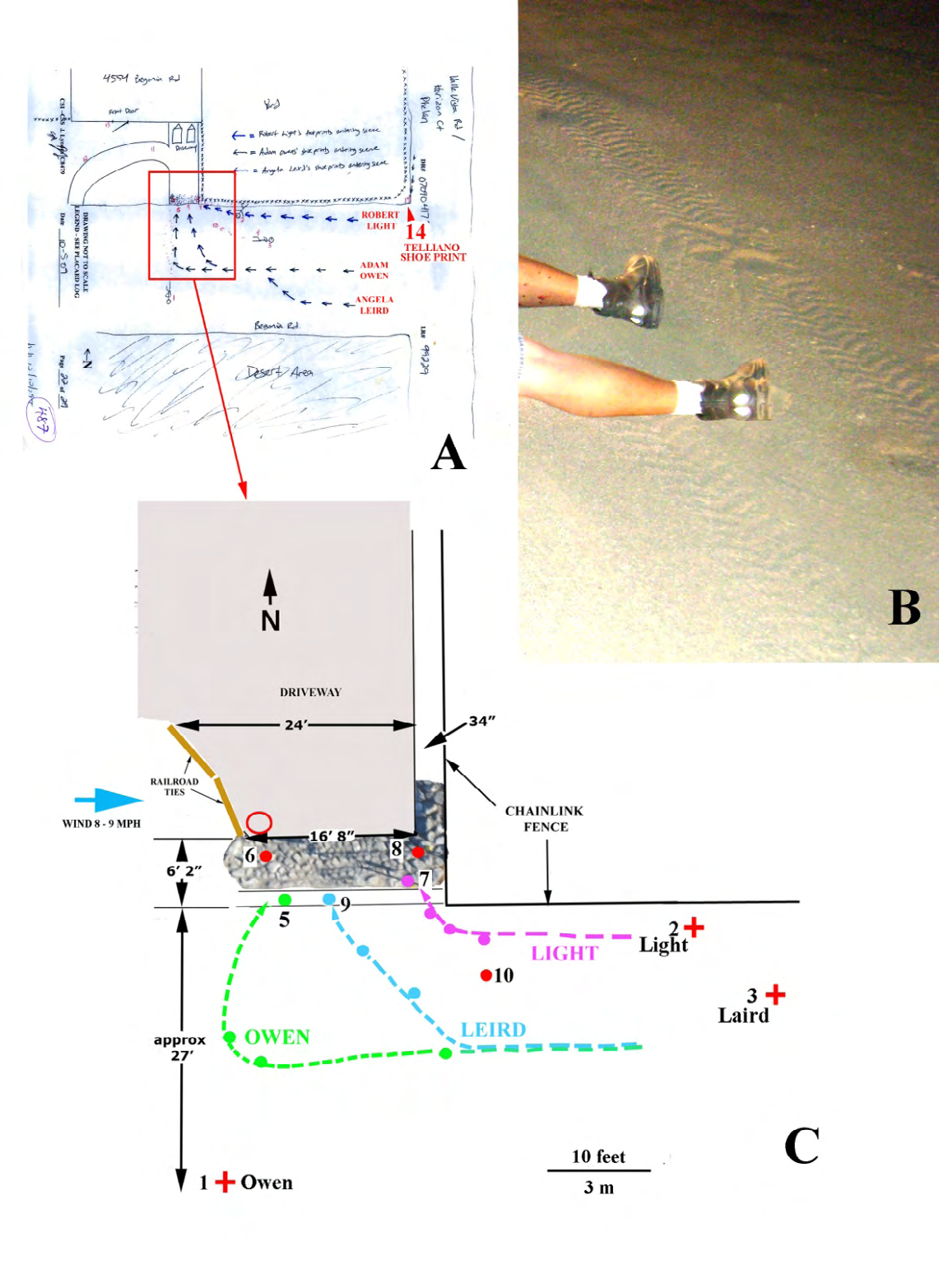
Figure 12. Foot trails of Laird, Owen, and Light on the dirt road. A. Drawing from the discovery in a non-scaled drawing showing the foot trails of the three victims; the identities of the tracks are from the key (upper center of the drawing). The red rectangle outlines the area of the scene to scale detailed in C. The shoe impressions of witness Telliano, despite her being at the scene twice (police reports, and her interview transcript on October 5, 2009), were not recorded at the scene. The only recorded witness Telliano’s shoe print was at the corner of Begonia Road and Valle Vista Road (at 14). B. A thick layer of powdery dirt covered the street, which allowed identification and tracking of each victim’s foot prints and documented their approach to the driveway; Owen’s legs are shown. C. Scaled drawing of the shooting scene created from scene measurements by the laser system and the author; the red circle approximates the position of Flechtner when the shootings occurred. Placards 5, 7, and 9 mark the locations of victims’ entrances by their foot impressions in the dirt leading onto the rocky entry of the driveway. Placard 9 was positioned as shown in the scene images (Figure 11B). The dots are the locations of individual foot tracks attributed to the three victims and were marked in the scene images by unnumbered placards (e.g., Figure 11B). Owen: green dots and dashed line; Leird: blue dots and dashed line; Light: pink dots and dashed line. The red dots mark the bloodstain trail locations of the victims. The red crosses are the locations of the bodies of Owen (1), Light (2), and Leird (3). Placard 6 marks the bloodstain trail attributed to Owen, placard 8 is a bloodstain trail attributed to Light, and placard 10 is the start of the bloodstain trail attributed to Leird.
Footprints on the Dirt Road
The scene criminalists were able to track the victim foot prints on the road dirt (Figure 12A) due to a surface layer of fine loose dirt (e.g., Figure 12B). Non-numbered red placards at the scene and aerial images mark the footprint tracks of Owen, Light, and Leird from Valle Vista Road (road east of the driveway) to Flechtner’s driveway on Begonia Road. The aerial images of the red placards were used to estimate the track measurements from the reference points. Based on the scene measurements, a scaled drawing was constructed (Figure 12C), which showed where the victims entered the rock-embedded area at the front of the concrete driveway.
According to witness Telliano’s first interview, Owen was stationary on the dirt road and arguing with Flechtner when she, Light and Leird approached them. This account does not explain why Leird’s shoe prints were on the middle of Begonia Road (Figure 12A), while Light’s foot prints were on the north side if they were walking together. There is no indication in the foot trail (Figure 12A) of Owen becoming stationary (i.e., leaving multiple foot prints at one location) before he changed direction from walking west to north as he approached the driveway. No foot prints in the road dust were attributed to Flechtner.
Telliano said she was at the scene twice. But her shoe print was only identified on the corner of Begonia Road and Valle Vista Road at placard 14 (Figure 12A). Her witnessing the shooting would have justified marking her shoe prints on Begonia Road along with those of the three victims (Figure 12C).
The foot tracks of the three victims showed that they entered the driveway at different locations away from each other and according to Telliano and the evidence, at the same time. Light approached Flechtner, from the east, Leird from the south mid driveway, and Owen from the south on the west side of the driveway. They were all either on the rocks or concrete of the driveway, within Flechtner’s property, when they were shot.
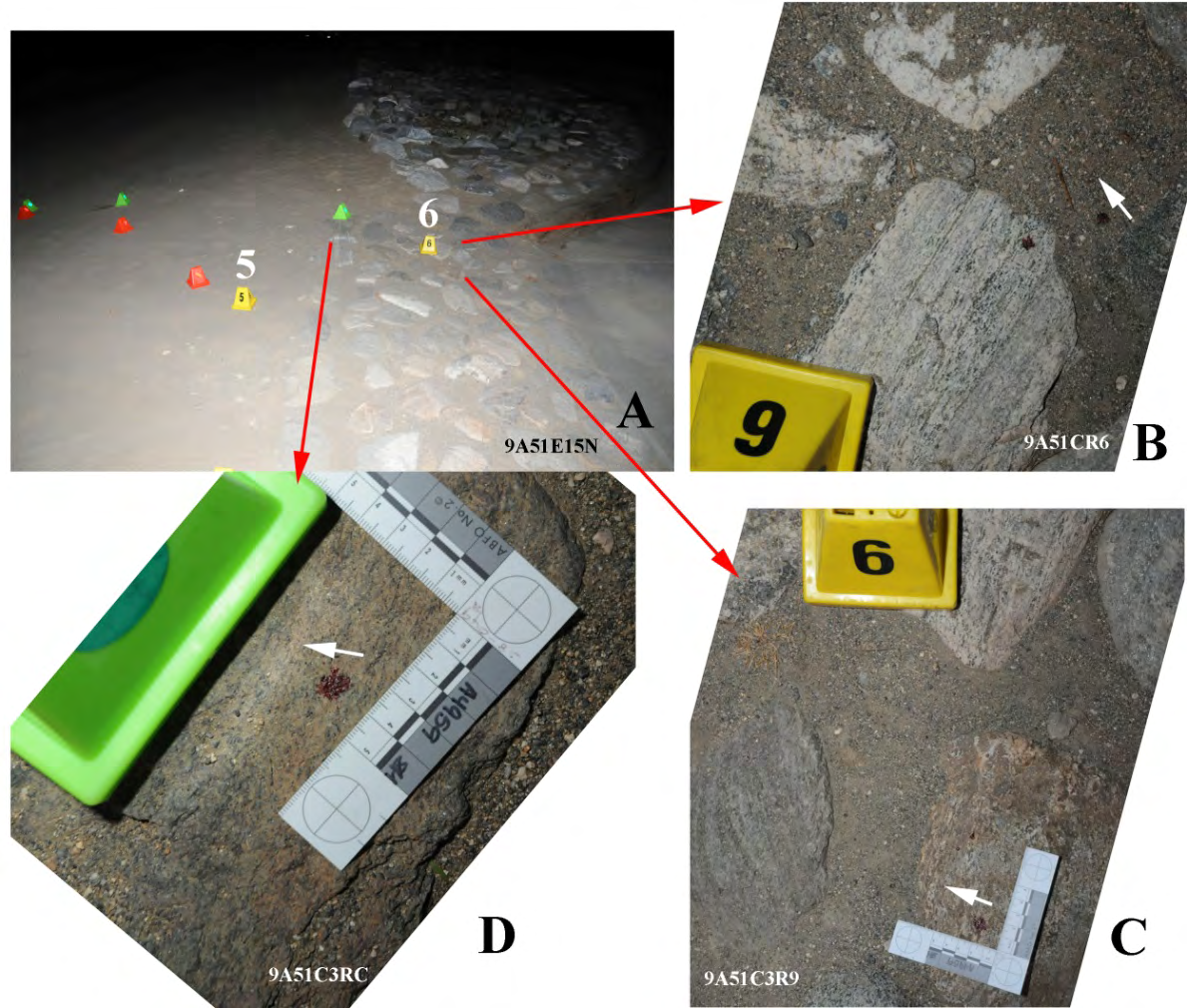
Figure 13. Adam Owen’s blood trail; the red placards mark Own’s shoe print trail; the green placards mark his bloodstain trail. A. the blood trails attributed to Adam Owen were deposited during Owen’s retreat from the shooting site; the image is looking west, with the concrete driveway on the right. B. Blood staining of rock and dirt; white arrow indicates the horizontal vector in which the blood drop traveled before hitting the rock. The bloodstains that show such directionality when deposited indicate the fatally wounded Owen was traveling south to the location where he collapsed (Figures 1 and 12C) on the south side of Begonia Road. C. As in B. D. As in B.
Adam Owen: Bloodstains
Fatally wounded Adam Owen retraced part of the path of his driveway entry. He reached the south side of the road and collapsed (Figures 1 and 12). Placard 6 (Figure 13A) marks the start of Owen’s blood trail onto the dirt road from the rocky driveway to where he collapsed. Figures 13B, 13C, and 13D show bloodstains from Owen on the rocks of the driveway.
![Figure 14: A. Image facing east showing Light’s bloodstain trail on the driveway rocks; the dashed arrow traces the blood trail between the rocky entry to the driveway and the chain link fence. B. Blood on the rocks on the east side of the chain link fence. C. Bloodstains on the rock of the driveway near the chain link fence; arrows represent the horizontal vector on the blood drops before impact; travel direction of a blood drop is indicated by spines that emanate from the main body of the blood drop when it hits a surface [12].](/fulltextimages/13502/fig_14.png)
Figure 14. A. Image facing east showing Light’s bloodstain trail on the driveway rocks; the dashed arrow traces the blood trail between the rocky entry to the driveway and the chain link fence. B. Blood on the rocks on the east side of the chain link fence. C. Bloodstains on the rock of the driveway near the chain link fence; arrows represent the horizontal vector on the blood drops before impact; travel direction of a blood drop is indicated by spines that emanate from the main body of the blood drop when it hits a surface [12].
Robert Light: Bloodstains
Light’s blood dripping began near the southeast corner on the rocky driveway. He was traveling east towards the chain link fence (Figures 14 & 15). His path to the fence was curved (Figure 14A). Telliano notes, “And he shot Robert.
Robert bent over like this, fell into the fence...” (Telliano interview transcript, Oct 5, 2009, p.22). Light impacted the fence with some force, which projected blood beyond the chain links of the fence (Figure 14B).
![Figure 15: The shooting scene reconstruction; the black dots within the yellow squares represent the evidence locations marked by the numbered placards. Placard 9 was placed according to the shooting scene images; the red arrow to Placard 9 points from its inaccurately measured position to its likely position. Flechtner was left handed. For Owen, who received the first shot, the estimated distance from the muzzle to his chest was less approximately 6 inches (15 cm). Both Light and Leird were shot while within the muzzle blast (GSR deposited on the hands of both), which would have placed both on the rocky driveway, but they were not close enough to deposit detectable gunpowder on either. The order of shots to Light and Leird is equivocal. Green dots: locations of the bloodstains from Adam Owen. Pink dots: locations of bloodstains from Robert Light. The bloodstains trace the routes taken by Owen and Light after their woundings. They started dripping blood quickly (within seconds) after being shot. Leird’s blood shedding took longer after her wounding than Owen and Light because she was more heavily clothed and was primarily bleeding internally. She was at the center of the road east of the driveway before she started to drip blood (Figure 12C, at placard 10). All victims were on Flechtner’s driveway when they were shot. The wind direction was from west to east at 8–9 MPH (12 to 14.5 KPH, Blue arrow) [11].](/fulltextimages/13502/fig_15.png)
Figure 15. The shooting scene reconstruction; the black dots within the yellow squares represent the evidence locations marked by the numbered placards. Placard 9 was placed according to the shooting scene images; the red arrow to Placard 9 points from its inaccurately measured position to its likely position. Flechtner was left handed. For Owen, who received the first shot, the estimated distance from the muzzle to his chest was less approximately 6 inches (15 cm). Both Light and Leird were shot while within the muzzle blast (GSR deposited on the hands of both), which would have placed both on the rocky driveway, but they were not close enough to deposit detectable gunpowder on either. The order of shots to Light and Leird is equivocal. Green dots: locations of the bloodstains from Adam Owen. Pink dots: locations of bloodstains from Robert Light. The bloodstains trace the routes taken by Owen and Light after their woundings. They started dripping blood quickly (within seconds) after being shot. Leird’s blood shedding took longer after her wounding than Owen and Light because she was more heavily clothed and was primarily bleeding internally. She was at the center of the road east of the driveway before she started to drip blood (Figure 12C, at placard 10). All victims were on Flechtner’s driveway when they were shot. The wind direction was from west to east at 8–9 MPH (12 to 14.5 KPH, Blue arrow) [11].
Angela Leird: Bloodstains
Angela Leird was bleeding internally, and a bra and two layers of fabric soaked her blood, thereby delaying the time from being shot until she started dripping blood. She was well into her retreat from the driveway onto the dirt road when that occurred (Figures 1 and 12A at 10).
Whitney Telliano: Witness to the Shooting
The effect of witnessing a traumatic event is often equally as traumatic for the witness as for the victim who survives [13]. Witnesses are usually confused in their recall of a traumatic event:
"A strong skepticism and distrust of eyewitness accounts is both justified and encouraged. It is quite common for individuals with no reason or motive to favor one side or the other to be in error in one or more respects regarding their recollection of a shooting incident. Guns that never were there are ‘seen’ and were often ‘fired.’ … The number of shots recalled is often incorrect. The timing of events, the sequence of events, positions and movements of the participants and the distances involved are often not supported by physical evidence. Shooters, victims, and witnesses frequently experience temporal and auditory distortions during shooting. It is more often the exception than the rule that the physical evidence squares with the accounts of eye or ear witnesses in every respect" [3].
Telliano showed she was not an exception. She was interviewed at 0225 h, approximately 6.5 h after the shooting. She was unable to accurately describe the entire event without conflicting with the physical evidence. Her interview transcript [4], contained many conflicts with the physical evidence, but parts of her first interview were consistent with the evidence. Notably, she did not witness Flechtner acting physically aggressively, “The guy might have been scared...” She also describes Flechtner as initially stationary, followed by likely stepping back at the contact with Owen. Flechtner then pulled his revolver and shot Owen, Light, and Leird (Figure 15). Telliano was likely near the corner of the chain link fence at the entrance to the driveway (Figure 15), to be able to describe the shooting as she did.
The support of the physical evidence stated during Telliano’s interview the following morning (from first interview transcript):
pp 13-14. “Robert [Light] and that lady [Laird] started to pass the fence [later identified as the chain link fence] and come towards the driveway, and Adam [Owen] moved in closer too. ...they were still in the dirt, and they moved, they just moved in a little closer." Owen, Laird, and Light moved together onto the rocky entry to the driveway. The footprints from all three (at placards 5, 7 and 9, Figure 12C) indicate that they separately entered the rocky area of the driveway at different locations which are verified by their foot prints in the road dust (Figure 12).
p. 18. “[Flechtner’s] feet were almost, like kind of in the dirt, and at the edge of the concrete.” The Flechtner position was at the end of the driveway concrete (Figure 11).
p. 18. Reference to Light’s position to Flechtner when shot: “Three or four feet” (~1 meter). This distance was estimated based on GSR evidence (Table 3) where Light was within the revolver’s discharge blast.
p. 18. Reference to Leird’s position to Flechtner when shot: “she was probably like maybe five or six feet” (~2 meters). This distance estimate may be exaggerated, but close proximity to the shooter is supported by her being within the muzzle blast, which despite a wind speed from the west of 8 to 9 MPH [11], the GSR evidence (Table 3) places Leird on the rocky driveway entry.
p. 22. “And he shot Robert [Light]." Robert bent over like this, fell into the fence, and said, “Run.” The bloodstains to the east of the chain link fence indicated that Light fell/hit the fence with enough momentum to project blood beyond the chain link fence (Figure 14B). Thus, Light saying to Telliano to “run” likely occurred. She was close enough to the shooting scene for Light to be concerned for her safety.
Telliano left the scene before the mortally wounded Leird, went past the chain link fence corner (Figure 12C), moved east, to the center of the road. The same applies to mortally wounded Light, as he moved east along the chain link fence bordering the Road. Telliano could not have been aware of the status of Light and Leird when she returned to the Leird house to call 911.
Tellianno’s court testimony was impeached on cross [2].
Reconstruction
Foot impressions on the dirt road reveal the three victims approached Flechtner as he stood near the south west edge of the concrete driveway. Flechtner testified that Owen pulled his hair which caused him to draw his pistol. Victims Owen and Leird were on rocky part of the driveway and Light may have been of the concrete (Figures 12 & 15) when they were shot. They were not shot on the street as contended by the prosecution. Bloodstains documented Owen’s and Light’s movements from the rocky area on the driveway to their collapse on the dirt road: Owen on the south side and Light on the north side of the road (Figures 1&12). Victims Owen and Light, started dripping blood (Figure 15) within seconds of being shot. The position of Leird when she was shot was between Owen and Light due to her foot print at the entry of the driveway (Figure 12C). Telliano said that Leird was on the driveway in her first interview. It is unlikely that Leird was standing in the street beyond the southern rocky of the driveway and still receive a muzzle blast GSR, although projection distance of the muzzle blast with a wind of 8 to 9 MPH (12 to 14.5 KPH) [11] could have had an effect that may have reduced the GSR deposition on her hand.
Flechtner was sampled for GSR at the sheriff’s station and was found to have an insignificant amount of GSR on the samplers [4]. A west wind of 8 to 9 MPH (12 to 14.5 KPH) [11] would have moved the cylinder gap GSR cloud from the revolver [14] away from Flechtner. Gunshot residue could have rubbed off Flechtner’s hands during his movements after the shooting, which would include while he was handcuffed in the back of the patrol car. All these factors contributed to a small amount of GSR on his hands despite firing the three shots [4].
All three victims were rotating while they were shot. Owen had the least amount (approximately 30 degrees) from facing Flechtner, and by his proximity to the muzzle of the revolver when he was shot and the location of his bloodstains, he received the first shot. Owen likely saw Flechtner produce the revolver and began his rotation. Light either responded to seeing the revolver before it fired the first time or he responded to Owen being shot. In either case, Light was able to rotate approximately 70° from facing Flechtner before being shot. He had enough time to also step back from Flechtner. Leird rotated approximately 40 degrees before being shot. Her rotation amount depended on when she saw the revolver or witnessed Owen being shot.
The Trial
Soon after the jury received the case, they requested more information as to how to deal with evidence associated with the shooting of Angela Leird. The Court instructed the jury to come to a decision on what they received during trial. The sticking point with them was that Leird had a flash light in her left hand and a beer bottle in her right hand when she collapsed on the dirt road. The jury questioned whether she was a spectator, rather than an aggressor. Her proximity to Flechtner when she was shot indicated that she was likely urging Owen and Light to attack Flechtner and participated in the attempted attack on Flechtner.
On August 19, 2011, after deliberating almost a full day, the jury found defendant Dennis Flechtner “not guilty” on all three counts of murder. This is the first time in American history that a man was found not guilty of a triple homicide by a jury.
References
-
DiMaio VJM (2016) Gunshot wounds, In: 3rd (Edn.), CRC Press, Boca Raton, USA.
-
Smith GW (2019) Deadly night shadows. For the first time in American history, a man has been found not guilty of triple homicide. A true story of self-defense. San Bernardo County, California, pp: 1-605.
-
Haag MG, Haag LC (2021) Shooting incident reconstruction, In: 3rd (Edn.), Elsevier, New York, pp: 1-560.
-
The Flechtner murder book. www.meixatech.com/ FlechtnerDiscovery.pdf
-
Burnett BR (1989) The form of the gunshot residue is modified by the target impact. Journal of Forensic Sciences 34(4): 808-822.
-
Burnett BR (1993) Detection of gunshot residue on fabric that has been previously been soaked in blood. Abstract: California Association of Criminalists, Semiannual Meeting.
-
Burnett BR (1995) Scanning electron microscopy/ energy dispersive X-ray analysis of gunshot residue associated with clothing. Proceedings of the American Academy of Forensic Sciences 1: 85.
-
Burnett BR (2010) The ill-fated beer run: The shooting of Christopher St. Louis. Investigative Sciences Journal 2(1):1-31.
-
Wecht CH, Graham MA, Hanzlick RL (2016) Forensic pathology in civil and criminal cases. Juris Publishing, Huntington, New York, pp: 1-703.
-
Gradascevic A, Resic E, Sarajlic N, Franjic B, Salkic A, et al. (2013) Is it possible to determine firearm caliber and shooting range by examining gunshot residue in close- range gunshot wounds? An experimental study. Journal of Health Sciences 3(3): 232-237.
-
(2009) Weather Underground, wunderweather.com/ history.
-
Bevel T, Gross RM (2002) Bloodstain pattern analysis, In: 2nd (Edn.), CRC Press, Boca Raton, USA.
-
Johnson SR (2016) Gun violence survivors and witnesses could face a lifetime of trauma and poor health. Modern Healthcare.
-
White RS, Gross MI (1994) Deposition of gunshot residue at various distances from discharging a firearm. The Seminar 4: 8-14.
- Narcotics and Digital Forensics: Bridging Crimes in the Digital Age
- Ethics in Forensic Psychiatry: Principles, Dilemmas, and Human Rights
- Impact of Acute Stress on Attentional Orienting to Social Cues
- Head Injury and Intracranial Hemorrhage in Western Region of Libya
- A Forensic Study on Handedness: Examination of Handwriting Features in Right and Left Handed Writers
- Techniques for Latent Fingerprint Development Using Natural and Synthetic Powders: A Review