
Unusual Gunshot Death and Contribution of Bloodstain Pattern Analysis in Determination of Manner of Death – Case Report
Bloodstain Pattern Analysis (BPA) represents the examination of the shapes, sizes, locations and distribution of bloodstains in order to provide an interpretation of the events that caused their uprise. The purpose of BPA is to draw conclusions about the nature, timing and other details of the crime. When it comes to firearm fatalities, the main goal of forensic analysis is to distinguish firearm suicides from homicides and accidents. We present a case of a 48–year man who was found in his camper with a gunshot wound on the chest. At first glance, it looked like a homicide, because of the fact that the bullet was not found, because of unusual position of death body and unusual distribution and amount of bloodstains. The autopsy revealed the entrance wound on the front and the exit wound on the back side of the chest, with heart injury. BPA in synergy with autopsy report revealed that gunshot took place in camper while a deceased was on a back seat of his vehicle in sitting position. Both front and back slide doors were closed at time of discharge and subsequent bleeding, and there was no void in bloodstains to indicate presence of second person. Finally, it was concluded that the manner of death of the deceased was suicide. According to obtained results from expertise re-examination of the vehicle resulted in finding a bullet in a back-window rubber seal.
Todorović S*, Stojanović I and Antović A Abbreviation
BPA: Bloodstain Pattern Analysis.
Introduction
Bloodstain Pattern Analysis (BPA) represents the examination of the shapes, sizes, locations and distribution of bloodstains in order to provide an interpretation of the events that caused their uprise and to form opinions about what did or did not happen [1].
BPA uses principles of biology, medicine, physics, chemistry, and mathematics, so this is a multidisciplinary branch of forensic science. BPA differs from other forensic disciplines in that it is not focused on source attribution, but rather on addressing what happened at a crime scene [1, 2]. BPA analysts can determine types of bloodstains by gathering information from spatter patterns, transfers, voids, and others, to assist investigators in recreating the sequence of events that occurred during and after bloodshed. So, the purpose of BPA is to draw conclusions about the nature, timing and other details of the crime. This important information assists the investigators in reconstructing the crime, including or excluding potential perpetrators from the investigation, and scientifically testing statements from witnesses. Based on facts and information gathered from BPA expertise, it is possible to determine the manner of death.
When it comes to firearm fatalities, the main goal of forensic analysis is to distinguish firearm suicides from homicides and accidents [2, 3, 4, 5, 6, 7, 8, 9].
Case Report
We present a case of a 48–year man who was found in his camper with a gunshot wound on the chest. At first glance, it looked like a homicide, because of the fact that the bullet was not found, because of unusual position of death body and unusual distribution and amount of bloodstains. The autopsy revealed the entrance wound on the front and the exit wound on the back of the chest, with heart injury.
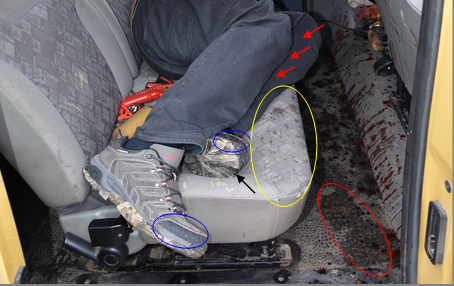
The position of the corpse was on the backseat of the camper (Figure 1). On the right and the left sneaker, smaller and larger spatter stains were observed. On the tread surface of the left sneaker was found a stain by the type of transfer. On the front of the left sock at the level of the lower leg, several small spatter stains were observed. The visible seat part of the bench where the corpse was located contained a number of smaller spatter stains with directionality toward the right sliding door of the camper, as well as several larger stains by the type of arterial blood pattern with spines directed towards the right sliding door.
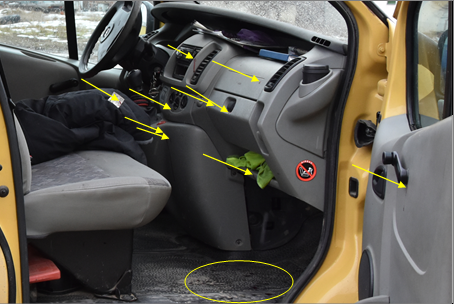
On the jacket label, on the dashboard in the center and in front of the passenger, on the passenger door mask and on the floor in front of the passenger seat, smaller and larger droplets were observed, which could correspond to a unique arterial blood pattern (Figure 2).
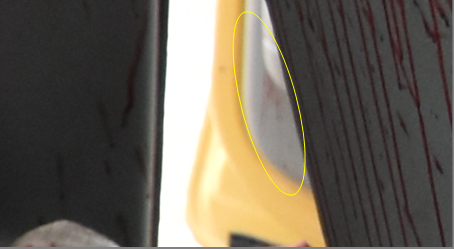
A larger spatter stain and flows were observed on a plastic mask of the driver’s door in the back-bottom area, which indicated that the driver’s door was closed at the time of firing and active bleeding from the wound (Figure 3).
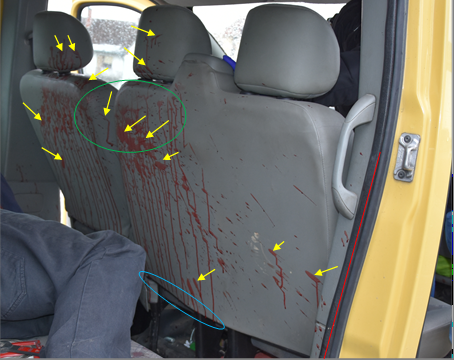
On the back, top, and right sides of the driver’s seat and head restraints, on the back and top of the passenger seat and head restraints, and on the rear of the plastic mask and the tire of the frame between the passenger and rear sliding doors were found many stains (Figure 4). Some of the larger and smaller stains, mostly with flows under the influence of the force of the earth’s gravity, could correspond to the arterial blood pattern. The stains on the back of the plastic mask and the tire of the frame between the passenger and rear sliding doors that may fit the above pattern were presented only to the left of the marked red line, indicated that the rear sliding door was closed at the time of firing and active bleeding. In the rear of the backrest of the driver’s seat and in the front passenger’s seat, small, mostly oval shape spatter stains were observed, which could correspond to the pattern of the backspatter.
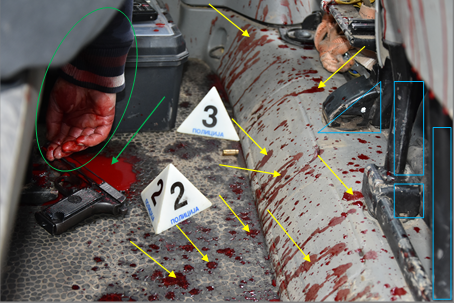
Blood stains were observed on the floor of the vehicle between the driver’s and passenger seats and the backseat where the corpse was found (Figure 5). The green arrow shows a stain by the type of pool, which contains a gun that also partly contains pool of blood. On the gun, but also around the pool, there are also smaller circular to oval spatter stains, formed as part of the drip pattern and pool formation.
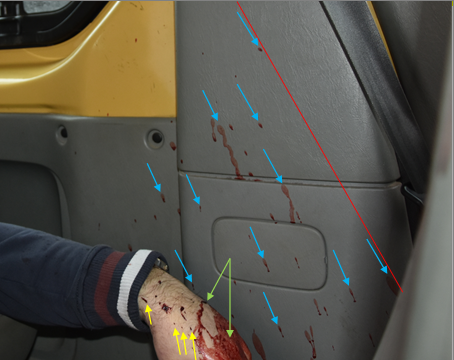
On a plastic mask of the frame behind the driver’s door, many smaller and larger spatter stains, partial with flows under the influence of the force of the earth’s gravity were observed (Figure 6), only presented to the left of the marked red line, which correspond to the projection of the driver’s seat backrest in the original position.
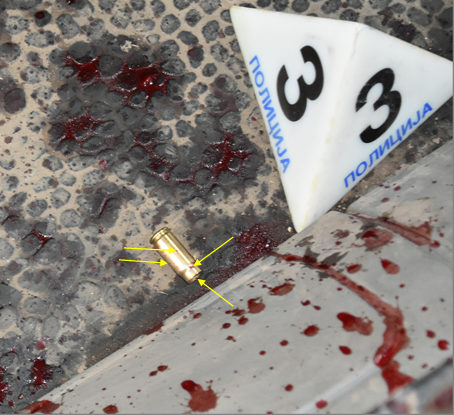
The bullet cartridge on the floor of the vehicle (Figure 7), which was contained a large number of small spatter stains, both on the outer surface and inside the cartridge, represented satellite stains formed at the moment of blood contact with the surface and the formation of a arterial blood pattern.
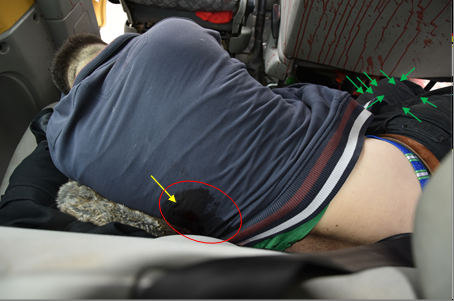
On the back of the corpse (Figure 8), where, at the level of the exit wound, a saturation stain was observed on the fabric. Spreading of that saturation stain down, but also up and to the right of the fabric defect was observed, which indicating that the deceased was a short time after injuring and the bleeding in an upright position. There was a lot of smaller and larger spatter stains on the fabric of the trouser part that corresponds to the fronts of both pants. All clothing on the upper body of the corpse is pulled towards the upper body parts, which may indicate a shear of the body down the left side of the interior of the camper towards the right side of the bench after the upper body has fallen.
Discussion
According to the results of the blood stain patterns analysis, it can be concluded that gunshot took place inside the vehicle while deceased was on a back seat of his vehicle in upright position of the upper body, front of the chest facing forward, when the previously described backspatter patterns have been created on the driver’s seat backrest and the front passenger seat, on the floor of the vehicle and even on pants in the level of both thighs. A few publications show that the analysis of backspatter is important for the reconstruction of the gun’s position and the manner in which it has been used [10, 11]. After gunshot, deceased began to actively bleed from an entrance wound by projection of blood under pressure from the injured heart, when specific arterial blood pattern was formed.
By analyzing the above mentioned arterial blood pattern, determined position of the body at the moment of gunshot, the position in which the body was found, and other findings of established facts, it can be concluded that after gunshot and during active bleeding, deceased changed position, most likely that the upper body fell to the left side glass and plastic upholstery at the level of the backseat and the shear of the body towards the right side of the backseat.
Traces of spatter stains found on the trouser’s legs and sneakers represent satellite stains that occurred at the time of blood contact with the surface and the formation of arterial blood pattern while still rested his feet on the floor of vehicles [12, 13].
Based on the appearance of blood stains on the cartridge, it can be concluded that the cartridge came to the floor of the vehicle while deceased was still alive and actively bleeding [13].
Conclusion
From all of the above it follows:
- Gunshot took place in camper while deceased was on a backseat of his vehicle in sitting position;
- Both front and back slide doors were closed at time of discharge and subsequent bleeding;
- There was no void in bloodstains to indicate presence of second person.
Finally, it was concluded that the manner of death of the deceased was suicide. According to obtained results from expertise re-examination of the vehicle resulted in finding a bullet in a back-window rubber seal.
References
-
James SH, Kish PE, Sutton TP (2005) Principles of Bloodstain Pattern Analysis: Theory and Practice, In: 1st (Edn.), CRC Press, Boca Raton, pp: 1-576.
-
Bevel T, Gardner RM (2008) Bloodstain Pattern Analysis with an Introduction to Crime Scene Reconstruction, In: 3rd (Edn.), CRC Press, Boca Raton, pp: 1- 440.
-
Mcewen T, Regoeczi W (2015) Forensic evidence in homicide investigations and prosecutions. J Forensic Sci 60(5): 1188-1198.
-
Karger B, Rand S, Fracasso T, Pfeiffer H (2008) Bloodstain pattern analysis-casework experience. Forensic Sci Int 181(1-3): 15-20.
-
Stojanovic I (2024) The Connecting Point of DNA and BPA Expertise of Bloodstained Objects. International Journal of Forens Science 9(1): 000373.
-
DeForest PR (1990) A review of interpretation of bloodstain evidence at crime scenes. J Forensic Sci 35(6): 1491-1495.
-
Yen K, Thali MJ, Kneubuehl BP, Peschel O, Zollinger U, et al. (2003) Blood-spatter patterns: hands hold clues for the forensic reconstruction of the sequence of events. Am J Forensic Med Pathol 24(2): 132-140.
-
Peschel O, Kunz SN, Rothschild MA, Mützel E (2011) Blood stain pattern analysis. Forensic Sci Med Pathol 7(3): 257-270.
-
Kunz SN, Brandtner H, Meyer H (2013) Unusual blood spatter patterns on the firearm and hand: A backspatter analysis to reconstruct the position and orientation of a firearm. Forensic Science International 228(1-3): 54-57.
-
Davidson PL, Taylor MC, Wilson SJ, Walsh KAJ, Kieser JA (2012) Physical Components of Soft-Tissue Ballistic Wounding and Their Involvement in the Generation of Blood Backspatter. Journal of forensic science 57(5): 1339-1342.
-
Singh P, Gupta N, Rathi R (2021) Blood pattern analysis-a review and new findings. Egyptian Journal of Forensic Sciences 11: 9.
-
Bettison A, Krosch MN, Chaseling J, Wright K (2021) Bloodstain pattern analysis: Does experience equate to expertise? Journal of forensic science 66(3): 866-878.
-
Home PH, Norman DG, Palmer A, Field P, Williams MA (2022) Quantifying forensic investigations involving bloodstain pattern analysis within the UK. Forensic Science International 339: 111421.
- Narcotics and Digital Forensics: Bridging Crimes in the Digital Age
- Ethics in Forensic Psychiatry: Principles, Dilemmas, and Human Rights
- Impact of Acute Stress on Attentional Orienting to Social Cues
- Head Injury and Intracranial Hemorrhage in Western Region of Libya
- A Forensic Study on Handedness: Examination of Handwriting Features in Right and Left Handed Writers
- Techniques for Latent Fingerprint Development Using Natural and Synthetic Powders: A Review