
Ingenious Deception: Heroin Concealed in Plastic Potatoes Smuggled
Drug trafficking, the most widespread and profitable form of organized crime globally, continuously evolves to outsmart law enforcement through innovative methods such as concealing drugs in maritime vessels, semi-submersible vessels, small aircraft, drones, hidden vehicle compartments, and commercial shipments. A recent case in Kochchikade, Negombo, Sri Lanka, where 388 plastic potatoes total containing 96.28 kilograms of brown colored powder were confiscated in a consignment from Pakistan, exemplifies these challenges. Initial suspicions led the Police Narcotics Bureau, Sri Lanka to a warehouse inspection, resulting in arrests and ongoing investigations. The detection methods employed included Thin Layer Chromatography (TLC), Gas Chromatography with Mass Spectrometry (GC/MS), Fourier Transform Infrared Spectroscopy (FTIR) for qualitative analysis, and Gas Chromatography with Flame Frame Ionization Detector (GC-FID) for quantitative analysis. As a result, heroin was detected in the brown colored powder by TLC, GC/MS, and FTIR and heroin was quantified using GC-FID. The analysis revealed that 67.76 kilograms of the brown-colored powder contained heroin (Diacetylmorphine (DAM)), with a purity level of 70.38 ±1.78 %.
Abbreviations
DAM: Diacetylmorphine; TLC: Thin Layer Chromatography; FTIR: Fourier Transform Infrared Spectroscopy; GC/MS: Gas Chromatography with Mass Spectrometry; GC-FID: Gas Chromatography with Flame Ionization Detector.
Introduction
Drug trafficking represents the most critical and perilous phase of the illicit drug market. Every day, thousands of kilograms of illegal drugs cross international borders, moving from violent traffickers to drug dealers and addicts. The trafficking process typically involves three key locations: the production state, one or more states serving as transshipment centers, and the consumption state. The traffickers’ mission is to transport drugs from suppliers to consumers as efficiently and undetected as possible, making this phase both the most important and lucrative in the drug trade chain [1].
Drug trafficking encompasses the importation, manufacturing, cultivation, distribution, and sale of illicit drugs. In this hierarchical system, narcotics move from smugglers, growers, or manufacturers to wholesalers, who then distribute the product down the chain to retailers and eventually to consumers. Various typologies have been developed to categorize upper-level drug dealing networks based on roles, market positions, tasks, or organizational structures [2].
Heroin is smuggled into Sri Lanka using a variety of methods, exploiting multiple channels to evade detection. Common methods include utilizing courier service providers, sea cargo shipments, and individual personal baggage. Smugglers employ a vast array of concealment techniques, ranging from simple hiding places within luggage to sophisticated methods requiring chemical extraction in a laboratory to retrieve the heroin. These advanced techniques illustrate the lengths traffickers to ensure their illicit cargo remains undetected.
substance Heroin, an illicit opioid drug synthesized from morphine, a natural opiate extracted from poppy plants, is available in two forms: a powder, which can be either white or brown, or a sticky black known as black tar heroin [3]. The chemical structures of heroin, 6-monoacetylmorphine (6-MAM), and morphine are shown in Figure 1[4].
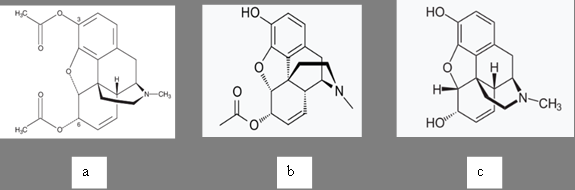
Heroin’s active ingredients stimulate opioid receptors in the brain, leading to effects such as pain relief, sedation, muscle relaxation, respiratory depression, and bradycardia. Heroin addiction can develop rapidly and intensely due to the body’s ability to build tolerance to the drug within 24 hours, leading to strong withdrawal symptoms, which often result in relapse and continued use. Heroin can be administered intravenously, causing rapid distribution and immediate effects, or it can be smoked, resulting in more unpredictable bioavailability and duration of effects [5].
The effects of heroin vary depending on the route of administration. When administered intravenously, heroin takes effect within 3-5 seconds and lasts between 2 and 4 hours [6]. Following oral administration, heroin undergoes extensive pre-systemic biotransformation through deacetylation, resulting in the systemic delivery of morphine as the pharmacologically active compound [7].
Injection of heroin bypasses pre-systemic metabolism, allowing it to quickly cross the blood-brain barrier due to its acetyl groups, making it more lipophilic than morphine [8, 9]. After systemic administration, heroin is rapidly metabolized into 6-MAM, with a half-life in humans of approximately 1.8 to 7.8 minutes [10]. Like other opioids, morphine produces euphoric, analgesic, and anxiolytic effects through the μ-opioid receptor in the brain [11]. However, heroin itself has a relatively low affinity for the μ receptor [12].
In the body, heroin is quickly converted to morphine via 6-MAM within minutes. Morphine typically becomes the dominant active metabolite, excreted through transformation into 3- and 6-glucuronides, which are then eliminated via urine and bile. The presence of 6-MAM in urine distinguishes heroin use from morphine use. Additionally, small amounts of codeine may be detected in the urine of heroin users due to the presence of acetyl codeine in heroin [13].
Case Report
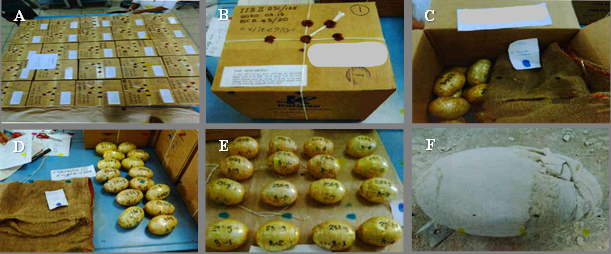
A recent incident in Kochchikade, Negombo, Sri Lanka highlights these challenges. A consignment of potatoes from Pakistan raised suspicions after customs clearance and was subsequently moved to a warehouse. Acting on a tip-off, the Police Narcotics Bureau conducted a thorough inspection and discovered 25 parcels containing 388 plastic potatoes containing brown-colored powder, suspected to be heroin (in Figure 2). The seized materials were handed over to the Government Analyst’s Department through the Police Narcotic Bureau for further analysis
Materials and Methods
Standards and Solvents
Methanol (AR) was obtained from VWR PROLABO chemicals, France. Chloroform (AR) was purchased from Sisco Research Laboratory, India. Ammonium hydroxide (AR), Hydrochloric acid (AR) Cyclohexane (AR), and diethyl amine (AR) were purchased from Loba Chemie Ltd, India. Platinic chloride (AR) Acetaldehyde (AR) and 2,2,2-triphenylacetaphenone were obtained from Sigma Aldrich, USA. Potassium Iodide (AR) was obtained from Research Lab Fine Chem Industries, India. The Certified Reference Material (CRM) of Diacetylmorphine (Heroin) was purchased from Lipomed, Switzerland.
Instruments and Equipment
Analytical balance (Mettler, AE 100, Poland) was used for necessary weighing procedures while Millipore filters (Nylon, 0.45 μm, Agilent Technologies, USA) were used to filter sample solutions. A digital vortex mixer (VELP, Scientifica) was used during the sample preparation to mix the solutions. SILICA 60 F- 254 plates (20 cm x 20 cm with 0.25 mm film thickness) for Thin Layer Chromatography (TLC) were purchased from Merck, Germany. FTIR spectrophotometer (Thermo Scientific Nicolet IS10), and GC/MS (Agilent Technologies 7890 N gas chromatograph with 5975C mass spectrometer) were used for qualitative analysis.
GC-FID (Agilent Technologies 7890A Gas chromatography with flame ionization detector) was utilized for quantitative analysis.
Sampling Method
Twenty five parcels contain 388 plastic potatoes, labeled as A1 to A15, B1 to B16, C1 to C15, D1 to D16, E1 to E15, F1 to F16, G1 to G15, H1 to H16, I1 to I15, J1 to J16, K1 to K15, L1 to L16, M1 to M15, N1 to N16, O1 to O15, P1 to P16, Q1 to Q15, R1 to R16, S1 to S15, T1 to T16, U1 to U15, V1 to V16, W1 to W15, X1 to X16 and Y1 to Y16 respectively. Hypergeometric sampling techniques were utilized to select twenty-nine plastic potatoes for analysis [14]. To ensure a representative sample, the selection process considered the appearance of the powder and other relevant parameters such as color consistency, texture, and the presence of any foreign substances.
Each plastic potato contains brown colored powder. The coning and quartering method was employed for sampling to analyze brown colored powder. Initially, the powder was placed on a flat surface, forming a conical heap, before being spread out into a circular shape resembling a flat cake. Subsequently, the cake was divided into quarters, and two opposite quarters were combined. This procedure was repeated until the sample size became small enough.
The powder from each selected plastic potato was subjected to various tests, including presumptive tests, TLC (Thin Layer Chromatography), GC/MS (Gas Chromatography with Mass Spectrometry), FTIR (Fourier-Transform Infrared Spectroscopy), and GC-FID (Gas Chromatography with Flame Ionization Detector).
Presumptive Test
A presumptive color test for the brown-colored powder was performed using the Marquis Test.
Thin Layer Chromatography
TLC was performed as the screening technique to identify the presence of DAM. The brown colored powder along with primary reference samples of DAM was spotted on the TLC plates and developed in the solvent system of methanol and ammonia in 100:1.5 ratios. Acidified Potassium Iodoplatinate was prepared by dissolving 0.25 grams of platinic chloride and 5 grams of potassium iodide in 100 mL of water and then adding 5 mL of concentrated hydrochloric acid. This reagent was sprayed on the TLC plates to visualize the spots and retardation factor (RF) was calculated for the samples and the standards.
Fourier Transform Infrared Spectroscopy (FTIR)
The presence of DAM was confirmed using the Thermo Scientific Nicolet iS10 FTIR.
Gas Chromatography with Mass Spectroscopy (GC/MS)
The presence of DAM was confirmed using the Agilent 7890 Gas Chromatograph equipped with a 5975C Mass Spectrometer (GC/MS). HP-5 MS (5% phenyl methyl siloxane) column with dimensions 30 m x 0.250 mm x 0.25μm was used. Carrier gas was helium with a flow of 0.6 mL/min. Splitless injection mode was used for the injection volume of 1.0 μL.
The injector temperature was set to 280°C. The oven temperature program was set at 90°C and held for 2 minutes. The temperature was increased from 90°C to 300°C at 14°C/ min ramp and held for 10 minutes.
The total run time was 27 minutes. Data analysis of the samples and standards was done using the Agilent MSD Chemstation software. The solvent delay was set to 3 minutes.
Gas Chromatography with Flame Ionization Detector (GC-FID)
GC-FID analysis was performed to generate standard and brown colored powder chromatographs using Agilent technologies 7890A Gas chromatography with flame ionization detector and HP- 5 column with 30 m x 250μm ID x 0.25μm phenyl methyl siloxane. Nitrogen was used as the carrier gas with a flow rate of 1.5 mL/min and a split ratio of 20:1 was used for the injection volume of 1 μL. The injector temperature was set to 250°C. The initial oven temperature was 200°C and held for 2 minutes. Then temperature was increased from 200°C to 280°C for 9 minutes. The total run time was 11.0 minutes.
The detector temperature was 300°C. Nitrogen (30 mL min-1), hydrogen (40 mL min-1), and dry air (400 mL min-1) were used as auxiliary gases for the flame ionization detector.
Sample Preparation and Procedure
A 1.0 mg/mL stock solution of diacetylmorphine was prepared using a diacetylmorphine CRM, with 2,2,2-triphenylacetophenone selected as the internal standard. The internal standard was chosen due to its structural stability, non-interference with the target analyte, similar chromatographic retention characteristics, and consistent response under GC-FID conditions.
These factors ensure accurate quantification by compensating for potential matrix effects, instrumental fluctuations, and sample preparation losses.
A diacetylmorphine standard series of 0.1 mg/ mL, 0.2 mg/mL, 0.4 mg/mL, 0.6 mg/mL, and 0.8 mg/ mL concentrations were prepared using the above stock solution and injected into GC-FID along with the 1.0 mg/mL stock solution. Calibration curves of area diacetylmorphine/area 2,2,2-triphenylacetophenone versus concentration diacetylmorphine/concentration 2,2,2-triphenylacetophenone were constructed.
A known weight of brown-colored powder from randomly selected 29 plastic potatoes was dissolved in 25 mL of a solvent mixture containing the internal standard. These samples were injected into GC-FID, and the purity of diacetylmorphine was calculated using the constructed calibration curve.
Results and Discussion
The progressively developed purple coloration from the Marquis test indicated the presence of opium alkaloid in the brown-colored powder found in all plastic potatoes.
The identical retardation factor values obtained for the heroin CRM and the brown-colored powder confirmed the presence of heroin across all samples.
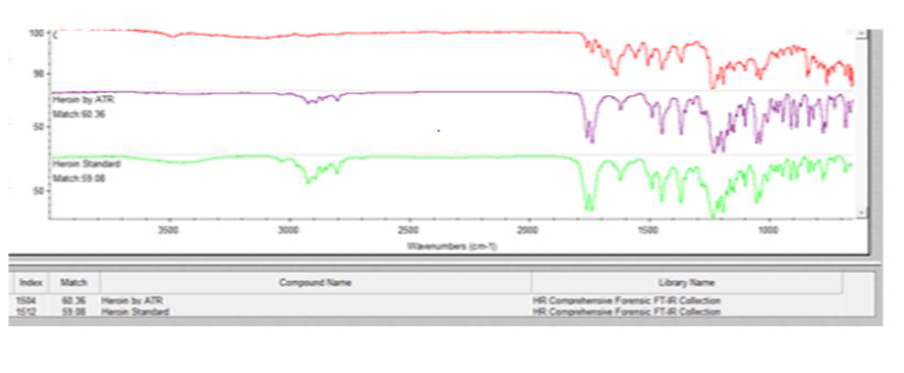
The FTIR spectroscopy results, as illustrated in Figure 3, substantiated the presence of DAM in the brown colored powder extracted from the plastic potatoes.
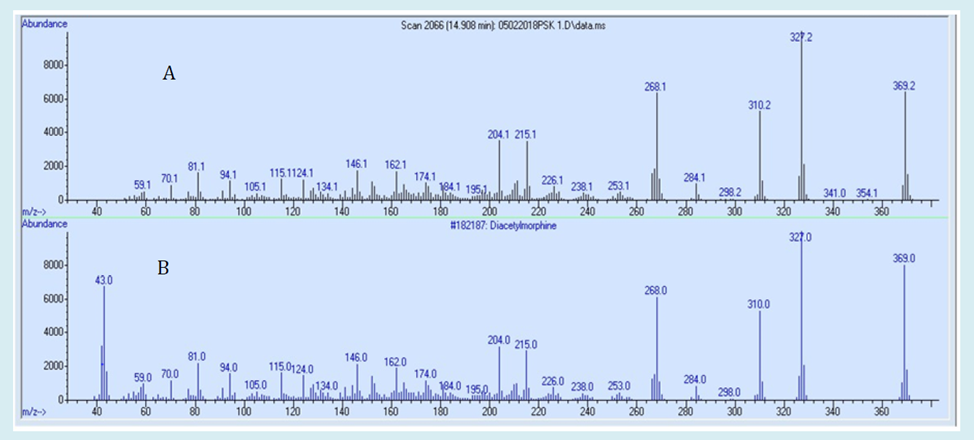
GC/MS results further corroborated the presence of DAM by matching the standard DAM’s mass spectrum with the brown colored powder found on all the plastic potatoes. The mass peaks at m/z 327, 268, 310, 215, 204, 162, and the base peak 369 are characteristic of the DAM molecule, as depicted in the mass spectra for both the brown colored powder and DAM CRM (Figure 4).
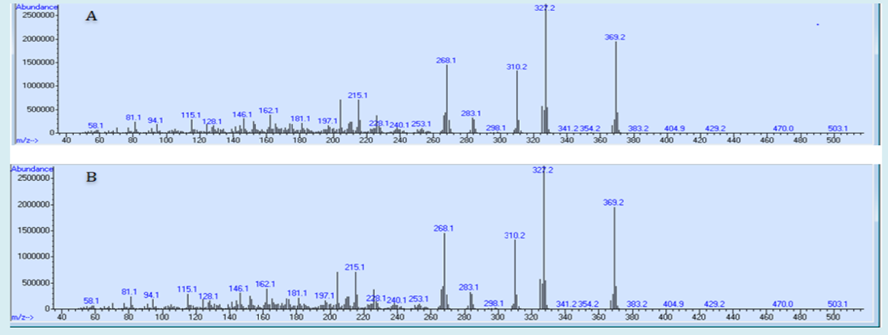
Figure 5 displays the mass spectrum of A1, accompanied by library match results from the NIST mass spectral library, reinforcing the identification of DAM.
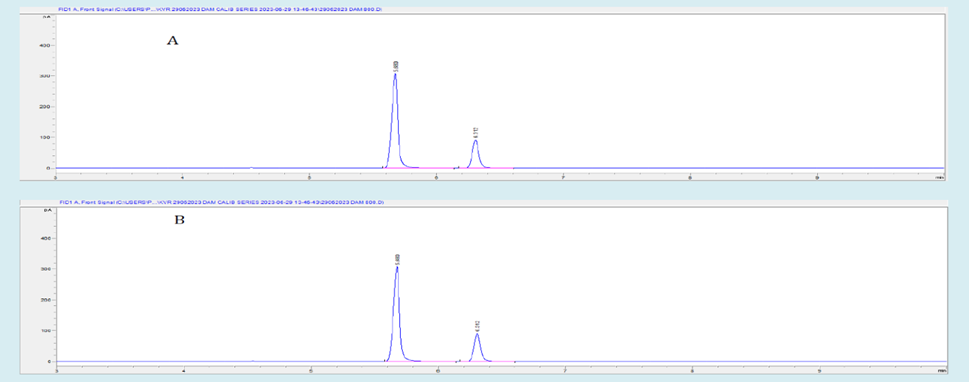
The Gas Chromatography-Flame Ionization Detection (GC-FID) chromatogram exhibited a peak at 5.68 minutes for the standard DAM, which was consistently observed in the brown-colored powder from the potatoes (Figure 6).
A calibration curve with a regression coefficient (r²) of 0.998 was utilized to determine the purity of DAM in the brown-colored powder. The formula for calculating the heroin percentage using GC-FID is provided below:
% 100 A V Dialution factor P of DAM M × × × = ×
Where;
A-Concentration of DAM from the calibration plot (mg/ mL) M-Weight of the brown colored powder taken from the plastic potato for analysis (mg) V-Volume of the dissolved sample (mL) P-Purity of the standard (CRM) of DAM Table 2 shows the percentages of DAM in the brown colored powder from 29 out of 388 plastic potatoes.
| Identity number of plastic potatoes | % DAM in the brown colored powder | Identity number of plastic potatoes | % DAM in the brown colored powder |
|---|---|---|---|
| A 1 | 70.24 | M 15 | 71.28 |
| B 1 | 70.62 | N 3 | 70.51 |
| B 16 | 71.09 | N 11 | 71.86 |
| C 6 | 70.49 | O 1 | 69.09 |
| D 16 | 70.36 | O 10 | 70.25 |
| F 11 | 70.28 | P 3 | 69.25 |
| G 12 | 71.77 | Q 1 | 70.25 |
| H 4 | 69.35 | R 2 | 70.12 |
| H 13 | 72.72 | S 13 | 70.59 |
| I 3 | 70.43 | T 16 | 69.24 |
| J 5 | 68.08 | U 11 | 71.47 |
| J 14 | 71.35 | W 4 | 71.82 |
| K 13 | 70.22 | X 5 | 66.35 |
| L 1 | 70.44 | X 16 | 70.07 |
| M 2 | 71.57 | Average | 70.38 ± 1.78 |
Table 1: The Percentage Calculation of DAM in 29 Plastic Potatoes.
The purity of DAM was quantified using a validated method for heroin quantification. The DAM percentages in the brown-colored powder within the 29 selected plastic potatoes ranged from 66.35% to 72.72%. with an average DAM percentage of 70.38%. The analysis revealed that 67.76 kilograms of the brown-colored powder, found in all the plastic potatoes, contained DAM.
Conclusion
This study focused on the examination and identification of heroin in the brown-colored powder found within plastic potatoes, as well as the determination of its purity. Initial screening tests and TLC analysis indicated the presence of heroin in all samples. This preliminary identification was subsequently confirmed through FTIR GC/MS analyses. The comprehensive analysis determined that 67.76 kilograms of the total 96.28 kilograms of brown-colored powder contained heroin (diacetylmorphine), resulting in a purity level of 70.38%, as established using Gas GC-FID techniques.
This case underscores the critical importance of continuous vigilance by Sri Lankan law enforcement agencies during the inspection and clearance of goods. Moreover, it highlights the pressing need for the development and implementation of advanced technical mechanisms to effectively combat and prevent drug smuggling into Sri Lanka.
References
-
Jenner, Matthew S (2011) International drug trafficking: A global problem with a domestic solution. Indiana Journal of Global Legal Studies 18(2): 901-927.
-
Rendi P, Warsito T, Surwandono S (2019) Narcotics Smuggling Routes in the Southeast Asia Region (Case Study in the Riau Province, Indonesia. Security Dimensions: International & National Studies 30: 116- 133.
-
O’Hagan A, Carvetta CA (2015) Chasing the dragon–an overview of heroin trafficking. Forensic Research & Criminology International Journal 1(4).
-
Bayram Y (2020) Quantitative GC-FID analysis of heroin for seized drugs. Annals of Clinical and Analytical Medicine 11(1): 38-42.
-
Freeman F (2013) Opiates. Nottingham Trent University.
-
Erowid (2014) Erowid Heroin Vault: Basics.
-
Jana S (1986) The therapeutic use of heroin: a review of the pharmacological literature. Canadian journal of physiology and pharmacology 64(1): 1-6.
-
Marjolein G (2005) Development of pharmaceutical heroin preparations for medical co-prescription to opioid dependent patients. Drug and alcohol dependence 80(3): 283-295.
-
Oldendorf WH (1972) Blood-brain barrier: penetration of morphine, codeine, heroin, and methadone after carotid injection. Science 178(4064): 984-986.
-
Elisabeth J (2006) Pharmacokinetics and pharmacokinetic variability of heroin and its metabolites: review of the literature. Current clinical pharmacology 1(1): 109-118.
-
Timothy HH, Stinus L, Le Moal M (1989) Differential mechanisms in the acquisition and expression of heroin- induced place preference. Psychopharmacology 98(1): 61-67.
-
Inturrisi CE 0(1983) Evidence from opiate binding studies that heroin acts through its metabolites. Life Sciences 33: 773-776.
-
Drummer Olaf H (2004) Postmortem toxicology of drugs of abuse. Forensic Science International 142(2-3): 101- 113.
-
United Nations Office on Drugs Crime (1998) Laboratory, and Scientific Section. Recommended Methods for the Identification and Analysis of Opium, Morphine, and Heroin: Manual for Use by National Drug Testing Laboratories. New York: United Nations.
- Narcotics and Digital Forensics: Bridging Crimes in the Digital Age
- Ethics in Forensic Psychiatry: Principles, Dilemmas, and Human Rights
- Impact of Acute Stress on Attentional Orienting to Social Cues
- Head Injury and Intracranial Hemorrhage in Western Region of Libya
- A Forensic Study on Handedness: Examination of Handwriting Features in Right and Left Handed Writers
- Techniques for Latent Fingerprint Development Using Natural and Synthetic Powders: A Review