
Indian Mottled Freshwater Eel, Anguilla bengalensis Bengalensis (Gray, 1831), A Threatened Species of Indian Subcontinent- A Review
The Indian mottled freshwater eel, Anguilla bengalensis bengalensis is globally consumed species which has good demand as a food fish as having high nutritional value. Eels have always been a source for human interest for their interesting shape and size. It was considered a luxury food and consumed as a delicacy by Greeks, Romans, Germans, Japanese and people of several Asian and European countries, whereas in India eels are considered as poor man's food. But their export demand offers scope for culture and live transport to foreign markets. Fish mucous from live fish mixed with rice or wheat flour is used as medicine for arthritis. It has been reported as near Threatened species in IUCN list. The common threats of extinction facing like many other freshwater fishes such as pollution, harmful fishing practices, habitat modification and degradation, environmental degradation, overfishing, game fishing and barrier effects of dams etc. The present study has been prepared with the aim to sum up the available information on different aspects of A. bengalensis bengalensis along with note down the possible measures that should for its conservation.
Introduction
Eels, Anguilla spp. are consumed globally and play a major role among fish industry in East-Asian countries [1]. More than 90% of Anguilla production is based on eel farming which requires wild-caught glass eels for stocking as the captive reproduction [1]. Global annual exports, as recorded by the FAO at the genus level, averaged around 20,000 t per year in the late 1970s (valued at 55-95 million US dollars year-1), rising to over 130, 000 t in 2000 (valued at 1000 million US dollars year-1) [2]. Eels have always been a source for human interest for their interesting shape and size [3]. They are considered a Indian Mottled Freshwater Eel, Anguilla Bengalensis Bengalensis (Gray, 1831), A Threatened Species of Indian Subcontinent- A Review luxury food and consumed as a delicacy by Greeks, Romans, Germans, Japanese and people of several Asian and European countries, whereas in India eels are considered as poor man's food [4].
It has good fishery of considerable value and bear high market price as a food fish due to its good taste and deliciousness in many European country and Asian country. In some part of Southern and Eastern India, Anguilla bengalensis is relished and fetch many a times more compatible than carps [5, 6]. Fish mucous from live fish mixed with rice or wheatflour is used as medicine for arthritis [7].
Int J Oceanogr Aquac
Taxonomy Position
Kingdom- Animalia
Phylum-Chordata
Class-Actinopterygii
Order-Anguilliformes
Family- Anguillidae
Genus-Anguilla
Species-bengalensis
Common Name
Indian mottled eel/ Indian long fin eel in India [8].
Conservation Status
Near Threatened by the IUCN in 2014
Morphological Characters
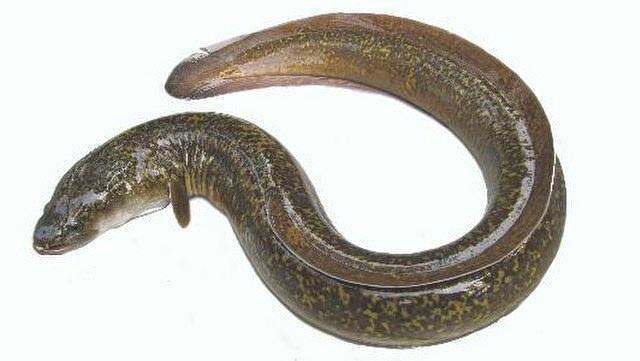
Anguilla bengalensis has an elongate body and snake like dorsally flattened a conical head and moderately compressed along the tail (Figure 1). It has small eyes, prominent thick lips and narrow bands of teeth on the jaws. Teeth always small, conical and multi-serial to form narrow to broad bands on jaws and vomer (roof of mouth). Nostrils separated, the anterior one a sort, free tube, the posterior one a simple aperture in front of eye; Gill opening a nearly vertical slit in front of pectoral fin. No spines in fins; dorsal and anal fins continuous around tail; Dorsal fin begins variously between pectoral fin and anus or over anus; pectoral fins always present; no pelvic fins. Minute, oval scales present, embedded in skin. Lateral line system is present but not especially prominent, typically as a series of minute, white pores. Eels are a crevice dweller fish or sediment-burrowing mode of life. Though they are good swimmers, many eels are rather sedentary and rely on well-developed sense of smell and comparatively large teeth to capture food.
Distribution
Indian mottled eel is widely distributed in India (Kerala, Andhra Pradesh, Arunanchal Pradesh, Manipur, Meghalaya, Orissa, West Bengal, Tamil Nadu, Assam, and Nagaland), Pakistan, Bangladesh, Nepal (Gandaki, Koshi, Karnali, Mahakali), Sri Lanka, Myanmar, and also in southeast Africa [2].
Habitat
An eel live in freshwaters, but also occurs in estuaries and in the sea during early life and near maturity [9]. Beside it occurs in freshwater streams, pools and reservoirs and commonly found in mud substrates of tanks and in deep rock pools of rivers [10]. Most common eel in Indian inland waters. Eels, facultative catadromy remain in estuary or move back and forth between freshwater and estuary [11]. A. bengalensis breeds in the ocean and migrates into freshwaters and estuaries as juveniles, which migrate up rivers and streams to mature in pools; some individuals remain in coastal waters. Most of the life is subsequently spent in lakes, streams and rivers [9].
Food and Feeding Habit
Carnivorous and predatory nocturnal in nature throughout the life; adults are piscivorous in nature, can actively forage fishes at night from top to bottom and small crabs. Fry of A. bengalensis mainly consumes small bottom-dwelling invertebrates while juveniles feed on insects and others small aquatic invertebrates [12].
Reproductive Biology
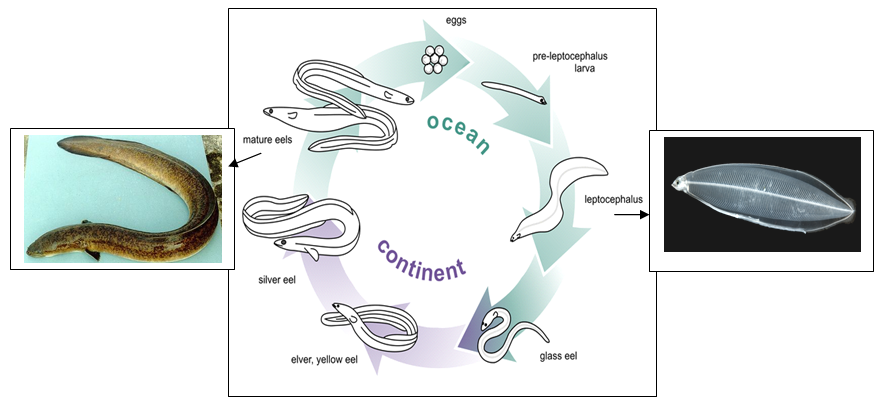
The life cycle of the freshwater eel includes five larvae stages: leptocephalus, glass eel, elver, yellow eel and silver eel stages. Like all freshwater species, A. bengalensis breeds in the open ocean and spend their early part of life in the pelagic realm as flat and very transparent. The life cycle of the freshwater eel includes five stages: leptocephalus, glass eel, elver, yellow eel and silver eel stages (Figure 2). Leptocephalus larvae are delicate larvae which look different from their adults.
Threats
As plain eels is highly desire in Japanese market than a mottled species, A. bengalensis; however, there is a growing market for mottled eels in China. In Nepal, this species is likely to suffer from the common threats facing many other freshwater fishes such as pollution, harmful fishing practices, habitat modification, and environmental degradation and barrier effects of dams. Most dams in this region do not have fish ladders and loss of freshwater habitat is potentially a real problem [13]. Habitat degradation, overfishing, and game fishing in eastern Africa; fishing pressure from hook and line catching, poisoning in southern Africa were also the major threats to this species. Beside, major impoundments and weirs are barriers to eel movement so areas of occurrence and occupancy are likely to decrease. Cabora Bassa and Kariba dams in Zimbabwe were preventing migration of eels [14]. The eel industry in East Asia was found to continue to evolve to cope with changes in supply, whilst global production and consumption appeared to be declining due to reduced species and eel fry availability, as well as other factors [1]. Crook and Nakamura [15] voiced concerns over the shifts in exploitation affecting this genus, whereby once one Anguilla species becomes over- exploited, trade shifts towards another species to satisfy the demand. In India, harvesting does occur but fact is unknown what impact fishing is having on the overall fish population. A. bengalensis has been found to contain levels of pollutants that could be toxic to humans. In the Ganges river, West Bengal for example, A. bengalensis specimens that were caught contained methyl mercury concentrations that were higher than the limits set by the PFA (Provention of Food Adulteration Act) for human consumption [16]. A new species of parasitic nematode was found in the intestines of A. bengalensis collected from the freshwater bodies of Kerala state in southern Indian in 2012 [17]. Climate change play a role in fluctuations of abundance in anguillid species – particularly larval transport and glass eel recruitment are very limited.
Conservation and Recommendations
Decline trends on the wild stock as well as providing protection to the existing populations are prime steps to get success in conservation of any fish species [18]. Population trends, threats, harvest levels management of fishing levels in a particular area of species were the main conservation step. Fish passes should be designed into dam and weir constructions. In South Africa in 1994, the River Health Programme (RHP) was established to monitor the health and ecosystem services provided by riverine habitats and, where necessary, establish protected areas to rejuvenate ecosystems and minimise human impacts [19]. The CAMP report on the freshwater fishes of India (1997) declared A. bengalensis as ‘Endangered’ according to IUCN criteria, reporting damming, and fishing, loss of habitat, overexploitation and domestic trade as the main drivers to the fish populations.
References
-
Shiraishi H, Crook V (2015) Eel market dynamics: an analysis of Anguilla production, trade and consumption in East Asia TRAFFIC Tokyo, JAPAN.
-
Jacoby D, Harrison I, Gollock M (2014) Anguilla bengalensis, Indian Mottled Eel. The IUCN Red List of Threatened Species.
-
Leander NJ, Shen KN, Chen RT, Tzeng WN (2012) Species Composition and Seasonal Occurrence of Recruiting Glass Eels (Anguilla spp.) in the Hsiukuluan River, Eastern Taiwan. Zoological Studies 51(1): 59-71.
-
Menon NG, Balachandran K, Scariah KS (1998) The Eels And Eel Fisheries Of India. Central Marine Fisheries Research Institute: 10-14.
-
Pantulu V (1957) Studies on the biology of the Indian freshwater Eel, Anguilla bengalensis gray. Central Inland Fisheries Research Station: 1-23.
-
Rahman S, Barua E, Choudhury JK, Duta A, Kalita ML (2015) Generation of DNA barcodes in Indian mottled EEL (Anguilla bengalensis): A threatened ichthyofauna of Assam, India. Int J Agri Envi & Biotechn 8(3): 511-519.
-
Arunachalam M, Sankaranarayanan A (2000) Some economically important and cultivable in Gadana river western Ghats. In: Ponniah AG & Gopalakrishnan A (Eds.), Endemic fish diversity of Western Ghats. NBFGRNATP Pub, National Bureau of Fish Genetic Resources, Lucknow, UP, pp: 244-246.
-
Eschmeyer WN (2014) Catalog of Fishes Volume 1.
-
Talwar PK, Jhingran AG (1991) Inland fishes of India and adjacent countries. CABI, pp: 1158.
-
Menon AGK (1999) Check list - fresh water fishes of India. Rec Zool Surv India Misc Publ Occas Pap No 175: 1-366.
-
Tsukamoto K, Arai T (2001) Facultative catadromy of the eel Anguilla japonica between freshwater and seawater habitats. Marine Ecology Progress Series 220: 265–276.
-
Okeyo DO (1998) Updating names, distribution and ecology of riverine fish of Kenya in the Athi-Galana- Sabaki River drainage system. Naga ICLARMQ 21(1): 44-53.
-
Shrestha TK (2003) Conservation and Management of Fishes in the Large Himalayan Rivers of Nepal International Symposium on the Management of Large Rivers for Fisheries Sustaining Livelihoods and Biodiversity in the New Millennium 11-14 February Phnom Penh Nepal.
-
Matiza T, Crafter SA (1994) Wetlands ecology and priorities for conservation in Zimbabwe: proceedings of a seminar on wetlands of Zimbabwe. International Union for Nature Conservation and Natural Resources, Gland Switzerland and Cambridge, UK.
-
Crook V, Nakamura M (2013) Glass eels: Assessing supply chain and market impacts of a CITES listing on Anguilla species. TRAFFIC Bulletin 25(1): 24-30.
-
Pal M, Ghosh S, Mukhopadhyay M, Ghosh M (2012) Methyl mercury in fish-a case study on various samples collected from Ganges River at West Bengal. Environ Monit Assess 184(6): 3407-3414.
-
Moravec F, Sheeba S, Kumar AB (2012) Rhabdochona (Rhabdochona) keralaensis sp. nov. (Rhabdochonidae) and some other nematodes in the Indian mottled eel Anguilla bengalensis bengalensis from India. Acta Parasitologica 57(1): 74-82.
-
Gupta S (2015) Wallago attu (Bloch and Schneider 1801), a threatened catfish of Indian waters. Int J Research in Fisheries & Aqua 5(4): 140-142.
-
River Health Programme (2003) State-of-Rivers Report: Free State Region River Systems. Department of Water Affairs and Forestry Pretoria.
- Genetic Improvement of Nile Tilapia (Oreochromis niloticus): Advances in Selective Breeding and Genomic Approaches for Sustainable Aquaculture
- Microplastics, Contaminants, and Waste Hotspots: Divergences and Faults in Prioritizing Control Efforts
- Creating a Healthier, More Vibrant Open and Closed Aquatic Environment. A Submersible, Centrifugal Magnetically Affixed Current Changing Aquarium Pump
- An Attempt to Assess Alpha Diversity and Sample Size: Using the Ostracod Assemblages off Kumamoto Port, Japan
- Assessment of the Efficiency of Common Fishing Gears and Crafts Used at Mohananda River of Chapai Nawabganj, Bangladesh
- Fish Productivity and Biodiversity Status of Sundarban Mangrove in Bangladesh