
First Documented Occurrence of the Bigeye Tuna Thunnus obesus in the Eastern Mediterranean Sea (Syrian Coast)
This manuscript represents the first documented record of the occurrence of Thunnus obesus in the eastern Mediterranean Sea off the Syrian coastline. The specimen measured a total length of 182 cm, a fork length of 165 cm, and weighed 85 kg. It was caught by an artisanal fisherman off the coast of Baniyas city on the Syrian coast using a longline at a depth of 20 m, with a surface water temperature of 23.4°C. This represents the first record of this species of such a large size in the Mediterranean Sea. This species will be monitored and its presence in the Mediterranean tracked through further catches by artisanal fishermen and the acquisition of additional specimens, to determine whether this occurrence was an anomaly or if its passage through these waters has become a regular event due to changing climatic and temperature conditions.
Introduction
Globally, there are recognized to be 8 tuna species distributed in the seas and oceans of the world. These include (Thunnus alalunga, Thunnus maccoyii, Thunnus obesus, Thunnus orientalis, Thunnus thynnus, Thunnus atlanticus, Thunnus tonggol, Thunnus albacares) [1, 2, 3]. Previously, only two tuna species were known to exist in the Mediterranean Sea, Thunnus alalunga and Thunnus thynnus [1, 2, 3]. However, in 2021, the species Thunnus albacores was recorded for the first time in Cyprus [4], and a genetic study also documented for the first time the presence of three juvenile individuals of Thunnus obesus in the western Mediterranean (Alboran) [5], where its existence in the Mediterranean had not been previously reported. Thunnus obesus is a widely distributed species compared to other tuna species. This fish is found in the tropical regions of the Atlantic, Pacific, and Indian Oceans. It is a highly migratory species [3]. Bigeye tuna, Thunnus obesus, is found in areas where water temperatures range from 13°C to 29°C, with an optimal temperature range between 17°C and 22°C. Its occurrence is closely tied to seasonal and climatic variations in surface temperature and thermocline. The bigeye tuna, Thunnus obesus, was most recently assessed for the IUCN Red List of Threatened Species in 2021, and is classified as Vulnerable under criteria A2bd [6, 7]. It has a high fishing vulnerability score of 56 out of 100 [8] and a moderate to high climate vulnerability score of 47 out of 100 [9].
This paper is reporting first occurrence of Thunnus obesus from Syrian coast also from Eastern Mediterranean Sea, and providing the principal biometric and meristic characters of this species.
Materials and Methods
A single specimen of Thunnus obesus was caught on 03 May, 2024, when the sea surface temperature was
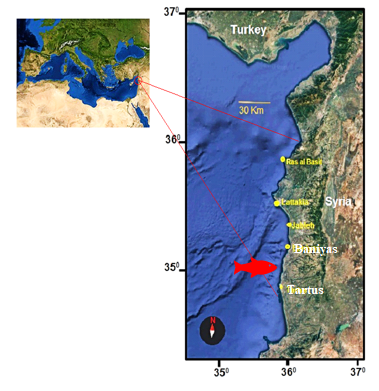
23.4°C. This occurred during a traditional longlining fishing operation at a depth of 20 metres, from the coastal area off the city of Baniyas (Figure 1). The specimen was measured to (cm) in length, weighed to (kg), and various morphometric measurements were recorded as percentages of the total length (TL). The identification key for Thunnus obesus was developed based on the work of Collette and Nauen [1].
Results
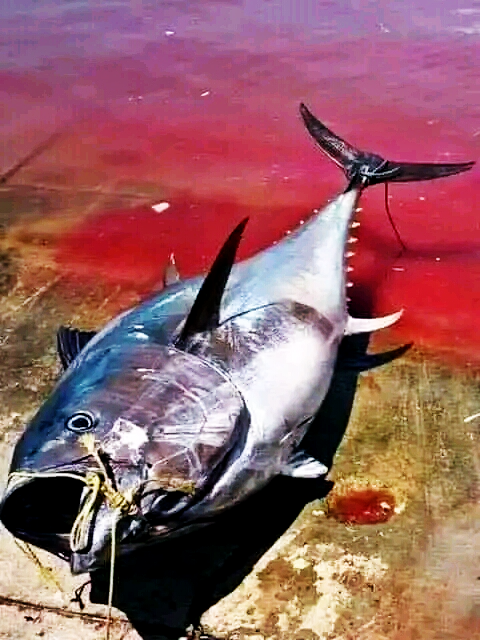
This large tuna specimen (Thunnus obesus) is characterized by the following features (Figure 2). The dorsal fin has 14 spines and 14 soft rays, while the anal fin has no spines and 14 soft rays. The body is robust and fusiform, slightly compressed laterally. The two dorsal fins are separated by a narrow interspace, with the second dorsal followed by 9 finlets. The anal fin is also followed by 7 finlets (Table 1). The pectoral fins are moderately long, 28% and 31% of the total length and fork length, respectively (Table 2). There are two flaps (interpelvic process) between the pelvic fins. The body is covered in very small scales, with a distinct corselet of larger and thicker scales. The caudal peduncle is very slender, with a strong lateral keel between two smaller keels. In coloration, the back is metallic dark blue, while the lower sides and belly are whitish. A lateral iridescent blue band runs along the sides in live specimens. The first dorsal fin is deep yellow, the second dorsal and anal fins are light yellow, and the finlets are bright yellow edged with black.
| Meristics | |
|---|---|
| Dorsal fin | XIV+15+9 finlets |
| Pectoral fin | 30 |
| Anal fin | 14+7 finlets |
| Total Weight (TW, kg) | 85 |
Table 1: Meristics of the Thunnus obesus specimen captured from the Syrian coast.
| cm | % TL | |
|---|---|---|
| Total length (TL) | 182 | |
| Standard length (SL) | 154 | 84.6 |
| Fork length (FL) | 165 | 90.7 |
| Head length | 44 | 24.2 |
| Body depth | 52 | 28.6 |
| Pre-dorsal fin length | 48 | 26.4 |
| Pre-pectoral fin length | 47 | 25.8 |
| Pre-pelvic fin length | 48 | 26.4 |
| Pre-anal fin length | 101 | 55.5 |
| Pectoral fin length | 51 | 28 |
| Head length (% HL) | ||
| Eye diameter | 11 | 25 |
| Pre-orbital length | 13 | 29.5 |
Table 2: Morphometric characteristics of the Thunnus obesus specimen captured from the Syrian coast.
Discussion
This manuscript reports the first documented occurrence of Thunnus obesus from the Syrian coast of the eastern Mediterranean. It provides the most important morphometric and meristic characteristics of the specimen. This discovery represents a significant extension of the known range of Thunnus obesus in the Mediterranean Sea. Prior to this report, the presence of this species had not been documented in this region. This is the first record of a Thunnus obesus of such a large size found in the Mediterranean Sea. The presence of this species in this region had not been previously documented. There may be some confusion in distinguishing Thunnus obesus from the similar Thunnus alalunga and Thunnus albacares, but we can rely on some key morphological features to distinguish them. Careful examination of the diagnostic characteristics is essential for accurate species identification. The albacore, T. alalunga, has very long pectoral fins, but its fins are dusky, not yellow. The yellowfin tuna, T. albacares, has yellow fins and finlets, but its pectoral fin is shorter (not reaching the posterior edge of the dorsal fin), its eye is smaller, and in larger fish the 2nd dorsal and anal fins are extremely elongated. It may also have broken vertical lines on its belly [10]. These differences in fin colouration and morphology are crucial in distinguishing these tuna species.
This new record of Thunnus obesus increases our understanding of the biogeography and habitat preferences of this commercially important tuna species in the Mediterranean ecosystem. Further studies are needed to assess the significance of this observation and its implications for regional tuna fisheries management.
Conclusions
This represents the first recorded instance of a Thunnus obesus specimen of such a large size being caught in the Mediterranean Sea. Going forward, this species will be closely monitored, and its presence in the Mediterranean will be tracked through continued catches by artisanal fishermen as well as the acquisition of additional specimens. This will help determine whether this occurrence was an anomaly, or if the passage of this species through these waters has become a regular event due to changing climatic and temperature conditions.
Acknowledgments
The author would like to express their gratitude to Tishreen University for their support and assistance in conducting this research, as well as extend a great appreciation to the artisanal fishermen, particularly the professional fisherman Abu Bassam.
References
-
Collette BB, Nauen CE (1983) FAO species catalogue. Scombrids of the world. An annotated and illustrated catalogue of tunas, mackerels, bonitos and related species known to date. FAO Fish Synop 2(125): 137.
-
Hamwi N (2024) Population Growth of Thunnus thynnus and Vulnerability to Fishing along the Syrian Coast (Eastern Mediterranean Sea). International Journal of Oceanography & Aquaculture 8(2): 1-7.
-
Froese R, Pauly D (2024) FishBase. World Wide Web electronic publication.
-
Tsagarakis K, Darmanin SA, Al-Mabruk SA, Auriemma R, Azzurro E, et al. (2021) New records of rare species in the Mediterranean Sea. Mediterranean Marine Science 22(3): 627-652.
-
Bielsa NP, Ollé J, Macías D, Saber S, Viñas J, et al. (2021) Genetic validation of the unexpected presence of a tropical tuna, bigeye tuna (Thunnus obesus), in the Mediterranean. Journal of Fish Biology 99(5): 1761- 1764.
-
Collette BB, Boustany A, Fox W, Graves J, Restrepo V, et al. (2021) Thunnus obesus. The IUCN Red List of Threatened Species 2021: e.T21859A46912402.
-
IUCN (2024) The IUCN Red List of Threatened Species.
-
Cheung WW, Pitcher TJ, Pauly D (2005) A fuzzy logic expert system to estimate intrinsic extinction vulnerabilities of marine fishes to fishing. Biological conservation 124(1): 97-111.
-
Jones MC, Cheung WW (2018) Using fuzzy logic to determine the vulnerability of marine species to climate change. Global change biology 24(2): 719-731.
-
Bowling B (2019) Identification Guide to Marine Fishes of Texas. Texas Parks and Wildlife Department 4: 331.
- Genetic Improvement of Nile Tilapia (Oreochromis niloticus): Advances in Selective Breeding and Genomic Approaches for Sustainable Aquaculture
- Microplastics, Contaminants, and Waste Hotspots: Divergences and Faults in Prioritizing Control Efforts
- Creating a Healthier, More Vibrant Open and Closed Aquatic Environment. A Submersible, Centrifugal Magnetically Affixed Current Changing Aquarium Pump
- An Attempt to Assess Alpha Diversity and Sample Size: Using the Ostracod Assemblages off Kumamoto Port, Japan
- Assessment of the Efficiency of Common Fishing Gears and Crafts Used at Mohananda River of Chapai Nawabganj, Bangladesh
- Fish Productivity and Biodiversity Status of Sundarban Mangrove in Bangladesh