
A Mini-Review of Microplastics in Aquaculture: Sources, Toxicity, Countermeasures and Prospects
Plastic waste has become an environmental problem of global concern. Since microplastics (MP) are accumulated in all marine compartments due to direct emissions from the fragmentation or technosphere of macroplastic waste, they constitute a potential risk for aquatic organisms that ingest them as well as for humans through the consumption of fishery products. Data on the effects and damages that MP debris may exert on marine biota and marine food supply chains is scarce, hence, the study of microplastics impact in aquaculture has become a universal research hotspot. This review shed light an overview on sources of MP, their deleterious impact on marine environment, their toxicological effects on marine organisms by affecting their survival rate, growth, behavior and reproduction which ultimately will reduce the economic benefits of aquaculture. Moreover, the potential health risks that MP pose to human at multiple levels through aquaculture products consumption are also discussed. Strengthening aquaculture management, ecological interception and purification as well as improving fishing gear and packaging are considered to be effective removal strategies for controlling MP pollution. As practical measures, new remote sensing technology and portable MP monitoring system are two prospects known to be widely applied. Finally, the supervision of MP pollution in aquaculture must be established by enforcing rapid waste management policies and strengthening the construction of laws and regulations.
Introduction
There has been a continuous increase in plastic production over the past seventy years, rising from 1.5 million tons in the 1950s to 367 million tons in 2020 [1]. Microplastics (MP) are polymeric matrices or synthetic solid particles with regular or irregular shapes, which mostly refer to plastics smaller than 5 mm in size [2, 3]. The subsequent production of plastic waste are linked to the growth of the human population, which has augmented from about 3.1 billion in 1961 to about 7.3 billion in 2015 and is projected to exceed 9 billion by 2050 [4]. MP formed through wear of plastic-containing articles or fragmentation are introduced into the marine environment in various means [5, 6]. The mass production and consumption of these MP have led to their accumulation in natural habitats resulting in negative impacts on marine biota and the blue economy [7]. MP can directly enter the food chain or indirectly contaminate it due to the leaching of their potentially harmful chemicals which will affect the human health [8, 9, 10]. To limit the adverse effects of MP pollution, many countries have set control measures for the reduction or elimination of plastic bags by preventing the use of plastic fishing gears in aquaculture and applying ecological interception of microplastics by aquatic plants [11, 12, 13]. The aim of this review is to summarize the different sources of MP, discuss the toxicological and pathological effects of MP on aquatic species and human heath, and provide modern countermeasures and feasible prospects to control MP pollution in aquaculture.
Sources of MP in Aquaculture
The impact of MP pollution is widespread in the various aquatic environment and the aquaculture products.
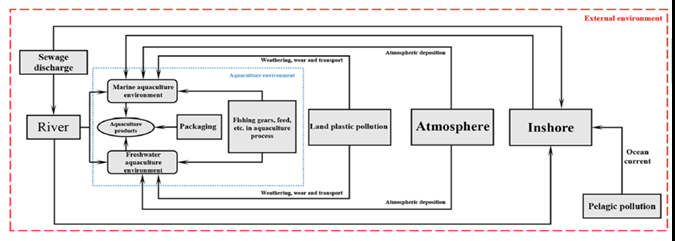
MP in aquaculture can be divided into two main sources: microplastics introduced from the external environment comprising marines, rivers, atmospheric sedimentation and terrestrial land. Furthermore, MP produced during aquaculture process such as aging, feeding, packaging of aquaculture products and wear of plastic fishing gears represent another source [14]. Figure 1 summarizes the means in which microplastics enter aquatic environments [14].
Impact of MP on Aquatic Environment and Marine Species
The harmful effect of MP in aquaculture is first manifested in aquaculture environment. Organic additives in microplastics, as phthalates and Bisphenol A pose a threat to aquatic organisms since they classified as endocrine disrupting chemicals when released into water [15]. Concerning chlorinated MP, they release Hydrochloric acid to the water in the process of decomposition, resulting in acidification of the aquatic environment [16]. Moreover, these MP accumulated in the marine environment after their release causing pollution diffusion [17].
As an important source of human protein, MP enter the aquaculture products through water environment and have numerous adverse effects on aquatic organisms [18]. These plastic wastes can improve the absorption efficiency of Nile tilapia (Oreochromis niloticus) to chemical contaminants [19], reduce the growth rate of Japanese medaka (Oryzias latipes) and cause its DNA damage [20] shorten intestinal villi of hybrid snakehead (Channa maculata × Channa argus) and stimulate its immune response [21]. MP can also cause neurotoxicity, behavioral change and slow down the growth and survival rate of aquatic organisms which will reduce the quality of aquaculture products which will ultimately lead to economic losses to aquaculture sector [22].
Adverse Effects of MP on Human Health
As consumers of aquaculture products, these MP have negative impacts on human health since they reduce the activity of the digestive enzyme which will affect human digestive absorption [23]. They can also promote the accumulation of antibiotics and microplastic organic additives in aquaculture products which increase the health risks they pose to human such as oxidative stress, mutagenicity, reproductive toxicity, cytotoxicity, teratogenicity and the increase in the intestinal microflora resistance [24, 25]. Consequently, microplastic pollution needs to be paid attention in aquaculture.
Modern Countermeasures and Prospects for MP Pollution in Aquaculture
Recently, many reports have discussed the treatment methods of MP pollution, as electro-coagulation [26], membrane bioreactors [27], and zirconium metal-organic framework-based foam material filtration process for seawater [28]. These new technologies represent purification efficiency for MP above 95 %, which may help to successfully reduce the entrance of MP to the aquatic environment. Blocking the external sources of MP and reducing their production in aquatic environment by applying ecological interception and purification, environmental fishing gears and packaging as well as strengthening their management are new countermeasures for controlling MP pollution [12, 13]. Moreover, there are some helpful prospective methods to examine MP pollution in aquaculture such as portable microplastic monitoring system [29] and remote sensing technology [30, 31]. To solve this environmental problem, cross-field cooperation and standardization of analytical process that help to improve relevant laws and regulations must be taken into consideration and applied as urgent directions to ensure sea food safety [14, 32].
Conclusion
Current estimations predict that the production of MP levels will continue to be highly accumulated in aquatic environments and surge exponentially in the near future due to mass consumption and inadequate waste management. To solve this problem, further studies are required to fill the gaps in understanding the impact of these microplastics with different sizes on aquatic species since the available data to accomplish a reliable assessment of the risks to human health is very scarce. Furthermore, analytical methods for the detection and quantification of microplastics in aquatic environments and in fishery products should be further standardized validated and developed.
References
-
Alberghini L, Truant A, Santonicola S, Colavita G, Giaccone V (2022) Microplastics in fish and fishery products and risks for human health: A review. International journal of environmental research and public health 20(1): 789.
-
Arthur C, Baker JE, Bamford HA (2009) Proceedings of the International Research Workshop on the Occurrence, Effects, and Fate of Microplastic Marine Debris, September 9-11, 2008, University of Washington Tacoma, Tacoma, WA, USA.
-
Frias J, Nash R (2019) Microplastics: finding a consensus on the definition. Mar Pollut Bull 138: 145-147.
-
FAO (2016) The state of world fisheries and aquaculture. In Contributing to Food Security and Nutrition for All; FAO: Rome, Italy.
-
Gesamp S (2015) Fate and effects of microplastics in the marine environment: a global assessment. In: Kershaw PJ (Ed.), IOC/UNIDO/WMO/IAEA/UN/UNEP/UNDP Joint Group of Experts on the Scientific Aspects of Marine Environmental Protection, Rep Stud 90: 96.
-
Chen G, Li Y, Wang J (2021) Occurrence and ecological impact of microplastics inaquaculture ecosystems. Chemosphere 274: 129989.
-
Wagner M, Lambert S (2018) Freshwater Microplastics: Emerging Environmental Contaminants? Springer Nature: Berlin/Heidelberg, Germany, pp: 303.
-
Abdelmeguid NE, Ghanem SF, Assem SS, Abou Shabana NM, Ismail RF, et al. (2024) Ameliorative effects of Chitosan in water remediation, endocrine disruption and reproductive impairment of Solea solea after exposure to Benzo (a) pyrene. Inter Aqua Res 16(1): 71-90.
-
Galloway TS, Lee BP, Buric I, Steele AM (2018) Plastics additives and human health: A case study of Bisphenol A (Bpa). Plast Environ 47: 131.
-
Chen JYS, Lee YC, Walther BA (2020a) Microplastic Contamination of Three Commonly Consumed Seafood Species from Taiwan: A Pilot Study. Sustainability 12: 9543.
-
Sonnemann G, Valdivia S (2017) Medellin declaration on marine litter in life cycle assessment and management. Int J LCA 22: 1637-1639.
-
Skirtun M, Sandra M, Strietman WJ, Van den Burg SWK, De Raedemaecker F, et al. (2022) Plastic pollution pathways from marine aquaculture practices and potential solutions for the North-East Atlantic region. Mar Pollut Bull 174: 113178.
-
Liu X, Liu H, Chen L, Wang X (2022) Ecological interception effect of mangroves on microplastics. J Hazard Mater 423: 127231.
-
Wu H, Hou J, Wang X (2023) A review of microplastic pollution in aquaculture: Sources, effects, removal strategies and prospects. Ecotoxicology and Environmental Safety 252: 114567.
-
Do ATN, Ha Y, Kwon JH (2022) Leaching of microplastic- associated additives inaquatic environments: a critical review. Environ Pollut 305: 119258.
-
Gewert B, Plassmann MM, MacLeod M (2015) Pathways for Degradation of PlasticPolymers Floating in the Marine Environment. Environ Sci Process Impacts 17: 1513-1521.
-
Ghanem SF (2021) Effect of endocrine disrupting chemicals exposure on reproduction and endocrine functions using the zebrafish model. Egypt J Aquat Biol Fish 25(5): 951-981.
-
Moore JD, Ototake M, Nakanishi T (1998) Particulate antigen uptake during immersion immunisation of fish: the effectiveness of prolonged exposure and the roles of skin and gill. Fish Shellfish Immunol 8: 393-408.
-
Zhang S, Ding J, Razanajatovo RM, Jiang H, Zou H, et al. (2019) Interactive effects of polystyrene microplastics and roxithromycin on bioaccumulation and biochemical status in the freshwater fish red tilapia (Oreochromis niloticus). Sci. Total Environ 648: 1431-1439.
-
Pannetier P, Morin B, Le Bihanic F, Dubreil L, Cl´erandeau C, et al. (2020) Environmental samples of microplastics induce significant toxic effects in fish larvae. Environ Int 134: 105047.
-
Zhang C, Pan Z, Wang S, Xu G, Zou J (2022a) Size and concentration effects of microplastics on digestion and immunity of hybrid snakehead in developmental stages. Aquac Rep 22: 100974.
-
Tang Y, Han Y, Zhang W, Yu Y, Huang L, et al. (2022) Bisphenol a and microplastics weaken the antimicrobial ability of blood clams by disrupting humoral immune responses and suppressing hemocyte chemotactic activity. Environ Pollut 307: 119497.
-
Tan HW, Yue TT, Xu Y, Zhao J, Xing BS (2020) Microplastics reduce lipid digestion in simulated human gastrointestinal system. Environ Sci Technol 54: 12285- 12294.
-
Zhang W, Tang Y, Han Y, Zhou W, Shi W, et al. (2022b) Microplastics boost the accumulation of tetrabromobisphenol a in a commercial clam and elevate corresponding food safety Risks. Chemosphere 29: 2133499.
-
Zhou W, Han Y, Tang Y, Shi W, Du X, et al. (2020) Microplastics aggravate the bioaccumulation of two waterborne veterinary antibiotics in an edible bivalve species: Potential mechanisms and implications for human health. Environ Sci Technol 54: 8115-8122.
-
Perren W, Wojtasik A, Cai Q (2018) Removal of microbeads from wastewater usingelectrocoagulation. ACS Omega 3: 3357-3364.
-
Lares M, Ncibi MC, Sillanpaa M (2018) Occurrence, identification and removal of microplastic particles and fibers in conventional activated sludge process and advanced MBR technology. Water Res 133: 236-246.
-
Chen B, Fan Y, Huang W, Rayhan ABMS, Chen K, et al. (2020b) Observation of microplastics in mariculture water of Longjiao Bay, southeast China: influence by human activities. Mar Pollut Bull 160: 111655.
-
Asamoah BO, Kanyathare B, Roussey M, Peiponen KE (2019) A prototype of a portable optical sensor for the detection of transparent and translucent microplastics in freshwater. Chemosphere 231: 161-167.
-
Martínez-Vicente V, Clark JR, Corradi P, Aliani S, Arias M, et al. (2019) Measuring marine plastic debris from space: Initial assessment of observation requirements. Remote Sens 11: 2443.
-
Workshop on the Occurrence, Effects, and Fate of Microplastic Marine Debris (2008) University of Washington Tacoma, Tacoma, Wa, USA.
-
Ghanem SF (2023) Beware of the Silver-Cheeked Toadfish. Int J Oceanogr Aquac 7(2): 000245.
- Genetic Improvement of Nile Tilapia (Oreochromis niloticus): Advances in Selective Breeding and Genomic Approaches for Sustainable Aquaculture
- Microplastics, Contaminants, and Waste Hotspots: Divergences and Faults in Prioritizing Control Efforts
- Creating a Healthier, More Vibrant Open and Closed Aquatic Environment. A Submersible, Centrifugal Magnetically Affixed Current Changing Aquarium Pump
- An Attempt to Assess Alpha Diversity and Sample Size: Using the Ostracod Assemblages off Kumamoto Port, Japan
- Assessment of the Efficiency of Common Fishing Gears and Crafts Used at Mohananda River of Chapai Nawabganj, Bangladesh
- Fish Productivity and Biodiversity Status of Sundarban Mangrove in Bangladesh