
Preparation of Magnetic Chitosan-Based MOFs (FCM) for Antimony Removal
The rapid development of industry has led to heavy metal pollution becoming a significant environmental concern, with particular attention being focused on antimony pollution. China, as one of the world’s largest producers of antimony, faces potential threats to ecosystems and human health from this type of pollution. To address this issue, an innovative method for preparing new green functional materials was proposed in this study. An efficient and economical composite material (FCM) was developed, based on non-toxic chitosan loaded with the metal-organic framework (MOFs) and magnetic nano ferrosolferric oxide. This material was then used to adsorb Sb (III) in water environments. The effects of the mass ratio of chitosan to metal-organic frameworks (MOFs) denoted as MIL-100(Fe), ferrosolferric oxide nanoparticles (Nano-Fe3O4) to chitosan, reaction temperature, reaction time, and initiator concentration on the removal rate of Sb (III) were investigated. The results indicated that a mass ratio of 1:2:2 for Fe3O4, chitosan, and MOFs, an initiator concentration of 1.25 mmoL·L-1, a reaction time of 90min, and a water bath temperature of 60℃ resulted in a removal rate of Sb (III) from FCM reaching 96.8%. Characterization analysis revealed the rough and uneven surface of FCM, with numerous aggregated irregular particles and porous crystalline structures. In conclusion, FCM demonstrates effective removal of heavy metal antimony from water while exhibiting high environmental compatibility and sustainability.
Yanda Qian*1, Hao Zhan1, Xiaoxue Wang2, Shengjiao Xu1 and Zhengchuan Wu1
Keywords: Water; Antimony; Chitosan; Magnetic Nanoparticle; Metal Organic Framework
Introduction
As a metalloid element, antimony is primarily obtained from stibnite or smelting byproducts [1]. The extensive exploitation of antimony ore and the widespread use of antimony-containing products have led to an increase in the concentration of antimony in water, soil, and atmosphere [2], posing a significant threat to human health and the ecological environment [3, 4]. Major sources of antimony pollution include mining, smelting, and industrial effluents. In the environment, Sb(III) and Sb(V) are the primary oxidation states; however, the former is ten times more harmful than the latter [5]. The International Agency for Research on Cancer has classified Sb(III) as a human carcinogen [1]. Antimony and its compounds accumulate in the water-soil- crop-human food chain and enter the human body through direct or indirect contact, causing damage to metabolic functions and vital organs [6]. In recent years, strict water quality standards have been developed around the world to control the content of antimony in water [7, 8]. Since 1979, the US Environmental Protection Agency (US EPA) and the European Union have considered antimony as a priority pollutant, while the World Health Organization has set the maximum acceptable value of antimony in drinking water at 0.020mg/L [9], and the maximum permissible level in drinking water in China at 0.005mg/L [10].
Currently, methods for removing antimony include adsorption, coagulation, bioremediation, ion exchange, and electrochemical technology [2, 11, 12, 13, 14]. Adsorption methods are preferred due to their high efficiency, speed, low cost, and simplicity [15]. Metal-organic framework materials (MOFs) are widely used in adsorption, gas storage, separation, and catalysis due to their spatial structure, large specific surface area, and adjustable pores [16, 17]. Studies have utilized MOFs for removing antimony from water. Zhu, et al. [18] proposed a biochar-supported magnetic MOF adsorbent for Sb (III) removal. Rangwani, et al. [19] proposed a mesoporous Zr-based metal-organic framework for the adsorption of Sb (V) from water. Ru, et al. [20] proposed a series of UiO metal- organic framework composites as advanced adsorbents to remove heavy metal ions. Liu, et al. [21] proposed using a zeolitic-imidazolate framework (ZIF-8) to remove Sb(V). He, et al. [22] suggested an amino-modified zirconium metal- organic framework (UiO-66(NH2)) for adsorbing antimony in aqueous solutions. Li, et al. [23] demonstrated zirconium- based metal-organic frameworks for efficient simultaneous removal of antimonite (Sb (III)) and antimonate (Sb (V)) from aqueous solution. Qi, et al. [24] removed Sb (III) from the aqueous solution by magnetic core-shell Fe3O4@TA@ UiO-66 microspheres. However, metal-organic Frameworks themselves have disadvantages such as low mechanical strength and difficulty in recycling. Therefore, functional modification of MOFs is particularly important. In this study, the surface of green non-toxic chitosan (CS) was loaded with Fe3O4 and MOFs, to synthesize a green-friendly composite material. This not only improves dispersion of MOFs in water environment, but also facilitates recycling of the material.
Materials and Methods
Chemicals
$$ \text{Chitosan} \quad (\text{CS}, \quad \text{deacetylation} \quad \text{degree} \quad \geq 95\%), $$
(3-Aminopropyl) triethoxysilane (APTES), and 2,2’-Azobis
[2-(2-imidazolin-2-yl)propane] dihydrochloride (VA-044)
were purchased from Maclin Biochemical Technology
Co., LTD. (Shanghai, China). Ferric chloride hexahydrate
(FeCl3·6H2O), sodium acetate anhydrous (C2H3NaO2) were
purchased from Taishan Chemical Plant Co., LTD. (Taishan,
China), ethylene glycol (EG), N, N-dimethylformamide (DMF)
were purchased from Guangdong Guanghua Technology Co.,
LTD. (Shantou, China), sodium hydroxide (NaOH), potassium
antimony tartrate (C8H4K2O12Sb2) was purchased from Xilong
Chemical Co., LTD. (Guangdong, China), 1,3,5-phthalic acid
(C9H6O6) was purchased from Shanghai Alding Biochemical
Technology Co., LTD. (Shanghai, China), anhydrous ethanol
(C2H5OH) was purchased from Hunan Huihong Reagent
Co., LTD. (Shanghai, China), and hydrochloric acid (HCl)
was purchased from Zhuzhou Star Chemical Glass Co., LTD.
All chemical reagents were analytically pure (AR) except
chitosan (deacetylation ≥95%, biological reagent). All
experiments were carried out with ultra-pure water.
Synthesis of the Adsorbents
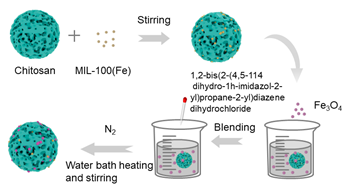
Preparation of modified Fe3O4: Magnetic nano-Fe3O4 was prepared by the solvothermal reduction method. First, 21.6 g ferric chloride hexahydrate and 57.6 g sodium acetate anhydrous were added to 800 mL ethylene glycol and stirred at room temperature for 30 minutes to make it evenly mixed. The solution is then transferred to a polytetrafluoroethylene- lined autoclave where it reacts at 200°C for 8 hours. After the temperature was cooled to room temperature, it was cleaned several times with ultra-pure water and ethanol absolute, and finally, the black magnetic nanomaterial (Fe3O4) was collected with magnets and dried in a vacuum drying oven at 60°C for 12 hours. Next, the magnetic nano-Fe3O4 was immersed in a prepared mixture of 3-Methacryloxypropyltris- (trimethylsiloxy)-silane and ethanol absolute and stirred at 30°C for 12 hours to obtain the modified Fe3O4. Finally, after washing with ultra-pure water and ethanol absolute several times, the product is collected with magnets and placed in a vacuum drying oven at 40°C for 12 hours for further use. Preparation of MIL-100(Fe): Add 2.0mmol of benzene- 1,3,5-tricarboxylic acid and 2.0mmol Fe3+ (from FeCl3·6H2O solution) to 60ml of ultra-pure water and stir continuously for half an hour to make it fully mixed. The mixture is then transferred to an autoclave and placed in an oven at 200°C for 8 hours. After cooling to room temperature, centrifuge with ethanol absolute, N, N-dimethylformamide, and ultra- pure water for 8min at 6000r/min. Finally, MIL-100(Fe) was obtained by vacuum drying at 80°C. Preparation of FCM: The prepared modified Fe3O4 was ultrasonically dispersed in a three-neck flask containing 30ml ultra-pure water to form a black suspension A. When the total monomer mass is determined, a certain mass ratio of MOFs and CS is dissolved in a 250ml beaker, and a stable suspension B is formed after stirring for one hour. Next, suspension B is injected drop by drop into suspension A and is rapidly stirred for 20 minutes to blend evenly. Subsequently, the reaction solution was completely deoxidized with pure N2 (99.99%) bubbling, and then the initiator 1,2-bis(2-(4,5-dihydro- 1h-imidazol-2-yl)propane-2-yl)diazene dihydrochloride was added to the reaction system and stirred in a constant temperature water bath for a certain time. After the reaction, the black-red suspension cooled naturally and continued crosslinking for 2 hours. Finally, the suspension is poured into a beaker, cleaned several times with ethanol absolute and ultra-pure water, then separated by magnets, placed in a vacuum oven, and the temperature is adjusted to 40°C for continuous vacuum drying until there is no water, which can be used for further experiments.
The effects of different proportions of chitosan and MIL-100(Fe) on the adsorption properties of the composite were investigated. Five kinds of composite materials with the ratio of chitosan to MIL-100(Fe) of 4:1, 2:1, 1:1, 1:2, and 1:4 were prepared according to the synthesis method of magnetic materials described in 2.2.3, and the mass of Fe3O4 was constant. The reaction temperature was 60℃, the pH value was 6.2, and the reaction time was 60 minutes. According to the concentration of Sb (III) measured before and after the experiment, the removal rate of Sb (III) at the initial concentration of 10 mg/L was obtained by using 5 composites with different proportion (Figure 1).
Study on the Influence of Preparation Conditions
The solid potassium antimony tartrate (K(SbO) C4H4O6·1/2H2O, 2.742g) was dissolved in ultra-pure water, transferred to 1000 mL volumetric bottle, and a small amount of dilute hydrochloric acid was added, and the ultra-pure water was continued to be added to the scale line, and fully oscillated evenly to obtain 1g/L Sb (III) stock solution. Then,
m(CS):m(MOFs) according to the required concentration, an appropriate amount of ultra-pure water was added to the Sb (III) stock solution to dilute it, and the required concentration of the Sb (III) solution was obtained.
The mass ratio of chitosan/MIL-100(Fe), ferric oxide/ chitosan mass ratio, reaction temperature, reaction time, and initiator concentration were selected as the variables to optimize the preparation of the composite material (FCM). Sb (III) was used as the evaluation criterion for the adsorption and removal of pollutants. The specific experimental method is as follows: 200mL antimony ion solution and adsorbent are added to the beaker and stirred for 30 minutes at 210 r/min and 60 r/min respectively using a six-set electric mixer. Half an hour after precipitation, the composite material is separated by magnets. The water sample at 2cm of the supernatant was filtered by a 0.45μm filter head, and the concentration of Sb (III) was determined by atomic absorption spectrophotometry.
The Effect of CS to MIL-100(Fe) Ratio
0.05g 0.1g 0.15g Figure 1: The removal efficiency of Sb (III) at an initial concentration of 10 mg/L by composite materials with different ratios of chitosan and MIL-100(Fe) and dosages.
As can be seen from Figure 1, Fe3O4-CS-MOFs showed significant differences in the removal of Sb (III) at different compound ratios of chitosan and MIL-100(Fe). With the decrease in the ratio of CS and MOFs, the removal rate of metal antimony increased first and then decreased. When the ratio of CS and MOFs was 1:1, the removal rate of Sb (III) by Fe3O4-CS-MOFs reached the highest. In summary, the optimal ratio of CS and MOFs was selected as 1:1 in the subsequent preparation.
The Effect of Fe3O4 to CS Ratio
The effects of different ratios of ferrosolferric oxide and chitosan on the adsorption properties of the composite were investigated. The mass ratio of CS and MOFs was 1:1, and five composites with different ratios were prepared according to the synthesis method of 2.2.3 magnetic materials, in which the ratio of Fe3O4 and CS was 4:1, 2:1, 1:1, 1:2, 1:4, respectively, and the total amount of fixed Fe3O4 and CS was 0.6g. The reaction conditions were: reaction temperature 50℃, pH 6.2, reaction time 60 minutes. According to the concentration of Sb (III) measured before and after the experiment, the removal rate of Sb (III) at the initial concentration of 10 mg/L was obtained by using 5 composites with different proportions (Figure 2).
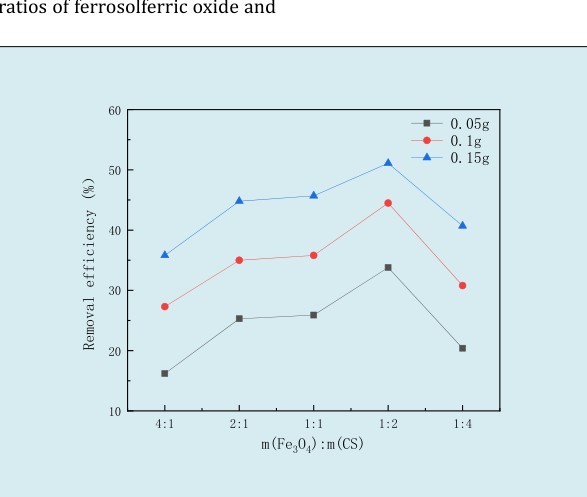
It can be seen from Figure 2 that the ratio of Fe3O4 and CS is in the range of 4:1 to 1:2, and with the decrease of the ratio of Fe3O4 and CS, the removal rate of metal antimony of the composite material gradually increases. When the ratio of Fe3O4 to CS was 1:2, the removal rate of Sb (III) by Fe3O4-CS- MOFs reached the highest. However, when the proportion of Fe3O4 was further reduced, the removal rate showed a sharp downward trend. This may be because too low component concentration will affect the collision probability between components, making the chain polymerization reaction inadequate. However, too high a component concentration will accelerate the chain termination and chain transfer rate between components, resulting in the termination of the reaction [25]. In summary, the optimal mass ratio of Fe3O4: CS: MOFs is 1:2:2.
The effect of Reaction Temperature
According to the synthesis method of magnetic materials in 2.2.3, the effects of different water bath temperatures on the adsorption properties of composite materials were investigated in this experiment. The reaction time was 60 minutes and the pH value was 6.2 under the conditions of a 1:2:2 ratio of Fe3O4, chitosan (CS), and MOFs. The reaction temperature ranges from 40℃ to 80℃. According to the concentration of Sb(III) measured before and after the experiment, the removal rate of Sb (III) at the initial concentration of 10 mg/L was obtained by the composite prepared at five different water bath temperatures (Figure 3).
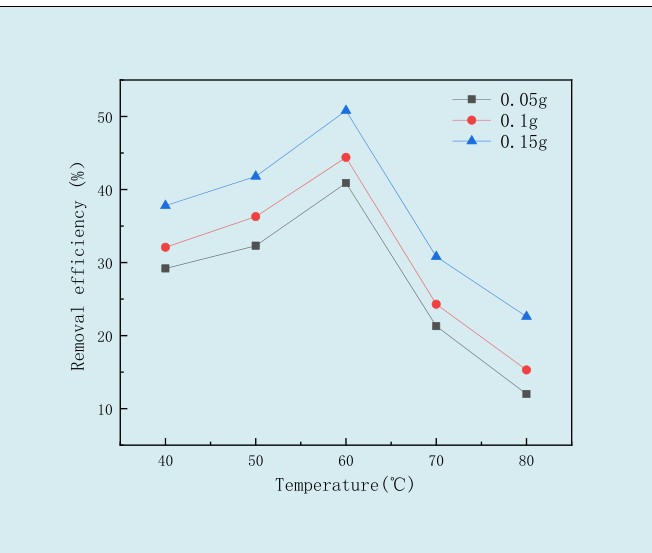
As can be seen from Figure 3, reaction temperature has a significant impact on the removal of antimony ions, and with the increase in reaction temperature, the removal increases first and then decreases. When the reaction temperature reaches 60℃, the removal rate reaches the highest. When the reaction temperature continued to rise, the removal rate dropped sharply and reached the lowest level at 80℃. In the range of 40℃ to 60℃, the reason for the increase in removal rate may be that with the increase of temperature, the decomposition rate of the initiator is accelerated, and more free radicals are generated, which makes each component fully react and the polymerization degree is higher. However, when the reaction temperature exceeds 60℃, the decomposition rate of the initiator increases sharply, resulting in uncontrolled polymerization, accelerated chain transfer reaction, and a decline in the degree of component polymerization [25]. Therefore, in the subsequent preparation, the optimal reaction temperature was selected as 60℃.
The Effect of Reaction Time
The effects of different reaction times on the adsorption properties of the composites were investigated. The reaction was prepared under the conditions of a 1:2:2 ratio of Fe3O4, chitosan (CS), and MOFs, a reaction temperature of 60℃, and a pH of 6.2. Response time ranges from 30 minutes to 150 minutes. According to the concentration of Sb (III) measured before and after the experiment, the removal rate of Sb (III) with the initial concentration of 10 mg/L was obtained under different reaction times (Figure 4).
It can be seen from Figure 4 that different reaction times have significant effects on the removal of antimony ions. When the reaction time was increased from 30 minutes to 90 minutes, the removal rate increased significantly. This may be because at this stage, the active free radicals produced in the system gradually increase, and the unreacted components are also more, increasing the removal rate of Sb (Ⅲ). However, when the reaction time exceeds 90 minutes, the active free radicals in the system gradually decrease, and the unreacted components also decrease, resulting in a decrease in the degree of polymerization of components, resulting in a corresponding decrease in the removal rate of Sb (Ⅲ). Therefore, in the subsequent preparation, 90 minutes was determined to be the optimal reaction time.
The effect of Initiator Concentration
The effect of initiator concentration on the adsorption properties of the composite was investigated. The reaction was prepared under the conditions of a 1:2:2 ratio of Fe$_2$O$_3$, chitosan (CS), and MOFs, reaction temperature of 60°C, pH of 6.2, and reaction time of 90 minutes. Initiator concentrations ranged from 0.5 mmol/L to 1.25 mmol/L. According to the concentration of Sb (III) measured before and after the experiment, the removal rate of Sb (III) at the initial concentration of 10 mg/L was obtained under different initiator concentrations (Figure 5).
It can be seen from Figure 5 that the initiator concentration has a significant effect on the removal of antimony ions. When the initiator concentration increased from 0.5 to 1.25 mmol/L, the removal rate of Sb (Ⅲ) showed a steady upward trend and reached the highest when the initiator concentration reached 1.25 mmol/L. When the removal rate of Sb (Ⅲ) exceeded 1.25 mmol/L, the removal rate of Sb (Ⅲ) decreased sharply. In the range of 0.5 mmol/L to 1.25 mmol/L, the increase in removal rate may be due to the increase of initiator concentration and the increase of active free radicals in the system, which promotes the chain polymerization reaction and improves the polymerization among components, thus increasing the removal rate. However, when the initiator concentration exceeds 1.25 mmol/L, the reason for the sharp decline in the removal rate may be that the initiator concentration is too high, generating too many free radicals, which makes the system reaction difficult to control, making the polymer difficult to form, and reducing the cross-linking probability of each component, resulting in a decrease in the removal rate. Therefore, 1.25 mmol/L was determined to be the optimal initiator concentration.
Verification
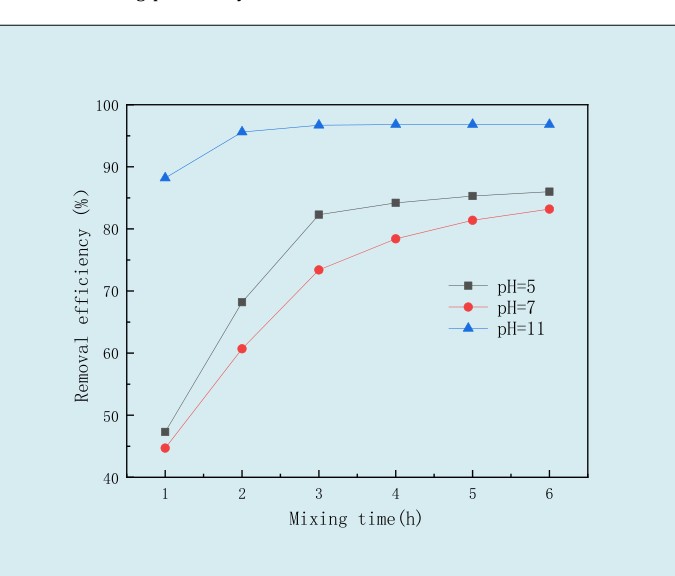
The initial concentration of Sb(Ⅲ) in the test was set at 10mg/L. Six 250 ml beakers were utilized for each experiment, and an equal volume of antimony solution was transferred into the six beakers using a measuring cylinder. Subsequently, the experiment was conducted with a six-set mixer, which underwent fast stirring (210 min/r) for 30 minutes followed by slow stirring (60 min/r) for another 30 minutes. After stirring, the solution was allowed to settle for 30 minutes before taking the supernatant to determine the concentration of antimony ion. The results indicated that FCM achieved a removal rate of metallic antimony reaching 96.8% under conditions including a dosage of 300mg, pH=11, and a stirring time of 3 hours (Figure 6).
Results and Discussion
Scanning Electron Microscope Analysis
SEM images Figures 7a-7d show that the morphology and structure of FCM are significantly different from that of nano-Fe3O4, MOFs, and chitosan. FCM was used to bind Fe3O4 and MOFs to the surface of chitosan by ionic bonding and electrostatic adsorption.
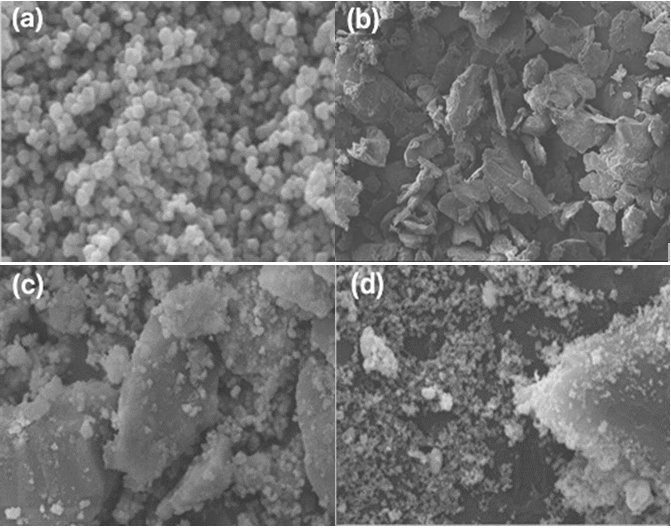
The nano-Fe3O4 particles have excellent structural characteristics, mainly in the shape of cubes with clear edges. The particles were evenly distributed, and no obvious aggregation or clustering was observed, showing good dispersion. The particle size is relatively consistent, the surface is smooth, and there is no obvious rough or porous structure (Figure 7a). The surface of chitosan has a lamellar structure with irregular and rough edges. The structure of the lamellar particles is tight, and some areas have accumulation and overlap. The particle size is large and has a good hierarchical feeling (Figure 7b). MIL-100 (Fe) has a large particle size, irregular morphology, rough surface, and many small particles attached. These characteristics may help improve the adsorption properties of the material (Figure 7c). According to the SEM diagram of the final product FCM (Figure 7d), the surface of chitosan was covered with a large number of substances, which showed a form similar to triiron tetraoxide and MOFs. This morphology may be due to the chemical combination of the carboxyl group on MOFs with the amino group on chitosan, and the combination of triiron tetraoxide with the amino group on chitosan after opening the double bond silane coupling agent.
X-Ray Diffraction Analysis
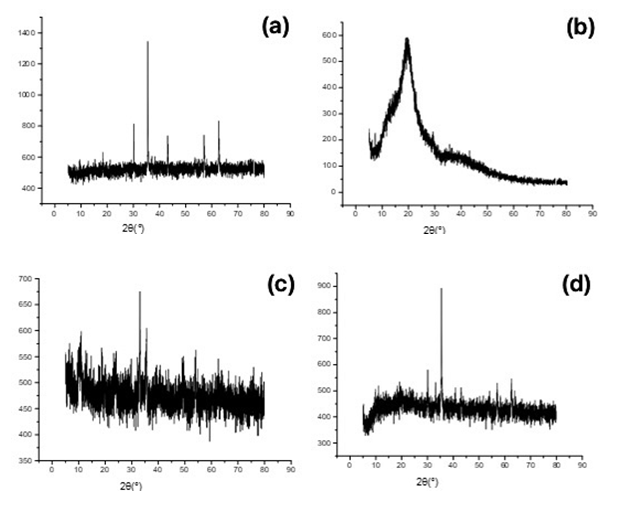
By comparing the XRD patterns of nano-Fe3O4 (Figure 8a), chitosan ((Figure 8b), and MOFs (Figure 8c) with the final product FCM (Figure 8d), it can be seen from the sharp and strong peaks of the four materials that they all have crystal structures [26].
The peak intensity of the final product FCM was around 11.04°, 19.19°, 30.09°, 35.43°, 56.96°, 62.59°. The peaks corresponding to angles 30.09°, 35.43°, 56.96°, and 62.59° are highly similar to Fe3O4, indicating that the final product largely retains the crystal structure of Fe3O4. The peak value at 19.19° is very similar to that of chitosan, so the final product also retains the crystalline structure of chitosan. At 11.04°, the final product showed a peak similar to that of MOFs, indicating that FCM also contains the crystal structure of MOFs.
Conclusions
Chitosan can be a carrier, to bind with Fe3O4 and MOFs and form a magnetic chitosan-based MOF composite (FCM), which shows high efficiency of removing Sb (III) form solution. The best conditions for the synthesis of FCM were: the mass ratio of Fe3O4 to chitosan 1:2, the mass ratio of chitosan to MOFs 1:1, the initiator concentration of 1.25 mmol/L, the reaction time of 90 mins, and the water bath temperature 60℃. The FCM product had a surface that was rough and uneven, with many aggregated irregular particles, and a structure of crystal. It can be used to treat Sb (III) solution with a removal efficiency of 96.8%. FCM is a kind of magnetic organic-inorganic composite material, easily prepared, not toxic and harmful, showing high environmental compatibility and sustainability.
References
-
De Boeck M, Kirsch-Volders M, Lison D (2003) Cobalt and antimony: genotoxicity and carcinogenicity. Mutation Research/Fundamental and Molecular Mechanisms of Mutagenesis 533(1-2): 135-152.
-
Long X, Wang X, Guo X, He M (2020) A review of removal technology for antimony in aqueous solution. Journal of Environmental Sciences 90: 189-204.
-
Gan Y, Ding C, Xu B, Liu Z, Zhang S, et al. (2023) Antimony (Sb) pollution control by coagulation and membrane filtration in water/wastewater treatment: A comprehensive review. Journal of Hazardous Materials 442: 130072.
-
Leuz AK, Mönch H, Johnson CA (2006) Sorption of Sb (III) and Sb (V) to goethite: influence on Sb (III) oxidation and mobilization. Environmental science & technology 40(23): 7277-7282.
-
Wilson SC, Lockwood PV, Ashley PM, Tighe M (2010) The chemistry and behaviour of antimony in the soil environment with comparisons to arsenic: a critical review. Environmental pollution 158(5): 1169-1181.
-
Bolan N, Kumar M, Singh E, Kumar A, Singh L, et al. (2022) Antimony contamination and its risk management in complex environmental settings: a review. Environment international 158: 106908.
-
Bagherifam S, Brown TC, Fellows CM, Naidu R (2019) Derivation methods of soils, water and sediments toxicity guidelines: a brief review with a focus on antimony. Journal of Geochemical Exploration 205: 106348.
-
Multani RS, Feldmann T, Demopoulos GP (2016) Antimony in the metallurgical industry: A review of its chemistry and environmental stabilization options. Hydrometallurgy 164: 141-153.
-
Hua L, Wu C, Zhang H, Cao L, Wei T, et al. (2021) Biochar- induced changes in soil microbial affect species of antimony in contaminated soils. Chemosphere 263: 127795.
-
He M, Wang X, Wu F, Fu Z (2012) Antimony pollution in China. Science of the Total Environment 421: 41-50.
-
Guo X, Wu Z, He M (2009) Removal of antimony (V) and antimony (III) from drinking water by coagulation– flocculation–sedimentation (CFS). Water Research 43(17): 4327-4335.
-
Kang M, Kawasaki M, Tamada S, Kamei T, Magara Y (2000) Effect of pH on the removal of arsenic and antimony using reverse osmosis membranes. Desalination 131(1- 3): 293-298.
-
Wang H, Chen F, Mu S, Zhang D, Pan X, et al. (2013) Removal of antimony (Sb (V)) from Sb mine drainage: biological sulfate reduction and sulfide oxidation– precipitation. Bioresource technology 146: 799-802.
-
Wu Z, He M, Guo X, Zhou R (2010) Removal of antimony (III) and antimony (V) from drinking water by ferric chloride coagulation: Competing ion effect and the mechanism analysis. Separation and Purification Technology 76(2): 184-190.
-
Rashid R, Shafiq I, Akhter P, Iqbal MJ, Hussain M (2021) A state-of-the-art review on wastewater treatment techniques: the effectiveness of adsorption method. Environmental Science and Pollution Research 28: 9050-9066.
-
Chakraborty G, Park IH, Medishetty R, Vittal JJ (2021) Two-dimensional metal-organic framework materials: synthesis, structures, properties and applications. Chemical Reviews 121(7): 3751-3891.
-
Zhang X, Maddock J, Nenoff TM, Denecke MA, Yang S, et al. (2022) Adsorption of iodine in metal–organic framework materials. Chemical Society Reviews 51(8): 3243-3262.
-
Zhu G, Lin J, Yuan Q, Wang X, Zhao Z, et al. (2021) A biochar supported magnetic metal organic framework for the removal of trivalent antimony. Chemosphere 282: 131068.
-
Rangwani S, Howarth AJ, DeStefano MR, Malliakas CD, Ana E. Platero-Prats, et al. (2018) Adsorptive removal of Sb (V) from water using a mesoporous Zr-based metal– organic framework. Polyhedron 151: 338-343.
-
Ru J, Wang X, Wang F, Cui X, Du X (2021) UiO series of metal-organic frameworks composites as advanced sorbents for the removal of heavy metal ions: Synthesis, applications and adsorption mechanism. Ecotoxicology and Environmental Safety 208: 111577.
-
Liu B, Jian M, Wang H, Zhang G, Liu R, et al. (2018) Comparing adsorption of arsenic and antimony from single-solute and bi-solute aqueous systems onto ZIF-8. Colloids and Surfaces A: Physicochemical and Engineering Aspects 538: 164-172.
-
He X, Min X, Luo X (2017) Efficient removal of antimony (III, V) from contaminated water by amino modification of a zirconium metal–organic framework with mechanism study. Journal of Chemical & Engineering Data 62(4): 1519-1529.
-
Li J, Li X, Hayat T, Alsaedi A, Chen C (2017) Screening of zirconium-based metal–organic frameworks for efficient simultaneous removal of antimonite (Sb (III)) and antimonate (Sb (V)) from aqueous solution. ACS Sustainable Chemistry & Engineering 5(12): 11496- 11503.
-
Qi P, Luo R, Pichler T, Zeng J, Wang Y, et al. (2019) Development of a magnetic core-shell Fe3O4@ TA@ UiO-66 microsphere for removal of arsenic (III) and antimony (III) from aqueous solution. Journal of Hazardous Materials 378: 120721.
-
Rani P, Sen G, Mishra S, Jha U (2012) Microwave assisted synthesis of polyacrylamide grafted gum ghatti and its application as flocculant. Carbohydrate Polymers 89(1): 275-281.
-
Mahmoodi NM, Abdi J, Oveisi M, Asli MA, Vossoughi M (2018) Metal-organic framework (MIL-100 (Fe)): Synthesis, etailed photocatalytic dye degradation ability in colored textile wastewater and recycling. Materials Research Bulletin 100: 357-366.
- Genetic Improvement of Nile Tilapia (Oreochromis niloticus): Advances in Selective Breeding and Genomic Approaches for Sustainable Aquaculture
- Microplastics, Contaminants, and Waste Hotspots: Divergences and Faults in Prioritizing Control Efforts
- Creating a Healthier, More Vibrant Open and Closed Aquatic Environment. A Submersible, Centrifugal Magnetically Affixed Current Changing Aquarium Pump
- An Attempt to Assess Alpha Diversity and Sample Size: Using the Ostracod Assemblages off Kumamoto Port, Japan
- Assessment of the Efficiency of Common Fishing Gears and Crafts Used at Mohananda River of Chapai Nawabganj, Bangladesh
- Fish Productivity and Biodiversity Status of Sundarban Mangrove in Bangladesh