
Reconstruction of the Nasal Columella of an Adult Patient with Nasolabial Subcutaneous Island Flap after Resection of a Dermoid Cyst
Dermoid cysts located in the nasal region are a kind of congenital lesions and may appear as a nasal swelling in the midline. Although nasal dermoid cysts are usually diagnosed during childhood, they can rarely be detected in adulthood. The most important feature that distinguishes nasal dermoid cysts from other Dermoid cysts of the body is that they can extend into deeper structures in the nose and even into intracranial area. Therefore, it is recommended to perform a good physical examination and a detailed imaging method such as computed tomography and magnetic resonance imaging before the operation. Although the nasolabial island flap is a good option for Columella reconstruction, the flap should be followed-up closely for possible circulation problems.
Introduction
Dermoid cysts are cysts lined with stratified squamous epithelium and may contain any of the normal components of the epithelium, including hair and sebaceous glands [1]. Dermoid cysts located in the nasal region are a kind of congenital lesions and may appear as a nasal swelling in the midline. Although nasal dermoid cysts are usually diagnosed during childhood, they can rarely be detected in adulthood [2]. Cysts in this region constitute 11-12% of Dermoid of the head and neck region and 1% of all body Dermoid [3, 4]. There are many methods for the reconstruction of Columella, ranging from local flaps such as nasolabial and perinasal alar flaps to regional flaps such as forehead and submental flaps, and even to free flaps [5].
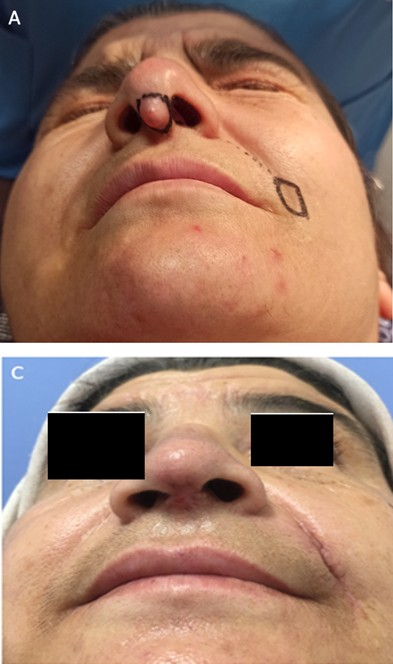
A 48-year-old female patient admitted to our clinic with the complaint of a mass at her nose. The patient stated that the mass enlarged over years without the signs of pain or nasal instruction. At the physical examination a nodular mass of approximately 1,5x1 cm (Figure 1A) was located at the middle of her Columella. A previous excisional biopsy taken from the same patient from her left thigh approximately 2 months ago was diagnosed as dermato fibroma. Thus, the mass in the Columella was also excised with the dermatofibroma being among the differential diagnoses. The excision was done with appropriate surgical margins. During the operation, it was observed that the mass was not related to the septum and did not extend to any other structure. At the end of the excision, the caudal ends of the medial crura of the lower lateral cartilages were exposed. The left nasolabial subcutaneous island flap was designed to be long enough to cover the defect without tension (Figure 1B). Elevation of the flap began with the incision of the skin island. After reaching the subcutaneous plane, blunt dissection was continued by obtaining sufficient thickness to protect the pedicle. The flap was delivered to the defect by passing it through a subcutaneous tunnel created under the alar floor. The inset of the flap was made to cover the medial crura totally. After bleeding control has been done, the skin and mucosa incisions were sutured. The capillary refill of the flap was observed to be normal. However, when the patient came to the follow-up one week later, partial necrosis was observed at the dermal layer of the flap. The patient was followed up with moist dressing. After 3 weeks, the defect was completely healed (Figure 1C).
Discussion
Nasal Dermoid cysts are congenital midline lesions that are usually seen in children and very rarely detected in adults [2]. In the literature, dermoid cysts found in the Columella generally originate from the septum and present as an ostium (sinus mouth) in the columella [6]. The most important feature that distinguishes nasal dermoid cysts from other dermoid cysts of the body is that they can extend into deeper structures in the nose and even into intracranial area. Therefore, it is recommended to perform a good physical examination and a detailed imaging method such as computed tomography and magnetic resonance imaging before the operation [7].
As for localization, nasal dermoid cysts can be found anywhere in the midline drawn from the glabella to the base of the columella. Although it is superficial in approximately 60% of the patients, it may extend intracranially in 10-45% of the patients [8]. In our case, the mass in the columella was approached with the suspicion of dermatofibroma, both because of the patient’s age and his previous history of dermatofibroma. During the excision of the mass, no finding regarding extension to the septum or other structure was encountered. The mass was removed as en-bloc with its overlying capsule.
Although the subcutaneous nasolabial flap is one of the most commonly used flaps for defects less than 2 cm, the forehead flap is preferred for defects over 2.5 cm [9]. The vascular nutrition of the nasolabial island flap originates from the subcutaneous and dermal vascular systems at the base of the flap [10]. Among the reasons that make this flap ideal for the reconstruction of columella are; [1] color matching, [2] the skin of the flap is hairless skin, [3] the scar of the donor area is hidden in the nasolabial sulcus and [4] the ability of harvesting a thin flap that suit small and thin defects. On the other hand, this flap is not suitable for defects larger than 2 cm [11].
Another important disadvantage of the flap is that the columella deviates to one side due to the contracture that occurs during wound healing. To avoid this, it is recommended that the flap be 10-20% longer than the defect. In order to prevent possible venous congestion of the flap, the created subcutaneous tunnel should be comfortable [12]. As seen in our case, the flap was designed to be tension-free (Figure 1). Although the capillary refill time of the flap was normal in the early postoperative period, we encountered partial necrosis of the skin at the postoperative 1st week. However, the flap recovered completely after 3 weeks (Figure 1).
Conclusion
Nasal dermoid cysts are rare congenital lesions in adult patients. When such a mass is encountered, regardless of the patient’s age, further imaging is recommended to rule out intracranial extension. Although the nasolabial island flap is a good option for Columella reconstruction, the flap should be followed-up closely for possible circulation problems.
References
-
Rodriguez DP, Orscheln ES, Koch BL (2017) Masses of the nose, nasal cavity, and nasopharynx in children. Radiographics 37(6): 1704-1730.
-
Loke DK, Woolford TJ (2001) Open septorhinoplasty approach for the excision of a dermoid cyst and sinus with primary dorsal reconstruction. J Laryngol Otol 115(8): 657-659.
-
Crawford JK, Webster JP (1952) Congenital dermoid cyst of the nose. Plast Reconst Surg 9:235-60
-
Littlewood AHM (1961) Congenital nasal dermoid cysts and fistulas. Plast Reconstr Surg 27(5): 471-488
-
Nowicki J, Abbas JR, Sudbury D, Anari S (2020) Nasal columella reconstruction - A comprehensive review of the current techniques. J Plast Reconstr Aesthet Surg 73(5): 815-827.
-
Jay PM, Bruce BS, Thomas NP (1988) Craniofacial Dermoids, Plastic and Reconstructive Surgery 82(6): 953-958
-
Hacker DC, Freeman JL (1994) Intracranial extension of a nasal dermoid sinüs cyst in a 56-year-old man. Head Neck 16(4): 366-371.
-
Choi YD, Park ES, Kang MS (2012) A nasal dermal sinus cyst involving the nasal septum. J Craniofac Surg 23(6): e636-e638.
-
Potter JK, Ducic Y, Ellis E (2005) Extended bilaminar forehead flap with cantilevered bone grafts for reconstruction of full-thickness nasal defects. J Oral Maxillofac Surg 63(4): 566-570.
-
Cormick GC, Lambery BG (1986) The arterial anatomy of skin flap. New York: Churchill Livingstone.
-
Barton FE Jr (1988) Aesthetic aspects of nasal reconstruction. Clin Plast Surg 15(1): 155-166.
-
Kang IG, Jung JH, Kim ST, Kim YJ (2014) Reconstruction of a columellar defect with a nasolabial island flap. Clin Exp Otorhinolaryngol 7(2): 142-144.
- Reconstruction of Nasal Defect Using a Local Flap Based in the Nanoperforants Concept: A Case Report
- Transplant Tourism in Japan: Insights from Nationwide Surveys and Emerging Ethical Challenges
- The Challenge of Peritoneal Vaginoplasty in Transgender Women: Review Literature and Personal Perspectives
- Algorithmic Paternalism: Autonomy Versus Automation
- Dermatoscopy in Gorlin Syndrome: Avoiding the Disfigurement in Patients
- How Artificial Intelligence is Ushering in a New Era of Innovation in General and Plastic Surgery: A Short Communication