
Abortive and Teratogenicity of Ethyl Acetate Extract Fraction of Eugenia Jambolana Seed in Pregnant Rats
<p style="text-align: justify;">The present study was aimed to explore the post-coital contraceptive activity and Teratogenicity effect of ethyl acetate extract fraction of Eugenia Jambolana seed in pregnant rats. In the previous experiments the ethyl acetate extract of Eugenia Jambolana seeds exhibited promising anti-implantation and antiestrogenic activity in female albino rats was examined for the isolation of its active fractions. Two fractions (I and II) were obtained using Thin Layer Chromatography (TLC) of the extract. Both fractions were subjected for testing post-coital contraceptive activity and Teratogenicity effect in pregnant rats. The fractions were administered orally at the dose level of 100 and 300mg/kg body weight from 10 to 18 days of pregnancy. The fraction I of ethyl acetate seed extract treated rats has showed strong abortifacient activity (100%) at 300mg/kg body weight, but did not show any developmental toxicity and Teratogenicity effect in treated rats. Phytochemical studies of fraction I of ethyl acetate extract revealed the presence of flavonoids and a mixture of compounds. These results suggest that a chromatographic fraction I of ethyl acetate extract of Eugenia Jambolana might be used as a contraceptive in the females.</p>
Introduction
Population control is of immense importance for individual and national welfare. Hence the fertility control is the most important and urgent mainstay of all biomedical and biosocial problems. Although a variety of synthetic contraceptive agents are available, these are not without side effects [1]. In recent years there has been considerable interest in plants with potential contraceptive properties. Research on Indian medicinal plants with contraceptive property has been exhaustively reviewed by so many researchers and scientists, but so far no single plant is available, which can safely use to prevent pregnancy and reproductive disorders [2].
Throughout the history women have tried to control or enhance their fertility with various levels of societal support. Many herbal remedies are traditionally used as contraceptive (to prevent the ovulation or fertilization), abortifacient (to prevent implantation) and emmenagogues (to prevent uterine flow) or Oxytosic (to stimulate uterine contraction particularly to promote labour) [3]. Many such plants are recommended in Ayurvedic, Unani and Folk medicines [4, 5, 6]. A good number of research works is going on medicinal plants for antifertility effect. In the same direction, present approach is being pursued to identify antifertility agent from the seeds of E. Jambolana. In our previous findings on the ethyl acetate extract of E. Jambolana seeds demonstrated their anti-implantation and antiestrogenic [7], abortifacient activity [8] in rats and mice. In the present study we have undertaken the investigation of post coital contraceptive activity and Teratogenicity property of chromatographic fractions of crude ethyl acetate extract of E. Jambolana seeds to elucidate its active ingredients.
Materials and Methods
Collection of Plant Material
The fully matured fresh seeds of E. Jambolana were collected from Madikeri district, Karnataka, India, during fruiting season i.e. in the month of June to August. The seeds were identified and authenticated by Dr. Sudharshan, Professor. Department of Botany, University of Mysore, Mysore and the plant bearing herbarium number of 1634, where voucher specimens were deposited.
Extraction of Seed and Preparation
The seeds were shade dried; powdered and 100 gm seed powdered was subjected to extraction with ethyl acetate (76-80oC) in a soxhlet extractor for 72 hr. The extract so obtained was concentrated to dryness in a flash evaporator under reduced pressure and controlled temperature (50-60oC) to obtain crude extract. The ethyl acetate extract was subjected to Thin Layer Chromatography using silica gel ‘G’ as absorbent. The extract was loaded on the preparative plates developed with solvent system. Two major bands were observed by exposing the plates to Iodine vapors. The compounds having high Rf was designated as fraction I and the compounds having low Rf value was designated as fraction II. The fractions were prepared in DMSO (1%) in distilled water for complete dissolution.
Animals
Healthy Wistar strain female rats of about two months old and weighing 150-200 g were obtained from the animal house of the University of Mysore. Mysore, showing regular estrous cycle were used for the experimentation. The rats were housed in polypropylene cages and maintained under environmentally controlled room provided with a 12:12 h light and dark cycle approximately at 25oC. They were fed on pellets and tap water ad libitum. The rats were allowed to acclimatize to laboratory environment for 15days before experimentation.
The experimental protocol was approved by the Animal Ethical Committee in accordance with the guidelines for care and use of laboratory animals prepared by the Institutional Animal Ethics Committee (NIH, 1985).
Determination of Abortifacient Activity
The abortifacient activity of the fractions of ethyl acetate extract of E. Jambolana seed was evaluated using the method [9] with some modifications. Briefly, adult healthy virgin female albino rats in the evening protestors phase were caged with male rats of proven fertility in the ratio of 2:1. Rats exhibited thick clump of spermatozoa in the vaginal smear were separated and that day was designated as 1st day of pregnancy. Those rats that became pregnant were completely randomized into 5 groups with 6 animals each. The pregnant rats were allowed normally for seven days and on the 8th day the laparotomy was performed under light ether anesthesia and semi sterile conditions. The uteri were examined to determine the number of implantation sites. Thereafter abdominal wound was sutured in layers. Post operational care was taken to avoid any infection. Group I: Control received the vehicle (0.2ml 1% DMSO) Group II: Received 100mg fraction-I extract / kg b w/0.2 ml/day/rat. Group III: Received 300mg fraction-I extract / kg b w/0.2ml/day/rat. Group IV: Received 100mg fraction-II extract / kg b w/0.2ml/day/rat. Group V: Received 300mg fraction-II extract / kg b w/0.2ml/day/rat. The fractions of ethyl acetate extracts were administered orally to operated pregnant rats at 100mg and 300mg/kg body weight daily by an intragastric catheter from day 10 to 18 of pregnancy to the above grouped animals. After 24 hrs of their last dose all the animals were laparotomized ventrally under light ether anesthesia, the uteri were examined to see the changes on implantation sites and their fetuses if any, was examined for malformations.
Study of Developmental Toxicity and Teratogenicity
The fetuses were removed by opening the uterus and were placed in a sequential manner in 0.9% saline solution. All dead and live fetuses were counted and the following observations were made.
Sex
The sex of the fetus was identified by observing the anogenital distance. The numbers of male and female fetuses were counted and sex ratio was noted.
Fetal Body Weight and Length
Individual fetuses were weighed to the nearest milligram on an electronic balance and fetal length (crown to rump) was measured.
External Examination
The fetuses were sacrificed using diethyl ether vapor. All the fetuses were examined for external malformations in an orderly manner starting from head, face, nostrils, eyes, external ears (pinna), trunk to tail and limbs.
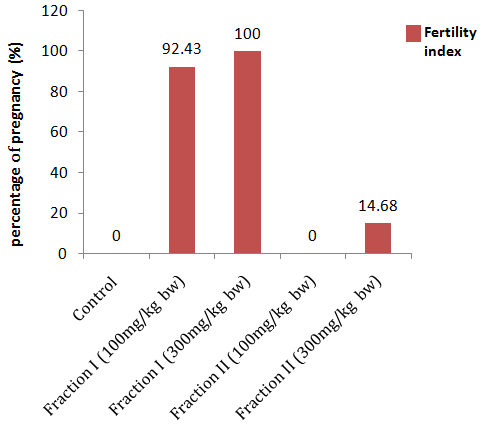
The experimental results were summarized in Table 1. Administrations of fraction I of ethyl acetate extract at both the dose levels were found to exhibit pregnancy interceptive activity. The treatment of fraction I extract at low dose level has caused 92.43% pregnancy loss with a mean number of pups born was 3.87±0.22 (P<0.001). The same fraction at high dose level has caused 100% failure of pregnancy as a result no fetuses has been observed in this group when compared to control (p<0.001). The pregnancy loss with fraction I administration seems to be at different phases of pregnancy as both implantation scars and placentomas were observed in the uterus on day 20. Fraction II was less effective as a result the low dose level treatment has not shown any pregnancy loss, but high dose has caused 14.68% pregnancy loss.
Visceral Examination
Half the number of male and female fetuses from each group were fixed overnight in 70% ethanol and examined by the modified Wilson’s necropsy [10].
Skeletal Examination
The remaining (half) number of fetuses from each of the control and treated groups were skinned, fixed in 70% ethanol, macerated in 1% KOH and stained with alcian blue and Alizarin red S according to the method [11]. The skeletal malformation viz., Skull, Vertebral column, stern brae, fore limbs and hind limbs, fore and hind paw, etc., if any, were observed using magnifying glass.
Statistical Analysis
One way analysis of variance [ANOVA] followed by Duncan’s multiple test were used to find out significant difference among mean values of each parameter of different experimental groups by fixing minimum significance level at P<0.05. Values with same superscript letters are not significantly [P<0.05] different whereas those with different superscript letters are significantly [P<0.05] different when compared to control.
Result
- Number of implantation sites on
- Number of implantation scars on day 20
- Number of placentomas on
- Number of live
- Treatment
- Dose (mg/kgbw) fetuses on day born on parturition
- Control
- 1% DMSO
- 5+6=11
- 5+6=11
- ---
- ---
- 11
- 11
- 11.33±0.47a day 10 day 20
- 20
- 6+7=13
- 7+5=12
- 13
- 12
- 5+5=10
- 6+6=12
- 10
- 11
- 5+3=8
- 7+4=10
- 5
- 2
- 1
- 0
- 3.87±0.22b
- 100
- 6+5=11
- 7+5=12
- 5
- 5
- 1
- 0
- 4+6=10
- 6+6=12
- 6
- 4
- 0
- 1
- Fraction I
- 4+5=9
- 6+4=10
- 4
- 5
- 0
- 0
- 00.00c
- 5+6=11
- 5+5=10
- 7
- 4
- 0
- 0
- 6+5=11
- 3+7=10
- 5
- 6
- 0
- 0
- 300
- 6+5=11
- 3+6=9
- 11
- 9
- 100
- 10.5±0.64a
- 6+5=11
- 5+7=12
- ---
- ---
- 11
- 12
- 5+5=10
- 4+6=10
- 10
- 10
- Fraction II
- 7+4=11
- 3+6=9
- 1
- 10
- 9
- 300
- 8.16±0.45a
- 7+6=13
- 6+6=12
- 1
- ---
- 12
- 11
- 5+4=9
- 5+5=10
- 0
- 9
- 9
Table 1: Effect of Fractions of ethyl acetate extract of E. Jambolana seeds on abortifacient activity.
All values are expressed as Mean ± Standard error. The data was analyzed by one way ANOVA, Analysis of Variance. Values with same superscript letters are not significantly [P<0.05] different whereas those with different superscript letters are significantly [P<0.05] different as judged by Duncan’s Multiple Test (Figure 1). The study of developmental toxicity and Teratogenicity is given in Table 2. The litter size, body weight and body length of litters born in control were 5.94±0.32, 5.00±0.39 and 4.01±0.42cm respectively. There were no statistical significant differences between groups in the litter size, body weight and body length of litters throughout the post partum period. There were no noticeable visceral malformations observed in the offspring of control as well as in all treated rats. External examination of all fetuses revealed no abnormality between the groups when compared to controls. There were no noticeable skeletal and teratogenic malformations in the skull, vertebral column, Sterne brae, forelimbs, hind limbs, fore and hind paws were observed in the fetuses of control as well as in all treated rats.
| Treatment | Dose (mg/kg bw) | Mean litter size | Mean weight of litters (g) | Mean body length of litters (cm) |
|---|---|---|---|---|
| Control | 1%DMSO | 5.94±0.32a | 5.00±0.39 a | 4.08±0.42 a |
| Fraction I | 100 | 6.0±0.65 a | 5.12±0.03 a | 4.80±0.43 a |
| 300 | 5.93±0.26 a | 4.93±0.05 a | 4.91±0.21 a | |
| Fraction II | 100 | 6.03±0.29 a | 4.98±0.19 a | 4.42±0.87 a |
| 300 | 5.98±0.13 a | 5.18±0.09 a | 4.71±0.25 a |
Table 2: Effect of Fractions of ethyl acetate extract of _E. Jambolana_ seeds on litters. All values are expressed as Mean ± Stan
Table 2: Effect of Fractions of ethyl acetate extract of E. Jambolana seeds on litters. All values are expressed as Mean ± Standard error. The data was analyzed by one way ANOVA, Analysis of Variance. Values with same superscript letters are not significantly [P<0.05] different whereas those with different superscript letters are significantly [P<0.05] different as judged by Duncan’s Multiple Test.
Discussion
In the present study, the chromatographic fractions of ethyl acetate extract of E. Jambolana seeds were tested for their abortifacient and Teratogenicity properties in female albino rat. The fraction - I was found to be most active fraction of ethyl acetate extract. The number of litters born as a result of this fraction I treatment was significantly less (nil) in comparison to control. This proves the pregnancy interceptive activity of fraction I of ethyl acetate extract of E. Jambolana seed.
There is much evidence that shows that some herbal drugs can be used as an abortifacient in mice, rats, rabbits and even humans [12, 13]. An agent that can disrupt pregnancy could be of obvious interest in human fertility control [14]. The implantation index, resorption index and pre-implantation loss are useful indices for evaluating the number of blastocycts implanted in the uterus and the underdeveloped [15]. Therefore, the increase in the resorption index by the fraction extract is an indication of failure in the development of the embryo. Such occurrence of fetal resorption suggests that interruption of pregnancy occurred after implantation of the foetus [16]. All these are indications of the pregnancy termination potential of fraction I of ethyl acetate extract of E. Jambolana seeds. Results of present study are in conformation with results obtained with Citrus hystrix [17]. Ethanolic extract of citrus hystrix in a dose of 1 gm/kg resulted in abortifacient effect in female albino rats. These findings are in agreement with those of Yakubu [18] who reported abortifacient activity of Senna alata leaves. Shibashi [19] reported Methanolic extract administration of Achyranthus aspera leaves caused abortifacient activity in pregnant rats. The resorption index and post implantation loss establishes correlation between the number of implanted blastocysts and those that have not developed [20, 21]. Similar observations were in agreements with those of Dabhadkar and Varsha [22] using Plumeria rubra pod extract in rats. The results of the present study also revealed that the fraction I extract was relatively non- embryotoxic as judged by the data on litter body size and the absence of any observable treatment related morphologic defects and skeletal and visceral malformation in the fetuses when compare to control. These findings are in agreement with Gebrie [23] who reported that the methanolic extract of the Rumex steudelli root did not show teratogenic effect in rats. Similar observations have been made with the findings of Chukwuka [24] and Abdulazeez [25] on Spondias and Carrica respectively.
Conclusion
The present study suggests that the chromatographic fraction I of ethyl acetate extract of Eugenia Jambolana possesses abortifacient activity and these findings could explain its traditional use as an abortifacient agent. Preliminary phytochemical analysis and TLC revealed that fraction I contains more of flavonoids and a mixture of compounds. The activity of the fraction I owes due to synergistic action of multiple metabolites. Therefore, it is hoped that this fraction can be further purified to get a potent compound and may be brought out as an effect contraceptive in near future.
References
-
Vaidya P, Padmashali S, Vagdevi HM, Sathyanarayana ND (2006) Antifertility effect of the plant Balanites roxburghii (Balanitaceae) in female rats. Indian J Pharm Sci 68(3): 347-351.
-
Ramesh LL, Sharanagouda JP, Saraswati BP (2009) Phytochemical and Contraceptive property of Sida acuta burm Lin. In albino rats. Int J PharmTech Res 1(4): 1260-1266.
-
Ritchie HE (2001) The safety of herbal medicine use during pregnancy. Frontier in fetal health 3: 259-266.
-
Chopra, RN, Chopra IC, Handa KL and Kapur LD (1958) Chopra’s Indigenous Drugs of India. UN Dhursons Pvt. Ltd., Calcutta, pp: 49.
-
Nadkarni, AK and Nadkarni KM. Indian Medicinal Plants. (1976): Vol 2, Popular Book Depot, Bombay.
-
Satyavathi GV, Gupta AK, Tandon N (1987) Medicinal plants of India. 1: 254.
-
Sarita M, Bhagya M (2012) Anti-implantation and Antiestrogenic activity of _Eugenia Jambolana_ seed. Journal of Pharmacy Research 5(5): 2607-2609.
-
Sarita M, Bhagya M (2012) Post-coital contraceptive and Teratogenicity of _Eugenia Jambolana_ seed. Journal of Pharmacy Research. 5(8): 4295-4298.
-
Salhab AS, Al-Tamimi SO, Gharaibeh MN, Shomaf MS (1998) The abortifacient effects of castor bean extract and ricin A- chain in rabbit. Contraception 58(3): 193- 197.
-
Monie LW, Kho KG, Morgan J (1965) Dissection procedure for rat fetuses permitting alizarin red staining of skeleton and histological study of viscera. Supplement to teratology workshop manual California, Berkeley.
-
Taylor P (1986) Practical Teratology, New York, Academic Press.
-
Kazerooni T, Mousavizadeh K, Abdollahee A, Sarkarian M, Saltar A (2006) Abortifacient effecet of Prangos ferularia on pregnant rats. Contraception 73(5): 554-556.
-
Koneri R, Saraswathi CD, Balaraman R, Ajeesha EA (2007) Antiimplantation activity of the ethanolic root extract of Momordica cymbalaria Fenzl in rats. Indian J Pharmacol 39(2): 90-96.
-
Goonasekara MM, Gunawardana VK, Jayasena K, Mohammed SG, Balasubramanian S (1995) Pregnancy terminating effects of Jatropha curcas in rats. J Ethnopharmacol 47(3): 117-123.
-
Almeida FCG and Lemonica IP (2000) The toxic effects of _Coleus barbatus_ B on the different periods of pregnancy in rats, J Ethnopharmacol 73(1-2): 53-60
-
Elbetieha A, oran SA, Alkofahi A, Darmani H, Raies AM (2000) Fetotoxic potential of Globularia Arabica and Globularia alypum in rats. J Ethnopharmacol 72(1-2): 215-219.
-
Piyachaturawati P, Glinsukon T, Chanjarunee AT (1985) Antifertility effect of _Citrus hystrix_ DC. J Ehnopharmacol: 13(1): 105-110.
-
Yakubu MT, Adeshina AO, Oladiji AT, Akanji MA, Oloyede OB (2010) Abortifacient potential of aqueous extract of _Senna alata_ leaves in rats. J Reprod Contracep 21(3): 163-177.
-
Shibeshi W, Makonnen E and Zerihun L (2006) Effect of _Achyranthes aspera_ L, on fetal abortion, uterine and pituitary weights, serum lipids and hormones. Afr Health Sci 6(2): 108-112.
-
Almeida FC, Lemonica IP (2000) The toxic effects of _Coleus barbatus_ B on the different periods of pregnancy in rats. J Ethnopharmacol 73(1-2): 53-60.
-
Chang CV, Felicio AC, Reis JE, Guerra Mde O, Peters VM (2002) Fetal toxicity of _Solanum lycocarpum_ (solanaceae) in rats, J Ethanopharmacol 81(2): 265- 269.
-
Dabhadkar D, Zade V (2012) Abortifacient activity of _Plumeria rubra_ Linn pod extract in female albino rats. Indian J Exp Biol 50(10): 702-707.
-
Gebrie E, Makonnen E, Debella A, Zerihun L (2005) Phytochemical screening and pharmacological evaluation for the antifertility effect of the methanlolic root extract of Rumex steudelli. J Ethanopharmacol 96(1-2): 139-143.
-
Chukwuka N, Uchendu, Thomus I (2008) Antifertility activity of aqueous ethanolic extract of _Spondias_ _mombin_ (Anacardiaceae) in rats. Afri Health Sci 8(3): 163-167.
-
Abdulazeez MA, Mansurah DA, Ameh AD, Ahmadu D, Ibrahim S, (2009) Effect of fermented seed extract of _Carica papaya_ on litters of female wistar rats. Afr J Biotechnol 8(5): 854.
- Mitochondrial Bio-Logistics: Steering Co-Enzyme Q10 and Lycopene Synergies within the Science 4.0 Bio-OS Framework
- Hymenoptera Specimens from the Caño Negro Wetland, of the National Museum Collection, Costa Rica
- Science 4.0: Comprehensive Architecture of the Biological Operating System (Bio-OS) A Framework for Systemic Resilience and Industrialized Bio-Governance
- Rabbit on, or Hare Back? Understanding Climate Change
- Clinical Validation of Science 4.0: Flow Steering and Epigenetic Drift Inversion on a 76-Year-Old Hybrid System
- Seeds Planted by another Mind