
New Annotated Records of Helminth Parasites, Mostly from North America, with Light Microscopy. I. Trematoda (Digenea), Cestoda, Nematoda
We give an account of 13 species of trematode, cestode, and nematode parasites collected from various hosts in different geographical locations mostly in North America. Each species account is annotated and morphologically presented using light microscopy showing characteristic diagnostic features. None of these accounts has been previously published. All geographical records and many host associations are new. This treatment includes the digeneans Brachylaima fuscatum (Rudolphi, 1819), and Echinostomum coalitum Barker and Beaver 1915, the cestodes Anonchotaenia quiscali Rausch & Morgan, 1947), Choanotaenia musculosa (Fuhrmann, 1896), Isoglaridacris calentinei Mackiewicz, 1974, Isoglaridacris chetekensis Williams, 1977, Isoglaridacris folius Fredrickson and Ulmer, 1965, Isoglaridacris longus, Fredrickson and Ulmer, 1965, Nybelinia Poche, 1926, and the nematodes Anisakis simplex (Rudolphi, 1809) Dujardin, 1845 type I, Camallanus ancylodirus Ward and Magath, 1916, Rhabdochona cascadilla Wigdor, 1918, and Subulura Molin, 1860.
Omar M Amin * and Nataliya Yu Rubtsova
Keywords: Digenea; Cestoda; Nematoda; Wildlife; Descriptions; Distribution; Light Microscopy
Introduction
We have collected thousands of parasitic organisms from vertebrates over the years as part of an overall research program from North America and elsewhere in the world. Other collections were gifted to us for diagnosis or for joint research efforts. Significant collections were published. A few others were just saved and put aside after having been processed as whole mounts as reference material for possible future examination. We begin this series of investigations by exploring a small group of digeneans, cestodes, and nematodes that have not been previously studied or published. Detailed discussions are presented on the distribution and taxonomy of two species of trematodes, seven species of cestodes, and 4 species of nematodes; all are new host and/locality records. The trematodes include species in the genera Brachylaima Dujardin, 1843 found in birds and mammals in most continents [1, 2] including sparrows in Illinois where we are reporting it and one species of Echinostomum Rudolphi, 1809 where our representative species E. coalitum Barker and Beaver, 1915 is commonly found in North American muskrats [3, 4]. The genera and species of cestodes reported include Anonchotaenia Cohn, 1900 with over 16 species known from birds in North America and Europe [5] and Choanotaenia Railliet 1896 which is a large cosmopolitan genus introduced to North America by starlings [6]. Four species of Caryophyllid cestodes of the genus Isoglaridacris Mackiewicz, 1965 commonly found in suckers (Catostomidae) in North America Mackiewicz JS [7, 8, 9] are described from hosts mostly in Illinois. Plerocercoids of a species of Nybelinia Poche (Trypanorhyncha) were strangely found in the body cavity of a skipjack tuna in the Pacific [10] and described. Among the nematode parasites, Anisakis larvae were also described from skipjack tuna in the Pacific and diagnostic characters defined. Descriptions of 3 other species of nematodes are also provided and distinguishing features from related species in a comparative context reported. These nematodes included species of Camallanus Ward and Magath, 1917 and Rhabdochona Railliet, 1916 from Mississippi River fishes, and Subulura sp. Molin, 1860 from starlings in Wisconsin. The acanthocephalans will be the subject of subsequent studies.
Materials and Methods
The specimens reported in this presentation were collected using dissecting scopes for external and internal examinations of anesthetized hosts before dissection. Longitudinal cuts were made in the intestinal track for recovery of gut parasites. Recovered specimens were fixed in 70% ethanol. Nematodes were punctured with a fine needle and subsequently stained in Mayer’s acid carmine (digeneans and cestodes were stained in Semichon’s acetocarmine), de- stained in 4% hydrochloric acid in 70% ethanol, dehydrated in ascending concentrations of ethanol (24 hr each), and cleared in 100% xylene then in 50% Canada balsam and 50% xylene (24 hr each). Whole worms were then mounted in Canada balsam. Optical microscope images were acquired using a BH2 light Olympus microscope (Olympus Optical Co., Osachi-shibamiya, Okaya, Nagano, Japan) attached to an AmScope 1000 video camera (United Scope LLC, dba AmScope, Irvine, California), linked to an ASUS laptop equipped with HDMI high-definition multimedia interface system (Taiwan-USA, Fremont, California). Measurements are in micrometers unless otherwise noted; the range is followed by the mean values between parentheses when appropriate. Width measurements represent maximum width.
Results
Thirteen species of helminths reported from vertebrate hosts in different geographical regions of the world are listed in Table 1 along with their hosts and localities from where they were collected. Morphological notes along with light microscopy images of major diagnostic features are included. Collectors’ information when known and dates are also added.
| Host | Distribution | |
|---|---|---|
| Trematoda | ||
| Brachylaima fuscatum (Rudolphi, 1819) | Zonotrichia albicollis (Gmelin), white-throated sparrow | Evanston, Cook County, Illinois |
| Echinostomum coalitum Barker and Beaver, 1915 | Fiber zibethicus (Lin.), muskrat | Waukesha, Kenosha County, Wisconsin |
| Cestoda | ||
| Anonchotaenia quiscali Rausch and Morgan | Zonotrichia albicollis (Gmelin), white-throated sparrow | Evanston, Cook County, Illinois |
| Choanotaenia musculosa (Fuhrmann, 1896) | Sturnus vulgaris Lin., starling | Kenosha, Kenosha County, Wisconsin |
| Isoglaridacris calentinei Mackiewicz, 1974 | Catostomus columbianus Eigenmann & Eigenmann, bridgelip sucker | Salmon River, Stanley Basin near Obsidian, Custer County, Idaho |
| Isoglaridacris chetekensis Williams, 1977 | Moxostoma anisurum (Rafinesque), silver redhorse | Kankakee River, Will County, Illinois |
| Isoglaridacris folius Fredrickson and Ulmer, 1965 | Moxostoma erythrurum (Rafinesque), golden redhorse_ | Kankakee River, Will County, Illinois |
| Isoglaridacris longus Fredrickson and Ulmer, 1965 | Moxostoma macrolepidotum (Lesueur), shorthead redhorse | Kankakee River, Will County, Illinois |
| Nybelinia lingualis (Cuvier, 1817) pleroceroids | Katsuwanus pelamis (Lin.), skipjack tuna | Pacific Ocean off Ecuador |
| Nematoda | ||
| Anisakis simplex (Rudolphi, 1809) Dujardin, 1845, type I | Katsuwanus pelamis (Lin.), skipjack tuna | Pacific Ocean off Ecuador |
| Camallanus ancylodirus Ward and Magath, 1917 | Moxostoma erythrurum (Rafinesque), golden redhorse_ | Kankakee River, Will County, Illinois |
| Rhabdochona cascadilla Wigdor, 1918 | Moxostoma macrolepidotum (Lesueur), shorthead redhorse | Kankakee River, Will County, Illinois |
| Subulura Molin | Sturnus vulgaris Lin., starling | Kenosha, Wisconsin |
Table 1: Helminth parasites reported from wildlife in this paper and their hosts and geographical distribution.
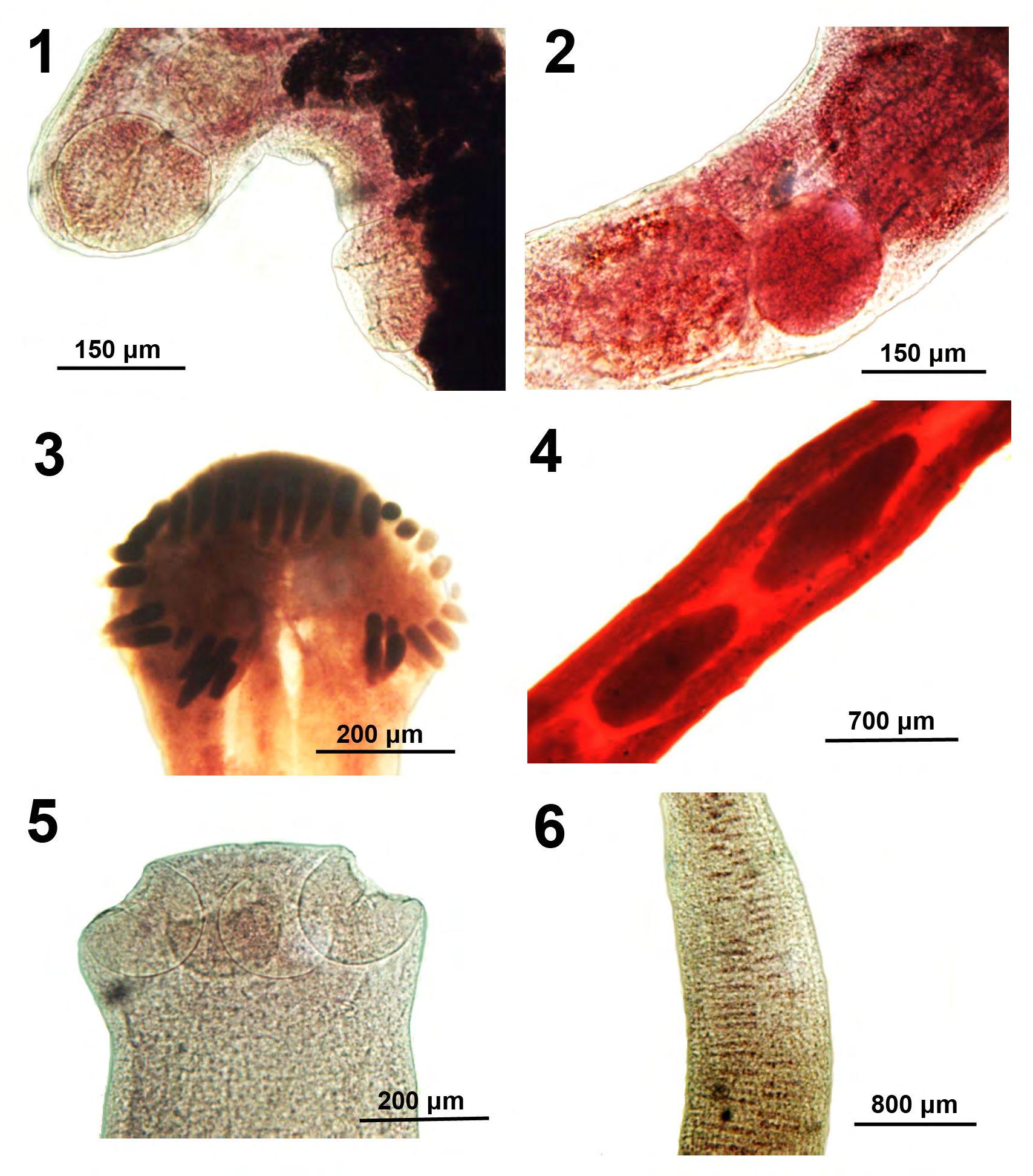
Figures 1-6: Helminths from wildlife. 1, 2 Brachylaima fuscatum (Trematoda) from Zonotrichia albicollis in Illinois.
- A lateral view of a worm showing the equal size of the oral sucker and acetabulum and the smaller size pharynx.
- The posterior part of the same worm showing the ovary in between the two testes. 3, 4: Echinostomum coalitum (Trematoda) from Fiber zibethicus in Wisconsin.
- Oral sucker surrounded by blunt collar spines.
- Testes. 5, 6: Anonchotaenia quiscali (Cestoda) from Zonotrichia albicollis in Illinois.
- A perspective of the scolex showing the 4 forward directed suckers.
- Anterior underdeveloped proglottids showing the alternating developing reproductive primordia.
Trematoda
Brachylaima fuscatum (Rudolphi, 1819) Joyeux, Baer, Timon-David, 1934 (Brachylaimidae) (Figures 1, 2)
Species of Brachylaima Dujardin, 1843 have been reported from most continents in birds and mammals. The genus contains about 72 species of which 12 are known from North America of which 3 species infect birds, Brachylaima fuscatum (Rudolphi, 1819) Joyeux, Baer, Timon-David, 1934, Brachylaima mcintoshi Harkema, 1939, and Brachylaima pellucidum (Werby, 1928) Joyeux, Baer, Timon-David, 1934 (see [1]). Ubelaker, et al. [2] reported 92 species in Brachylaima. Our 3 specimens were collected from white throated sparrows in Evanston, Illinois in the fall of 1977 by Lynn Meyer. They resemble the one specimen of Brachylaima reported by Peet and Ulmer [11] from brown thrasher Toxostoma rufum (Linn.) in Iowa in having the oral sucker and the acetabulum of equal size that we tentatively identify as B. fascatum. In B. mcintoshi, the oral sucker is much larger than the acetabulum. Brachylaima fuscatum was also reported from a starling, the common myna, Ascridotheres tristis (Lin.) in Pakistan [12] and its morphology was very similar to that of our specimens.
Our specimens were moderately elongate with well- developed equal sized oral sucker and acetabulum. The pharynx was also prominent but the esophagus was short (Fig 1). Part of the uterus extended anterior to the acetabulum. The testes were ovoid separated by a smaller ovary (Fig 2). The ceca extended to posterior end of the body and the genital pore in its posterior half. The body measured 3.00-3.50 (3.25) mm long by 0.50-0.60 (0.55) mm wide, the oral sucker 225-250 (237) in diameter, the spheroid pharynx 146-166 (156) in diameter, the acetabulum 220- 270 (245) in diameter, the testes 364-416 (390) long by 270-406 (338) wide, the ovary 229-230 (229) long by 166- 198 (182) wide, and the eggs 20-27 (24) by 15-18 (17). The Pakistani specimen had comparable measurements except that the testes and the ovary were somewhat smaller but the critical egg measurements and shape Fig 1 of [12] were identical.
Our record of B. fuscatum from the white throated sparrow in Evanston, Illinois appears to be new. This is very interesting considering the finding of this trematode in another host species, A. tristis in Pakistan but not in white throated sparrow in Ontario [13] or in Iowa [14].
Specimens: Deposited at the Harold W. Manter Laboratory of Parasitology Collection no. HWML 217029.
Echinostomum (=Echinostoma) coalitum Barker and Beaver, 1915 (Echinostomatidae) (Figures 3, 4)
Thirteen specimens of E. coalitum were recovered from muskrat in Waukesha, Wisconsin in November, 1974. Barker [3] described 8 species of trematodes, 2 species of cestodes, and 3 species of nematodes from muskrats but he did not give locality records in Nebraska. Our specimens were quite similar to those described by Barker [3] and their morphology was practically identical to his specimens depicted in his figures 1 & 2. The most recent update about parasites and pathogens of muskrats [4] (p. 5) noted that “since 1915, 46 articles have reported 32 species of trematodes in muskrats from 19 U.S. states and 6 Canadian provinces.” Of these species, E. coalitum was not among the widespread species. Between 18 and 29 species of trematodes depending on years of review were reported in British Columbia (3234 studies), Main (38 studies), and Ohio (19 studies) but none from Wisconsin [4]. Our collection was made almost 50 years ago but it remains first record for Kenosha County, Wisconsin.
In our specimens, length and width of body were 11.00-13.00 (12.00) by 0.45-1.05 (0.80) mm, oral sucker with blunt collar spines (Fig 3), 156-300 (230) by 312-475 (381), acetabulum 468-825 (677) by 447-600 (546), testes oblong (Fig 4), 478-875 (694) by 156-280 (248), ovary 249- 416 (300) by 220-447 (296), and eggs 83-114 (103) by 42- 72 (59). Our specimens were somewhat smaller than those described by Barker [3] but the critical egg measurements were similar.
Beaver [15] declared E. coalitum, along with E. armigerum Barker and Irvine, 1915 from Nebraska muskrats and 6 other species of Echinostoma as synonyms of Echinostoma revolutum (Froelich, 1802) Looss, 1899. We do not agree as these species are morphologically distinct. Beaver [15] assumed that these species are physiological variants and listed 10 other species of Echinostoma as possible synonyms (species inquirenda). These three species of Echinostoma have been reported independently by a number of observers from various parts of the US as reviewed by Boyd and David [16] who also noted the lack of host specificity with worms infecting 23 species of birds and 9 species of mammals including man. Distinguishing differences between the long E. coalitum and the shorter E. revolutum include the shape of the testes being elongate-ovoid in the first and round-lobulated in the second species, and having blunt collar spines in E. coalitum as opposed to sharply pointed collar spines in the E. revolutum [17, 18]. Kanev, et al. [19] assigned the E. revolutum of Beaver [15], E. armigerum, and E. coalitum to Echinostoma trivolvis (Cort, 1914) Kanev, 1985 that also has sharply pointed collar spines and round testes which makes it distinct from the bluntly pointed collar spines and the elongate oval testes of E. coalitum. We believe that these authors have not given sufficient consideration to the significant species-specific characters, as lumpers do.
Specimens: Deposited at the Harold W. Manter Laboratory of Parasitology Collection no. HWML 217030.
Cestoda
Anonchotaenia quiscali Rausch and Morgan, 1947 (Dilepididae) (Figures 5-8)
We have recovered about 15 specimens of A. quiscali from white throated sparrow in Evanston, Illinois in the fall of 1977 by Lynn Meyer. There were 16 species of Anonchotaenia Cohn, 1900 as of 1947 of which only three species were primarily known in North America [5]: (1) Anonchotaenia globata (von Linstow, 1879) from many birds in Ohio, Wisconsin, and Michigan as well as Europe, (2) Anonchotaenia quiscali Rausch and Morgan, 1947 from the common grackle Quiscalus versicolor Vieill in Ohio, and (3) Anonchotaenia rostellata Rodgers, 1941 from the cardinal Richmondina c. cardinalis (Linn.). Anonchotaenia globata is the most widely distributed species and occurs in large numbers in many hosts. The extreme variations in the parauterine organ and uterus as seen in A. globata renders this character of no value in separating species as Rausch and Morgan [5] originally proposed. These 3 species are distinguished from each other based on the fixed number of testes [20] being 9 in A. quiscali and A. rostellata but 5 in A. globat_a. The first two species are distinguished from each other by the absence of a _rostellum in A. quiscali.
Anonchotaenia quiscali is a long cestode with a scolex distinct from neck and 4 forward directed suckers without rostellum (Fig 5). Strobila cylindroid wide anteriorly and decreasing in width in pre-gravid and gravid proglottids posteriorly. Mature proglottids are few, with 9-10 testes, compact ovary and vitelline gland, and small uterus (Figs 6-8). Our specimens were long, lightly stained, and in broken segments so it was hard to get a measure of their exact length. The following measurements were made. Scolex 275- 325 (295) long by 500-625 (546) wide; suckers 200-212 (204) in diameter; mature segments shallow, 800-875 (835) wide; pre-gravid segments less shallow, 675-875 (761) wide; gravid segments narrower and almost rectangular, 525-650 (582) wide; testes 52-73 (66) in diameter. In their description of the species, Rausch and Morgan [5] did not measure the segments but our other measurements were almost identical to theirs. They recovered specimens from white-throated sparrows but based their description on specimens from Q. versicolor in Ohio, suggesting that our records from white- throated sparrows in Illinois may be new.
Specimens: Deposited at the Harold W. Manter Laboratory of Parasitology Collection no. HWML 217031.
Choanotaenia musculosa Fuhrmann, 1896 (Dilepididae: Dipylidiinae) (Figs 9-12)
The genus Choanotaenia Railliet, 1896 underwent considerable nomenclature changes since 1896. It is a large cosmopolitan genus with up to 77 species as of 1986 [21]. Choanotaenia musculosa is a common parasite of the European starling, Sturnus vulgaris Linn. in Europe. It has apparently been introduced into North America by the starling, which is now found in native birds [6]. We have collected 22 specimens of C. musculosa from S. vulgaris in Kenosha, Wisconsin in the autumn of 1974 with the help of Bob Sewell. This record appears to be new. We have records of C. musculosa mostly from S. vulgaris and occasionally in other hosts such as the common blackbird Turdus merula Linn., common grackle Quiscalus versicolo_r, and the red-winged blackbird _Agelaius phoeniceus (Linn.) in 16 other states and Canada, in Europe (France, Romania, Ireland, and Spain), and in the Middle East in Iraq. The worldwide distribution of this cestode clearly extends beyond the above records.
Characteristic features of the relatively small C. musculosa are the diagnostic single crown of rostellar hooks, 4 unarmed suckers (Figs 9 & 10), wider than long craspedote proglottids getting larger posteriorly with irregularly alternating genital pores, many testes posterior to compact pre-equatorial female glands (Fig 11), and lobed sac-like uterus that branches laterally breaking into capsules containing a single egg each when ripe. Ripe proglottids are longer than wide with practically all organs recycled into egg production (Fig 12). The single rostellar crown of hooks occasionally appeared double when the hooks are irregularly arranged (Fig 10). For instance, Cooper [22], Cannon [23] and Joyeux and Baer [24] stated that the rostellum of C. musculosa has a double crown of hooks but Schmidt’s (p. 361) [21] diagnosis of the genus Choanotaenia stated “Rostellum with a single circle of hooks.” Wardle and McLeod [25] placed C. musculosa in a group of Choanotaenia cestodes with a double crown (p. 500-501) but stated that in sections of specimens from Alabama, hooks on the rostellum are “disposed in a single row” and that “when the rostellum is partially retracted, the hooks often manifest an irregular or alternating arrangement, probably the result of unequal muscle tension, and this condition simulates a double row." Yamaguti [26] was keenly aware of this difficulty and noted that “those genera or subgenera differentiated on the basis of this character alone …. are merged provisionally into Choanotaenia.” Cooper [22] and Joyeux and Baer [24] recorded 22 crown hooks but Boyd [6] found 18-22 in her specimens.
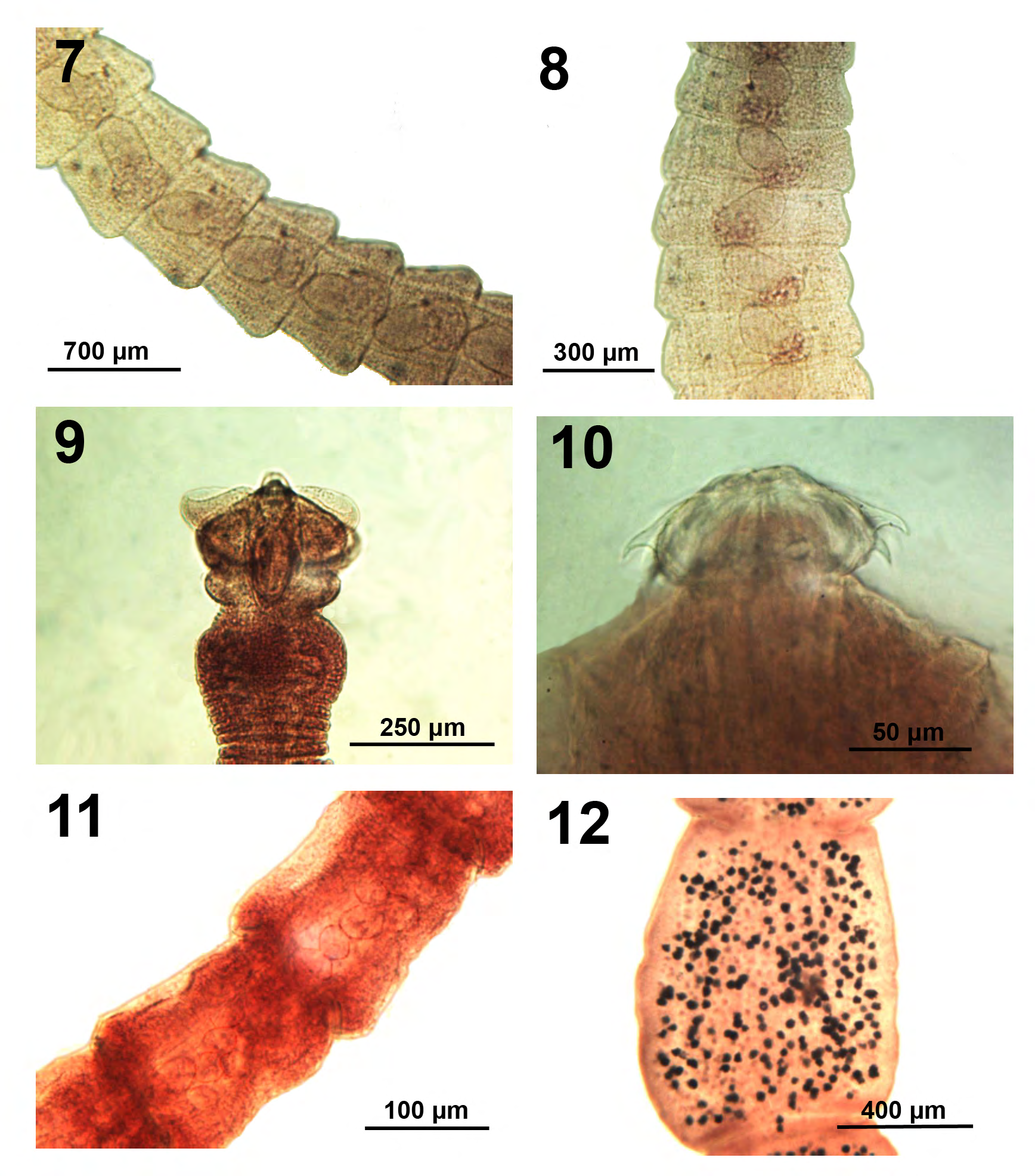
Figures 7-12: Helminths from wildlife: 7, 8. Anonchotaenia quiscali (Cestoda) from Zonotrichia albicollis in Illinois. Various stages in the growth of developing proglottids. 9-12: Choanotaenia musculos_a from _Sturnus vulgaris in Wisconsin. 9. The anterior end of a worm showing the 4 anteriorly directed suckers and the rostellum. 10. A high magnification of the rostellum showing the shape of hooks in profile. 11. A mature proglottid showing the testes. 12. A gravid proglottid.
Measurements of our specimens follow. Body length (from rostellum to last proglottid) 17.50-26.87 (21.50) mm by maximum width 0.57-1.15 (0.98) mm; scolex 177- 225 (202) by 200-343 (254); rostellum 62-94 (73) by 73- 109 (89); sucker diameter 120-135 (127), anterior mature proglottid 150-525 (397) by 125-312 (204); posterior-most gravid proglottid 1125-1550 (1320) by 550-1125 (808). Our measurements are comparable to those of Cooper [22] of the same species from the same host in Ohio. Specimens: Deposited at the Harold W. Manter Laboratory of Parasitology Collection no. HWML 217032.
Isoglaridacris calentinei Mackiewicz, 1974 (Caryophyllidea: Capingentidae) (Figs. 13, 14)
Seven specimens of I. calentinei were collected from the bridgelip sucker Catostomus columbianus (Eigenmann and Eigenmann) in the Salmon River, Idaho at the Sawtooth National Fish Hatchery, Stanley during the summer of 1990 by Richard Heckmann [27]. Our specimens were similar to those described by Mackiewicz [7] from C. columbianus (type host) in 3 other rivers also in Idaho. Mackiewicz [7] also reported it from the large-scale sucker Catostomus macrocheilus Girard in Idaho, redetermined Glaridacris confusus Hunter, 1929 reported by Fritts [28] from C. macrocheilus in Idaho and Caryophyllaeus terebrans of Bangham and Adams [29] from Catostomus catostomus Forster in British Columbia as I. calentinei.
Our specimens had well-developed cuneiformloculate scolex (Fig 13), short neck, absent outer longitudinal muscles, round testes beginning posterior to lateral rows of pre-ovarian vitellaria and extending to cirrus, absence of post-ovarian vitellaria, prominent cirrus sac, and distinct anterior external seminal vesicle, ovary H-shaped or inverted-A shaped of reticular lobes with long arms (Fig 14), and operculate eggs with smooth shells. We do not know the level of infection of our specimens in C. columbianus but Mackiewicz [7] reported as many as 209 worms in one fish. We have described Neoechinorhynchus idahoensis Amin and Heckmann 1992 [23] from C. columbianus in Idaho co-infected with I. calentinei [27]. Measurements of our specimens included body length and maximum width of 9.00-13.75 (11.50) mm by 1.05-1.25 mm; scolex 525-650 (581) by 925-1050 (975); distance between anterior-most pre-ovarian vitellaria and anterior tip 625-1200 (903) (7.8% of body length); distance between anterior-most testis and anterior tip 1125-1500 (1268) (11.02% of body length); testis diameter 156-250 (195); vitelline follicle diameter 100-175 (121); cirrus sac diameter 224-250 (234); ovarian arms 1600-1900 (1791) long and apart 600-650 (625) at level of commissure; and eggs 32-38 (36) by 25-30 (27). Measurements were comparable to those reported by Mackiewicz [7]. Specimens: Deposited at the Harold W. Manter Laboratory of Parasitology Collection no. HWML 217033.
Isoglaridacris chetekensis Williams, 1977 (Caryophyllidea: Capingentidae) (Figs. 15-17)
Williams [8] described Isoglaridacris chetekensis from the northern redhorse Moxostoma macrolepidotum (LuSueur) in the Red Cedar River, Barron County, Wisconsin. Sule and Skelly [30] collected I. chetekensis from the silver redhorse Moxostoma anisurum (Rafinesque) in the Kankakee River, Will County, Illinois and Skelly provided 6 specimens from this collection to Amin for further study. Our specimens were very similar to those described by Williams [8] except that the scolex had occasionally expanded into a rounded form that compromised the definition of the loculi, the neck was very narrow, and the post-ovarian vitellaria were more extensive, among other minor differences.
Our specimens were moderate in length with rounded to cuneiform scolex (Fig 15), variably shallow loculi (Fig 16) and long narrow neck, indistinct outer longitudinal muscles, spheroid to irregularly shaped testes beginning posterior to anterior margin of lateral rows of smaller, round or irregular vitellaria, that are usually posteriorly contiguous with anterior arms of the H-shaped lobate ovary (Fig 17). Commissure straight and well delineated. Third and middle rows of vitellaria shorter than lateral rows with smaller and more rounded follicles. Uterus extending anteriorly past cirrus sac and posteriorly to near the extensive post-ovarian vitellaria. Cirrus sac at anterior margin of ovarian arms. The following measurements include body length and maximum width of 8.25-12.00 (10.07) mm by 0.62-0.77 (0.73) mm; scolex 425- 525 (503) by 600-685 (652); neck 1.87-3.27 (2.46) mm long from scolex base to anterior vitellaria by 0.20-0.40 (0.32) wide at its narrowest point; distance between anterior-most pre-ovarian vitellaria and anterior worm tip 2.17-3.50 (2.70) mm (27% of body length); distance between anterior-most testis and anterior worm tip 2.43-4.00 (3.04) mm (30% of body length); testis diameter 104-325 (222); vitelline follicle diameter 104-250 (141); cirrus sac diameter 146-208 (173); ovarian arms 0.72-1.09 (0.99) mm long and 0.47-0.83 (0.59) mm apart at level of commissure (Fig 17); and eggs 30-50 (42) by 22-35 (30). Measurements were comparable to those reported by Williams [8], but in our slightly slimmer specimens, the ovarian arms were relatively shorter and the eggs were somewhat larger. Williams [8] noted that size (length) of worms and shape of such structures as the testes exhibit variations depending on the method and temperature of fixation. Two other species of Caryophyllid cestodes also possess a median row of pre-ovarian vitellaria: Isoglaridacris wisconsinensis Williams, 1977 from the northern hogsucker Hypentelium nigricans (Lesueur) from Wisconsin and Isoglaridacris etowani Williams, 1975 from the Alabama hogsucker Hypentelium etowanum (Jordan) from Alabama.
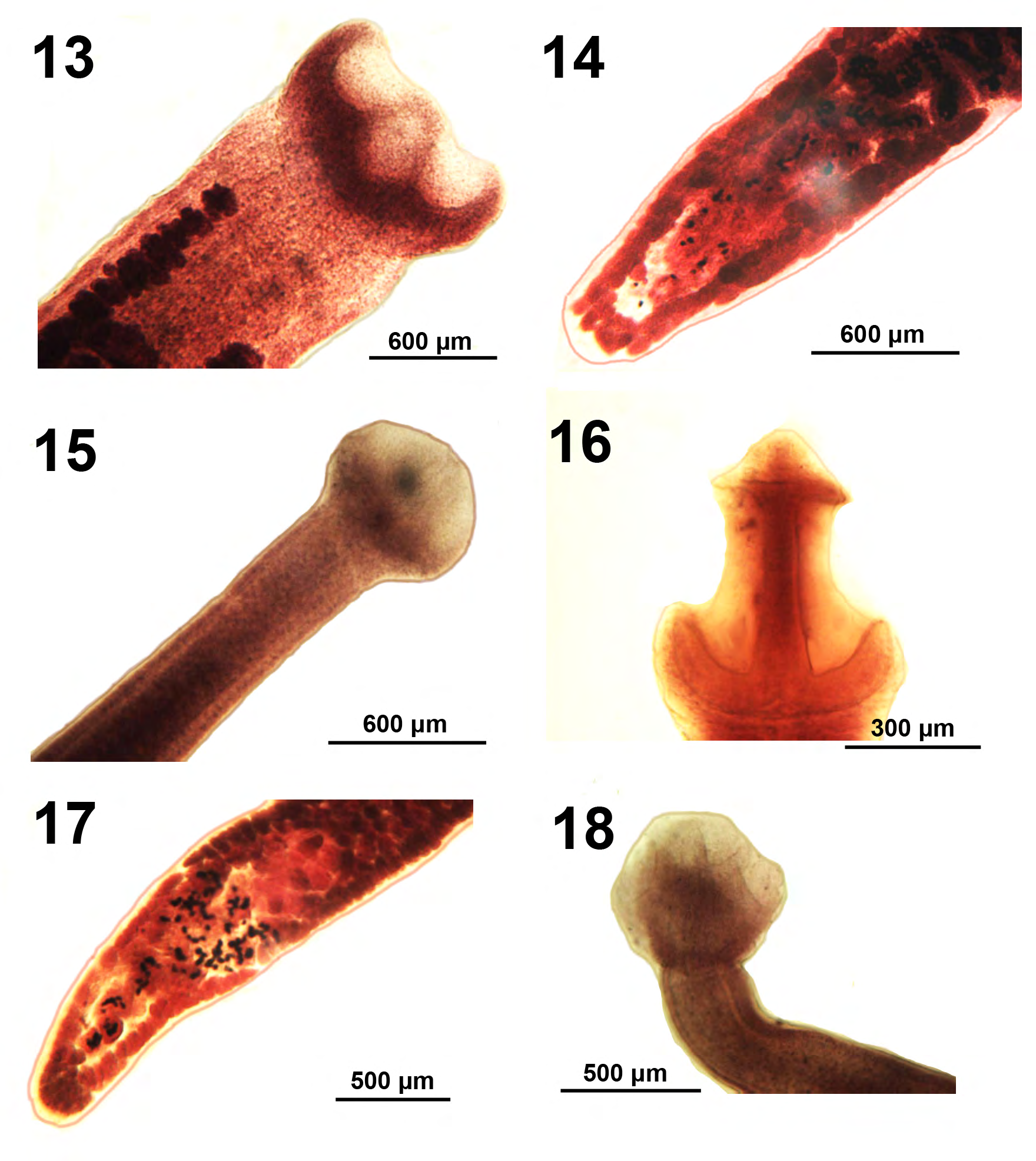
Figures 13-18: Helminths from wildlife 13, 14. Isoglaridacris calentinei from Catostomus columbianus in Idaho. 13. A perspective of the cuneiformloculate scolex and the disposition of the lateral vitellaria anterior to anterior tests. 14. The inverted-A shaped ovary of reticular lobes and the absence of post-ovarian vitellaria in a mature specimen. 15-17. Isoglaridacris chetekensis from Moxostoma anisurum in Illinois. 15, 16. Round to cuneiform scolex with variably shallow loculi and long narrow neck. 17. Vitellaria are usually posteriorly contiguous with anterior arms of the H-shaped lobate ovary. 18. Isoglaridacris folius from Moxostoma erythrurum in Illinois showing a rounded wedge-shaped scolex with 3 shallow loculi.
Specimens: Deposited at the Harold W. Manter Laboratory of Parasitology Collection no. HWML 217034.
Isoglaridacris folius Fredrickson and Ulmer, 1967 (Caryophyllidea: Capingentidae) (Figs. 18-20)
Fredrickson and Ulmer [9] described I. folius from the golden redhorse Moxostoma erythrurum (Rafinesque) in various rivers bordering Iowa and South Dakota between 1961 and 1963. Amin [31] collected 10 gravid specimens of I. folius from the white sucker Catostomus commersoni (Lacépède) in Tichigan Lake (Racine County, Wisconsin) in 1977 which was declared new state and host records. Surprisingly, none of the 18 golden redhorses examined from Tichigan Lake at the same time harbored specimens I. folius. Tichigan Lake is connected to the Fox River which is a tributary of the Mississippi River that feeds into rivers and streams in Iowa and South Dakota from which Fredrickson and Ulmer [9] collected I. folius. Amin OM [31] (p. 54) studied the specimens from C. commersoni of Tichigan Lake and determined that “Measurements of the local material fell within the range of those in the original specimens except for the longer ovarian arms (1.68-2.18 mm long); Fredrickson and Ulmer’s [9] corresponding measurements were 0.8-1.65 (1.19). At about the same time, Sule and Skelly [30] reported but did not measure specimens of I. folius from M. erythrurum in the Kankakee River, Will County, Illinois, and Skelly sent Amin 12 specimens (3 juveniles and 9 gravid adults) from this collection for further study.
We are here making a first description of the adult I. folius material from M. erythrurum in Illinois to compare with the original description from the same host from Iowa and South Dakota. Body relatively medium in size 6.00-9.75 (7.17) mm long by 0.67-1.15 (0.93) mm widest anterior to cirrus sac. Wedge-shaped scolex 375-625 (499) long by 489-700 (605) wide, with 3 shallow pairs of loculi (Fig 18) with prominent longitudinal muscles (Fig 19). Neck 1.15-2.15 (1.52) mm long by 0.17-0.55 (0.36) wide at the narrowest point. Distance from anterior-most vitellaria to anterior worm tip 1.22-2.50 (1.81) mm (25% of body length). Distance from anterior-most testis to anterior worm tip longer 1.42-2.75 (2.08) mm (29% of body length). Spheroid to irregularly shaped testes in dorsal and ventral rows, 73-156 (99) in diameter. Pre-ovarian vitellaria continuous with anterior ovarian arms with flat follicles 42-62 (50) in diameter. A few post-ovarian vitellaria in a cluster (Fig 20). Spherical cirrus sac small, at anterior edge of ovarian arms 146-187 (160) in diameter. Prominent external seminal vesicle attached to cirrus sac anteriorly. Uterus barely extends past cirrus sac. Lobular H-shaped ovarian arms 0.77-1.50 (0.95) mm long. Thin-shelled eggs with yolk cells, 30-42 (36) 22-30 (26) wide. All measurements fell within the range of those in the original description. Fredrickson and Ulmer (1967) described the ovary as inverted A-shaped (p. 453) but also as “not continuous posteriorly” (p. 455) which has been our observation all along.
Specimens: Deposited at the Harold W. Manter Laboratory of Parasitology Collection no. HWML 217035.
Isoglaridacris longus Fredrickson and Ulmer, 1967 (Caryphyllidea: Capingentidae)
Fredrickson and Ulmer [9] [9] described I. longus from the northern redhorse Moxostoma macrolepidotum (LeSueur) in various rivers bordering Iowa and South Dakota between 1961 and 1963. Sule and Skelly [30] reported but did not measure specimens of I. longus from M. erythrurum in the Kankakee River, Will County, Illinois, and Skelly sent to Amin one specimen from this collection for further study. We are here making a first description of an adult I. longus from M. erythrurum in Illinois to compare with the original description from the same host from Iowa and South Dakota.
Body elongate but broadest posteriorly, 12.50 mm long by 1.10 mm widest posteriorly. Weak wedge-shaped scolex 450 long by 850 wide with 3 barely visible loculi. Neck 375 long by 650 wide at the narrowest point. Distance from anterior- most vitellaria to anterior worm tip 0.80 mm (6.8% of body length). Distance from anterior-most testis to anterior worm tip much longer, 2.80 mm (22% of body length). Spheroid to irregularly shaped, usually randomly arranged testes, 208- 270 (232) in diameter. Pre-ovarian vitellaria not connected to anterior ovarian arms, 125-187 (156) in diameter. Few post-ovarian vitellaria in a row. Spherical cirrus sac large (Fig 21), at anterior edge of ovarian arms, 343 in diameter. Prominent external seminal vesicle, 250 by 125, attached to cirrus sac anteriorly. Uterus barely extending to level of mid-cirrus sac but does not extend anterior to it. Lobulated inverted A-shaped ovary with 1.20 mm long arms. Thin- shelled operculate eggs with yolk cells, 35-37 (36) long by 22-25 (24) wide. All measurements fell within the range of those in the original description.
Specimens: Deposited at the Harold W. Manter Laboratory of Parasitology Collection no. HWML 217036.
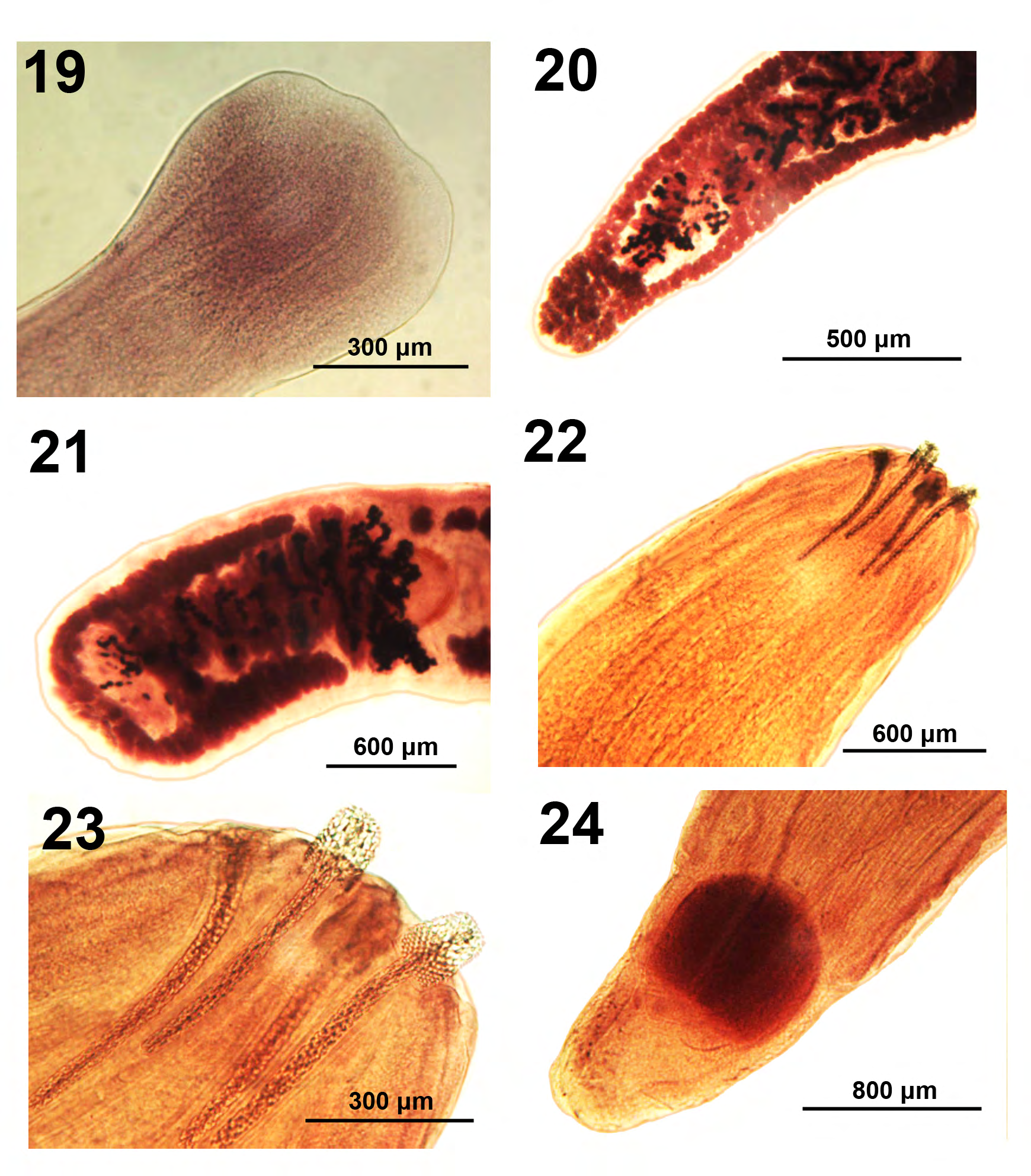
Figures 19-24: Helminths from wildlife. 19, 20. Isoglaridacris folius from Moxostoma erythrurum in Illinois. 19. Another perspective of a scolex focusing on the longitudinal muscles. 20. Pre-ovarian vitellaria are shown continuous with anterior H-shaped lobular ovarian arms and with a few post-ovarian vitellaria in a cluster. 21. Isoglaridacris longus from Moxostoma macrolepidotum in Illinois showing an inverted A-shaped lobulated ovary with pre-ovarian vitellaria not connected to anterior ovarian arms, a few post-ovarian vitellaria in a row, and a large spherical cirrus sac. 22-24. Nybelinia lingualis from Katsuwanus pelamis in the Pacific Ocean off Ecuador. 22,23. The broad rounded anterior end of a plerocercoids with 4 tentacles each. 24. The posterior end of a plerocercoid.
Nybelinia lingualis (Cuvier, 1817) (Plerocercoids) (Trypanorhyncha: Tentaculariidae) (Figs. 22- 25)
Eight plerocercoids of a tapeworm of the genus Nybelinia were recovered from the body cavity at the stomach surface of individuals of skipjack tuna, Katsuwonus pelami_s (Linn.) in the Pacific Ocean off the coast of Ecuador in 2005 while collecting the acanthocephalan _Rhadinorhynchus ornatus Van Cleave, 1918 from the same host then [10]. Our specimens are similar to those in Fig 36 of Wardle and McLeod [25] of a plerocercoid of Nybelinia sp. after Dollfus (1929) with no attached text. In their annotated checklist, Alves et al. [32] listed 7 species of Nybelinia and Nybelinia spp. without specific diagnosis from about 50 species of marine fish, none of which was K. pelamis. Our specimens, however, appear to be similar to those of N. linguali_s found in the viscera of skipjack tuna (our host) in Puerto Rico [33] and the post-larvae described by Palm [34] (Figs 6-9) from the weeping toadfish _Torquigener pleurogramma (Regan), South Australia, and in the imperial scaldfish Arnoglossus imperialis (Rafinesque), and the sand sole Pagusa lascaris (Risso) in the English Channel. Nybelinia lingualis is widespread geographically into Australia and is known to be quite variable [34, 35].
Our specimens were elongate and rounded anteriorly (Figs 22 & 23) but bluntly tapering posteriorly (Fig 24), 2.62-6.85 (4.80) mm long by 1.22-2.15 (1.64) mm wide with unremarkable aspinose bothridia with free margins. Four tentacles (Figs 22 & 23), 525-650 (599) long, less than half as long as tentacle sheaths 1.42-1.64 (1.64) mm long that gradually widen to slightly larger bulbs posteriorly. Hooks 25-28 (26), sharply curved with short but robust roots and well-developed anterior manubria (Fig 25). Tentacle sheaths in the specimens of Williams and Williams [33] from skipjack tuna in Puerto Rico were reported to be “approximately as long as tentacles” even though their line drawing (p. 111) and that of Palm [34] agree more with our observations. The hooks in our specimens were similar in shape to those in Palm [34] (Fig 8 & 9) but markedly larger than in his much smaller specimens.
Specimens: Deposited at the Harold W. Manter Laboratory of Parasitology Collection no. HWML 217037.
Nematoda
Anisakis simplex (Rudolphi, 1809) Type I, L3 larvae (Rhabditida: Anisakidae) (Fig. 26)
The herring worm that infects organs of marine animals throughout the world. We found it in the Pacific Ocean off the coast of Ecuador from where Amin obtained 7 worms from skipjack tuna, Katsuwonus pelamis (Linn.) while collecting the acanthocephalan R. ornatus from the same host then [10]. Williams and Williams [33] found it in skipjack tuna off Puerto Rico. Amin [36] reviewed human cases of anisakiasis worldwide and Ángeles-Hernandez, et al. [37] discussed the geographical distribution of genera and species of the Anisakidae. Katsuwonus pelamis was not included among the many species of paratenic hosts assigned to 10 species of Anisakis listed in Ángeles-Hernandez, et al. [37] who also listed 10 species of other hosts associated with A. simplex most commonly found in fish and squids.
Our specimens were long and thread-like, 13.25-17.50 (15.50) mm long by 0.25-0.35 (0.30) mm wide with some evidence of molting encapsulation. They are characterized by straight, long esophagus, 1.42-1.87 (1.56) by 0.05-0.09 (0.07) mm with cylindrical ventriculus and no cecum or appendix. Lips with dentigerous ridges and triangular boring tooth with the dull end directed anteriorly (Fig 26). Anterior region of lips medial and bilobed. Posterior end with tail 73- 124 (90) long and curved cone-shaped mucron (see SEM Fig 10 in Ishii, et al. [38] and Fig. 73 in Arai, et al. [39]).
Specimens: Deposited at the Harold W. Manter Laboratory of Parasitology Collection no. HWML 217038.
Camallanus ancylodirus Ward and Magath, 1917 (Camallanida: Camallanidae) (Fig. 27-30)
There are two species of Camallanus Raillient and Henry, 1915 known from North America; C. oxycephalus Ward and Magath, 1917 and the less common C. ancylodirus Ward and Magath, 1917. Differences in the prevalence of these species were demonstrated by the recovery of C. oxycephalu_s and _C. ancylodirus from 16 and 2 species of fish hosts, respectively in the Mississippi River [40]. The two species are primarily distinguished by the anterior bend ventrad with the buccal capsule set at an angle to the body axis and by the more anterior position of the vulva of C. ancylodirus, as well as the number and arrangement of the male caudal papillae. Baker [41] redescribed C. ancylodirus from Cyprinus carpio Linn. (type), Ictiobus bubalus (Rafinesque), Ictiobus cyprinellus (Valenciennes), and carpiodes cyprinus (LeSueur) (Catostomidae) in Iowa (type), Wisconsin, and Oklahoma. Hoffman [42] summarized records of C. ancylodirus from Illinois, New Hampshire, New York, North Dakota, Oklahoma, and Wisconsin. Sule and Skelly [30] reported but did not measure specimens of C. ancylodirus from M. erythrurum and M. macrolepidotum in the Kankakee River, Will County, Illinois, and Skelly sent to Amin 6 adult females from this collection for further study; 3 gravid specimens were measured.
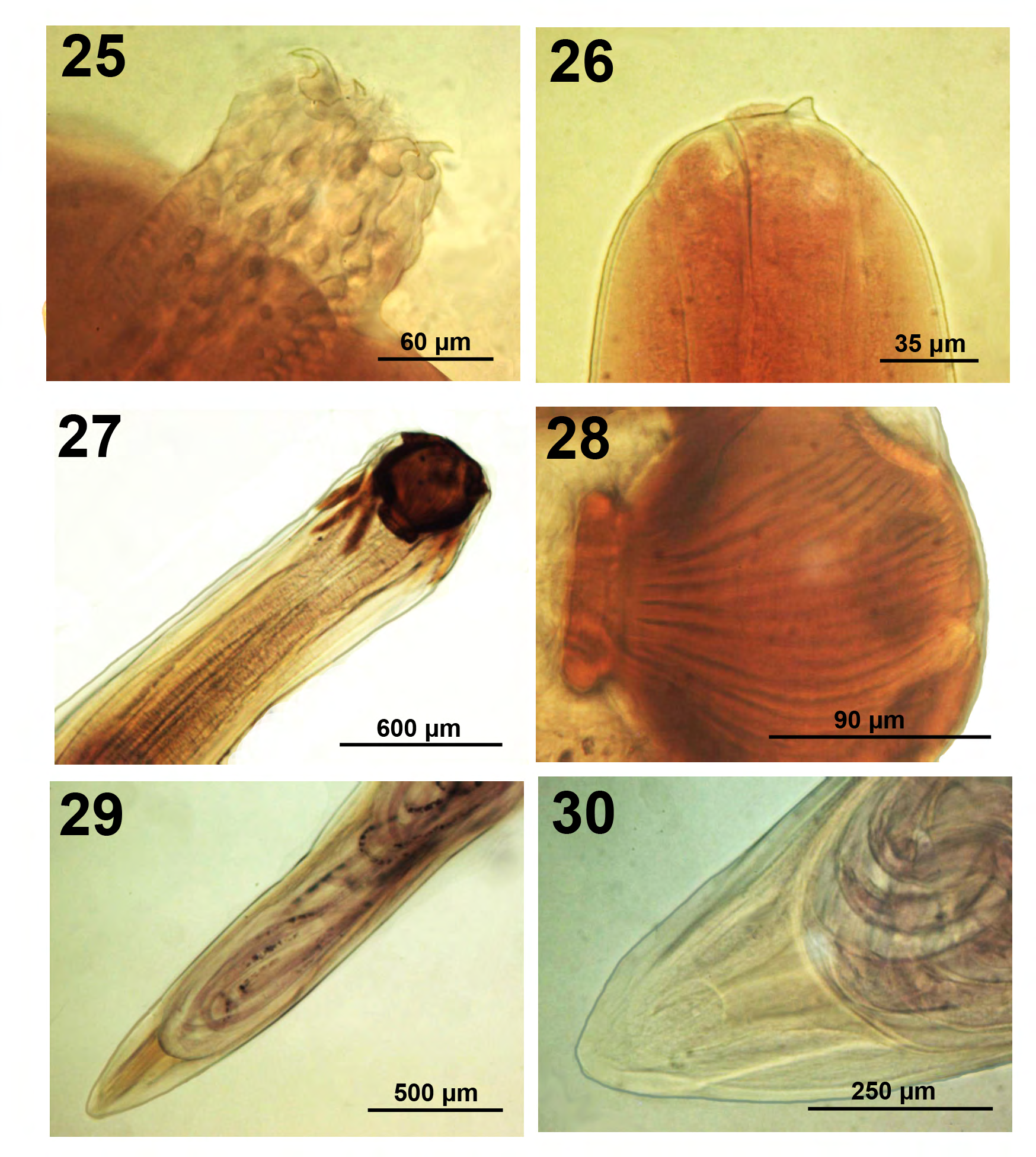
Figures 25-30: Helminths from wildlife. 25. Nybelinia lingualis from Katsuwanus pelamis in the Pacific Ocean off Ecuador showing the distal end of a tentacle with the characteristic manubriated hooks. 26. A specimen of Anisakis simplex showing the triangular boring tooth and the anterior esophagus. 27-30. Camallanus ancylodirus from Moxostoma erythrurum in Illinois. 27. The anterior end of one worm showing one pair of tridents (left), the buccal capsule and the esophagus. 28. A greater magnification of the buccal capsule and its basal sclerotized ring. 29, 30. The posterior trunk of a female at two magnifications showing the posterior reach of larvae.
Our slender specimens were almost identical to those described by Baker [41] (Fig 1-8) with comparable body sizes 19.12-25.75 (22.79) mm long by 0.40-0.65 (0.56) mm wide, and blunt anterior end with 4 cephalic papillae, and buccal capsule 177-197 (187) long by 146-208 (180) wide, with identical lateral valves. Prominent sclerotized ring surrounds posterior end of buccal cavity with 3 adjacent prominent pairs of tridents 177-208 (187) long (Figs 27 & 28). Esophagus muscular anteriorly 1.20-1.35 (1.29) mm long, and glandular posteriorly 132-162 (146) mm long. Uterus gravid with larvae extending to posterior end behind anus (Figs 29 & 30).
Specimens: Deposited at the Harold W. Manter Laboratory of Parasitology Collection no. HWML 217039.
Rhabdochona cascadilla Wigdor, 1918 (Thelazioidea: Rhabdochonidae) (Figs. 31-34)
The genus Rhabdochona Railliet, 1916 is cosmopolitan in freshwater fishes with about 96 species of which 19 are known in North and South America [42]. Rhabdochona cascadilla was recorded from 13 families, 30 genera, and 53 species of freshwater fish in Canada and the US [43] with additional records since. Byrne [44] redescribed R. cascadilla from Notropis cornutus Mitchill in Ontario and Moravec and Muzzall [45] declared Rhabdochona rotundicaudatum Byrne, 1992 and Rhabdochona californiensis Magenti, Abdel- Rahman, Cid del Prado Vera, 1992 as junior synonyms.
Sule and Skelly [29] reported but did not measure specimens of R. cascadilla from all 3 species of redhorse, M. Anisurum, M. erythrurum, and M. macrolepidotum examined in the Kankakee River, Will County, Illinois. Skelly sent Amin 35 adult males and females from this collection for further study.
Our specimens were small, slender and mostly coiled. Seven specimens of each sex were measured. Males 4.12- 5.25 (4.75) mm long by 75-87 (81) wide and females 6.00- 7.87 (7.21) mm long by 87-125 (103) wide. Apical outer circle with four cephalic papillae. Prostom with sclerotized protuberances basally and over 10 sclerotized conical teeth anteriorly (Fig 12), 15-20 (18) long by 10-12 (11) wide in males and 15-25 (21) long by 10-15 (12) wide in females. Nerve ring over anterior part of the shorter muscular esophagus. Tail 198-250 (222) long in males and shorter in females (Fig 32), 146-228 (195) long. With about 30 mostly sub-ventral caudal papillae; 9 pairs preanal and 5 pairs postanal. Spicules unequal: left 322-375 (340) long, right 82-104 (88) long (Fig 33 & 34). Vulva at middle of body. Underdeveloped eggs packed in utero ovoid and smooth, 17-25 (21) long by 12-17 (15) wide. All measurements and counts were very comparable to those in Byrne [44] except for the relatively smaller eggs.
Specimens: Deposited at the Harold W. Manter Laboratory of Parasitology Collection no. HWML 217040.
Subulura Molin. 1860 (Subuluridae: Subulurinae) (Figs. 35, 36)
The genus Subulura appears to be cosmopolitan in birds and mammals but of uncommon distribution in North America. We, with the help of Bob Sewell, have collected 14 specimens (13 variably developed females & 1 anteriorly incomplete male) from S. vulgaris, in Kenosha County, Wisconsin in 1974. Previously, only Rodrick, et al. [46] reported Subulur_a sp., also from starling, in Kansas and declared their record as new for starlings in North America; Roy Anderson, Univ. of Guelph identified their specimens. Yamaguti [47] listed 53 species of _Subulura with worldwide distribution (none of which were from starling) that included 4 species occurring in USA birds and mammals including Subulura galloperdicis Baylis and Daubney, 1922 from Galliform birds in Arizona. Ubelaker, et al. [48] reported three other species occurring in mammals in New Mexico, Minnesota, and Nevada. Our record from starling in Wisconsin appears to be new. The generic diagnosis by Yamaguti [47] is most appropriate for zoogeographical analysis where Baruš, et al. [49] “evaluated all valid nominal taxa in species of the genus Subulura parasitizes birds with remarks on its synonymy and specialization in avian orders.” Our specimens were medium sized, 5.00-41.25 (16.54) mm long and 0.20-0.95 (0.44) mm wide tapering towards both extremities, rounded anteriorly and pointed posteriorly. Esophagus, muscular, slightly dilated posteriorly, 624-1250 (676) long by 52-200 (96) wide posteriorly followed by a weak bulb 146-300 long by 94-250 (138) wide, separating it from a thick intestine often obscured by winding uterus (Fig 35). Cephalic plate, 31-112 (63) long by 62-187 (111) wide with slightly chitinized vestibule and three large bluntly pointed strongly chitinized teeth (Fig 36). No eggs or larvae observed. Vulva at middle of body. Tail 114-600 (359) long. Spicules unequal, 562 and 375 long, without distal enlarged tip. Ventral caudal papillae could not be observed because of heavy cuticular folds.
Our species is certainly not the Arizona S. galloperdici_s from galliform birds or the Florida _S. forcipata (Rudolphi, 1819) from the burrowing owl _Athene cuniculari_a (Molina) that have equal spicule lengths [47]. The final specific status of this species could not be determined at this time.
Specimens: Deposited at the Harold W. Manter Laboratory of Parasitology Collection no. HWML 217041.
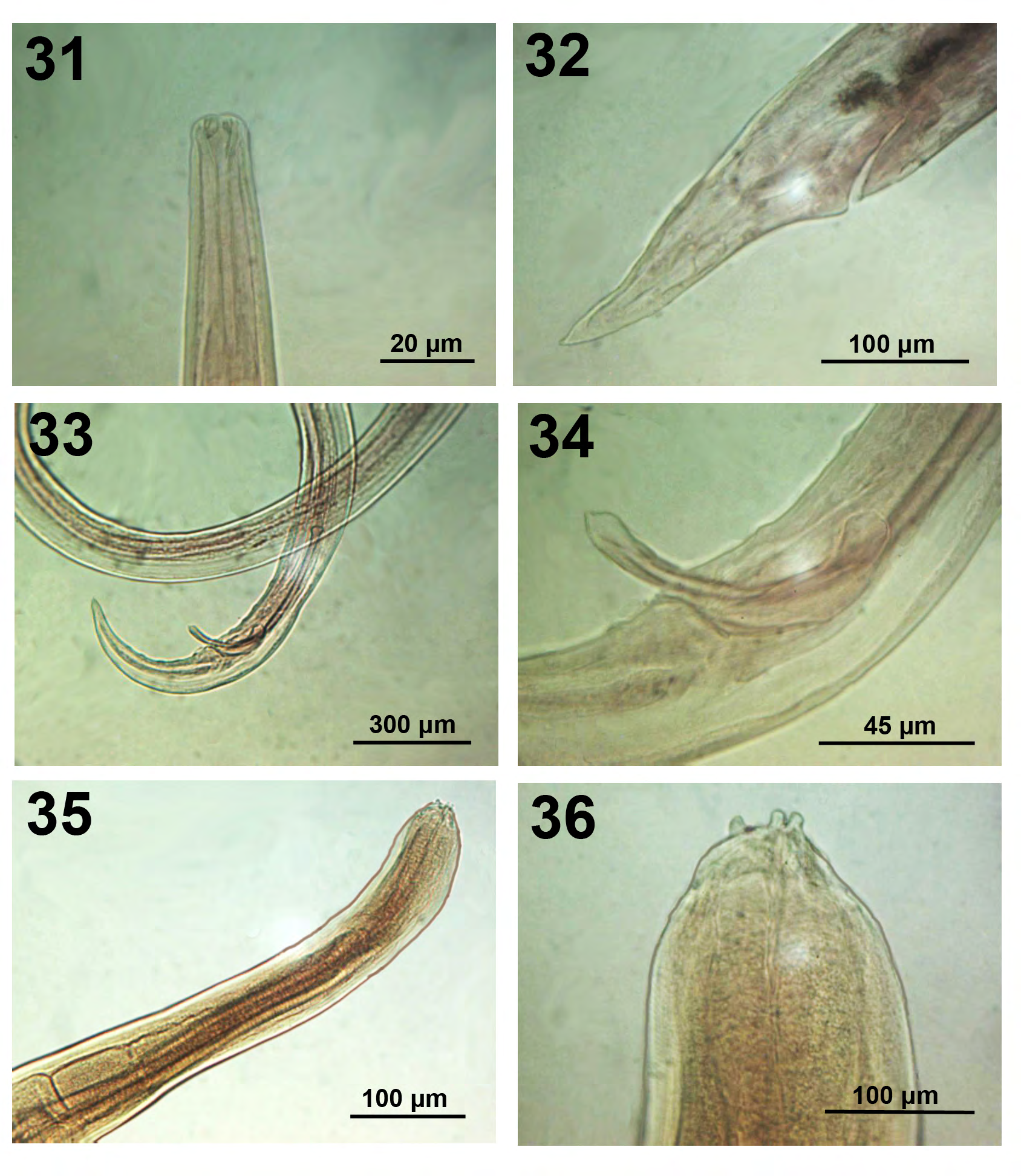
Figures 31-36: Helminths from wildlife. 31-34. Rhabdochona cascadilla from Moxostoma macrolepidotum in Illinois. 31. Anterior end; note sclerotized conical teeth. 32. The pointed posterior end with anal opening of a female. 33. Posterior end of a male. Note the long and the short spicules and the papillae. 34. A high magnification of the terminal end of the short spicule. 35, 36. Subulura sp. from _Sturnus vulgari_s in Wisconsin. 35. The anterior of a worm showing the muscular esophagus followed by the weak bulb (left) and the barely visible teeth (far right). 36. A higher magnification of the anterior end showing the characteristic three bluntly pointed chitinized teeth.
Discussion
This is the first in a series of papers covering almost lifelong collections of helminthological materials that for some reason or the other have found their way into my personal collection of specimens that were waiting to, someday, see the light of the day. This presentation includes 2 species of trematodes, 7 species of cestodes, and 4 species of nematodes in my collection that have not been previously published. The treatments encompass the taxonomy and measurements of specimens in each species within the framework of their host and geographical distribution. Almost all host and locality records are new. The light microscope images emphasize the diagnostic features characteristic of each species. While there are no new taxa described here, we are still providing plenty of new information to science that supplements already published materials and, sometimes, correcting old records.
Our description of B. fuscatum from the white-throated sparrow in Illinois varied from that of Ubelaker and Dailey [2] especially regarding the sizes of the oral sucker and the acetabulum. We have clarified the confusing issue of the many synonymies in the Echinostoma complex previously proposed by Beaver [15] as physiological variants and emphasized the importance of blunt collar spines that has been overlooked by other observers. The importance of the fixed number of testes of A. quiscal_i [5, 20] is verified in our specimens where we measured all proglottid types that were missing in some other accounts, e.g., [3]. The confused taxonomic history of _C. musculosa is resolved with the understanding of the introduction of its host, starlings, to North America [6]. The disagreements about whether the crown of rostellar hooks is made of a single or a double circles of hooks has also been resolved to one circle with justification provided. New records, redescriptions, measurements, and images of the scolex and ovarian complex of 4 species of the Caryophyllid cestodes genus Isoglaridacris from Idaho and Illinois suckers provide new insights into their morphology and add to the understandings presented in the original descriptions including making corrections to records based on new observations. Our specimens of N. lingualis collected from the unique site of the body cavity of skipjack tuna off the Ecuadorian coast was described in detail and represented a new record. The tentacle morphology agrees with those described from Puerto Rico [33] and elsewhere [34]. We have verified the presence of A. simplex Type I, L3 larvae from skipjack tuna of the Ecuadorian coast by a number of morphological details especially the presence of the anteriorly directed triangular boring tooth and the cone- shaped mucron at the posterior end. We have confirmed the presence of the uncommon nematode C. ancylodirus from M. erythrurum and M. macrolepidotum in Illinois and the absence of the normally more common C. oxycephalus in North America [40]. Our description and images of C. ancylodirus are in agreement with those of Baker [41]. Our small filamentous specimens of R. cascadilla from Illinois showed sexual differentiation in size, recognizable but hard to document prostom, nerve ring, and cephalic papillae. All our measurements were comparable to those taken by Byrne [44]. Our recovery of Subulura sp. from starlings in Kenosha is another new record of this nematode in Wisconsin and of uncommon distribution in North America [46] but with at least 53 species worldwide [47].
Acknowledgments
This project was partially supported by an ongoing institutional grant from the Parasitology Center, Inc., Scottsdale, Arizona, USA. We are immensely grateful to the many collaborators and former students who contributed the study materials that made the execution of this work possible. Students’ involvements were part of joint research projects mostly under independent study programs at the University of Wisconsin-Parkside, Kenosha Wisconsin. Collaborators simply shared research material as part of joint research understandings. We also gratefully recognize the help of Dr. Gabor Racz., Collection Manager, Harold W. Manter Laboratory of Parasitology, University of Nebraska- Lincoln for kindly accessing and cataloging our specimens.
References
-
Butcher AR (2003) _Brachylaima_ _cribbi_ n. sp. (Digenea: Brachylaimidae): Taxonomy, life-cycle kinetics and infections in animals and humans. PhD Thes School of Molecul and Biomed Sci Univ Adealaide S Australia.
-
Ubelaker JE, Dailey MD (1966) Taxonomy of the genus _Brachylaima_ Dujardin (Trematoda: Digenea) with description of _B. chiapensis_ sp. n. from _Peromyscus_ _guatemalensis_ in Mexico. Journal of Parasitology 52(6): 1062-1065.
-
Barker FD (1915) Parasites of the American muskrat (_Fiber zibethicus_). J Parasitol 1: 184-197.
-
Ganoe LS, Brown JD, Yabsley MJ, Lovallo MJ, Walter WD (2020) A review of pathogens, diseases, and contaminants of muskrats (_Ondatra zibethicus_) in North America. Front Vet Sci 7: 233.
-
Rausch R, Morgan BB (1947) The genus _Anonchotaenia_ (Cestoda: Dilepididae) from North American birds, with the description of a new species. Trans of the Amer Microsc Soc 66(2): 203-211.
-
Boyd EM (1951) A survey of parasitism of the starling _Sturnus vulgaris_ L in North America. J Parasitol 37(1): 56-84.
-
Mackiewicz JS (1974) _Isoglaridacris calentinei_ n. sp. (Cestoidea: Caryophyllidea) from catostomid fish in western United States. Trans Amer Micros Soc 93(1): 143-147.
-
Williams DD (1977) _Isoglaridacris chetekensis_ sp. n. and _I. wisconsinensis_ sp. n. (Cestoda: Caryophyllaeidae) from Red Cedar River, Wisconsin catostomid fishes. Proc Helminthol Soc Wash 44 (1): 91-95.
-
Fredrickson LH, Ulmer MJ (1967) Caryophyllaeid cestodes from two species of redhorse. Proceedings Iowa Acad Science 72(1): 444-461.
-
Amin OM, Heckmann RA, Radwan NA, Mantuano JS, Alcivar MAZ (2009) Redescription of _Rhadinorhynchus_ _ornatus_ (Acanthocephala: Rhadinorhynchidae) from skipjack tuna, Katsuwonus pelamis, collected in the Pacific Ocean off South America, with special reference to new morphological features. J Parasitol 95(3): 656-664.
-
Peet S, Ulmer MJ (1970) Trematode parasites of the brown thrasher, _Toxostoma rufum_, from Dickinson County, Iowa. Proc Iowa Acad Sci 77(1): 196-199.
-
Suleman S, Khan MS (2016) First report of the _genus_ _Brachylaima_ Dujardin, 1843 (Trematoda: Brachylaimidae) from the small intestine of common myna (Acridotheres tristis) of district Swabi, Khyber Pakhtunkhwa, Pakistan. Turkish J Zool 40(4): 595-600.
-
Brooks DR, Hoberg EP, Houtman A (1993) Some Platyhelminths inhabiting white-throated sparrows, _Zonotrichia albicollis_ (Aves: Emberizidae: Emberizinae), from Algonquin Park, Ontario, Canada. J Parasitol 79(4): 610-612.
-
Ellis CJ (1963) Trematodes of passerine birds from Chickasaw County, Iowa. Proc Iowa Acad Sci 70(1): 486- 492.
-
Beaver PC (1937) Experimental studies on _Echinostoma_ _revolutum_ (Froelich), a fluke from birds and mammals. Ill Biol Monogr 15(1): 1-96.
-
Boyd IV, David A (1967) Metazoan Parasites of the Muskrat, _Ondatra zibethica cinnamominus_, from the English coulee, Grand Forks County, North Dakota. Theses and Dissertations: 3995.
-
Sohn W, Chai J, Yong T, Eom KS, Yoon CH, Sinuon M, et al. (2011) _Echinostoma revolutum_ infection in Children, Pursat Province, Cambodia. Emerg Infect Diseases 17(1): 117-119.
-
Chai JY, Cho J, Chang T, Jung BK, Sohn WM (2020) Taxonomy of _Echinostoma revolutum_ and 37-collar- spined _Echinostoma_ spp.: a historical review. Korean J Parasitol 58(4): 343-371.
-
Kanev I, Fried B, Dimitrov V, Radev V (1995) Redescription of _Echinostoma trivolvis_ (Cort, 1914) (Trematoda: Echinostomatidae) with a discussion on its identity. Syst Parasitol 32: 61-70.
-
Mariaux J, Georgiev BB (2020) Cestode parasites (Neodermata, Platyhelminthes) from Malaysian birds, with description of five new species. Eur J Taxon 616: 1-35.
-
Schmidt GD (1986) CRC handbook of tapeworm identification. CRC Press, In: Boca Raton, Florida, pp: 675.
-
Cooper CL (1975) The helminth parasites of an insular avian passerine community: relationship to landscape epidemiology. PhD Thesis, Ohio State Univ Microfilms pp: 209.
-
Cannon DG (1939) On the parasites of the small intestine of the European starling (_Sturnus vulgaris_) in Quebec. Canad Field Nat 53: 40-42.
-
Joyeux CH, Baer JG (1936) Fauna of France. Cestodes. Paul Lechevalier and Sons, Paris France, 30: 1-613.
-
Wardle RA, McLeod JA (1952) The zoology of tapeworms. Univ Minnesota Press, Minneapolis pp: 780.
-
Yamaguti S (1959) Systema Helminthum Vol II. The cestodes of vertebrates. Interscience Publ New York, USA, pp: 860.
-
Amin OM, Heckmann RA (1992) Description and pathology of _Neoechinorhynchus idahoensis_ n. sp. (Acanthocephala: Neoechinorhynchidae) in _Catostomus_ _columbianus_ from Idaho. J Parasitol 78(1): 34-39.
-
Fritts DH (1959) Helminth parasites of fishes of northern Idaho. Trans Amer Micros Soc 78(2): 194-202.
-
Bangham RV, Adams JR (1954) A survey of the parasites of freshwater fishes from the mainland of British Columbia. J Fish Res Board Can 11(6): 673-708.
-
Sule MJ, Skelly TM (1985) The life history of the shorthead redhorse, _Moxostoma macropelidotum_, in the Kankakee River drainage, Illinois. Ill Nat Hist Surv Champaign 123.
-
Amin OM (1986) Caryophyllaeidae (Cestoda) from lake fishes in Wisconsin with a description of _Isoglaridacris_ _multivitellaria_ sp. n. from Erimyzon sucetta (Catostomidae). Proc Helminthol Soc Wash 53(1): 48-58.
-
Alves PV, de Chambrier A, Scholz T, Luque JL (2017) Annotated checklist of fish cestodes from South America. Zoo Keys 650: 1-205.
-
Williams EH, Williams LB (1996) Parasites of offshore big game fishes of Puerto Rico and the Western Atlantic. Puerto Rico Dept Natur Environ Res, San Juan, PR, Univ PR & Univ Puerto Rico, Mayaguez, PR, pp: 382.
-
Palm HW _Nybelinia_ Poch (1926) _Heteronybelinia_ gen. nov. and _Mixonybelinia_ gen. nov. (Cestoda, Trypanoprhyncha) in the collections of the Natural History Museum, London. Bull Nat Hist Mus, Lond Zool 65(2): 133-153.
-
Dollfus RPh (1942) Etudes critiques sur les Tétrarhynques du Muséum de Paris. Archives du Musée National d’Histoire Naturelle 19: 1466 pages.
-
Amin OM, Eidelman WS, Domke W, Bailey J, Pfeifer G (2000) An unusual case of Anisakiasis in California USA. Comp Parasitol 67(1): 71-75.
-
Ángeles-Hernández JC, Gómez-de Anda FR, Reyes- Rodríguez NE, Vega-Sánchez V, García-Reyna PB, et al. (2020) Genera and species of the Anisakidae family and their geographical distribution. Animals (Basel) 10(12): 2374-2397.
-
Ishii Y, Fujino T, Weerasooriya MV (1989) Morphology of Anisakine larvae, In: Ishikura H, Kikushi K (Eds.), Gastric anisakiasis in Japan. Springer-Verlag, Tokyo, Japan, pp: 14-265.
-
Arai HP, Smith JW (2016) Guide to the Parasites of Fishes of Canada. Part V: Nematoda. Zootaxa 4185(1): pp: 274.
-
Robinson GL, Jahn LA (1980) Some observations of fish parasites in pool 20, Mississippi River. Trans Amer Micros Soc 99(2): 206-212.
-
Baker MR (1997) Redescription of _Camallanus_ _ancylodirus_ Ward and Magath 1916 (Nematoda: Camallanidae) from freshwater fishes of North America. J Parasitol 65(3): 389-392.
-
Hoffman GL (1999) Parasites of North American freshwater fishes. Comstock Publish, Cornell Univ Press, Ithaca, London, pp: 539.
-
Dyer WG, Poly WJ (2002) First record of _Rhabdochona_ _cascadilla_ Wigdor, 1918 (Nematoda: Thelazioidea) in the blue sucker, _Cycleptus elongatus_ (LeSueur, 1817), from Illinois. Transactions of the Illinois State Academy of Science 95(2): 107-109.
-
Byrne PJ (1992) _Rhabdochona rotundicaudatum_ n. sp. and a redescription of _R_. _cascadilla_ Wigdor, 19 18 (Nematoda: Thelazioidea) from minnows in southern Ontario, Canadian Journal of Zoology 70(3): 476-484.
-
Moravec F, Muzzall P (2007) Redescription of _Rhabdochona cotti_ (Nematoda, Rhabdochonidae) from _Cottus caeruleomentum_ (Teleostei, Cottidae) in Maryland, USA, with remarks on the taxonomy of North American _Rhabdochona_ spp. Acta Parasitologica 52(1): 51-57
-
Rodrick GE, Johnson CJr (1971) Helminths of the starling _Sturnus vulgaris_ L from southeastern Kansas. Trans Amer Micros Soc 90(2): 253-254.
-
Yamaguti S (1961) Systema Helminthum Vol III, Part I The nematodes of vertebrates Interscience Publ New York, pp: 679.
-
Ubelaker JE, Easter-Taylor R, Marshall A, Duszynski DW (2007) A new species of _Subulura_ (Nematoda: Subuluroidea) from ground squirrels, _Spermophilus_ _spilosoma_ Bennett, 1833, in New Mexico. Faculty Publications from the Harold W Manter Laboratory of Parasitology 138.
-
Baruš V, Mašová Š, Koubková B, Sitko J (2013) _Subulura mackoi_ n. sp. (Nematoda: Subuluridae) and the zoogeography of subulurids parasitizing birds. Helminthologia 50: 46-56.
- Mitochondrial Bio-Logistics: Steering Co-Enzyme Q10 and Lycopene Synergies within the Science 4.0 Bio-OS Framework
- Hymenoptera Specimens from the Caño Negro Wetland, of the National Museum Collection, Costa Rica
- Science 4.0: Comprehensive Architecture of the Biological Operating System (Bio-OS) A Framework for Systemic Resilience and Industrialized Bio-Governance
- Rabbit on, or Hare Back? Understanding Climate Change
- Clinical Validation of Science 4.0: Flow Steering and Epigenetic Drift Inversion on a 76-Year-Old Hybrid System
- Seeds Planted by another Mind