
Notes on Euglossini (Hymenoptera: Apidae: Apinae) of Costa Rica: Identification key for genus Eulaema Lepeletier, 1841 and Exaerete hoffmannsegg, 1817
Within the Euglossini tribe we find the Exaerete genus, a group of cuckoo bees which attacks Eulaema and Eufriesea hives. In Costa Rica, the interspecific associations of paracitism in bees have been little studied, so the exact association between paracitous and paracitous taxa is unknown. Eulaema bees are popularly known as bumblebees just like Bombus, and their resemblance to some Eufriesea makes it difficult to identify them in the field, likewise the species of cuckoo bees are very similar, for which an identification key is presented for the bees of the genera Eulaema and Exaerete. The size, coloration and venation of the wings of these bees can be very important when identifying them in the field, so it is concluded that they are the most appropriate diagnostic traits for identification in the field.
Introduction
Within the Euglossini tribe we find the Euglossa, Eufriesea and Eulaema genera of pollinators known as orchid bees [1], the latter two are usually attacked by two other genera of cuckoo bees from the same group: Exaerete, et al. [2], from which only the first is present in Costa Rica.
Contrary to eusocial bees, euglossines are solitary, and do not have casts or elaborate nests with workers and complex brood structures, but instead have what Zucchi, et al. [3] called communal behavior or parasocial nesting.
Due to this biology, the species of these groups have very few studies, since they are not a group with economic importance because they are not suitable for producing honey, but rather their importance lies at the wildlife level, playing a vital role. In the genetic connection of plants in the case of the genus Eulaema, and population control in the case of the Exaerete.
This paper deals with the identification of the species of the genera Eulaema and Exaerete present in Costa Rica.
Methodology
An identification key was generated for each genus, for which material from the bee collections of the National Museum of Costa Rica (MNCR), and the Museum of Insects of Agronomy of the University of Costa Rica (AUCR) was used, as well as Likewise, a review of the bibliography corresponding to taxonomy and diagnostic characters of the genera was carried out, namely: Michener [4], Nemesio, et al. [5], Moure [6] and Engel [7].
Results
Genus Exaerete Hoffmannsegg, 1817
This genus has a total of seven recorded species, without subgenera. The identification key for the three species present in Costa Rica is presented below:
1 Body length less than 18mm______E. dentata 1´ Body length of about 20 mm or more _____2 2 Hind tibia with a very pronounced curvature, body more than 20mm long (Figure 1A) _____E. frontalis 2´ Hind tibia slightly curvature, body length less than 20mm (Figure 1B)____ E. smaragdina
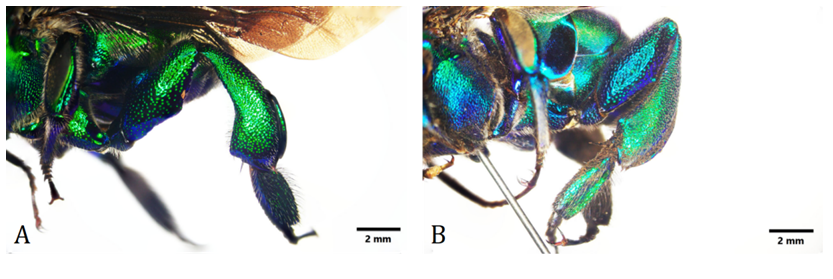
Exaerete dentata (Linnaeus, 1758) They occur in the low areas of the Pacific and Caribbean slopes, as well as in the northern hetar zone, between 0masl and 800masl. It is expected to be found even at altitudes close to 1000masl.
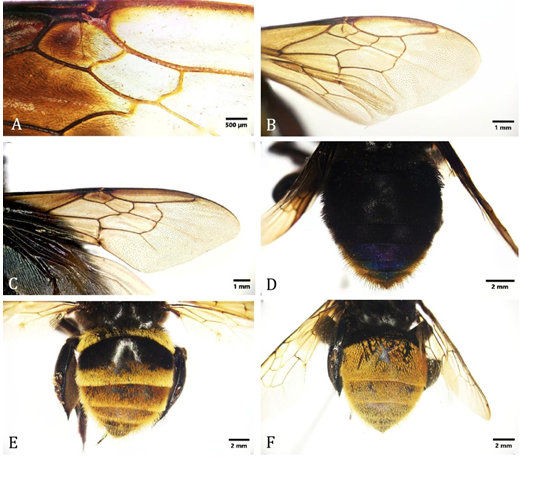
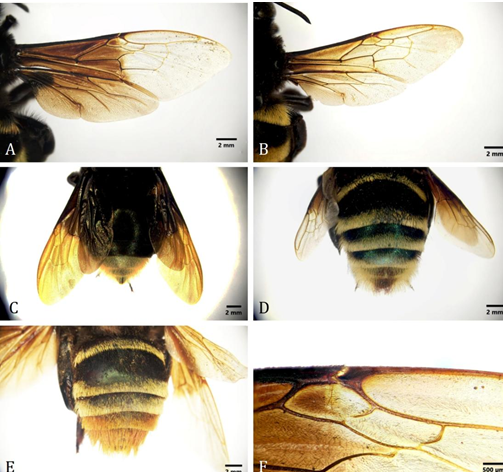
Exaerete frontalis (Guérin, 1844) They are present throughout the country between 0masl and 1800masl. It is expected to be found even at altitudes close to 2000masl. Exaerete smaragdina (Guérin, 1844) Like E. frontalis, it is present throughout the country between 0masl and 1800masl. It is expected to be found even at altitudes close to 2000masl. Genus Eulaema Lepeletier, 1841 This genus contains a total of 32 accepted species, divided into 10 in the subgenus (Apaelaema) and 22 in the subgenus (Eulaema), and for Costa Rica a total of eight species are reported, four from each subgenus. Below is the key to identify them: 1 Forewing with proximal half of surface darkened (Figure 2A)____2 1’ Forewings without proximal half of surface darkened (Figure 2B)____6 2 Black abdomen with only the last three segments completely covered by yellow setae, distal area of wings orange (Figure 2C)____ E. leucopyga 2´ Banded abdomen with the setae of the last three segments very long, distal area of the wings transparent_____3
3 Bands of the entire abdomen with yellow setae, except in some cases of a small medial section in the last three segments which are slightly darker (Figure 2D)_____4 3´ Abdomen bands with yellow setae, except for the last 3 segments where they are markedly orange (Figure 2E)____5 4 Yellow strip of setae occupying barely a tenth of the width of T2____E. luteola 4´ Yellow stripe of setae occupying a third of the width of T2____E. seabrai 5 Forewings with first submarginal cell open at distal end, long marginal cell with terminal area narrower than medial, hindwing with 34 hamuli (Figure 2F)____E. meriana 5´ Forewings with the first submarginal cell closed at the distal end, short marginal cell with the terminal zone of a width similar to the medial one, hindwings with 32 hamuli (Figure 2G)___E. bombiformis 6 Forewings with marginal cell short and broad (Figure 2H)____E. speciosa 6´ Forewings with thin and long marginal cell (Figure 2I)_____7 7 Abdomen completely covered with very dark setae (Figure 2J)____E. nigrita 7´ Abdomen with very bright pale yellow setae____8 8 Abdomen with a single black band on the T2 (Figure 2k)_____E. cingulata 8´ Abdomen completely yellow without bands_____E. polychroma
Discussion
As mentioned at the beginning, these bee genera tend to be little studied, to the point where the state of knowledge about their interspecific associations is limited to few reports.
Among the most important reports are those related to Euleama nigrita, with which the Exaerte smaragdina is associated as the main predator along with the beetle Melotyphlus fuscatus (Coleoptera: Meloidae) and some species of Rhipiphorids (Coleoptera), Leucospids (Hymenoptera) and Mutilids (Hymenoptera) [4, 8, 9], although of these last three groups there are no reports of specific species for Costa Rica.
For the rest of the species of both genera, there is a lack of information on the paracytism associations of the Exaerete with the other species of Eulaema and Eufriesea, of which only their relationship is confirmed in a general way, but the species that interact are not known. , just as the specific plant-pollinator associations of Eulaema are not known in depth.
Conclusions
- For Costa Rica, a total of three species of the Exaerete genus and eight of the Eulaema genus are reported.
- With the exception of the association of the Exaerete smaragdina and the beetle Melotyphlus fuscatus with the Eulaema nigrita, other specific associations of both genera are unknown, so the study of their biology in the forests of Costa Rica is very scarce.
References
-
Roubik WD, Hanson EP (2004) Orchid Bees of Tropical America: Biology and Field Guide. INBio, Heredia, Costa Rica.
-
Roubik WD (2019) Population Traits and a Female Perspective for Aglae and Exaerete, Tropical Bee Parasites (Hymenoptera: Apinae: Euglossini). Psyche (2): 1-9.
-
Zucchi RS, Sakagami F, Camargo JMF (1969) Biological observations on a neotropical parasocial bee, Eulaema nigrita, with a review on the biology of Euglossinae (Hymenoptera, Apidae). Acomparativestudy. Journal of the Faculty of Science, Hokkaido University Series VI, Zoology 17: 271-380.
-
Michener CD (2007) The Bees of the World. The Johns Hopkins University Press. Maryland, United States of América, pp: 953.
-
Nemesio A, Ferrari RR (2012) The species of Eulaema (Eulaema) Lepeletier, 1841 (Hymenoptera: Apidae: Euglossina) from eastern Brazil, with description of Eulaema quadragintanovem sp. n. from the state of Ceará. Zootaxa 3478: 123-132.
-
Moure JS (2000) The species of the genus Eulaema Lepeletier, 1841 (Hymenoptera, Apidae, Euglossinae). Acta Biológica Paranaense 29(1/4): 1-70.
-
Engel MS (2018) A new species of the cleptoparasitic orchid bee genus Exaerete from northern Venezuela (Hymenoptera, Apidae). Entomologist’s Monthly Magazine 154(3): 161-175.
-
Garófalo CA, Camillo E, Serrano JC (2001) Reproductive aspects of Meloetyphlus fuscatus a meloid beetle cleptoparasite of the bee Eulaema nigrita (Hymenoptera, Apidae, Euglossini). Apidologie 42: 337-348.
-
Pinto JD (1999) The New World genera of Meloidae (Coleoptera): a key and synopsis. Journal of Natural History 33(4): 569-620.
- Mitochondrial Bio-Logistics: Steering Co-Enzyme Q10 and Lycopene Synergies within the Science 4.0 Bio-OS Framework
- Hymenoptera Specimens from the Caño Negro Wetland, of the National Museum Collection, Costa Rica
- Science 4.0: Comprehensive Architecture of the Biological Operating System (Bio-OS) A Framework for Systemic Resilience and Industrialized Bio-Governance
- Rabbit on, or Hare Back? Understanding Climate Change
- Clinical Validation of Science 4.0: Flow Steering and Epigenetic Drift Inversion on a 76-Year-Old Hybrid System
- Seeds Planted by another Mind