
Case of Bovine’s Retained Placental (RP) Associated with a Subclinical Mastitis 3th Degree, Anémia and Parasitism
A 10-year-old black piebald cow is presented for persistence of the placenta, a sign of anemia plus a pitted coat and dejection. A transvaginal palpation plus a subclinical mastitis test of the 4 teats are performed showing an open cervix with 2 fingers plus a grade three subclinical mastitis of the right posterior teat. A hormonal medical intervention is carried out, allowing the expulsion of the placenta, the exploration of the cervix allowed the introduction of an intrauterine syringe. Antibiotic treatment, calcium therapy plus vitamin therapy based on vitamin A, vitamin E Selenium plus vitamin B12 plus antiparasitic treatment based on fenbendazole is implemented, allowing an improvement in the general condition and the absence of relapse during the 5 weeks of follow-up. According to the literature, this is the first published case of retained placenta/ parasitism/subclinical mastitis in a dairy cow in Algeria.
Memorials and Clinical Examination
A 10.5-year-old, 350 kg Friesian black piebald dairy cow was referred for persistent placenta called retained placenta RP [1] or non-delivrance [2, 3, 4], more than 60 hours of birth (resulting in a old black magpie of low vitality weighing 10Kg, rectal temperature equal to 38.50c) pale ocular and vaginal mucous membranes and slight dejection. This patient is a breeding animal and her last mating took place 375 days before the consultation. This anomaly of the placenta appeared with rectal temperature equal to 39.60c without notable evolution.
Additional Tests
A palpation of the genital tract is performed. The cervix was closed (2 fingers in diameter) letting a bloody brown discharge appear very thickened. This discharge relates to postpartum lochia, a physiological discharge of uterine contents. The placental portion hanging from the inferior commissure of the vulva was of normal color and odor with no signs of putrefaction, an examination for subclinical mastitis was carried out using the California Mastitis test 4 teat test (RaidexND) according to method Derivaux et Ectors [5].
In order to explore the germ responsible for subclinical mastitis, an aseptic sample is taken and sent directly to the bacteriology laboratory in a cold regime at 40°C [6].
In order to search for probable parasitism, a sample of faeces is taken for coproscopy [7].
Therapeutic Protocol
On the first day, the patient underwent hormonal treatment, pGf2alpha (EnzaprostND, 2 ml IM) and antibiotic (oxytetracycline + tylosin, TenalineND, 1ml/10kg IM, Tylo-
vetND, 3ml/100kg, IM), then a second hormonal treatment on the sixth day, pGf2alpha (EnzaprostND, 2 ml IM) allowing the opening of the cervix and the spontaneous expulsion of the placenta on the 7th day (after 168 hours from the first treatment).
The opening of the cervix allowed the establishment of uterine antisepsis based on Iodure de Potassium diluted to 10% as well as local intrauterine medication based on céphapirine (MétricureND, single dose intrauterine syringe) alongside systemic medication based on a vitamin complex (MultivitalND, 15 ml, IM), calcium therapy (calciomylND peros during 10 days) plus an antiparasitic treatment based on fenbendazole (PanacurND, 50ml/100kg, peros) [8, 9].
For mastitis, an intramammary injection of ceftiofur has been considered (Spectramast LCND) [5, 10, 11].
Post-Therapeutic Care and Follow-Up
The animal is placed in a clean place with a diet based on concentrated alfalfa-oat hay and corn silage, and a large
clipping of the scrotum and caudal abdomen is performed.
Systemic antibiotic prophylaxis is considered for one week (oxytetracycline, TenalineND 1ml/10kg IM + tylosin, Tylo-vetND, 3ml/100kg, IM) It was recommended, after the first return to heat, an injection of cephapirin (MétricureND, intrauterine, single dose) is renewed.
An antiparasitic treatment based on fenbendazole (PanacurND, 50 mg/kg) for 4 weeks is prescribed. A telephone check is carried out at the end of the treatment:
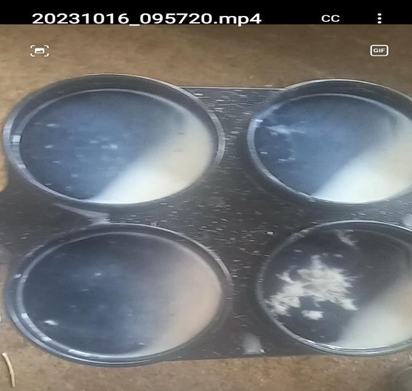
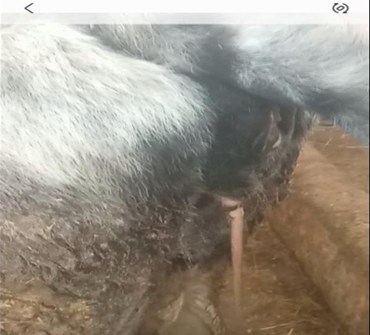
The patient is living normally and has no clinical signs. An ultrasound control is carried out 05 weeks after the intervention plus a screening for subclinical mastitis. The genital tract remaining normal in appearance. The entire endometrium seems to have been restored, the healthy udder the milk is of normal macroscopic and microscopic appearance [12] (Figures 1 & 2).
Discussion
A retained placental known as adnexal retention or placenta retained RP or non-delivery may be isolated or associated with other pathologies [1, 2, 3, 4]. In our case it was combined with subclinical grade 3 mastitis (Corynebacterium sp), anemia and parasitism (Strongyles sp). This is not frequently found in the Black Friesian dairy cow breed as well as in ewes or mares [8, 13].
However, it is likely that this multiple condition is underdiagnosed and therefore undertreated. Indeed, the underlying clinical signs are often crude or even non-specific (weakness, anemia, dysorexia, parasitism, subclinical mastitis, etc) [4, 8]. Our case is no exception to these observations, apart from a discreet dejection, pallor, only the increase in rectal temperature led to an exploration.
However, the diagnosis remains complicated. It is based on clinque examination [10] transrectal palpation, coproscopic examination and bacteriological examination.
Conclusion
This case illustre cow witch have a retained placental RP associated with 3 others healthy problems: anemia, subclinical mastitis (Corynebacterium sp) and signes of parasitism ( Strongyloïdes sp). This case was treteated with many drugs with success. After many resaerchin bibliograc, it is the first case with 4 diseases associated in the same time screened ane treated with full success. The évolution of this case was positive with absence of rechute after 5 weeks.
Acknowlegement
Thanks for Teachers: PR: Hirèche S; Bougherara H; Dr: Zeghilet N. Dr: Zine-Labiddine L; Dr: Daoudi Y; Pr: Kouhil K; Pr; Zouyed I. Studiants: Dilmi sohaib zin eddin; Debeb sadek elamine; Sadoune salah eddine; Diaf Youcef; Zani sohaib bader elyakine & Dekar ssoudaif abd elhak, also many thanks to: Hassene, Salim & Mustapha.
Déclaration Interest Conflict
Autors déclare haven’t any interets conflict.
References
-
Paździor K, Rapacz A, Rotkiewicz T, Raś A (2012) Proliferation and Apoptosis in Fetal Membranes and Endometrium During Placental Retention in Heavy Draft Mares. J Equ Vet Sci 32(2): 80-84.
-
Derivaux J, Ectors F (1981) Physiology of pregnancy and veterinary obstetrics. Fac Med Vet pp: 273.
-
Villemin M (1984) dictionary of veterinary and zootechnical terms Ed Vigot.
-
Meyer C (2023) Presentation of the animal science dictionary. Dictionary of Animal Sciences.
-
Berthelot X (1987) Mammary infections of dairy cattles. National Veterinarian School of Toulouse, pp: 192.
-
Quinn PJ, Carter ME, Markey B, Carter GR (1994) Clinical Veterinary Microbiology. Wolfe Publishing, London, UK, pp: 648.
-
Villeneuve A (2013) Parasites in cattle Parasite sheets. Parasitology laboratory, Faculty of Veterinary Medicine, Saint Hyacinthe, pp: 26.
-
Bazin S (1991) Pathologies of bovins. 1st(Edn.), Ins Tec Ele Bov, Frances Agricole.
-
Beagley JC, Whitman KJ, Baptiste KE, Scherze J (2010) Physiology and treatment of retained fetal membranes in cattle. J Vet Intern Med 24(2): 261-268.
-
Brion A, Fontaine M (1996) Vade mecum of veterinary.
-
Ziółkowsk H, Jaroszewski JJ, Maślanka T, Grabowski T, Katolik K, et al. (2014) Influence of oral co-administration of a preparation containing calcium and magnesium and food on enrofloxacin pharmacokinetics. Res Vet Sci 97(1): 99-104.
-
Picon JB (1994) Pathology of Goats. Ed Fr Agr.
-
Cadore JL, Fontaine M (1995) Vade mecum of veterinary. 16th (Edn.), vigot.
- Mitochondrial Bio-Logistics: Steering Co-Enzyme Q10 and Lycopene Synergies within the Science 4.0 Bio-OS Framework
- Hymenoptera Specimens from the Caño Negro Wetland, of the National Museum Collection, Costa Rica
- Science 4.0: Comprehensive Architecture of the Biological Operating System (Bio-OS) A Framework for Systemic Resilience and Industrialized Bio-Governance
- Rabbit on, or Hare Back? Understanding Climate Change
- Clinical Validation of Science 4.0: Flow Steering and Epigenetic Drift Inversion on a 76-Year-Old Hybrid System
- Seeds Planted by another Mind