
Sodium Hunger in the Amazon
Sodium is one of the biological essential elements for most animals; this element is required for growth maintenance, and survival
Editorial
Sodium is one of the biological essential elements for most animals; this element is required for growth, maintenance, and survival [1]. However, it is not equally available in nature. Coastlines typically have the highest sodium concentrations; in contrast with some portions of Amazon, which have less sodium deposition than in regions closer to the sea [2].
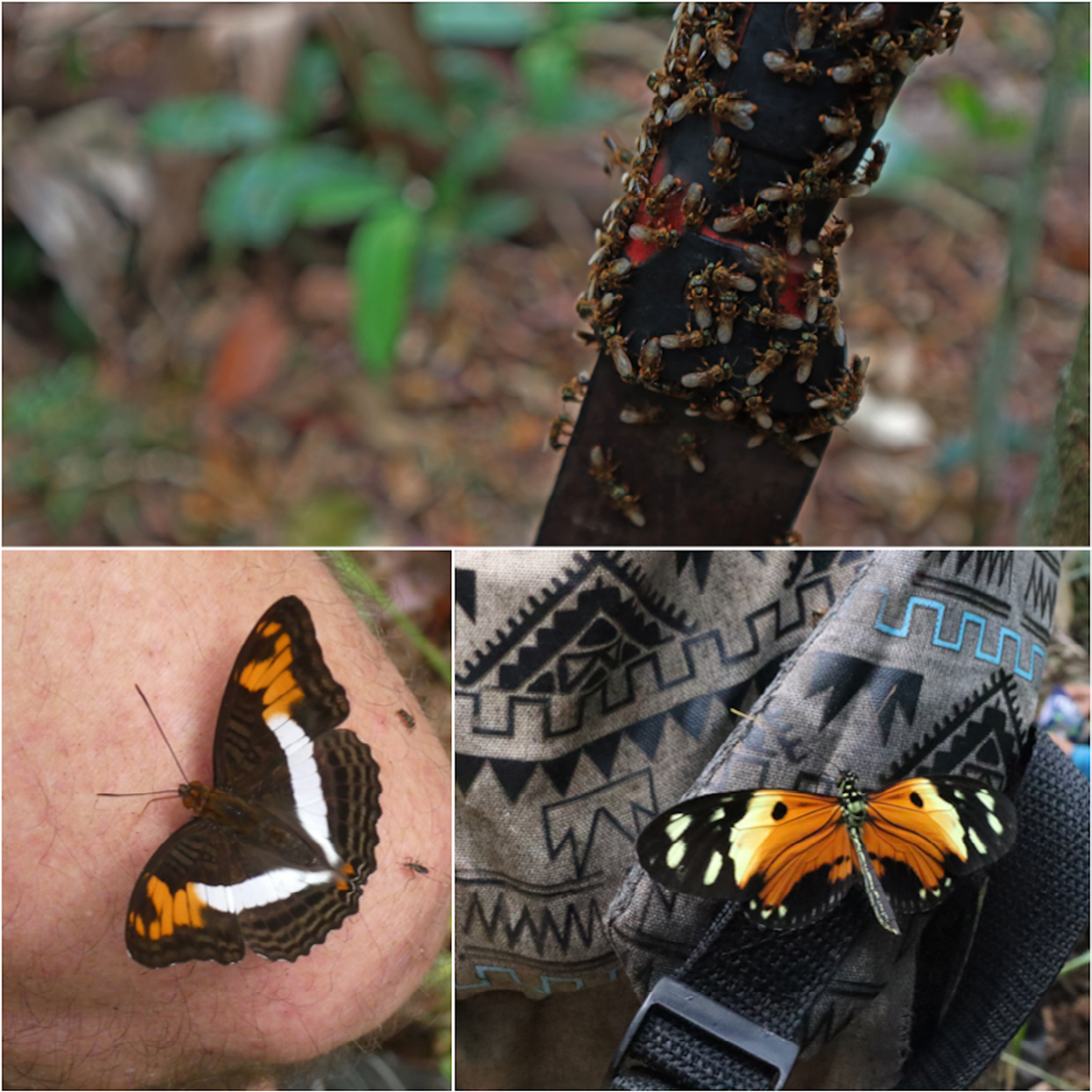
In Western Amazon (approximately 3.000 km away from the Atlantic Ocean and 2.000 from the Pacific Ocean), the sodium from the sea carried by the rain is scarce, the rains formed in this region by the ‘flying rivers’ are primarily recycled by the forest itself and the need for sodium is easily perceived; insects, especially bees are everywhere licking the sodium released from our sweat and ingrained in clothes, backpacks and tools. Bees, butterflies and other insects that often feed on nectar and pollen they collect from flowers are the most frequent visitors to our sweat (Figure 1), but birds and mammals are often attracted to salt licks, which are becoming tourist attractions in western Amazonia. Understanding more about sodium deposition could improve predictions about the geographic distribution of Amazonian species [3], and highlight additional questions, such as what the consequences of the sodium-availability are to ecosystem dynamics and species assemblages.
Sodium levels in the soil may favor salt-tolerant species [4], this relationship is also influenced by the interactions between plants and fungi [5]. Animal assemblages are affected by the existence of ‘sodium hotspots’ in nature — places where animals congregate in search of sodium-rich food sources [6]. Such congregations may impact species interactions, such as predator-prey dynamics [7]. Furthermore, plant-animal interactions are being influenced by the variability of sodium in the landscape, especially plant-pollinator networks [8]. At the ecosystem level, decomposition rates are affected by sodium availability [9], as well as what alternative sources of sodium are present in the forest [10]. Given the multifaceted nature of sodium’s impact across different ecological scales, there are clearly many open questions. These questions offer fertile ground for further research and warrant detailed empirical investigations to fully understand the nuances of sodium’s role in shaping ecosystems and assemblages of animals and plants.
A better understanding of these basic needs are crucial to predict species distributions in the Amazon, especially under scenarios of climate change and anthropogenic disturbances, which could alter patterns of sodium deposition, and hence the hunger for salt.
Acknowledgments
We are grateful to the Program for Biodiversity Research (PPBio) of the Brazilian Ministry of Science, Technology and Innovation (MCTI) and the Long-Term Ecological Research Program in the Southwest of Amazonas (Edital 021/2020 – Process 441366/2020-1). SSJ is supported by Fundação de Amparo à Pesquisa do Estado do Amazonas (PRODOC-FAPEAM Edital 016/2023). WEM is supported by a productivity grant from CNPq (PQ – 301873/2016-0).
References
-
Remick KA, Helmann JD (2023) The elements of life: A biocentric tour of the periodic table. In Advances in Microbial Physiology Academic Press 82: 1-127.
-
Salati E, Dall’Olio A, Matsui E, Gat JR (1979) Recycling of water in the Amazon Basin: An isotopic study. Water Resources Research 15(5): 1250-1258.
-
Kaspari M, Welti EAR, de Beurs KM (2020) The nutritional geography of ants: Gradients of sodium and sugar limitation across North American grasslands. Journal of Animal Ecology 89(2): 276-284.
-
Borer ET, Lind EM, Firn J, Seabloom EW, Anderson TM, et al. (2019) More salt, please: global patterns, responses and impacts of foliar sodium in grasslands. Ecology Letters 22(7): 1136-1144.
-
Welti EAR, Kaspari M (2021) Sodium addition increases leaf herbivory and fungal damage across four grasslands. Functional Ecology 35(6): 1212-1221.
-
Brightsmith DJ, Cáceres A (2017) Parrots consume sodium‐rich palms in the sodium‐deprived landscape of the Western Amazon Basin. Biotropica 49(6): 921-931.
-
Clay NA, Lehrter RJ, Kaspari M (2017) Towards a geography of omnivory: Omnivores increase carnivory when sodium is limiting. Journal of Animal Ecology 86(6): 1523-1531.
-
Finkelstein CJ, CaraDonna PJ, Gruver A, Welti EAR, Kaspari M, et al. (2022) Sodium-enriched floral nectar increases pollinator visitation rate and diversity. Biology Letters 18(3): 20220016.
-
Jia Y, Kong X, Weiser MD, Lv Y, Akbar S, et al. (2015) Sodium limits litter decomposition rates in a subtropical forest: Additional tests of the sodium ecosystem respiration hypothesis. Applied Soil Ecology 93: 98-104.
-
China S, Burrows SM, Wang B, Harder TH, Weis J, et al. (2018) Fungal spores as a source of sodium salt particles in the Amazon basin. Nature Communications 9(1): 4793.
- Mitochondrial Bio-Logistics: Steering Co-Enzyme Q10 and Lycopene Synergies within the Science 4.0 Bio-OS Framework
- Hymenoptera Specimens from the Caño Negro Wetland, of the National Museum Collection, Costa Rica
- Science 4.0: Comprehensive Architecture of the Biological Operating System (Bio-OS) A Framework for Systemic Resilience and Industrialized Bio-Governance
- Rabbit on, or Hare Back? Understanding Climate Change
- Clinical Validation of Science 4.0: Flow Steering and Epigenetic Drift Inversion on a 76-Year-Old Hybrid System
- Seeds Planted by another Mind