
Three New Species of the Genus Lecithocera Herrich-Schäffer (Lepidoptera: Lecithoceridae: Lecithocerinae) from Uganda
Three new species of the genus Lecithocera Herrich-Schäffer, 1853 belonging to the subfamily Lecithocerinae are described from Uganda. The new species are: L. ptyona Park, sp. nov., L. sarangalis Park, sp. nov., and L. pseudideologa Park, sp. nov.
Introduction
The genus Lecithocera Herrich-Schäffer [1] is the most diverse genus of the family Lecithoceridae, comprising more than 310 species worldwide. However, the genus has been poorly studied in Afrotropical Region. Since 29 species of Lecithocera was listed in the checklist of Lecithoceridae of Afrotropical Region by Park et al. [2], additional eleven new species were described by Park et al. [3], Park & Heppner [4], Park et al. [5, 6]. Among all these 40 known species of the genus from the Afrotropical Region, only two species, L. corythaeola Meyrick, 1931 and L. xanthocosma (Meyrick, 1923) have been known from Uganda [7, 8]. L. corythaeola was described based on a single male, but the abdomen of the type (in NHMUK) was missed, and the type of L. xanthocosma (also in NHMUK) was dissected and illustrated only the female genitalia by Clarke (1965, gen. slide no. 9167) [9]. The new species described here can be easily distinguished from them by the much smaller size and the forewing color pattern.
In the present study, three new species of the genus; L. ptyona Park, sp. nov., L. sarangalis Park, sp. nov., and L. pseudideologa Park, sp. nov. are described. Consequently, five species of Lecithocera are known from Uganda.
Materials and Methods
The present study is based on material collected from Uganda by L. Aarvik, Natural History Museum, University of Oslo (NHMO), Norway, in 2007 and W. Mey, Museum für Naturkunde, Berlin (MfN), Germany in 2014. The color standard for the descriptions of adults follows Kornerup and Wanscher [10]. The type depositories of the new species are indicated for each new species.
Taxonomic Accounts
Genus Lecithocera Herrich-Shäffer, 1853 Lecithocera ptyona Park, sp. nov. urn:lsid:zoobank.org:act:F98F65CE-B9D0-4064-8252- E630989FC366 (Figure 1) Type specimens. Holotype: Male, Uganda, Kibale Nat. Park, Biol. Field Stn., 19–24 xi 2014, LF, leg. W. Mey, gen. slide no. CIS-7230, COI barcode CBNU-108 (Acc. no. PQ008659). Paratype: 1♂, same data as holotype, gen. slide no. CIS-7605, in NHMO. Diagnosis: The male genitalia of the new species are similar to those of L. myopa Meyrick, 1913 which was described from S. Africa, but can be distinguished by the unique large, fan- shaped basal plate of gnathos, and the cucullus not so much taenioid as that of L. myopa with rounded apex, whereas in L. myopa, the basal plate rectangular and the cucullus narrowly elongated, taenioid, about as long as basal part of valva.
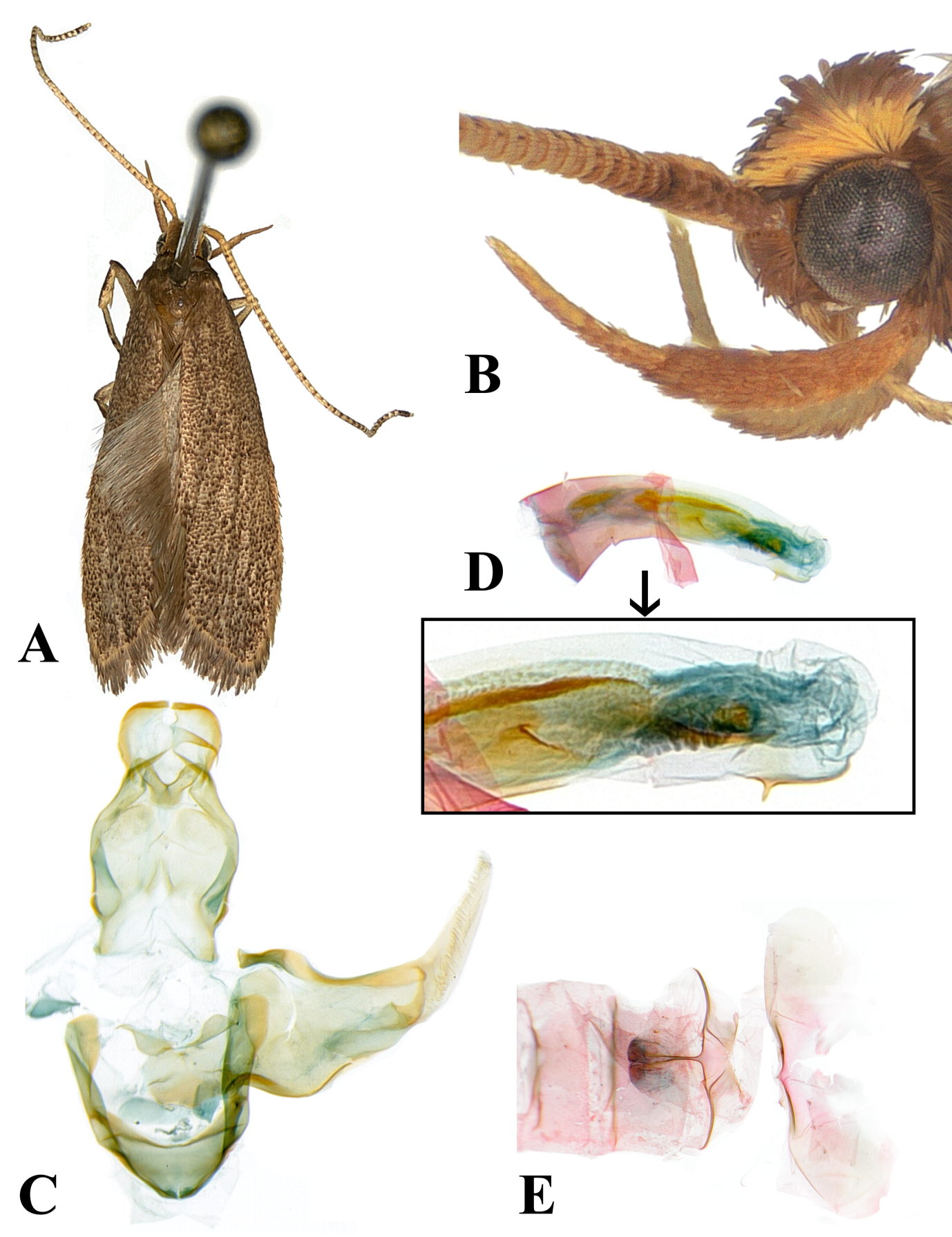
Description: Male (Figures 1A, B). Wingspan 13.0–14.0 mm. Head: Vertex bronzy yellowish brown, with reddish-orange erect scales laterally. Scape of Antenna as long as forewing; scape slightly dilated distally; flagellum pale orange with brownish annulations, darkened in apical 1/7. Second segment of labial palpus thickened, rather long, slightly arched, yellowish brown on outer surface; 3rd segment shorter than 2nd segment, yellowish brown with some blackish scales outwardly. Thorax: Tegula and notum yellowish brown. Forewing ground color brownish yellow, densely scattered with dark- brown scales throughout, slightly dilated distally; costa slightly arched beyond 2/3; discal stigma absent; apex slightly produced; termen oblique; fringe concolorous. Hind wing pale orange grey. Abdomen: Abdominal segment VII with a bundle of long hair- pencils (Figure 1E). Male genitalia (Figures 1C, D): Uncus basal lobes digitate, more or less slender with round apices, deeply concaved into V-shaped on caudal margin. Gnathos basal plate broad, fan-shaped, with rounded lateral margin. Costal bar nearly S-shaped, sclerotized, Valva broad basally; cucullus narrowed, tapered toward apex from base, shorter than basal part of valva; sacculus narrow, heavily sclerotized, strongly curved in S-shape. Juxta shield-shape, with well-developed halfmoon-shaped protrusions on caudal margin. Vinculum broadly developed, triangularly produced on anterior margin. Aedeagus broad at base, gradually narrowed, with a small, sclerotized process prior to apex ventrally; cornuti consisting of a narrow plate, about 2/5 the length of aedeagus, a small Y-shaped sclerite medially, and a short plate bearing numerous spines in apical 1/4. Female unknown. Distribution: Uganda (Kabarole Distr.). Etymology: The species name is derived from the Greek, -ptyon (= fan), referring to the fan-shaped basal plate of the gnathos in the male genitalia.
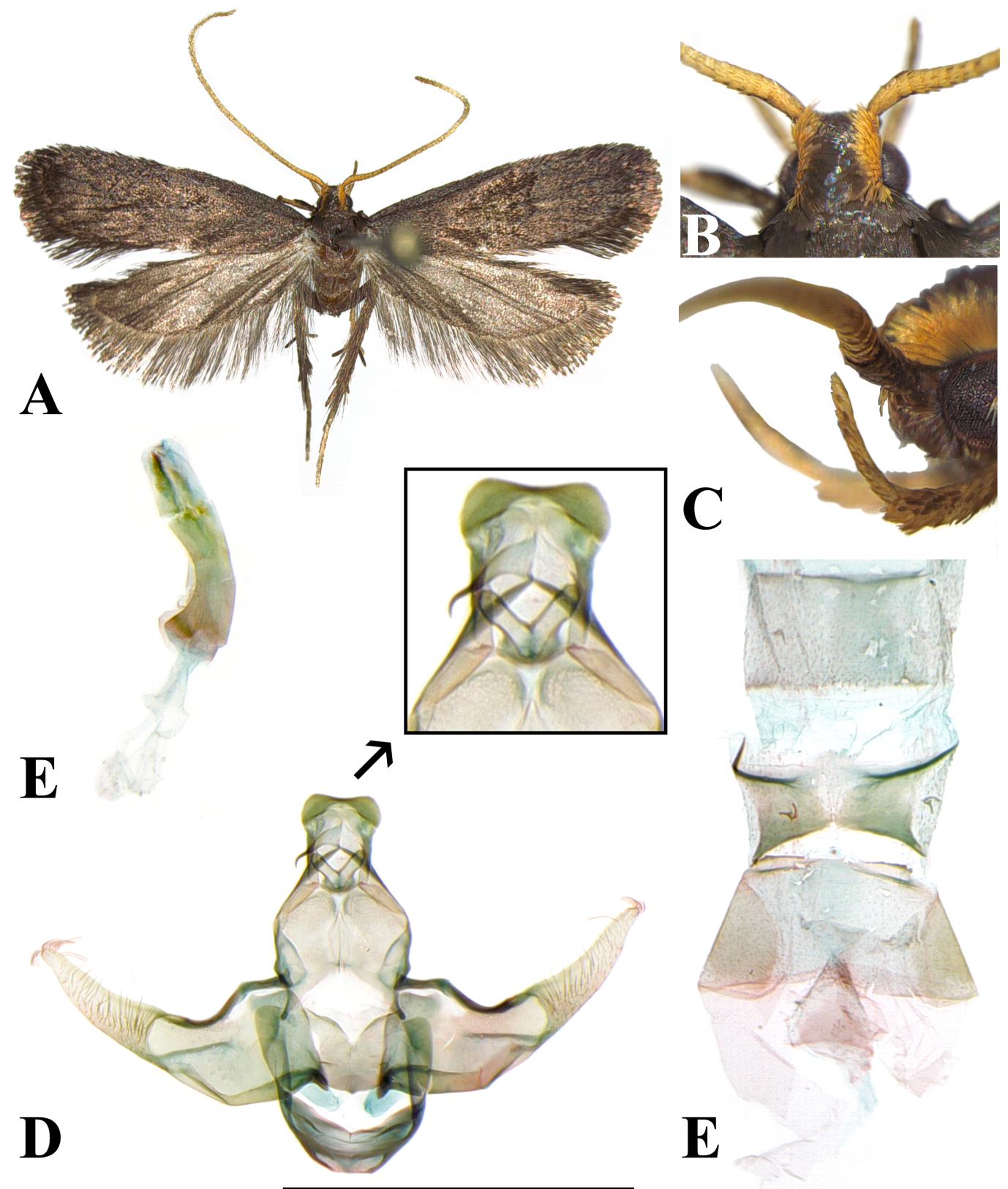
Lecithocera sarangalis Park, sp. nov. urn:lsid:zoobank.org:act:D8A62ABF-1CEA-4198-88B8- C02A6766F10F (Figure 2). Type specimen: Holotype: Male, Uganda, Kabarole Distr., Ruwenzori Mts., Nyakalengija (0˚20’994”N 30˚01’820”E) 1700 m, 10–11 xi 2007, leg. L. Aarvik & M. Fibiger, gen. slide no. CIS-7604, in NHMO. Diagnosis: This new species is similar to L. ptyona Park, sp. nov. in appearance, but the forewing is more darkened, antenna without distinct dark annulations, the 3rd segment of the labial palpus as long as 2nd segment (much shorter in L. ptyona), and the male genitalia differ as follows: gnathos basal plate parallel-sided in basal 2/3 laterally, broadened distally, and concaved on caudal margin (in L. ptyona, lateral margin convex and caudal margin nearly flat); cucullus not strongly upturned; juxta deeply incised into V-shape, half- moon-shaped protrusion on caudal margin poorly developed (in L. ptyona, half-moon-shaped protrusion on caudal margin well-developed). Description: Male (Figures 2A–C). Wingspan 14.0 mm. Head: Vertex bronzy dark brown, with reddish-orange erect scales laterally. Scape of antenna slightly dilated distally, reddish orange dorsally; flagellum pale orange throughout, lacking dark annulations. Second segment of labial palpus roughly thickened, slightly arched, yellowish brown, speckling with dark-brown scales on outer surface; 3rd segment strongly upturned as long as 2nd segment, pale yellowish brown with dark-brown scales outwardly. Thorax: Tegula and notum bronzy dark brown. Hind tibia with brownish rough scales dorsally. Forewing ground color mustard brown, densely scattered with dark-brown scales; costa slightly arched in basal 1/3; apex rounded; termen slightly convex. Hind wing greyish brown. Abdomen: Segment VII with heavily sclerotized anterior and posterior margin (Figure 2E); sternite VIII slightly concave on caudal margin. Male genitalia (Figures 2D, E): Uncus basal lobes long, digitate with round apices; caudal margin deeply concaved into V-shape. Gnathos basal plate broadened distally, nearly parallel-sided in basal 2/3, caudal margin concave medially. Costal bar heavily sclerotized, nearly flat in basal 1/3, thereafter oblique and deeply concave. Valva subquadrate basally; cucullus tapered toward apex, densely setose, nearly as long as the basal part of valva; sacculus broadened, upturned beyond middle, terminated at lower corner of cucullus. Juxta subquadrate; caudal margin deeply incised into V-shape, half-moon-shaped protrusions poorly developed. Vinculum broadly developed, saccal zone nearly straight on anterior margin. Aedeagus bent at basal 1/4, nearly parallel-sided, lacking cornutus. Female unknown. Distribution: Uganda (Kabarole Distr.). Etymology: The species name is derived from the Korean term, -sarang, meaning ‘love’.
Lecithocera pseudideologa Park, sp. nov. urn:lsid:zoobank.org:act: C1F72DCE-3155-42FB-B9A5-B6D 33B35CEB5 (Figure 3) Type specimen. Holotype: Male, Uganda, Mpigi, Mpanga Forest., 25–30 xi 2014, Leg. W. Mey, gen. slide no. CIS-7050, COI barcode CBNU-664 (Acc. no. PQ008658), in MfN.
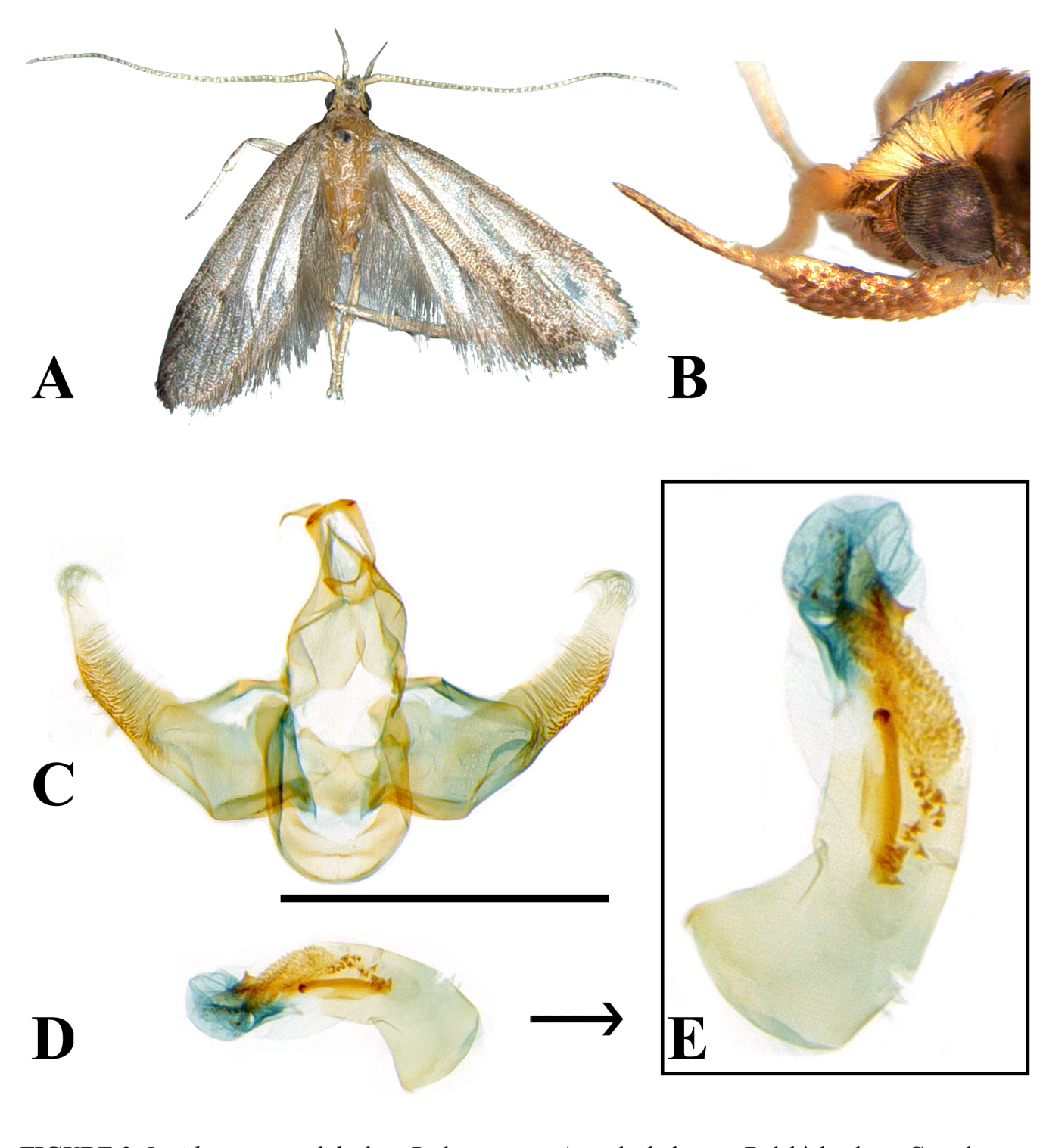
Diagnosis: The new species is similar to L. ideologa Meyrick [11], which was described from Cape, S. Africa, in the superficial and the male genital characters (See Park & De Prins, 2019, Figs. 5D, E), but it can be distinguished from the latter by the male genitalia: 1) cucullus more slender and more narrowly tapered in distal part which about 2/5 the length of cucullus, (in L. ideologa, distal part about the 1/3 length of cucullus); 2) aedeagus with distinct small triangular spine on dorsal margin preapically (absent in L. ideologa); cornuti consisting of a narrow, long bar, two patches of numerous minute spinules, and a series of conical spines (in L. ideologa, more or less elongate-triangular plate at middle, instead of a long bar). Description: Male (Figures 3A, B). Wingspan 13.0 mm. Head: Vertex brownish orange, with pale orange erect scales laterally. Antenna as long as forewing; scape slightly dilated distally, orange white; flagellum orange white throughout with brownish annulations. Second segment of labial palpus thickened, rather stout, slightly arched, densely covered with brownish scales on outer surface; 3rd segment shorter than 2nd segment, yellowish brown with some blackish scales ventrally. Thorax: Tegula with blackish scales anteriorly; notum brownish orange. Forewing ground color brownish orange, uniformly scattered with dark-brown scales, slightly dilated distally; costa slightly arched beyond 2/3; discal stigmata poorly developed; apex somewhat rounded; termen oblique; fringe concolorous. Hind wing greyish white. Male genitalia (Figures 3C–E): Uncus basal lobes rather short, deeply emarginated in V-shape on caudal margin. Gnathos basal plate more or less rectangular, not sharply angles at upper corner. Costal bar slightly angled at middle. Valva broad basally; cucullus narrowed, narrowly tapered in distal 2/5 the length of cucullus, with round apex bearing brush-like setae; apex rounded; sacculus heavily sclerotized, reaching about half of ventral margin of basal part of valva. Juxta with halfmoon-shaped protrusions on caudal margin; produced on anterior margin medially. Vinculum broadly developed. Aedeagus broad at base, gradually narrowed, with a small spine-like process prior to apex dorsally; cornuti consisting of a narrow, long bar, two patches of numerous minute spinules, and a series of conical spines. Female unknown. Distribution: Uganda (Kabarole Distr.).
Discussion
The male genitalia of Lecithocera ideologa Meyrick, 1937, which was described from Eastern Cape, S. Africa, were illustrated by Janse (1954, pl. 141, Fig. 2- line drawing; Pl. 151, Fig. 4) [12], and by Park & De Prins [13], based on a male specimen collected from S. Africa. In the comparison of the male genitalia of this new species with those of L. ideologa, we could identify this species as a new species.
Conflicts of Interest
The authors declare that there are no conflicts of interest.
Acknowledgements
We are indebted to L. Aarvik, Natural History Museum, University of Oslo, Norway, and W. Mey, Museum für Naturkunde, Humbolt Univ. (MNHB), Berlin, Germany, who provided material collected from Uganda. This research was supported (for KTP) by the Basic Science Research Program, through the National Research Foundation of Korea (NRF), funding (2018R1D1A1B07042503) by the Ministry of Education.
References
-
Herrich-Schäffer GAW (1853) Systematische Bearbeitung der Shmetterlinge von Europa, zugleich als Text, Revision und Supplement zu Jakob Häübner’s Sammlung europäischer Schemetterlinge. GJ Manz, Regensberg, 4: 394.
-
Park KT, De Prins J, De Prins W (2021) A checklist of Lecithoceridae (Lepidoptera: Gelechioidea) of the Afrotropical Region. Journal of Asia-Pacific Biodiversity 14(3): 355-370.
-
Park KT, Koo JM, Jeong SY, De Prins W, De Prins J (2023c) Review of the genus Lecithocera Herrich-Schäffer (Lepidoptera, Lecithoceridae) in DR Congo, with description of four new species. Zootaxa 5339(4): 355- 368.
-
Park KT, Heppner JB (2023) Four new species of Lecithocera from Malawi (Lepidoptera, Lecithoceridae). Lepidoptera Novae 16(1): 67-76.
-
Park KT, Aarvik L, Agassiz DJL (2023) Lecithocera murphy-complex in Africa, with two new species from Zimbabwe (Lepidoptera: Lecithoceridae). Lepidoptera Novae 16(2): 81-86.
-
Park KT, Koo JM, De Prins W (2023) Six new species of the family Lecithoceridae (Lepidoptera) from Ghana. International Journal of Zoology and Animal Biology 6(1): 000438.
-
Meyrick E (1923) Exotic Microlepidoptera. Printed by Taylor and Francis, London. UK, pp: 36-48.
-
Meyrick E (1931) Exotic Microlepidoptera. Printed by Taylor and Francis, London. UK, pp: 73-82.
-
Clarke JFG (1965) Catalogue of the type specimens of Microlepidoptera in the British Museum (Natural History) described by Edward Meyrick. British Museum (Natural History), London, Uk, 2: 255.
-
Kornerup A, Wanscher JH (1978) Methuen Handbook of Colour. In: 3rd (Edn.), Eyer Methuen, London, UK, pp: 252.
-
Meyrick E (1937) Exotic Microlepidoptera. Printed by Taylor and Francis, London, UK, pp: 95-96.
-
Janse AJT (1954,1963) Gelechiidae. In: Janse AJT (Ed.), The moths of South Africa 5(4): 332-384.
-
Park KT, De Prins W (2019) A review of the Lecithoceridae (Lepidoptera: Gelechioidea) of southern Africa, based on type specimens deposited in the Ditsong National Museum of Natural History (TMSA), with descriptions of three new species. Zootaxa 4623: 61-89.
- Mitochondrial Bio-Logistics: Steering Co-Enzyme Q10 and Lycopene Synergies within the Science 4.0 Bio-OS Framework
- Hymenoptera Specimens from the Caño Negro Wetland, of the National Museum Collection, Costa Rica
- Science 4.0: Comprehensive Architecture of the Biological Operating System (Bio-OS) A Framework for Systemic Resilience and Industrialized Bio-Governance
- Rabbit on, or Hare Back? Understanding Climate Change
- Clinical Validation of Science 4.0: Flow Steering and Epigenetic Drift Inversion on a 76-Year-Old Hybrid System
- Seeds Planted by another Mind