
A New Lace Sheet Weaver Spider, Psechrus taclobo N. Sp. (Araneae: Psechridae) from Mt. Guiting-Guiting, Romblon Island, Philippines
Psechrus taclobo n. sp. from Mt. Guiting-guiting, Romblon Island, Philippines is described and photographed. It is the third species of lace sheet weaver spider belonging to the family Psechridae reported from the Philippines. Only Psechrus cebu Murphy,1986 collected in Camp 7, White Cave, Cebu City, Cebu Province in 1983-84 and Psechrus schwendingeri Bayer, 2012 from Mt. Data, Mt.Province collected between 1883-1894 and from Banaue, Mt. Province in 1984 had been recorded in the Philippines. Only a key to the females of Philippines Psechrus is provided as no male of the new species is available.
Mini Review
The lace sheet weaver spiders belong to the family Psechridae. It is represented by only two genera, namely, Fecennia Simon 1887 and Psechrus Thorell 1878 (Platnick, 2011). As a whole, it is systematically poorly known prior to 1981 except for the works of Dalmas (1917), Petrunkevitch (1923,1928), Bristowe (1938), Homann (1950), Lehtinen (1967), and Forster and Wilton (1973) as cited by Bayer (2012). Levi (1982) provided a comprehensive worldwide revision of the family. Additional taxonomic information were added by several workers after the revision [1, 2, 3]. To date, Bayer [1] provided the most comprehensive taxonomic treatment of the genus Psechrus where 46 nominal species and eight species groups are recognized.
In the Philippines, the first recorded lace sheet weaver spider is a subadult male and it was collected by Otto Koch between 1883-1884 in Mt. Data, Mt. Province. Karsch identified this specimen as Lancaria sp. but is now known as Psechrus schwendingeri Bayer. The second species Psechrus cebu Murphy,1986 is based on three females collected by G. Alberti from the cave entrance in Cebu City, Cebu Province in March 1983 and a male and a female collected by Fr. Schoenig and Mr. Tumilap and company on January 17, 1984 from the White cave in Camp 7, Cebu City, Cebu Province.
Recently, in the process of understanding the spider biodiversity of Mt. Guiting-guiting, Sibuyan Island, Romblon Province some lace sheet weaver spiders were collected. Upon examination, the specimens cannot be identified using the key developed by Murphy [3] and Bayer [1]. Herewith, we provided the description and photographs of the new species of Psechrus in order to make the name available to science and update information on biological diversity of spiders particularly from the Philippines.
The following abbreviations are used: AbL-abdominal ength; AbW-abdominal width; AME-anterior median eyes; ALE-anterior lateral eyes; CL-carapace length; CW-carapace width; MOQ-median ocular quadrangle; PME-posterior median eyes; PLE-posterior lateral eyes; RTA-retrolateral tibial apohysis; UPLBMNH-University of the Philippines at Los Banos Museum of Natural History, Los Banos, Laguna. All measurements are in mm.
Taxonomy
Family Psechridae Simon,1890 Psechrus Thorell, 1878 [Type species: Tegenaria argentata Doleschall,1857]
Diagnostic Characters
Venter of abdomen has a median longitudinal white line; AME almost equal in size with other eyes; cephalic region of carapace high; clypeus height 2-3.5x diameter of anterior median eyes (AME); length of leg IV almost as long as leg II; male without RTA and median apophysis in pedipalp; females have a simple epigyne, with a median septum and vulva with rounded spermathecal heads.
Description of Species
Psechrus taclobo Barrion, Llavor & Barrion-Dupo new species (Figures 1-3) Holotype female: Total length 18.60. Carapace length 7.10, Carapace width 5.00. Abdomen length 11.50, Abdomen width 4.00. Eye sizes and interdistances: AME=ALE 0.37, PME=PLE
0.46; AME-AME 0.26, AME-ALE 0.09, PME-PME 0.31, PME- PLE 0.29, ALE-PLE 0.0.60. Clypeus height at AME 0.91, at ALE 0.80. MOQ wider behind than in front (1.14:0.94), length 1.13x longer than posterior width , 1.37x longer than anterior width. Leg measurements: I 54.30 (15.70 + 3.00+ 15.50+ 14.10+6.00); II 41.20 (12.10+2.70+11.00+10.50+4.90); III 28.60 (8.60+1.90+7.10+7.50+3.50); IV 38.35 (12.55+2.35+11.10+12.30+5.00). Leg formula 1243. Pedipalp 8.60 (2.89+1.20+1.54+2.97), as long as femur III. Dorsal spine of pedipalp’s patella long, 1.85x longer than patella and 1.32x longer than tibia. Coloration: Carapace brownish yellow with broad longitudinal yellow submarginal bands. Cephalic area marked with a short spade-like yellow brown band. Eye margins brown to dark brown. Clypeus brown, with a white median triangular band. Chelicerae brownish yellow, with a longitudinal reddish brown submedian and lateral bands. Basolateral area of clypeus enclosed by two moderately concave bands and light yellow. Cheliceral teeth black with two promarginal and four retromarginal teeth. Three intercheliceral teeth all brown. Maxillae and labium dark brown both covered with black hairs, hairs on maxillae thicker and longer than those in labium. Sternum yellow and heart-shaped, with a gray V-band in the middle and entire sternum covered with long brownish yellow hairs. Legs brown with alternating yellow and pale gray rings in all femora. Anterior end of femora I and II with a solid black band. Tibia I and II marked with alternating black and yellow rings becoming darker towards distal ends. Tibia III and IV with paler alternating rings but darker distally. Metatarsi and tarsi I to IV yellow.
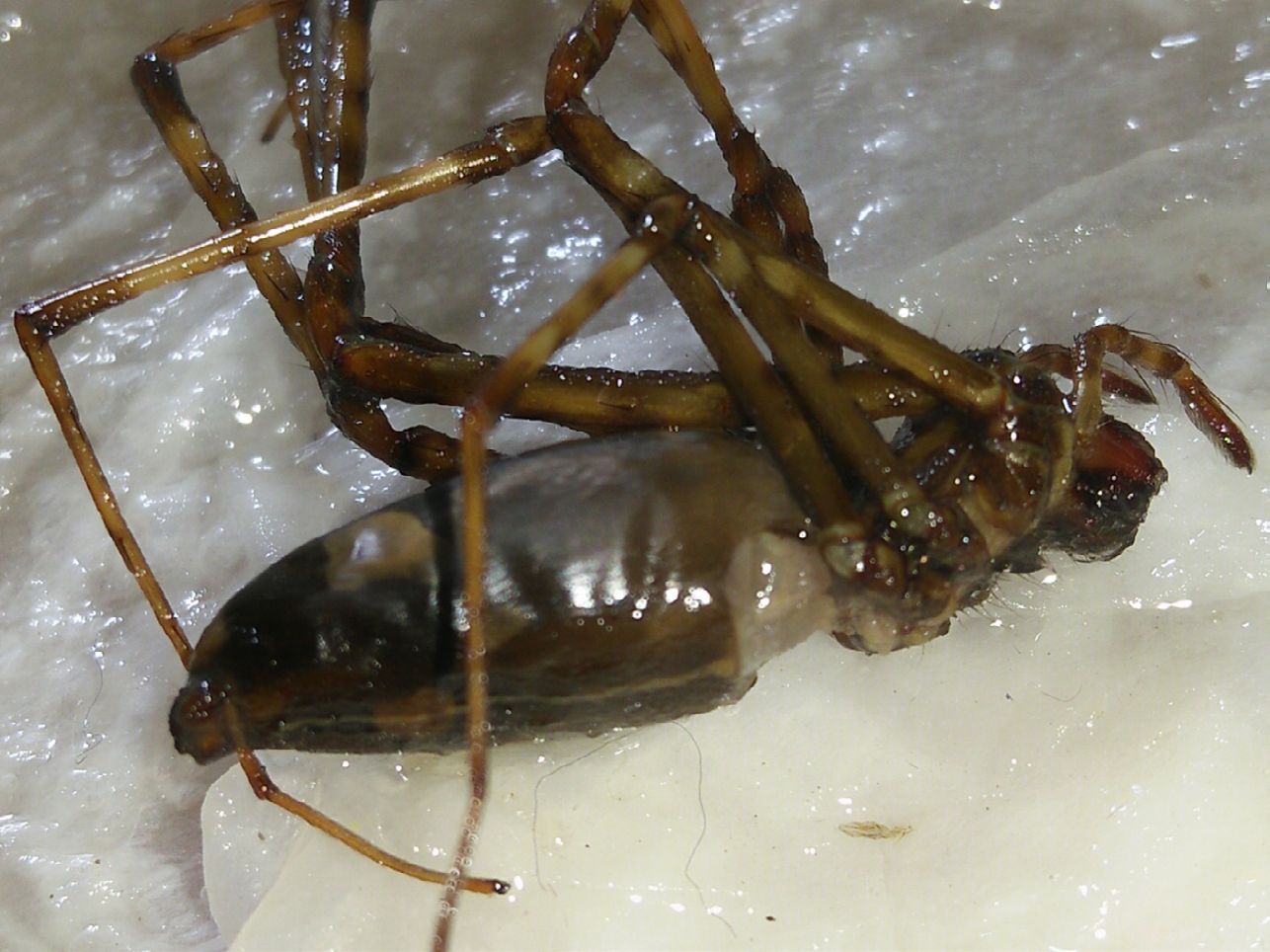
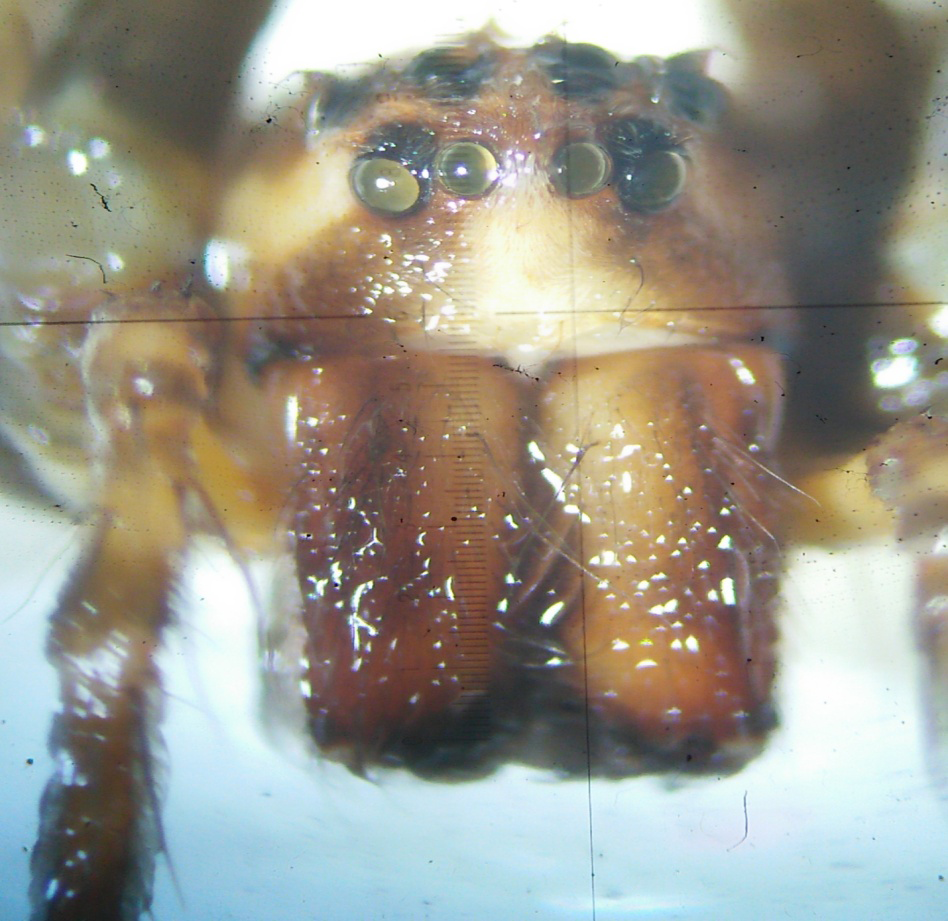
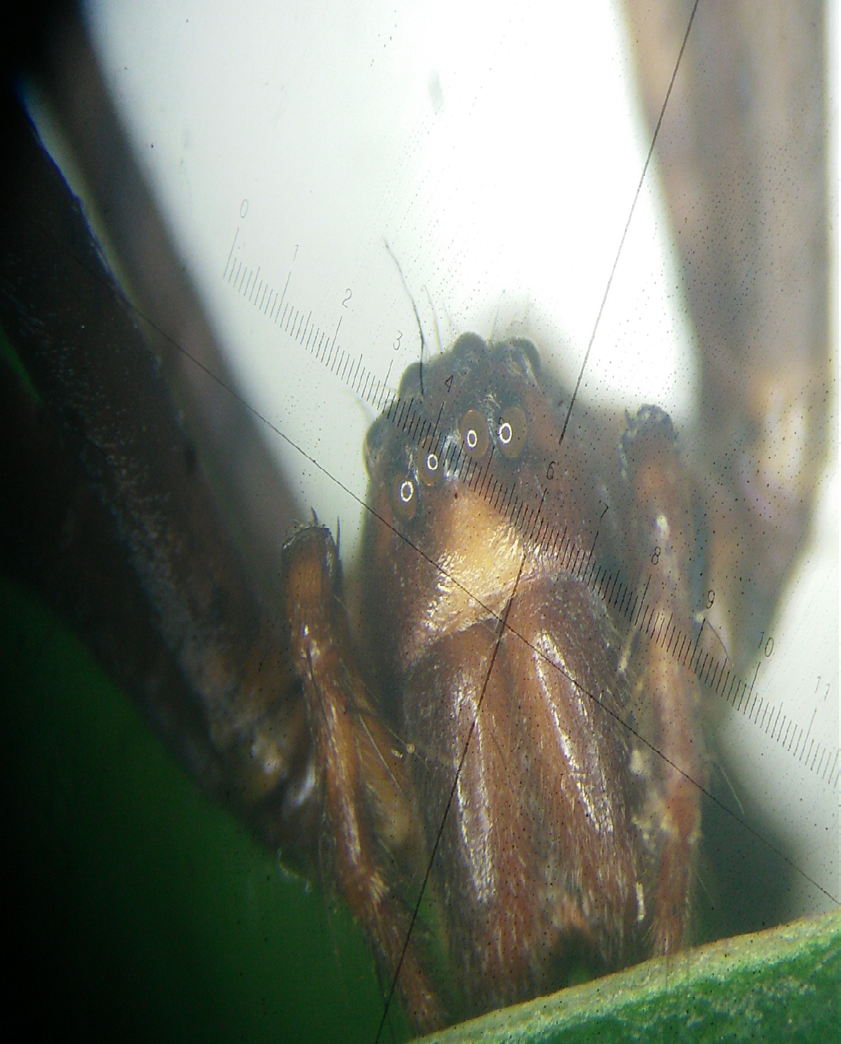
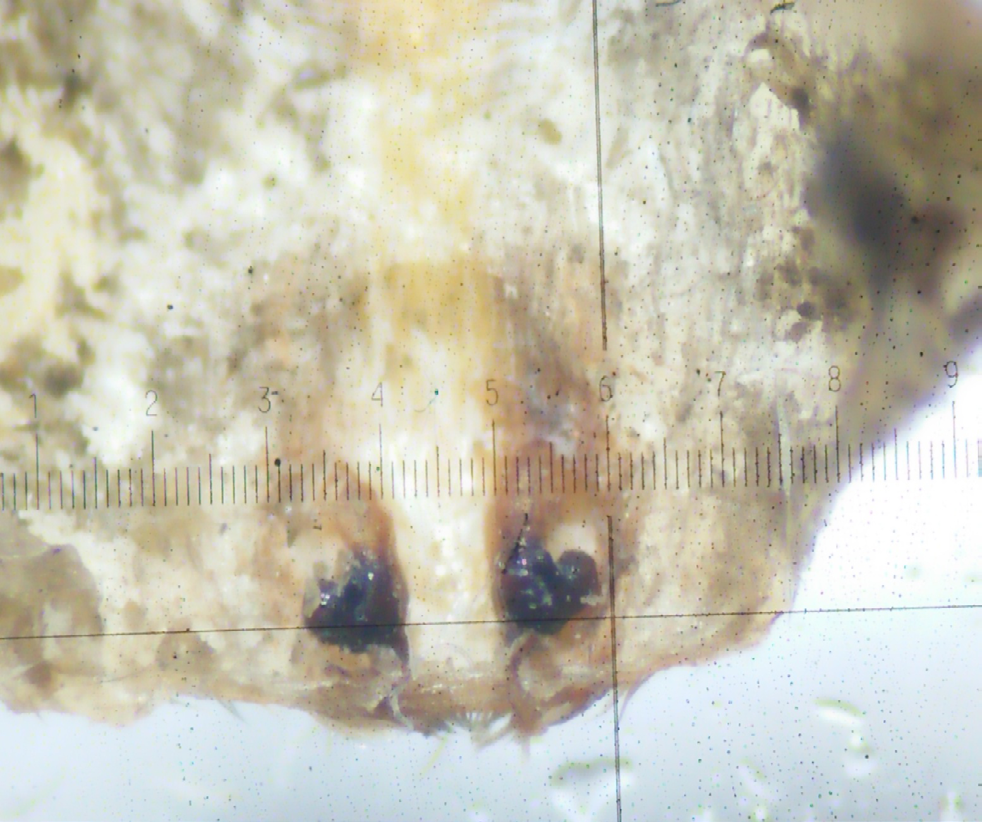
Abdomen: Elongate, 2.66x longer than wide, dorsally yellowish brown mottled with wavy longitudinal grayish brown lines. Two small brown and rounded sigilla at anterior one-fourth of abdominal dorsum present. Submedian area with four grayish black spots and a cup-shaped band below abdominal midlength, and six transverse yellow lines visible at posterior one-third but marked anteriorly with a grayish brown interrupted bands. Lateral sides of abdomen mottled with dark brown spots becoming larger towards the middle and posterior end. Midanterolateral two-thirds of abdomen with a thin wavy whitish yellow lines. Venter of abdomen uniformly brownish yellow, except distinct yellow median longitudinal line and a wavy thin line along the laterals. Length of cribellum about one-third greatest width of abdomen. Spinnerets with robust brown anterior pair, and a much thinner and brown posterior pair.
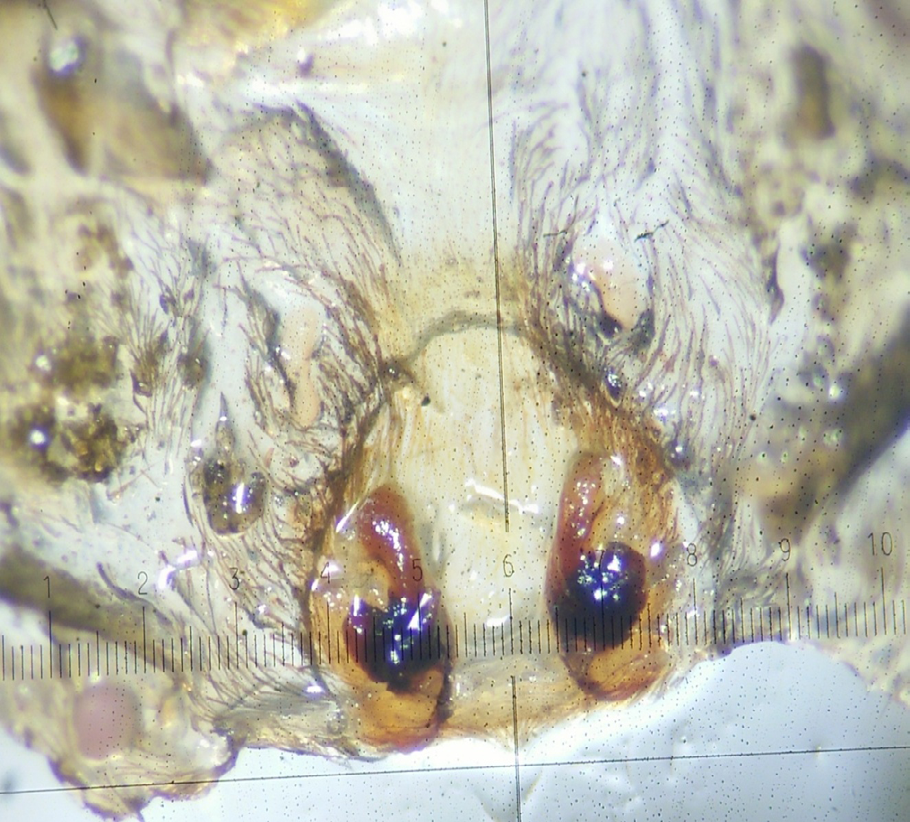
Epigynum: Median septum knoblike, constricted at about midlength. Lateral epigynal margin bean-shaped. Epigynal muscle sigilla elongate, 3x longer than wide (0.26:0.086 mm). Spermathecal head and spermathecal base separated by cleft as the spermathecal head arises at the base of spermathecal bulb and diverging. Copulatory duct medium-sized, short and narrow anteriorly forming two hook-like processes. Paratype female: Total length 22.30. CL 8.00, CW 4.40. AbL 14.30, AbW 4.20. Eye sizes and interdistances: AME 0.46; ALE=PME = PLE 0.49; AME-AME 0.23, AME-ALE 0.07, PME- PME 0.23, PME-PLE 0.24, ALE-PLE 0.43. Clypeus height at AME 1.00 and 0.91 at ALE. MOQ wider behind than in front (0.97: 1.20), length 1.38x longer than anterior width and 1.12x longer than posterior width. Leg measurements: I 54.40 (16.80 + 3.40 + 16.40 + 16.30 + 6.50), II 44.70 (12.90 + 2.90 + 11.90 + 12.00 + 5.00), III 31.20 (9.50 + 2.20 + 7.70 + 8.00 + 3.80), IV 46.20 (13.30 + 2.70 + 11. 50 + 12.90 +5.80). Pedipalp 9.50 (3.20 + 1.30 + 1.90 + 3.10). Coloration: Very much similar to the holotype female except for the paler legs and darker chelicerae. Carapace also dark brown with a narrow brown longitudinal submedian band merging towards the thoracic area. Cephalic area with a short nail-like yellow band. Midclypeal triangular band dark yellow and relatively narrow. Sternum with a V- to Y-shaped brown band covered with brown hairs. Basal part of ventral coxae II to IV yellow white, and coxa I mostly yellow except with a brown spot in the middle covered by brown hairs. Basal half of the pedipalp’s femur yellow.Midlongitudinal white band in the abdominal venter not reaching the cribellum. Material examined: Philippines, Romblon Province, Sibuyan Island, Mt. Guiting-guiting, Layag, Taclobo San Fernando, holotype female (Coll. No.RL038), MLlavor, 26 January, 2015 and two paratype females: one female, same data as holotype (Coll. No. RL039) and one female, Mt. Guiting-guiting, Layag, paratype female (RL2021), MLlavor, 11 January 2021. Etymology: Named after the type locality. Remarks: Closely resembles P. cebu, however, the new species P. taclobo has a differently shaped median septum as its ratio (h:w) height is 1.45x and smaller in P. cebu 1.20- 1.26x.The spermathecal heads in P. taclobo are diverging while it is converging in P. cebu. Type depository. The holotype and paratype specimens are deposited in the arachnological collections of the UPLBMNH, Los Banos, Laguna. Key to the females of Philippine Psechrus Thorell, 1878 1" Spermathecal heads relatively small and converging; ratio of length and width of median septum 1.20-1.26; carapace length:width 1.5; abdominal length 10.8mm......P. cebu Murphy 1" Spermathecal heads large and diverging; ratio of length and width of median septum 1.45; carapace length:width 1.81; abdominal length 14.30mm.........Psechrus taclobo Barrion, Llavor and Barrion-Dupo
References
-
Bayer S (2012) The lace-sheet weavers – a long story (Araneae:Psechridae). Zootaxa 3379: 1-170.
-
Lehtinen PT (1967) Classification of the cribellatespiders and some allied families with notes on the evolution of the suborder Araneomorpha. Ann. Zool. Fennici 4: 199- 468.
-
Murphy J (1986) Additional information concerning the spider family Psechridae. Bulletin British Arachnological Society 7(2): 65-68.
- Mitochondrial Bio-Logistics: Steering Co-Enzyme Q10 and Lycopene Synergies within the Science 4.0 Bio-OS Framework
- Hymenoptera Specimens from the Caño Negro Wetland, of the National Museum Collection, Costa Rica
- Science 4.0: Comprehensive Architecture of the Biological Operating System (Bio-OS) A Framework for Systemic Resilience and Industrialized Bio-Governance
- Rabbit on, or Hare Back? Understanding Climate Change
- Clinical Validation of Science 4.0: Flow Steering and Epigenetic Drift Inversion on a 76-Year-Old Hybrid System
- Seeds Planted by another Mind