
Objective Regressive Regression Methodology as a Function of Dengue Cases in the Pediatric Age Group in Villa Clara, Cuba
The possibility of having a methodology that allows modeling and prediction in the short, medium and long term of biological, social and natural disaster processes and/or phenomena, as well as a large number of infectious entities, is something great.
Abbreviations
ROR: Objective Regressive Regression; NoC: Number of Base Cases.
Opinion
The possibility of having a methodology that allows modeling and prediction in the short, medium and long term of biological, social and natural disaster processes and/or phenomena, as well as a large number of infectious entities, is something great. The objective of the research consisted of demonstrating the potential and real capacity of application of the methodology of the Objective Regressive Regression (ORR) in terms of cases of Dengue fever in pediatric age (children under 18 years of age) in the province of Villa Clara, Cuba. In order to carry out the research, a database of confirmed cases of the infectious entity Dengue was used, covering the years 2016 to 2021. The methodology (ROR) was used for the analysis and processing of all the data contained in the database.
The increase in diseases transmitted by vector-borne organisms increasingly commits the scientific community to prioritise the search for much more efficient, economic, feasible and sustainable control alternatives over time, where the use of mathematical modelling, which has been Opinion applied in different fields and areas of science, stands out in recent decades.
The methodology of the Objective Regressive Regression ROR, in a first step, dichotomous variables DS, DI and NoC are created, where:
NoC: Number of base cases, DS = 1, if NoC is odd; DI = 0, if NoC is even, when DI=1, DS=0 and vice versa.
Subsequently, the module corresponding to the Regression analysis of the statistical package SPSS version 19.0 (IBM Company) is executed, specifically the ENTER method where the predicted variable and the ERROR are obtained. Then the autocorrelograms of the variable ERROR will be obtained, paying attention to the maximums of the significant partial autocorrelations PACF. The new variables are then calculated according to the significant Lag of the PACF. Finally, these regressed variables are included in the new regression in a process of successive approximations until white noise is obtained in the regression errors.
Figures 1 & 2 show the plotting of confirmed cases, with the highest number of cases occurring in the months of July to November, and the mean number of cases studied was close to 28 cases.
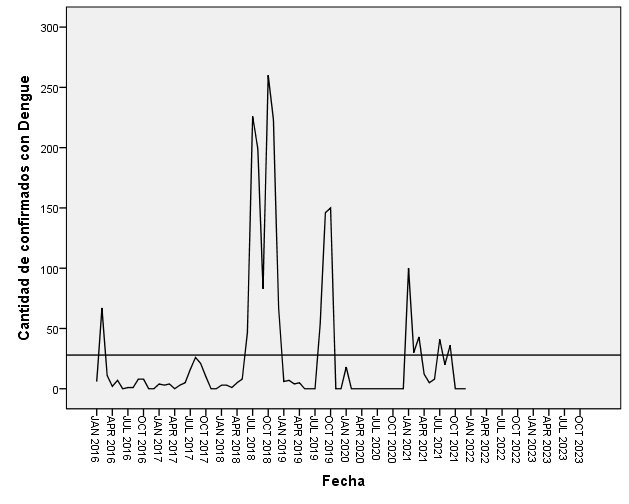
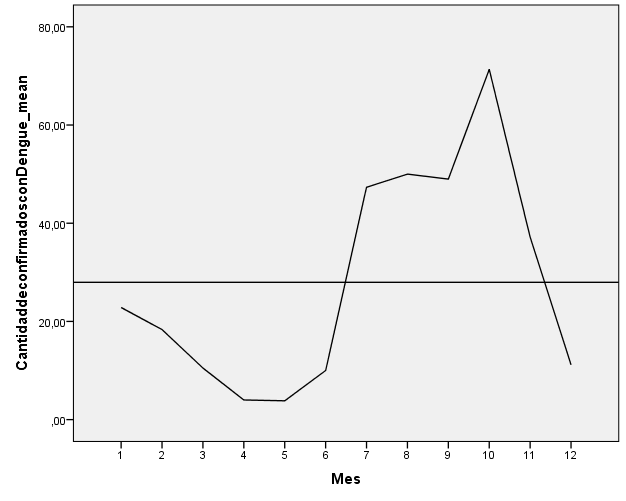
The highest value occurred in October 2018, with 260 cases, while the standard deviation was large (57.6 cases) (Table 1).
| Descriptives statistics | |||||
|---|---|---|---|---|---|
| N | Minimum | Maximum | Media | Standard deviation | |
| Number of confirmed cases of Dengue | 72 | 0 | 260 | 27.96 | 57.573 |
| N valid (by list) | 72 |
Table 1: Behaviour of descriptive statistics for confirmed cases of Dengue.
In the case of the short-term model, 98.7% of the variability was explained, with an error of only 13.4 cases. Fisher’s F was found to be significant at 100%, with a value of 97.36. The model in question in the short term depends on the regressed cases in 1, 2, 7 and 14 months, which indicates a strong dependence on the previous month, so that the cases in one month in prevention have a very decisive and impacting repercussion on the following month, it also depends on 2, 7 and 14 months ago, which corresponds to the cycle of approximately six months, which divides the warm and less warm period, and the annual cycle, where the Step variables, are cases that have an important impact on the series by greatly increasing the number of cases; some variables are not significant but contribute variance to the model and for this reason are left in the model. The trend (NoC) was small and negative but not significant.
A long-term forecast was made that explains 99.5% of the variance, with an error of 9.9 cases, which is a tool to get an idea of how Dengue cases will behave one year in advance, and thus be able to take measures that will lead to a lower number of cases. In this case Fisher’s F was 143, higher than in the short-term model, but still significant at 100%. This long-term model depended on the regressed cases over 12 months, where the trend was positive and significant.
Figures 3 & 4 show the good performance of the actual value and its forecast, as well as the small errors.
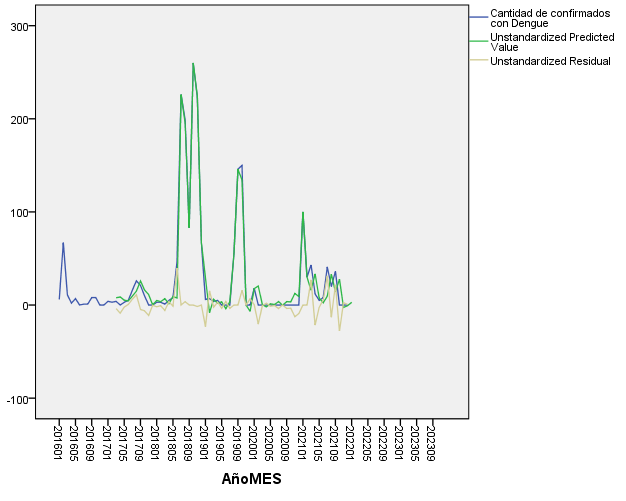
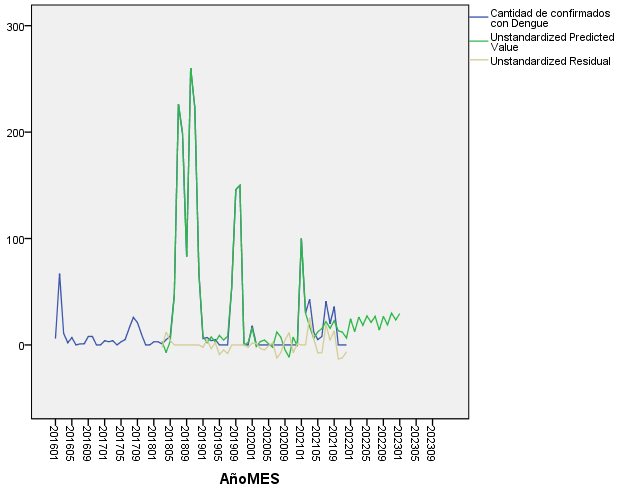
It is concluded that Dengue cases can also be modeled in the pediatric age group, by means of the ROR methodology, observing a trend in the short term towards a non-significant decrease, while in the long term this trend was towards a significant increase, with a dependence of the cases of 1, 2, 7 and 14 months ago, where the best model was obtained in the long term, so that the behavior of this infectious entity can be predicted one year in advance by means of this methodology. Evidently, this is a study that could be extended over a longer period of years to analyze the impact of the solar cycle, which is approximately 11 years.
- Mitochondrial Bio-Logistics: Steering Co-Enzyme Q10 and Lycopene Synergies within the Science 4.0 Bio-OS Framework
- Hymenoptera Specimens from the Caño Negro Wetland, of the National Museum Collection, Costa Rica
- Science 4.0: Comprehensive Architecture of the Biological Operating System (Bio-OS) A Framework for Systemic Resilience and Industrialized Bio-Governance
- Rabbit on, or Hare Back? Understanding Climate Change
- Clinical Validation of Science 4.0: Flow Steering and Epigenetic Drift Inversion on a 76-Year-Old Hybrid System
- Seeds Planted by another Mind