
Modeling of Monthly Solar Radiation by Climatic Variables and its Impacts on Human and Animal Health
In this work the radiation corresponding to the monthly values of the year 2000 is modeled and the historical data for all the other years of the database of the city of Santa Clara, capital of Villa Clara province, Cuba is estimated using the Objective Regressive Regression (ORR). A model that explains 100 % of the explained variance was obtained, which represents an important tool to provide climatic services of radiation without having an actinometric station. The variables that entered into the equation were the monthly minimum temperature of the Yabu station and the monthly precipitation of the Yabu, Sagua and Caibarién meteorological stations. As the minimum temperature increases by 1°C the radiation decreases by 4.8 Watt/m2. With respect to rainfall, there are different impacts, some positive, such as Yabu and Caibarien, and others negative, such as in Sagua la Grande. A rainfall of 100 mm in Sagua can cause a decrease in radiation in Santa Clara of 89 Watt/m2. It is recommended to extend this model to neighboring stations changing only the minimum temperature of these stations in order to have the radiation data of these stations.
Opinion
With the weakening of the ozone layer, the levels of radiation received directly by the earth’s surface have increased enormously; this radiation, coming from the sun, is highly energetic, which produces several affectations to the life that currently exists on earth, especially to human beings. This type of radiation can modify the genetic information of organisms (DNA) and produce different diseases mainly in their skin. Skin cancer is one of the most severe ailments Opinion affecting human health, and it is currently one of the main problems facing human beings due to the increase in the number of people suffering from this malignant condition.
The Sun (from the Latin sol, solis) is a star of spectral type G2 at the center of the Solar System and is the major source of electromagnetic radiation in this planetary system.
The Sun is at an average temperature of 6000 K in whose interior a series of nuclear fusion reactions take place, which produce a loss of mass that is transformed into energy. This energy released from the Sun is transmitted to the exterior through solar radiation. The Sun behaves practically as a (black body) which emits energy following the law of (Plank) at the aforementioned temperature.
Where: I(ϑ,T): spectral radiance (J m-2 sr-1), ϑ: Frequency (Hz), T: Temperature (K), h: Planck’s constant (Js) [ h=6.62606896 ×〖10 〗^(-34) Js], c: Vacuum speed of light (m/s) [c=299’792’458 m/s].
The application of Planck’s Law to the Sun with a surface temperature of about 6000 K leads us to the conclusion that 99% of the emitted radiation is between 0.15 µm (micrometer) and 4 µm wavelengths. The Sun emits in a spectral range from 150 nm (nanometer) to 4000 nm. Visible light extends from 380 nm to 830 nm.
Solar radiation is distributed from infrared to ultraviolet. Not all radiation reaches the Earth’s surface, because the shorter ultraviolet waves are absorbed by atmospheric gases, mainly ozone. The quantity that measures the solar radiation that reaches the Earth is the irradiance, which measures the energy (per unit of time and area) that reaches the Earth. Its unit is the W/m² (watt per square meter).
Max Karl Ernest Ludwig Planck (Kiel, Germany, April 23, 1858 - Göttingen, Germany, October 4, 1947) was a German physicist considered the founder of quantum theory and awarded the Nobel Prize in Physics in 1918.
Irradiance is the quantity used to describe the incident power per unit area of all types of electromagnetic radiation. I=P_i/A_i Where: I: Irradiance. P_i: Incident power. A_i: It is the area of the surface on which the wave is incident.
Irradiance allows us to define the solar constant, the amount of solar energy reaching the Earth’s upper atmosphere per unit area and time, whose value is (1367 W/ m²). The irradiance received directly on the Earth’s surface ranges from a maximum of 275 W/m² in the cloud-clear regions of the Sahara and Arabia to a minimum of 75 W/m² in the misty islands of the Arctic. The global average is 170 W/m².
Of the total radiation received at the earth’s surface, ultraviolet radiation or UV radiation, whose wavelength is approximately between 400nm (4x10⁻⁷ m) and 15nm (1.5x10⁻⁸ m), because it carries a lot of energy, interferes with molecular bonds. Especially those of less than 300nm can alter DNA molecules, which are very important for life, and the interaction of this type of radiation with DNA is associated with skin cancer.
Skin cancer encompasses a group of neoplastic diseases that have very different diagnosis, treatment and prognosis. The only thing they have in common is the same anatomical location: the skin.
Basal Cell Cancer and Squamous Cell Cancer
Basal cell and squamous cell cancers are by far the most common skin cancers. Both cancers are found primarily on sun-exposed parts of the body, such as the head and neck. These cancers are strongly related to the amount of sun exposure a person has had.
Basal and squamous cell cancers are much less likely to spread to other parts of the body and pose a threat to life compared to melanomas. Still, it is important to find and treat them early. If left untreated, they can grow further and invade nearby tissues and organs, causing scarring, deformity, or even loss of function of some parts of the body. Some of these cancers (especially squamous cell cancers) can spread if left untreated, and in some cases can even cause death.
For physicians, it is important to separate the types of skin cancer, as they are treated in different ways. It is also important to know what skin cancers look like. This may help to find them at the earliest possible stage, when they are most easily cured.
In this work we model the radiation corresponding to the monthly values for the year 2000 and estimate the historical data for all other years from the database of the city of Santa Clara using Objective Regressive Regression (ORR).
For the realization of this work we had a monthly database from 1977 to 2017 of the following variables: Maximum Temperature, Minimum Temperature and Precipitation, the daily data corresponding to the four meteorological stations of Villa Clara were used:
Yabú: Latitude: 22º 26’ N, Longitude: 79º 59’ W.
Sagua: Latitude: 22º13’ N, Longitude: 80º02’ W. Caibarién: Latitude: 22º 29’40’’ N, Longitude: 79º28’30’’ W. INIVIT: Latitude: 22º58, Longitude: 80º22.
Objective Regressive Regression (ORR) was used for the modeling. First, the monthly data of solar radiation for the year 2000 were taken, which were measured for the city of Santa Clara by an automatic station and then the climatic
- data of the different climatic variables mentioned above were taken, the data of the year 2000 were assigned to the year
- 1977 and the radiation data of all the years were estimated.
- The analysis of variance cannot determine Fisher’s
- F (Table 1), since it presents a division by zero, so we recommend to see 17-18 where this subject is discussed.
- With this procedure, an error-free series is obtained.
- ANOVAc,d
- Model
- Sum of squares gl
- Quadratic mean
- F
- Sig.
- Regression
- 365259.48
- 6
- 60876.58
- .
- .a
- Residual
- 0
- 0
- .
- 1
- Total
- 365259.480b
- 6
Table 1: Analysis of variance of radiation model for Santa Clara.
In Table 2 it can be seen that the standard errors are zero so that the values of Student’s T cannot be appreciated, as we know:
t 1 =B 1 /Sb 1, so to calculate t of each coefficient it would be necessary to develop the calculation of divisions by zero for this it is suggested to use the form of calculation according to 18 where some principles of how to operate with the division by zero are defined in order to calculate Coefficientsa,b the statistics of influence of each variable. We think that this way of modeling can be used in artificial intelligence for learning processes of machine computers. As the minimum temperature increases by 1°C the radiation decreases by 4.8 Watt/m2. With respect to rainfall there are different impacts, some positive as in Yabú and Caibarien and some negative as in Sagua. A 100 mm rainfall in Sagua can cause a decrease in radiation in Santa Clara of 89 Watt/m2.
| Model | Unstandardized coefficients | Typified coefficients | t | Sig. | ||
|---|---|---|---|---|---|---|
| B | Typical error | Beta | ||||
| 1 | DS | 343.36 | 0 | 0.984 | . | . |
| DI | 307.23 | 0 | 0.88 | . | . | |
| Minimum Temperature (Yabú) | -4.813 | 0 | -0.392 | . | . | |
| Precipitations (Yabú) | 0.338 | 0 | 0.21 | . | . | |
| Precipitations (Sagua) | -0.891 | 0 | -0.619 | . | . | |
| Precipitations (Caibarién) | 0.517 | 0 | 0.446 | . | . |
Table 2: Radiation model coefficients for Santa Clara according to ROR. a. Dependent variable: radiac_mean b. Linear regression t
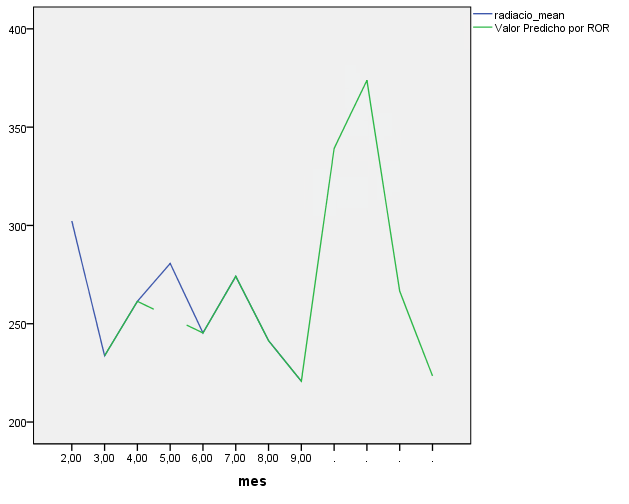
The residuals have zero value since the model is perfect, they have zero mean and standard deviation 1. On the other hand, the correlation between the actual and predicted values is striking, especially in the period from month 2 to month 9, the period for which radiation data are available (Figure 1).
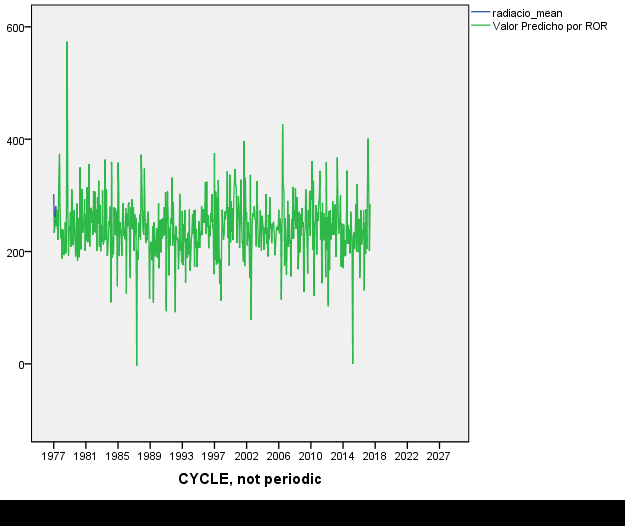
In relation to the data predicted by the ROR methodology for the Santa Clara station, Villa Clara, Cuba, it can be seen that there are some data with zero radiation, which should be analyzed later and could be related to heavy rainfall in Sagua, which would bring with it a drop in radiation in the city of Santa Clara (Figure 2).
Impacts on Human and Animal Health
UV radiation is having a greater impact on the earth every day due to the reduction of the ozone layer, which gives rise to the existence of various diseases. Skin cancer is one of the most severe effects of UV radiation on human beings. At present, skin tumors are the most frequent type of human neoplasms. This paper describes some of the current knowledge on physical aspects related to ultraviolet radiation and the different skin cancers that exist, especially those related to solar radiation. But the effects are much more devastating in many organisms belonging to the animal kingdom, mainly mosquitoes, fish and mollusks, ranging from sex change, through thermal castration in male specimens to sterility.
Since the model is perfect, it is recommended its use in the emission of climatic services of radiation in the city of Santa Clara, as well as to the rest of the provinces of the country, to make measurements in a year to the rest of the stations or to use this model with the three precipitations and to vary the minimum temperature of each station to calculate the radiation of the same one in these meteorological stations.
- Mitochondrial Bio-Logistics: Steering Co-Enzyme Q10 and Lycopene Synergies within the Science 4.0 Bio-OS Framework
- Hymenoptera Specimens from the Caño Negro Wetland, of the National Museum Collection, Costa Rica
- Science 4.0: Comprehensive Architecture of the Biological Operating System (Bio-OS) A Framework for Systemic Resilience and Industrialized Bio-Governance
- Rabbit on, or Hare Back? Understanding Climate Change
- Clinical Validation of Science 4.0: Flow Steering and Epigenetic Drift Inversion on a 76-Year-Old Hybrid System
- Seeds Planted by another Mind