
Resistance-Linked Volatile Profiles of Sugarcane Varieties in Sri Lanka and their Potential for Semiochemical-based Management of Chilo sacchariphagus indicus (Lepidoptera: Crambidae)
The sugarcane internode borer (INB), Chilo sacchariphagus indicus (Lepidoptera: Crambidae), poses a major challenge to sugarcane cultivation in Sri Lanka. Characterizing the volatile profiles of sugarcane varieties provides crucial insights for integrated pest management (IPM) strategies, particularly identification of attractant green leaf volatiles (GLVs). These compounds have the potential to be used for the development of Semiochemical based environmentally friendly pest control products, thereby promoting sustainable agriculture in the region. This study analyzed the volatility profiles of mature leaves of five sugarcane varieties (Co 775, SL 83 06, SL 90 6237, SL 92 5588, SL 96 128) that exhibited different resistances to INB attack. Volatiles were collected using dynamic headspace sampling and analyzed using gas chromatography-mass spectrometry (GC-MS). A total of 74 organic compounds were detected, of which 28 were identified as GLV. Seven GLVs showed significant variations, including 1-hexanol, 4-methyl; (S)-3-Ethyl-4-methylpentanol; and 3-octanone. Positive correlations were observed between certain GLVs, while others showed negative correlations, facilitating the classification of cultivars into two groups based on their volatile profiles. This study represents the first record of the volatile profiles of sugarcane in Sri Lanka. The results lay the foundation for further development of Semiochemical based IPM solutions against Chilosacchariphagus indicus and provide an innovative green pest control approach for the sugarcane industry.
Wanasinghe VKASM¹, Kumara ADNT²*, Ranaweera GKMMK², Chanchala KMG¹, Hemachandra KS³ and Nugaliyadde L⁴
¹Sugarcane Research Institute, Uda Walawe, Sri Lanka ²Faculty of Technology, South Eastern University of Sri Lanka, Sri Lanka ³Faculty of Agriculture, University of Peradeniya, Sri Lanka ⁴Sri Lanka Organization of Agriculture Professionals, Department of Agriculture, Sri Lanka
Introduction
In the realm of insect management, the utilization of green leaf volatiles (GLVs) represents a promising frontline in sustainable pest control strategies. GLVs, comprising a diverse array of volatile organic compounds emitted by plants, play complicated roles in plant-insect interactions, serving as both cues for herbivore defense and communication among organisms within ecosystems. The induced plant volatiles play a major role in the alteration of plant interaction with the environment and the current scenario of research on metabolomics, proteomics, and genomics studies needs biochemical information on plant volatiles. The volatile compounds produced in sugarcane leaves play a very important role in the agroecosystem, and these compounds can influence the choice of the host crop of the plague insects [2].
Sugarcane volatiles comprise a complex mixture of organic compounds, including terpenes, aldehydes, ketones, alcohols, and esters. Studies employing gas chromatography- mass spectrometry (GC-MS) and other analytical techniques have identified hundreds of VOCs emitted by different sugarcane cultivars and plant tissues. Terpenoids, such as monoterpenes and sesquiterpenes, are among the most abundant volatiles, contributing to the characteristic aroma of sugarcane. Additionally, volatile aldehydes, such as hexanal and (E)-2-hexenal, play crucial roles in plant defense and stress response mechanisms. Hexanal or myrcene had increased the capture of African sugarcane borer; Eldana saccharina adults whereas octanal and methyl salicylate decreased it [3]. Eldana saccharina females prefer to oviposit on Pennisetum polystachion, but progeny survival is zero [4]. 260 different VOCs have been identified from different sugarcane cultivars and they concluded that possibility of chemical differentiation of sugarcane cultivars. Recently, the Volatile Organic Compounds (VOC) profiling was widely recognized as a valuable tool for cultivar differentiation of grass crops, such as barley, wheat, and rice [5].
Currently, Sugarcane Internode Borer (INB) (Chilo sacchariphagus indicus, Lepidoptera: Crambidae) is considered a major pest due to its effects on the cane and sugar yield in Sri Lanka. The Sugarcane Research Institute (SRI) in Sri Lanka has determined the damage incidence as 85 - 92%, by the number of infested plants, and the damage severity as around 20 - 22%, by the number of infested internodes in some severely infested sugarcane plantations in the country. Every 1% of damage of Chilo sacchariphagus causes 0.5% reduction in sugar content [6]. Stalk weight, stalk length and sucrose content are negatively correlated with stalk damage [7]. According to the given values, Sri Lankan sugarcane plantations have faced to a difficult condition due to this borer pest.
Currently, the Sugarcane Research Institute (SRI) in Sri Lanka is reinforcing the existing integrated pest management program for borer pests. High priority has been given to develop resistant sugarcane varieties, to improve habitat management and to develop semiochemical based green pest management products.
Characterization of volatile profile has many benefits and previous research has not been found in Sri Lanka for sugarcane. It will be a huge advantage for identification of attractant GLVs which can be used to develop semiochemical based green pest management products in the country. Therefore the present study was conducted to characterize the volatile profiles of commercially grown five sugarcane varieties (Co 775, SL 83 06, SL 90 6237, SL 92 5588 and SL 96 128) in Sri Lanka with different resistance levels for the INB infestations.
Materials and Methods
Experiments were conducted in the laboratories of the Sugarcane Research Institute (SRI), Udawalawe, and the South Eastern University of Sri Lanka, Oluwil from August 2022 to August 2023.
Plant Materials and Plant Growing Conditions
Commercially released five sugarcane varieties; Co 775, SL 83 06, SL 90 6237, SL 92 5588, and SL 96 128 were used for the study and their status for the infestation of sugarcane internode borer (INB; Chilo sacchariphagus indicus) is listed in Table 1. Field plots of these varieties were maintained in the research farm, the Sugarcane Research Institute, Udawalawe. Four plots of 2 x 2 m rows from each variety with a one-meter row length were established. The inter-row spacing and distance between the two plots were maintained as 1.37 m and 2m, respectively. Standard sugarcane cultural practices were adopted for managing the crop except for the use of insecticides.
| Variety | INB resistance level |
|---|---|
| Co 775 | Moderately resistant |
| SL 83 06 | Resistant |
| SL 90 6237 | Moderately resistant |
| SL 92 5588 | susceptible |
| SL 96 128 | Highly susceptible |
Table 1: Five sugarcane varieties used for the study and its resistance level for infestations of INB
Collection of Plant Volatiles
The dynamic headspace method was followed to collect volatiles from green leaves of sugarcane varieties. A headspace collection apparatus from the Department of Biosystem Technology, Faculty of Technology, Southeastern University of Sri Lanka, Oluvil was used for this method. Green leaves from 10-month-old plants were collected and cleaned to remove dust and other materials. Leaves were cut into about 5 cm length pieces and 100 g of the leaves were weighted. The leaf bits were placed in the bottle (2.5 L) and a gentle stream of air was sucked through the activated charcoal filter cartridge at 30ml/min and allowed to pass over the samples. The odor- laden air was trapped using a glass tube containing Poropak Q absorbent (Supelco) 30 mg (50-80 mesh sealed with glass wool on either side). The collection was performed for 12 hours and the trapped VOC was eluted with HPLC grade dichloromethane (DCM) 5 ml and concentrated into 1 ml by passing gentle steam of ultra-pure nitrogen (N2) gas. Samples were stored in chromatographic glass vials under -20°C until analysis. In each volatile collection, the apparatus was cleaned using DCM. To ensure the results blank run was carried out every day and eluted as above and subjected to analysis.
Chemical Identification of Volatiles
Collected VOC were identified using gas chromatography- mass spectrometry (GC-MS) at the Faculty of Technology, South Eastern University of Sri Lanka. GC-MS consisted of GC 8890 Agilent technologies coupled with a 5977B Agilent technology MSD with a capillary column type (HP5MS 30 m×0.250mm×0.25µm). Inert gas, Helium (99.99%) was used as carrying gas at the rate of 1.2 ml/min and 2µl of the sample was injected with a split ratio of 10:1. The oven temperature was programmed as follows; the temperature of oven and column was maintained at 35ºC for 1 min and then increased at 10ºC/min to 230ºC and the injector and column temperature were 240ºC. The total run time was 88 min. The MS ion source temperature of 230ºC and ionization energy of 70 eV and the mass ranges between 40-600 amu. The separated constituents were identified by comparing mass spectra in the NIST library.
Statistical Analysis
The GC/MS integrated peak lists data was processed using Agilent qualitative analysis software and those were subjected to statistical analysis. Metabo Analyst 6.0 online platform was used for the statistical analysis. The raw MS peak intensities were filtered through the interquartile range (IQR) and normalized using log transformation (base 10). One-way ANOVA test was performed and Tukey post hoc test was followed to identify the significantly different GLVs. Then the principal component analysis (PCA) was done using all the peaks. Heat maps were constructed using the top most abundant 25 chemicals under the Euclidean distance and ward method. Hierarchical cluster analysis (HCA), based on Ward’s method (with 95% confidence) among different varieties, was also used to construct the similarity dendrogram.
Results
Green Leaf Volatiles (GLVs) Content as Chemotaxonomy for Sugarcane Varieties
Seventy-four different organic compounds were detected from GC-MS analysis conducted using dynamic head space samples collected from five different sugarcane varieties; Co 775, SL 83 06, SL 90 6237, SL 92 5588, and SL 96 128. Hydrocarbons, terpenoids, esters, aldehydes, alcohols, Green Leaf Volatiles (GLVs), ketones, and furanoids were found. Among them, 28 compounds were found as green leaf volatiles (GLVs) of five sugarcane varieties. They are, (S)-(+)-6-Methyl-1-octanol, (S)-3-Ethyl-4-methylpentanol, 1-Decanol, 2-ethyl-, 1-Decanol, 2-hexyl-, 1-Dodecanol, 3,7,11-trimethyl-, 1-Hexanol, 2-ethyl-, 1-Hexanol, 4-methyl-, 1-Hexanol, 5-methyl-2-(1-methylethyl)-, 1-Octen-3-ol, 1-Undecene, 8-methyl-, 2,3,4-Trimethyl-1-pentanol, 2-Acetyl- 2-methyltetrahydrofuran, 2-Isopropyl-5-methyl-1-heptanol, 3,4-Hexanedione, 2,2,5-trimethyl-, 3-Ethyl-3-methylheptane, 3-Heptanone, 4-methyl-, 3-Hexen-1-ol, acetate, (Z)-, 3-Hexen- 1-ol, formate, (Z)-, 3-Octanol, 3-Octanone, 4-Hexen-1-ol, (E)- , 9-Octadecene, (E)-, Acetic acid, hexyl ester, Hexadecanal, Hexane, 3,3-dimethyl-, Nonanal, Nonane, 3-methyl-5-propyl- and Vinyl butyrate.
Identification of Significantly Different Green Leaf Volatiles (GLVs) of Sugarcane Varieties by Analysis of Variance and Post-HOC Analysis
According to the One-way ANOVA test and post-hoc analysis, seven GLVs were significantly different from 28 GLVs which were detected from five sugarcane varieties. They are 3-Octanone, Hexane, 3, 3-dimethyl-, 1-Hexanol, 4-methyl-, Nonanal, 3-Heptanone, 4-methyl-, 2, 3, 4-Trimethyl-1- pentanol and (S)-3-Ethyl-4-methylpentanol. F-values and P-values are presented in Table 2.
The extremely high F-value and extremely low p-value suggest that the concentration of 3-Octanone, Hexane, 3, 3-dimethyl- and 1-Hexanol, 4-methyl- vary significantly among different sugarcane varieties. Though the F-value is smaller than these compounds, Nonanal, 3-Heptanone, 4-methyl- and 2, 3, 4-Trimethyl-1-pentanol are also considerable. Even though the F-value and significance are substantially smaller than for the other compounds, (S)-3- Ethyl-4-methylpentanol exhibits a significant difference among the varieties (Table 2).
| Compound | F-value | P-value |
|---|---|---|
| 3-Octanone | 7.35E+31 | 2.73E-157 |
| Hexane, 3,3-dimethyl- | 1.72E+31 | 3.88E-154 |
| 1-Hexanol, 4-methyl- | 4.47E+30 | 3.30E-151 |
| Nonanal | 3365500 | 1.36E-30 |
| 3-Heptanone, 4-methyl- | 484070 | 2.20E-26 |
| 2,3,4-Trimethyl-1-pentanol | 1216.2 | 2.18E-13 |
| (S)-3-Ethyl-4-methylpentanol | 52.029 | 1.17E-06 |
Table 2: F-values and P-values GLVs of five different sugarcane varieties.
Determination of Correlations among GLVs of Different Sugarcane Varieties
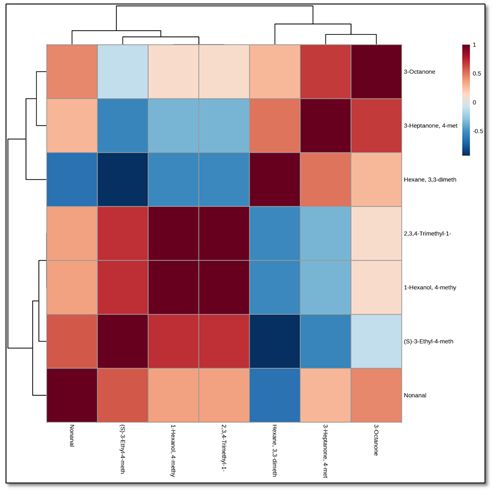
The correlations among the seven GLVs of five selected sugarcane varieties have been shown in the correlation table (Table 2) and the correlation heat map (Figure 1). Between 1-Hexanol, 4-methyl, and (S)-3-Ethyl-4-methanol, the correlation coefficient value is 0.71703, indicating a highly significant positive correlation. The virtually perfect correlation of 0.99891 indicates that the chemicals that change the closest to each other are 1-hexanol, 4-methyl, and 2, 3, 4-trimethyl-1-pentanol. There is a strong negative association (r = -0.92255) between (S)-3-Ethyl-4-methanol and hexane, 3, 3-dimethyl-. The correlation coefficient between nonanal and 3, 3-dimethyl hexane is -0.64757, indicating an inverse association.
There is a slight negative correlation of -0.1169 between 3-Octanone and (S)-3-Ethyl-4-methanol. The correlation coefficient of 0.12714 indicates a slight positive correlation between 1-hexanol, 4-methyl, and 3-octanone (Table 3).
| Nonanal | (S)-3-Ethyl-4-meth | 1-Hexanol, 4-methyl | 2,3,4-Trimethyl-1- | Hexane, 3,3-dimeth | 3-Heptanone, 4-met | 3-Octanone | |
|---|---|---|---|---|---|---|---|
| 1 | 0.58835 | 0.36674 | 0.36629 | -0.6476 | 0.29116 | 0.45064 | |
| (S)-3-Ethyl-4-meth | 0.58835 | 1 | 0.71703 | 0.70948 | -0.92255 | -0.5565 | -0.1169 |
| 1-Hexanol, 4-methy | 0.36674 | 0.71703 | 1 | 0.99891 | -0.54187 | -0.35109 | 0.12714 |
| 2,3,4-Trimethyl-1- | 0.36629 | 0.70948 | 0.99891 | 1 | -0.54368 | -0.35065 | 0.12033 |
| Hexane, 3,3-dimeth | -0.6476 | -0.92255 | -0.54187 | -0.54368 | 1 | 0.50641 | 0.2795 |
| 3-Heptanone, 4-met | 0.29116 | -0.5565 | -0.35109 | -0.35065 | 0.50641 | 1 | 0.68132 |
| 3-Octanone | 0.45064 | -0.1169 | 0.12714 | 0.12033 | 0.2795 | 0.68132 | 1 |
Table 3: Correlation coefficient values (distance measure: Pearson r) for seven GLVs of five sugarcane varieties.
Principal Component Analysis (PCA) for Seven Different GLVs of Five Sugarcane Varieties
The results of the Principal Component Analysis (PCA) are shown in this scree plot (Figure 2). The major components are listed on the x-axis (PC index) in descending order of the percentage of variance. The percentage of the overall variation that each primary component accounts for is displayed on the y-axis.
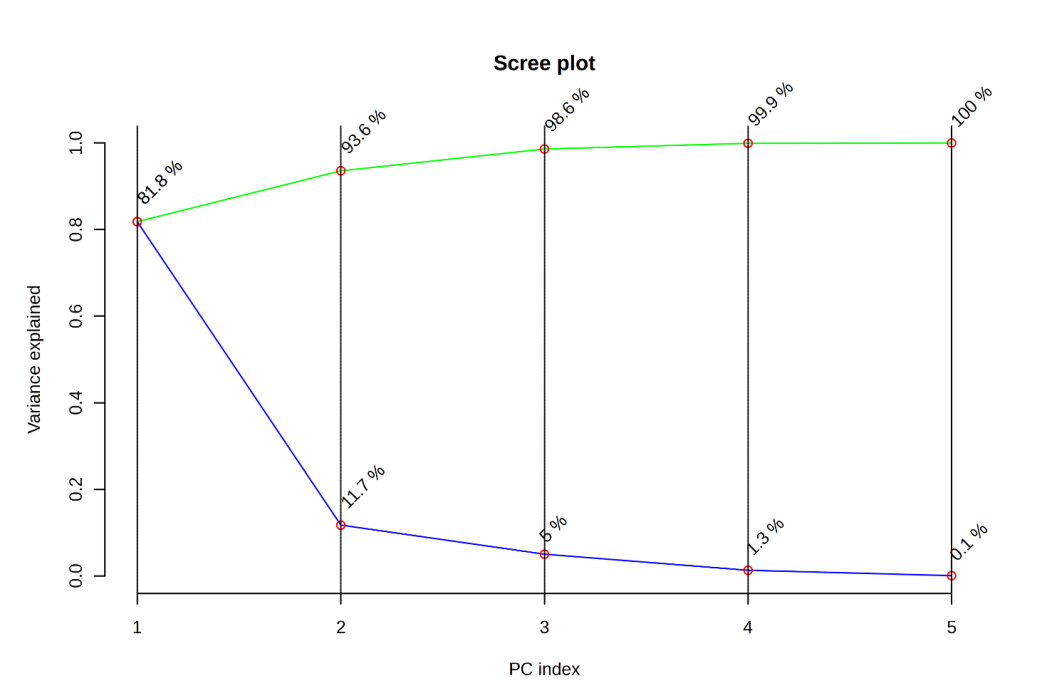
According to the PCA for the headspace GLVs of five sugarcane varieties resulted in components 1,2,3,4 and 5 explaining 81.8%, 11.7%, 5%, 1.3%, and 0.1% variance respectively. When PC1 and PC2 combine, they account for 93.5% of the variance, which means that combined PC1 and PC2 account for the majority (Figure 2). PC1: Hexane, 3,3-dimethyl-has a high positive loading (0.69085), suggesting that it plays a significant role in the variance collected by this component and that it strongly contributes to PC1. The high negative loading (-0.6381) of (S)-3-Ethyl-4- methylpentanol indicates that it contributes as much as hexane, 3,3-dimethyl-, but in the opposite direction. PC2: The highest negative loading (-0.93772) of 3-heptenone, The main compounds that affect PC1 are Hexane, 3,3-dimethyl-, and (S)-3-Ethyl-4-methylpentanol. These substances are the most important in differentiating the GLVs in different varieties if PC1 accounts for a significant amount of the variance (Table 4).
4-methyl- suggests that it is the primary contributor to PC2, however in a negative way. A smaller amount of other substances, such as hexane and 3,3-dimethyl-(0.26581), also contribute to PC2. PC3: Hexane, 3,3-dimethyl-(0.52728) and 1-Hexanol, 4-methyl-(0.519) are important contributors to the variance explained by this component because they positively impact PC3.
| PC1 | PC2 | PC3 | PC4 | PC5 | |
|---|---|---|---|---|---|
| Hexane, 3,3-dimethyl- | 0.69085 | 0.26581 | 0.52728 | -0.3998 | -0.06662 |
| 1-Hexanol, 4-methyl- | -0.12292 | -0.02933 | 0.519 | 0.42866 | -0.04394 |
| 3-Heptanone, 4-methyl- | 0.28756 | -0.93772 | 0.054938 | -0.04482 | -0.16427 |
| (S)-3-Ethyl-4-methylpentanol | -0.6381 | -0.11656 | 0.39515 | -0.63344 | -0.14475 |
| Nonanal | -0.0388 | -0.15385 | -0.01026 | -0.02933 | 0.3916 |
| 3-Octanone | 0.016691 | -0.10483 | 0.12456 | -0.12523 | 0.88953 |
| 2,3,4-Trimethyl-1-pentanol | -0.12637 | -0.03013 | 0.5271 | 0.48643 | 0.032956 |
Table 4: Component loadings from the PCA of seven GLVs of five sugarcane varieties.
Determination of the Distribution of Different GLVs Across the Five Sugarcane Varieties
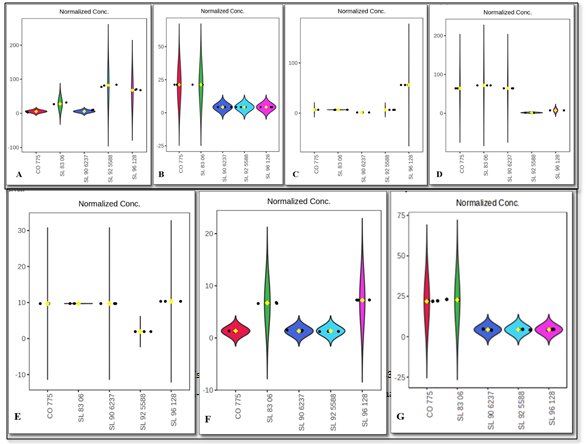
Violin plots have been used to visualize the distribution of different GLVs across the five sugarcane varieties (Figure 3).
• Hexane, 3,3-dimethyl- The Highest concentration was recorded from SL 92 5588 followed by SL 96 128 and SL 83 06 • 1-Hexanol, 4-methyl- Similar concentrations were recorded from the varieties; SL 83 06 and Co 775 • 3-Heptanone, 4-methyl- The highest concentration was recorded from SL 96 128. Nearly similar concentrations were recorded from SL 83 06, Co 775, and SL 92 5588. The variety SL 90 6237 was without this GLV • (S)-3-Ethyl-4-methylpentanol: SL 83 06 had the highest concentration, followed by SL 90 6237 and Co 775. SL 96 128 had the lowest concentration on record. • Nonanal: High concentrations were found in SL 90 6237, Co 775, and SL 96 128. • 3-Octanone: SL 96 128 had the highest concentration, followed by SL 83 06. • 2, 3, 4-Trimethyl-1-pentanol: SL 83 06 had the highest concentration, which was followed by Co 775.
Clustering Of Different Sugarcane Varieties Based on the Presence of Different GLVs
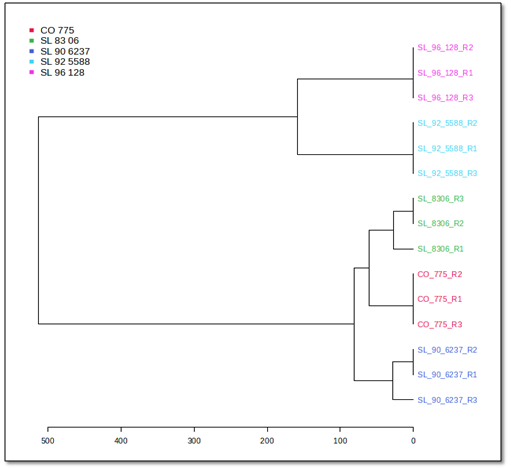
The clustering of different five sugarcane varieties has been shown using a hierarchical clustering dendrogram (Distance measure: Euclidean; Clustering algorithm: average) (Figure 4). According to it, the five sugarcane varieties have been grouped into two major groups SL 90 6237, Co 775, and SL 83 06 in the first group and SL 92 5588 and SL 96 128 in the second group. The varieties SL 90 6237, Co 775, and SL 83 06 are in the tolerant group and SL 92 5588 and SL 96 128 are in the susceptible group for INB infestations.
Discussion
This study was conducted to identify different green leaf volatiles (GLVs) of different sugarcane varieties which have different resistance levels for internode borer (INB; Chilo sacchariphagus indicus; Lepidoptera: Crambidae) infestations. These data provide the first known categorization of sugarcane green leaf volatiles in Sri Lanka using Gas Chromatography mass spectrometry (GC-MS) and Metaboanalysist 6 software.
Volatiles as plant secondary metabolites have multiple important roles in plants, from the defense of plants as their ancestral function, to the attraction of pollinators and in plant-plant interactions. Plant-based chemicals are significant to scientists and have several applications, mostly in the food, cosmetic, and pharmaceutical industries [8]. Plant species from more than 90 families have yielded almost 2000 volatile chemicals to date [9]. These compounds are released from plant organs above or below the ground and some are induced by biotic activities. Green leaf volatiles (GLVs), terpenoids, nitrogen-containing nitriles and oximes, methyl salicylate, and other compounds are released by plants in response to herbivore eating. At least three biochemical routes are involved in the synthesis of these volatiles by plants: the shikimic acid pathway for methyl salicylate, the isoprenoid pathway for terpenoids, and the fatty acid/ lipoxygenase pathway for green leaf volatiles [10]. Some of the most prevalent terpenoids and GLVs, which are crucial in initiating plant-to-plant communication and modulating the behaviors of herbivores and their natural enemies, are released by herbivore-damaged plants. Functional research on C6-volatiles in green leaves has drawn a lot of interest lately and has advanced in fascinating ways [9].
In the present study, we found 28 GLVs from five sugarcane varieties. However, only ten GLVs have been identified from both sugarcane and Erianthus arundinaceous leaves [11]. Those GLVs were, (E or Z)-3-hexen-1-ol, 1-hexanol, (E,E)- 2,4-hexadienal, (E)-2-hexanal, 4-oxo-E-2-hexenal, Hexanal, Hexyl acetate, (Z)-3-hexenyl acetate, (E or Z)-3-hexenal and (Z)-2-hexenal. From that study, 71 organic compounds have been identified. It included ten green leaf volatiles (GLVs), 5 short-chain alcohols, twelve ketones, four aldehydes, eight terpenoids, eight hydrocarbons, four aromatics, five furanoids, one carboxylic acid, one sulfide, one amine, one ester and eleven unknown compounds. Among them, only two compounds have been found in significantly higher amounts in Erianthus arundinaceous compared to the sugarcane. They were (E) –β- ocimene and 3-methylcyclopentene. They have concluded that, the terpene (E) –β- ocimene is constitutively emitted by E. arundinaceous but not by sugarcane_. We also have not detected this (E) –β- ocimene from five sugarcane varieties. However, in another study conducted to categorize the volatile profile of _Erianthus sp. using 26 accessions in Sri Lanka, we found (E) –β- ocimene from five accessions of Erianthus sp. (unpublished data).
β-ocimene has a variety of uses in relation to plants and insects. For example, it can increase the rates of mating and oviposition in Hyphantria cunea [12], function as a pheromone in early larvae, alter the way that workers mature behaviorally [13], and prevent honey bee workers from maturing their ovaries [14]. β-ocimene (monoterpene, C10H16) is a key plant volatile organic compound found widely in nature, particularly in the essential oils of various plants and its with multiple relevant functions in plants, depending on the organ and the time of emission. It is a very common plant volatile released in important amounts from the leaves and flowers of many plant species. This acyclic monoterpene can play numerous biological roles in plants, by potentially affecting floral friends and also by facilitating defensive responses to pests [15]. β-ocimene is recognized as an herbivore-induced plant volatile that plays an important role in the chemical communication between plants and pests [16]. This substance belongs to a class of isomers that, like alpha-ocimene, differ in the position of double bonds, which has a big impact on both their biological activity and smell. Because of its well-known sweet, herbaceous, and woodsy aroma, beta-ocimene is highly prized in the fragrance and flavor sectors. Beyond its sensory qualities, beta-ocimene has numerous uses and advantages in a variety of sectors. β-ocimene has roles in plant ecology in agriculture by attracting beneficial insects for pollination or pest management and serving as a signaling molecule in plant defense against herbivores.
Three main compounds have been detected from eight sugarcane varieties and two pasture species [17]. They were, (Z)-3-hexen-1-ol, 1-octen-3-ol and Phytol. Among them, (Z)-3-hexen-1-ol was the compound with greater frequency and it was detected in seven sugarcane species and two pasture species. However, it was not detected from RD 75- 11. The abundance of (Z)-3-hexen-1-ol varied from 20.35% to 57.36% in sugarcane. The highest amount of (Z)-3-hexen- 1-ol was detected in African star grass and it was 59.69% abundance. The compound 1-octen-3-ol was detected in seven sugarcane varieties. It was not found in COLPOS CT MEX 05-204. The abundance of the compound has ranged from 16.37% and 40.06% from L 77-50 and RD 75-11 respectively. (Z)-3-hexen-1-ol, 1-octen-3-ol and Phytol were detected in five varieties named CP 72-2086, MEX 69-290, MEX 79-431, L 77-50, and COLPOS CT MEX 05-223. Among these five varieties, three varieties have shown susceptibility to pests like spittlebugs; Aeneolamia, and Prosapia [17]. In our present study, we did not identify phytol from five sugarcane varieties.
In the present study, 3-Octanone, Hexane, 3, 3-dimethyl-, 1-Hexanol, 4-methyl-, Nonanal, 3-Heptanone, 4-methyl-, 2, 3, 4-Trimethyl-1-pentanol and (S)-3-Ethyl-4-methylpentanol are the significantly different seven GLVs from twenty-eight GLVs found from five sugarcane varieties. Among them, Hexane, 3,3-dimethyl-, and (S)-3-Ethyl-4-methylpentanol are the main responsible GLVs for differentiating the sugarcane varieties.
3-Octanone is n-amyl ethyl ketone and it is a fragrant liquid produced by plants as diverse as lavender (Lavandula angustifolia), rosemary (Salvia rosmarinus), and nectarines (Prunus persica var. nucipersica). Its olfactory properties make it a useful flavor and fragrance agent [18]. 3-Octanone is produced by oyster mushrooms as an insecticide to kill roundworms [19]. Also, it has been identified as an excellent candidate for the development of a snail attractant and molluscicide in the “Lure and Kill” or “Attract and Kill” strategy for controlling garden snails [19]. The active ingredient in the alarm pheromone of the leaf-cutting ant Acromyrmex is the ketone 3-octanone, which has been shown to influence insect behaviour [19]. It is well known that high concentrations of 1-octen-3-ol and 3-octanone, which are generated by the entomopathogenic fungus Metarhizium brunneum, have insecticidal effects on a variety of invertebrate pests. Much research has been conducted to identify their role in pest management. They attract nematodes and mollusks at low doses but repel them at higher concentrations and higher doses they are lethal to insects, nematodes, and mollusks [22]. Numerous mosquito species, grain beetles, collembola, and tsetse fly are attracted to the alcohol 1-octen-3-ol. Wireworms (Agriotes obscurus; Coleoptera: Elateridae) avoided the soil treated with Metarhizium spores. Also, the avoidance is increased with the increase in concentration of conidia even from a distance [23].
1-hexanol, E-2-hexenal, and Z-3-hexen-1-ol are key compounds in plant defense, helping to inhibit microbial growth in wounded areas [24]. According to Kim, et al. [25] hexanal and E-2-hexenal showed antibacterial efficacy against Salmonella enteritidis, Escherichia coli, Staphylococcus aureus, and Listeria monocytogenes. Additionally, it demonstrated how an increase in E-2-hexenal can help plants by drawing in predatory insects’ natural enemies and informing gravid females of potential egg-laying locations [26]. Uses of Z-3-hexen-1-ol in plant-plant communication have been shown, including defending against herbivore attacks [27]. It also turned out to be the most significant information signal for triggering gene expression in plants that are in danger of extinction. Furthermore, this chemical demonstrated beneficial priming and indirect defensive effects. The emission of Z-3-hexen-1-ol must be the plants’ defensive response, even though it is difficult to determine whether the substance is an attractant or a repellent. Increasing data, however, indicates that Z-3-hexen-1-ol is at least partially an important volatile that can modify the behavior of herbivorous insects.
Numerous plants contain nonanal, a volatile substance that is extensively distributed. On the other hand, studies have shown that nonanal is important for various physiological processes in insects, like choosing their host plant. According to Xiang, et al. [28], nonanal is reportedly appealing to mated female Grapholitha molesta in Y-tube bioassays.
Nonanal also induced behavioral responses in the source contacting and landing of the corn borer Ostrinia nubilalis in a wind tunnel [29]. Volatiles of tobacco plants attract and stimulate oviposition in female moths of Helicoverpa assault. Among the different volatiles, nonanal has greatly increased the oviposition preference of this moth. They have concluded that nonanal is a key signal volatile of tobacco plants that attract female moths of Helicoverpa assault to oviposition [30].
In the present study, the highest concentration of (S)-3- Ethyl-4-methylpentanol- was recorded in SL 83 06 followed by Co 775 and SL 90 6237. The lowest concentration was recorded from SL 96 128. SL 83 06, Co 775, and SL 90 6237 varieties have moderate to high tolerance against INB infestations. SL 96 128 is a variety with high susceptibility for INB infestations. Further research should be undertaken to identify the effect of this GLV against INB. 3-Ethyl-4- methylpentanol is a critical component of the queen sex pheromone of slave-making ants [24]. (S)-3-Ethyl-4- methylpentanol- is an active volatile of coffee to locate host by coffee berry borer [25].
The different sugarcane varieties were successfully grouped by cluster analysis based on different GLVs in varieties. Our findings of the present study showed that the total leaf volatile profile varies from one variety to another. In agreement with our results, some research in other countries also showed that the total leaf volatile profile varies among sugarcane species [17]. Previous research is not available on the volatile profile of sugarcane in Sri Lanka to compare our present results. In addition to the differences in total volatile between varieties, our results also showed that there were differences in the abundance of the main volatile group among the different varieties. Fascinatingly, the PCA results showed that volatile profiles of INB tolerant varieties were different from those of INB susceptible varieties which indicated that these GLVs could be implicated in sugarcane tolerance/resistance to INB.
Although the PCA and cluster analysis showed that the green leaf volatile profiles of INB tolerant were different from those of INB susceptible varieties, the separation was not clear in a few cases. The lack of total separation was predictable because the multivariate analysis was only based on the volatile metabolites and not on the total metabolomics profile. Unidentified compounds by NIST library had be removed. Accordingly, future studies should focus on the non-volatile metabolites, unidentified compounds and their possible roles in sugarcane resistance against INB.
Scientific awareness has been extremely increased in the biochemistry, physiology, ecology, and atmospheric chemistry of plant VOCs. It has directed the development of a variety of systems for the collection and analysis of volatiles [33]. In the past decade in particular, volatile analysis has improved by the design of relatively inexpensive but sensitive bench-top instruments for gas chromatography- mass spectrometry (GC-MS) [34]. In our present study, we used the sophisticated, highly sensitive, and fast GC-MS equipment available in the faculty of Technology, at South Eastern University of Sri Lanka which is a highly useful instrument to identify different compounds in plants to use in smart agriculture in Sri Lanka in future.
The sugarcane leaf volatiles from different sugarcane varieties was extracted using the dynamic headspace method. This method was found to be fast and trustworthy and needs only a small amount of plant tissues [35]. The developed headspace analysis techniques provide a more representative volatile profile of living plants than the traditional method of solvent extraction or steam distillation. Compared with solvent extractions of GLVs from plants, headspace analysis gives a more precise image of the volatile profile emitted by plants and detected by insects, making this method most suitable for many ecologically related uses [34]. Generally, the devices used for headspace collections and the background environment should be free of contaminants that can be detected in the compound list. We maintained well-cleaned background in the laboratory and avoided using any perfumes and other cosmetics during the washing of the volatile trapped glass tubes containing Poropak Q absorbent. The commonly used materials that do not show bleeding include glass, metal, and special plastics such as Teflon. However teflon is not completely inactive and details of materials appropriate for the creation of headspace collection chambers are listed by Millar, et al. [36]. A major problem with all trapping materials is their incomplete adsorption of volatile organic compounds. This problem can be resolved by using multiple-layer adsorption tubes. Multi- bed tubes are commercially available or can be self-made [37].
To significantly lower the volatility of the materials and increase their duration of activity, experiments are being carried out to encapsulate the volatile organic compounds (VOCs) into absorbent materials. Further research has been suggested to confirm the effect of encapsulated VOCs on other soil insects [38].
In sugarcane, the identification of different semiochemicals in different varieties will be an advantage in increasing sugar production in the country. These types of studies are essential for many disciplines of any crop research. The identified GLVs can be used for bioassay tests against different pest species of sugarcane in Sri Lanka to identify attractant and repellent compounds. Results from the present study are an input to develop novel semiochemical- based green pest management products in the future. Also, the results of this study can be the basis for further research on responsible GLVs in different sugarcane varieties for insect resistance and susceptibility. It will help breeders to build a data bank for the GLVs that will enable the incorporation of aroma traits during variety selection and development. Breeding for fragrance is not an easy job. However, the present results make routes to produce evidence useful for further grouping and to accelerate sugarcane variety screening programs for insect pests in Sri Lanka. Also, these results may lead to the creation of transgenic plants with modified volatile profiles in the future that are more tolerant to the severe pest; INB.
In conclusion, our results showed that the leaf GLV profiles of INB-tolerant varieties were different from those of susceptible varieties. This finding may indicate a possible role of these volatiles in sugarcane resistance against INB. Further research will be focused on determining the olfactory and behavioral responses of ovipositing females of INB for identified GLVs from different varieties.
Conclusions
Twenty eight green leaf volatiles (GLVs) were found from five sugarcane varieties and seven GLVs have shown significant variation among the varieties. They are 3-Octanone, Hexane, 3,3-dimethyl-, 1-Hexanol, 4-methyl-, Nonanal, 3-Heptanone, 4-methyl-, 2,3,4-Trimethyl-1-pentanol, and (S)-3-Ethyl-4- methylpentanol. The sugarcane varieties were grouped into two clusters: SL 90 6237, Co 775, and SL 83 06 in one, and SL 92 5588 and SL 96 128 in the other. The susceptible varieties for INB infestations; SL 96 128 and SL 92 5588 have high concentration of 3-Heptanone, 4-methyl- and Hexane, 3,3-dimethyl-. The resistant variety; SL 83 06 has high concentration of (S)-3-Ethyl-4-methylpentanol and 2,3,4-Trimethyl-1-pentanol. Further studies are needed to find out the mechanism of those GLVs on resistance and susceptibility to INB.
Acknowlegdements
The authors express their sincere gratitude to Dr. Aruna Wijesooriya, a former Director of the Sugarcane Research Institute (SRI), Sri Lanka, for his invaluable guidance during the proposal formulation of this long-term program for the management of borer pests in Sri Lanka. We also extend our thanks to the supportive staff of the Division of Crop Protection at SRI for their assistance in sample preparation and other laboratory activities.
References
-
Palial S, Nidhi (2019) The potential use of semiochemicals in pest suppression. International journal of zoology and animal biology. Medwin publishers 2(4).
-
Martínez A (2013) Introducción a la ecología química y su uso en el manejo de insectos plaga en sistemas forestales. Serie técnica: manejo integrado de plagas forestales. INTA EEA Bariloche. Río Negro. Argentina. Cuadernillo núm. 17: 14.
-
Harraca V, Rutherford R.S, Conlong DE (2013) Understanding the interaction between plant and pest to develop sustainable control: A case study with the African sugarcane borer Eldana saccharina (Lepidoptera: Pyralidae). Proc Int Soc Sugar Cane Technol 28: 883-889.
-
Schulthess F, Bosque-Perez NA, Chabi-Olaye A, Gounou S, Ndemah R, et al. (1997) Exchange of natural enemies of Lepidopteran cereal stemborers between african regions. International Journal of Tropical Insect Science 17(1): 97-108.
-
Silva P, Freitas J, Nunes F M, Camara J S (2021) Chemical Differentiation of Sugarcane Cultivars Based on Volatile Profile and Chemometric Analysis. Journal of Agricultural and Food Chemistry 69(11): 3548-3558.
-
Achadian E, Kristini A, Magarey R, Sallam N, Samson P, et al. (2012) Sugarcane Pests and Diseases. Field Guide. Westminster Printing. BSES Limited.
-
Goebel FR, Achadian E, Kristini A, Sochib M, Adi H (2011) Investigation of crop losses due to moth borers in Indonesia. In Proceedings of the Australian Society of Sugar Cane Technologists 33(9).
-
Derbassi NB, Pedrosa MC, Heleno S, Carocho M, Ferreira IC, et al. (2022) Plant volatiles: Using Scented molecules as food additives. Trends in Food Science & Technology 122: 97-103.
-
Dudareva N, Negre F, Nagegowda DA, Orlova I (2006) Plant volatiles: recent advances and future perspectives. Critical reviews in plant sciences 25(5): 417-440.
-
Paré PW, Tumlinson JH (1997) De novo biosynthesis of volatiles induced by insect herbivory in cotton plants. Plant Physiology 114(4): 1161-1167.
-
Jacob V, Tibère R, Nibouche S (2021) Few sensory cues differentiate host and dead-end trap plant for the sugarcane spotted borer Chilo sacchariphagus (Lepidoptera: Crambidae). Journal of Chemical Ecology 47(2): 153-166.
-
Tang R, Zhang F, Zhang ZN (2016) Electrophysiological responses and reproductive behavior of fall webworm moths (Hyphantria cunea Drury) are influenced by volatile compounds from its mulberry host (_Morus alba_ L.). Insects 7(2): 19.
-
Maisonnasse A, Lenoir JC, Beslay D, Crauser D, Le Conte Y (2010) E-β-ocimene, a volatile brood pheromone involved in social regulation in the honey bee colony (Apis mellifera). PLOS one 5(10): e13531.
-
Maisonnasse A, Lenoir JC, Costagliola G, Beslay D, Crauser D, et al. (2009) E-β-ocimene is a new volatile primer pheromone that inhibits worker ovary development in honey bees. In Colloque de l’Union Internationale pour l’Etude des Insectes Sociaux-Section Francophone. UIEIS.
-
Farré-Armengol G, Filella I, Llusià J, Peñuelas J (2017) β-Ocimene, a key floral and foliar volatile involved in multiple interactions between plants and other organisms. Molecules 22(7): 1148.
-
Kang ZW, Liu FH, Zhang ZF, Tian HG, Liu TX (2018) Volatile β-ocimene can regulate the developmental performance of peach aphid Myzus persicae through activation of defense responses in Chinese cabbage Brassica pekinensis. Frontiers in Plant Science 9: 708.
-
Ramírez-Medorio NJ, Hernández-Rosas F, Osorio-Acosta F, López-Collado J, Figueroa-Rodríguez KA, et al. (2019) Chemical composition of volatiles from sugarcane leaves and pastures by gas chromatography. Revista mexicana de ciencias agrícolas 10(SPE22): 129-138.
-
Takeoka GR, Flath RA, Guentert M, Jennings W (1988) Nectarine volatiles: vacuum steam distillation versus headspace sampling. Journal of Agricultural and Food Chemistry 36(3): 553-560.
-
Li H, Liu J, Hou Z, Luo X, Lin J, Jiang N, et al. (2022) Activation of mycelial defense mechanisms in the oyster mushroom Pleurotus ostreatus induced by Tyrophagus putrescentiae. Food Research International 160: 111708.
-
Yavasoglu Sİ, Wood MJ, Alkhaibari AM, Touray M, Butt T (2023) The potential of 3-octanone as a lure and kill agent for control of the Brown garden snail. Journal of Invertebrate Pathology 198: 107920.
-
Iwabuchi K, Takahashi J, Sakai T (1987) Occurrence of 2, 3-octanediol, and 2-hydroxy-3-octanone, possible male sex pheromone in Xylotrechus chinensis Chevrolat (Coleoptera: Cerambycidae). Applied Entomology and Zoology 22(1): 110-111.
-
Khoja S, Eltayef KM, Baxter I, Myrta A, Bull JC, et al. (2021) Volatiles of the entomopathogenic fungus, Metarhizium brunneum, attract and kill plant parasitic nematodes. Biological Control 152: 104472.
-
Kabaluk JT, Ericsso JD (2014) Environmental and behavioral constraints on the infection of wireworms by Metarhizium anisopliae. Environmental entomology 36(6): 1415-1420.
-
Patrignani F, Iucci L, Belletti N, Gardini F, Guerzoni ME, et al. (2008) Effects of sub-lethal concentrations of hexanal and 2-(E)-hexenal on membrane fatty acid composition and volatile compounds of Listeria monocytogenes, Staphylococcus aureus, Salmonella enteritidis, and Escherichia coli. International Journal of Food Microbiology 123(1-2): 1-8.
-
Kim YS, Shin DH (2004) Volatile constituents from the leaves of Callicarpa japonica Thunb. and their antibacterial activities. Journal of agricultural and food chemistry 52(4): 781-787.
-
Ameye M, Allmann S, Verwaeren J, Smagghe G, Haesaert G, et al. (2018) Green leaf volatile production by plants: a meta‐analysis. New Phytologist 220(3): 666-683.
-
Wei J, Kang L (2011) Roles of (Z)-3-hexenol in plant- insect interactions. Plant signaling & behaviour 6(3): 369-371.
-
Xiang HM, Ma RY, Diao HL, Li XW, He XJ, et al. (2017) Peach-specific aldehyde nonanal attracts female oriental fruit moths, Grapholita molesta (Lepidoptera: Tortricidae). Journal of Asia-Pacific Entomology 20(4): 1419-1424.
-
Molnár BP, Tóth Z, Fejes-Tóth A, Dekker T, Kárpáti Z (2015) Electrophysiologically-active maize volatiles attract gravid female European corn borer, Ostrinia nubilalis. Journal of chemical ecology 41: 997-1005.
-
Wang C, Li G, Miao C, Zhao M, Wang B, Guo X (2020) Nonanal modulates oviposition preference in female Helicoverpa assulta (Lepidoptera: Noctuidae) via the activation of peripheral neurons. Pest Management Science 76(9): 3159-3167.
-
Castracani C, Tamarri V, Grasso DA, Le Moli F, Palla G, et al. (2008) Chemical communication in the mating behavior of the slave-making ant Polyergus rufescens (Hymenoptera, Formicidae): 3-ethyl-4- methylpentanol as a critical component of the queen sex pheromone. Insectes sociaux 55: 137-143.
-
Mendesil E, Bruce TJ, Woodcock CM, Caulfield JC, Seyoum E, et al. (2009) Semiochemicals used in the host location by the coffee berry borer, Hypothenemus hampei. Journal of chemical ecology 35: 944-950.
-
Bicchi C, Maffei M (2012) The plant volatilome: methods of analysis. High-throughput phenotyping in plants: Methods and Protocols pp: 289-310.
-
Tholl D, Boland W, Hansel A, Loreto F, Röse US, et al. (2006) Practical approaches to plant volatile analysis. The plant journal 45(4): 540-560.
-
Hijaz F, Nehela Y, Killiny N (2016) Possible role of plant volatiles in tolerance against huanglongbing in citrus. Plant Signaling & Behavior 11(3): e1138193.
-
Millar JG, Sims JJ (1998) Preparation, cleanup, and preliminary fractionation of extracts. Methods in chemical ecology 1: 1-37.
-
Schnitzler JP, Steinbrecher R, Zimmer I, Steigner D, Fladung M (2004) Hybridization of European oaks (Quercus ilex× Q. robur) results in a mixed isoprenoid emitter type. Plant Cell & Environment 27(5): 585-593.
-
Bourdon PA, Zottele M, Zafar Z, Baxter I, Midthassel A, et al. (2023) Behavioral response of three subterranean pests (Agriotes lineatus, Diabrotica virgifera virgifera, Phyllopertha horticola) to the fungal volatile organic compounds 1-octen-3-ol and 3-octane. Arthropod-Plant Interactions 17(4): 473-483.
- Mitochondrial Bio-Logistics: Steering Co-Enzyme Q10 and Lycopene Synergies within the Science 4.0 Bio-OS Framework
- Hymenoptera Specimens from the Caño Negro Wetland, of the National Museum Collection, Costa Rica
- Science 4.0: Comprehensive Architecture of the Biological Operating System (Bio-OS) A Framework for Systemic Resilience and Industrialized Bio-Governance
- Rabbit on, or Hare Back? Understanding Climate Change
- Clinical Validation of Science 4.0: Flow Steering and Epigenetic Drift Inversion on a 76-Year-Old Hybrid System
- Seeds Planted by another Mind